




Does radiator flushing work?

Thread Starter
Melting Slicks


Joined: Apr 2007
Posts: 3,189
Likes: 111
From: Tolland CT
 Does radiator flushing work?
I have a 70 LS5 which tends to overheat when driving on the highway. I see the temps slowly rise if I drive on the highway for 30 minutes or more. Temps remain relatively stable though higher than the thermostat rating when driving on back roads. This car has no AC. The fan shroud, extension, and seals are in place.
I've had this car for about 30 years now. The prior owner had the radiator recored just before I bought it. Going from memory, the cooling was never great but the temps stayed under 210 even when highway driving. The car was taken to a bare frame 20 years ago, didn't go back on the road until a few years ago.
Since everything else looks OK, I've verified temps with an infrared thermometer, I'm guessing there's either some scale build up which is reducing efficiency or the recore was of poor quality. The coolant looks OK, green, no obvious indication of rust.
Has anybody had success flushing a radiator to get rid of scale? I'm considering replacing the radiator if necessary, possibly going with an aluminum from DeWitts.
I've had this car for about 30 years now. The prior owner had the radiator recored just before I bought it. Going from memory, the cooling was never great but the temps stayed under 210 even when highway driving. The car was taken to a bare frame 20 years ago, didn't go back on the road until a few years ago.
Since everything else looks OK, I've verified temps with an infrared thermometer, I'm guessing there's either some scale build up which is reducing efficiency or the recore was of poor quality. The coolant looks OK, green, no obvious indication of rust.
Has anybody had success flushing a radiator to get rid of scale? I'm considering replacing the radiator if necessary, possibly going with an aluminum from DeWitts.

Melting Slicks


Joined: Mar 2009
Posts: 3,126
Likes: 15
Slow overheating at Highway speeds is most likely due to insufficient water flow through the radiator. Flushing is normally ineffective. You can't go wrong with a Dewitt's. My '77 has never ran so cool. mike...


Last edited by mds3013; Apr 21, 2013 at 10:01 PM.

Race Director


Joined: Jan 2000
Posts: 13,015
Likes: 2,260
From: Corsicana, Tx
2020 C2 of the Year - Modified Winner
2020 Corvette of the Year (performance mods)
C2 of Year Winner (performance mods) 2019
2017 C2 of Year Finalist
Flushing doesn't usually do a lot of good. If you use one of the cleaners you can almost count on a leaking water pump or freeze plugs soon after.
After verifying the fan clutch works properly and that the temp gauge is accurate....sounds like time for a new core again or a new radiator.
JIM
After verifying the fan clutch works properly and that the temp gauge is accurate....sounds like time for a new core again or a new radiator.
JIM

Race Director
Joined: Mar 2006
Posts: 14,112
Likes: 28
From: Florida
I'll disagree and say it does work most of the time IF done properly, but it really is a PITA to do.
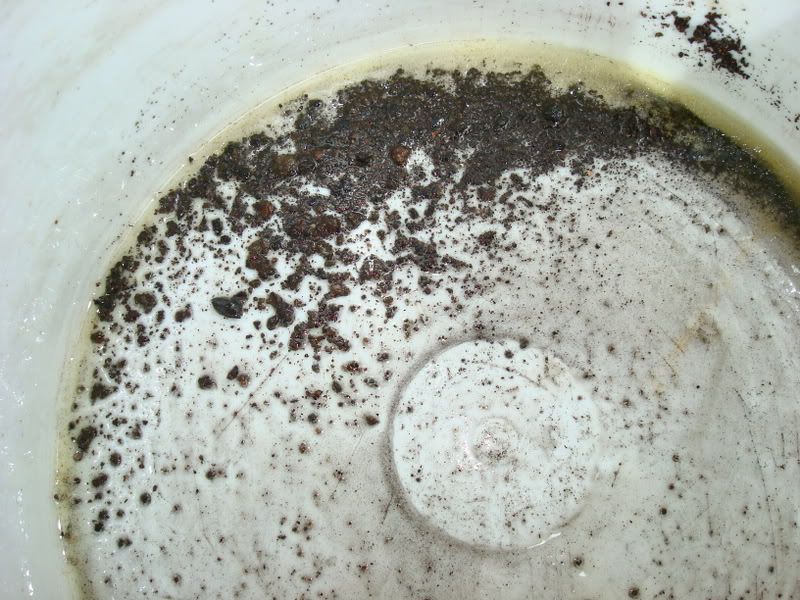
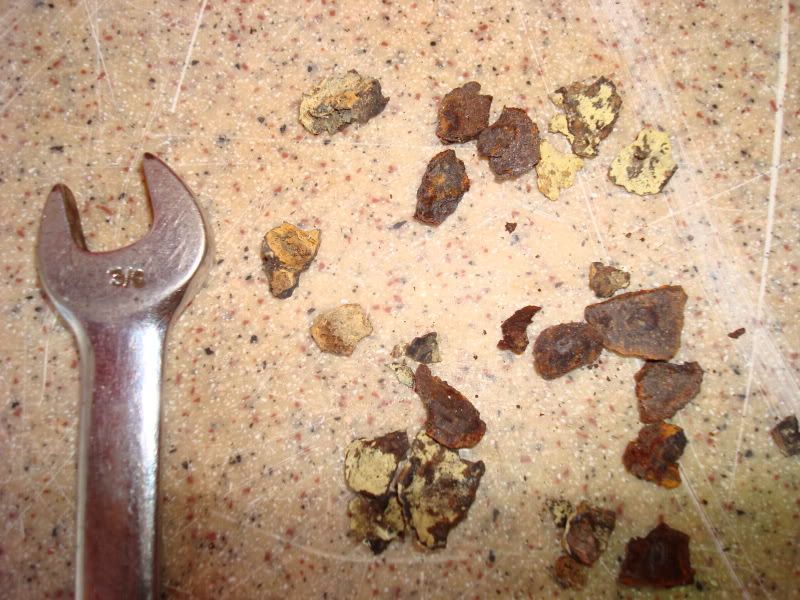
Below are some pics of a crudded up system.
The chunks mostly came out of the block, but the radiator usually ends up just as clean. Pictured is probably only 10% of the crud that came out.
This job took most of the day to do properly and a LOT of water for flushing. Removing the block drains is a must.
Whenever I get an old car, this is one of the first things I do.
If the radiator develops a leak, then it is on it's way out anyway.
If replacing the radiator, do this cleansing first, before installing it.
And to prevent this, spend 20 bucks and change the coolant yearly.

Here are some links to the products used and detailed GM instuctions.
http://forums.corvetteforum.com/c4-t...ol-sludge.html
http://forums.corvetteforum.com/c3-t...lush-help.html
http://forums.corvetteforum.com/c3-t...-should-i.html
Below are some pics of a crudded up system.
The chunks mostly came out of the block, but the radiator usually ends up just as clean. Pictured is probably only 10% of the crud that came out.
This job took most of the day to do properly and a LOT of water for flushing. Removing the block drains is a must.
Whenever I get an old car, this is one of the first things I do.
If the radiator develops a leak, then it is on it's way out anyway.
If replacing the radiator, do this cleansing first, before installing it.
And to prevent this, spend 20 bucks and change the coolant yearly.


Here are some links to the products used and detailed GM instuctions.
http://forums.corvetteforum.com/c4-t...ol-sludge.html
http://forums.corvetteforum.com/c3-t...lush-help.html
http://forums.corvetteforum.com/c3-t...-should-i.html

Team Owner


Joined: Jun 2000
Posts: 38,923
Likes: 1,481
From: Southbound
Cruise-In II Veteran
Define "tends to overheat." What temperatures are you reaching?

Last edited by Easy Mike; Apr 22, 2013 at 12:28 PM.

Drifting


Joined: Aug 2010
Posts: 1,839
Likes: 45
From: nassau co. new york
flushing can and does work given the right product.i tried the soap bubbles and got nowhere.i then rolled up my sleeves and used a commercial scale remover which comes with litmus paper to test strength as the solution is circulated.took around an hour and a half to boil out mine.i used a submersible acid pump and did the radiator only to avoid collateral damage.i warn you this is very nasty stuff. 

Last edited by billcarson; Apr 22, 2013 at 12:54 PM.

Melting Slicks
Joined: Jul 2009
Posts: 3,264
Likes: 3
From: Vero Beach FL
I had a car (not a Corvette) that would overheat when it ran at a consistent RPM for any length of time such as on the highway. When I would rev the engine it would cool down. Turns out that the water pumps impeller was worn. After replacing the pump no more issues. Just a thought.
Corvette Stories
The Best of Corvette for Corvette Enthusiasts

Top 10 Most Explosive Corvettes Ever Made: Power-to-Weight Ratio Ranked!
Joe Kucinski
150 hp to 1,250 hp: Every Corvette Generation Compared by the Specs That Matter
Joe Kucinski
8 Coolest Corvette Pace Cars (and Replicas) of All Time
Verdad Gallardo
Top 10 Corvette Engines RANKED by Peak Torque (70+ Years of Muscle!)
Joe Kucinski
Corvette ZR1X Will Be Pacing the Indy 500, And Could Probably Race, Too!
Verdad Gallardo
Top 10 Corvettes Coming to Mecum Indy 2026!
Brett Foote
Top 10 C9 Corvette MUST-HAVES to Fix These C8 Generation Flaws!
Michael S. Palmer
10 Revolutionary 'Corvette Firsts' Most People Don't Know
Joe Kucinski
5 Reasons to Upgrade to an LS6-Powered Corvette; 5 Reasons to Stay LT2
Michael S. Palmer
Team Owner


Joined: Jan 2006
Posts: 37,637
Likes: 3,116
From: Crossville TN
Flushing is fine if you change coolant every 3 years [or so]. It will get rid of some collection of 'goo' that might have circulated in the cooling system.
But, if you have a build-up of scale material on the inner surface of the radiator tank, then it is also in the cooling fins and will significantly reduce the radiator's ability to transfer heat efficiently. In this case, you need to use radiator cleaner. You can find it in the same area as radiator 'flush' stuff; but, it comes in a smaller jug and is a completely different fluid. You need to buy the cleaner and read the instructions carefully. Then, you need to follow those instructions as written. Basically, you will drain the coolant (take it to a recycle center that accepts oil and other 'toxic' fluids), fill with fresh water AND the cleaner. Then you will drive the vehicle for some period of time. By circulating this cleaner as the engine is operating at normal temperature, the scale and built-up crud in the radiator and block will be dissolved and can be removed with another draining of the coolant. If you wish to 'flush' after the cleaning process, that would be even better.
But, if you have a build-up of scale material on the inner surface of the radiator tank, then it is also in the cooling fins and will significantly reduce the radiator's ability to transfer heat efficiently. In this case, you need to use radiator cleaner. You can find it in the same area as radiator 'flush' stuff; but, it comes in a smaller jug and is a completely different fluid. You need to buy the cleaner and read the instructions carefully. Then, you need to follow those instructions as written. Basically, you will drain the coolant (take it to a recycle center that accepts oil and other 'toxic' fluids), fill with fresh water AND the cleaner. Then you will drive the vehicle for some period of time. By circulating this cleaner as the engine is operating at normal temperature, the scale and built-up crud in the radiator and block will be dissolved and can be removed with another draining of the coolant. If you wish to 'flush' after the cleaning process, that would be even better.

CF Community Team


Joined: Oct 2004
Posts: 19,361
Likes: 5,243
From: Cape Cod, Mass.
2025 C6 of the Year Finalist - Unmodified
2025 C8 Z06/7/E-Ray of the Year Finalist - Unmodified
2023 C3 of the Year Finalist - Unmodified
2021 C8 of the Year Finalist Unmodified
2020 Corvette of the Year Finalist (performance mods)
2019 C1 of Year Winner (performance mods)
2017 Corvette of the Year Finalist
2016 C2 of Year
2015 C3 of Year Finalist
My 68 427/390 was running warm on the highway, 210-220 on a summer day. I bought a Dewitt's aluminum restoration radiator. It runs 180 all the time now. IMO trying to fix/flush/repair an old radiator is a waste of time if you want to drive and enjoy your Corvette. I've put Dewitt's in all of my older Corvettes. On average the temps have gone down almost 30 degrees in each car.
Team Owner
Joined: Jan 2006
Posts: 37,637
Likes: 3,116
From: Crossville TN
Ahhhh.... The 'tried and true' American approach of "throwing money at the problem" remains alive and well !!!
The initial design of the C3 radiator is fine, if the engine hasn't been hopped-up. If the radiator is 'dirty', clean it; if it is scaly, have it boiled out or descale it with radiator cleaner; if it needs to be recored, get that done. Or, if you just don't know what to do, THROW MONEY AT IT.

The initial design of the C3 radiator is fine, if the engine hasn't been hopped-up. If the radiator is 'dirty', clean it; if it is scaly, have it boiled out or descale it with radiator cleaner; if it needs to be recored, get that done. Or, if you just don't know what to do, THROW MONEY AT IT.

Le Mans Master


Joined: Dec 2006
Posts: 5,557
Likes: 9
From: Oquirrh Mountains
St. Jude Donor '09
1st, verify all the components of your cooling system are working. Jim already mentioned the fan clutch. You mentioned you have a IR temp gun. What's the temp drop from the inlet to the outlet on your current radiator?
Before tearing out the radiator, throw a timing light on your engine. Make sure it's at least 8* advanced at idle with the vacuum canister disconnected (I think that's the right number for the '70). Make sure your vacuum and mechanical advance is working too. If you haven't already; it's worthwile to recurve the distributor. The factory advance comes in way too slow and doesn't allow the engine to run at it's maximum potential. Poor timing adjustment will definately overheat a BB corvette.
See where that gets you. A lean air/fuel ratio will also cause the car to overheat.
Before tearing out the radiator, throw a timing light on your engine. Make sure it's at least 8* advanced at idle with the vacuum canister disconnected (I think that's the right number for the '70). Make sure your vacuum and mechanical advance is working too. If you haven't already; it's worthwile to recurve the distributor. The factory advance comes in way too slow and doesn't allow the engine to run at it's maximum potential. Poor timing adjustment will definately overheat a BB corvette.
See where that gets you. A lean air/fuel ratio will also cause the car to overheat.
CF Community Team
Joined: Oct 2004
Posts: 19,361
Likes: 5,243
From: Cape Cod, Mass.
2025 C6 of the Year Finalist - Unmodified
2025 C8 Z06/7/E-Ray of the Year Finalist - Unmodified
2023 C3 of the Year Finalist - Unmodified
2021 C8 of the Year Finalist Unmodified
2020 Corvette of the Year Finalist (performance mods)
2019 C1 of Year Winner (performance mods)
2017 Corvette of the Year Finalist
2016 C2 of Year
2015 C3 of Year Finalist
Ben's is good advice. Once you have confirmed everything is in order, IMO it makes no sense to try and clean out a 43 year old radiator. They are well beyond their useful service life. I've tried all the heroics to squeeze some life out of an old radiator. It generally doesn't work very well or just delays the inevitable.
I'm not big on throwing money away or wasting time with old radiators. Pulling a radiator out of a big block is a PITA. Certain components like radiators and gas tanks need to be replaced after 40 plus years. .
I'm not big on throwing money away or wasting time with old radiators. Pulling a radiator out of a big block is a PITA. Certain components like radiators and gas tanks need to be replaced after 40 plus years. .
Melting Slicks
Joined: Mar 2009
Posts: 3,126
Likes: 15
Let's see. Recore quote of $350.00 from the old school radiator shop, that I have used for 35 yrs., using off shore parts and my old tanks. Soldered together which always leaks after a couple of years. Would be the same BTU capacity as stock. Dewitt's, increased BTU capacity, American made, all new, $475.00 delivered. I don't know, I'm gonna have to think about it. mike...
mike...
Team Owner
Joined: Jan 2006
Posts: 37,637
Likes: 3,116
From: Crossville TN
If you check out the 'numbers' and do the math, and your result says to buy a new radiator, have at it. If you want to keep the same radiator 'envelope' and connections, and the tanks and fittings are all sound, why spend more to get a "new" item to do the same job???
Basically, to each his/her own. But, throwing out a 40+ year old radiator only because it is 40+ years old is absurd.
Basically, to each his/her own. But, throwing out a 40+ year old radiator only because it is 40+ years old is absurd.
Thread Starter
Melting Slicks
Joined: Apr 2007
Posts: 3,189
Likes: 111
From: Tolland CT
I had a car (not a Corvette) that would overheat when it ran at a consistent RPM for any length of time such as on the highway. When I would rev the engine it would cool down. Turns out that the water pumps impeller was worn. After replacing the pump no more issues. Just a thought.
My 68 427/390 was running warm on the highway, 210-220 on a summer day. I bought a Dewitt's aluminum restoration radiator. It runs 180 all the time now. IMO trying to fix/flush/repair an old radiator is a waste of time if you want to drive and enjoy your Corvette. I've put Dewitt's in all of my older Corvettes. On average the temps have gone down almost 30 degrees in each car.
1st, verify all the components of your cooling system are working. Jim already mentioned the fan clutch. You mentioned you have a IR temp gun. What's the temp drop from the inlet to the outlet on your current radiator?
Before tearing out the radiator, throw a timing light on your engine. Make sure it's at least 8* advanced at idle with the vacuum canister disconnected (I think that's the right number for the '70). Make sure your vacuum and mechanical advance is working too. If you haven't already; it's worthwile to recurve the distributor. The factory advance comes in way too slow and doesn't allow the engine to run at it's maximum potential. Poor timing adjustment will definately overheat a BB corvette.
See where that gets you. A lean air/fuel ratio will also cause the car to overheat.
Before tearing out the radiator, throw a timing light on your engine. Make sure it's at least 8* advanced at idle with the vacuum canister disconnected (I think that's the right number for the '70). Make sure your vacuum and mechanical advance is working too. If you haven't already; it's worthwile to recurve the distributor. The factory advance comes in way too slow and doesn't allow the engine to run at it's maximum potential. Poor timing adjustment will definately overheat a BB corvette.
See where that gets you. A lean air/fuel ratio will also cause the car to overheat.
I believe the timing is right around what you recommend. I know the mechanical advance is working. Not sure about the curve. It feels a bit sluggish for a big block. Checking timing is on my to do list.
The carb was recently gone over by Cliff Ruggles, runs great. I don't know if it may be lean.
Flushing is fine if you change coolant every 3 years [or so]. It will get rid of some collection of 'goo' that might have circulated in the cooling system.
But, if you have a build-up of scale material on the inner surface of the radiator tank, then it is also in the cooling fins and will significantly reduce the radiator's ability to transfer heat efficiently. In this case, you need to use radiator cleaner. You can find it in the same area as radiator 'flush' stuff; but, it comes in a smaller jug and is a completely different fluid. You need to buy the cleaner and read the instructions carefully. Then, you need to follow those instructions as written. Basically, you will drain the coolant (take it to a recycle center that accepts oil and other 'toxic' fluids), fill with fresh water AND the cleaner. Then you will drive the vehicle for some period of time. By circulating this cleaner as the engine is operating at normal temperature, the scale and built-up crud in the radiator and block will be dissolved and can be removed with another draining of the coolant. If you wish to 'flush' after the cleaning process, that would be even better.
But, if you have a build-up of scale material on the inner surface of the radiator tank, then it is also in the cooling fins and will significantly reduce the radiator's ability to transfer heat efficiently. In this case, you need to use radiator cleaner. You can find it in the same area as radiator 'flush' stuff; but, it comes in a smaller jug and is a completely different fluid. You need to buy the cleaner and read the instructions carefully. Then, you need to follow those instructions as written. Basically, you will drain the coolant (take it to a recycle center that accepts oil and other 'toxic' fluids), fill with fresh water AND the cleaner. Then you will drive the vehicle for some period of time. By circulating this cleaner as the engine is operating at normal temperature, the scale and built-up crud in the radiator and block will be dissolved and can be removed with another draining of the coolant. If you wish to 'flush' after the cleaning process, that would be even better.
Race Director
Joined: Mar 2006
Posts: 14,112
Likes: 28
From: Florida
The oxalic acid I previously linked to was the strongest available ever, so much so that the EPA ended it.
Any good product should be neutralized afterwards, doesn't matter if you want it call it a flush, clean, neutralizer, rinse or enima.

Le Mans Master
Joined: Apr 1999
Posts: 6,134
Likes: 46
From: Raleigh North Carolina
Some info...
I'm replacing my LS5 radiator currently.
I've decided on buying a reproduction core and recoring it myself because I have the original tanks in perfect condition. If you go the recore route, I was told by a local radiator shop that the new core would be a generic core which will work but will not have the same top & bottom plates as the original. On my LS5, one of the seals was glued to the top radiator plate. This will not work on the generic core because the profile of the plate is different than stock. Consequently. I am buying the "repro" core. The aftermarket generic core was quoted to me at more $ than the repro core. Local radiator shops were unwilling to negotiate price. As soon as they heard the word "Corvette" they got all excited and I swear I could see dollar signs in their eyes. They all quoted me over $550 on just the core... no labor.
Also... I've recored radiators myself in the past and they didn't leak. You just have to do the job right, or have a competent shop do the work. Sloppy work will leak.
I media blast the brass tanks and "tin" the flanges before I attach the old tanks to the new core. Cleanliness is the key.
I'm replacing my LS5 radiator currently.
I've decided on buying a reproduction core and recoring it myself because I have the original tanks in perfect condition. If you go the recore route, I was told by a local radiator shop that the new core would be a generic core which will work but will not have the same top & bottom plates as the original. On my LS5, one of the seals was glued to the top radiator plate. This will not work on the generic core because the profile of the plate is different than stock. Consequently. I am buying the "repro" core. The aftermarket generic core was quoted to me at more $ than the repro core. Local radiator shops were unwilling to negotiate price. As soon as they heard the word "Corvette" they got all excited and I swear I could see dollar signs in their eyes. They all quoted me over $550 on just the core... no labor.
Also... I've recored radiators myself in the past and they didn't leak. You just have to do the job right, or have a competent shop do the work. Sloppy work will leak.
I media blast the brass tanks and "tin" the flanges before I attach the old tanks to the new core. Cleanliness is the key.
Team Owner
Joined: Jan 2006
Posts: 37,637
Likes: 3,116
From: Crossville TN
HELLO.... 
Doesn't everyone on this Forum know that you NEVER mention the word "Corvette" when you get repair work done on a component that you have removed from the car? I just tell the shop it's out of an "old Chevy"....and that's still the truth. I try not to 'invite' the escallation of price that comes with foreign cars, Cadillacs, and Corvettes.
Doesn't everyone on this Forum know that you NEVER mention the word "Corvette" when you get repair work done on a component that you have removed from the car? I just tell the shop it's out of an "old Chevy"....and that's still the truth. I try not to 'invite' the escallation of price that comes with foreign cars, Cadillacs, and Corvettes.
Thread Starter
Melting Slicks
Joined: Apr 2007
Posts: 3,189
Likes: 111
From: Tolland CT
You seem to be missing an important point.You should clean the crud out of your block BEFORE you install another radiator. You don't want it building up in the new rad, especially an alum one with smaller ID tubes.
The oxalic acid I previously linked to was the strongest available ever, so much so that the EPA ended it.
Any good product should be neutralized afterwards, doesn't matter if you want it call it a flush, clean, neutralizer, rinse or enima.
The oxalic acid I previously linked to was the strongest available ever, so much so that the EPA ended it.
Any good product should be neutralized afterwards, doesn't matter if you want it call it a flush, clean, neutralizer, rinse or enima.