


clutch adjustment question


Thread Starter
Melting Slicks

Joined: Mar 2002
Posts: 2,164
Likes: 7
From: Beringen
 clutch adjustment question
I've been fighting some clutch and shifter issues since I have had my car on the road, nothing bad, but I was trying to get rid of some of the issues, but don't seem to get there.
When I bought the car it had a Muncie M22 with an original bellhousing. The clutch rod was an adjustable type and the clutch fork wasn't original to the car.
When I did my restoration, I had to buy me a new flywheel and I bought a Mcleod SFI steel flywheel. I changed to a explosion proof bellhousing from Lakewood in the process. The clutch remained the centerforce gold one that was on the car when I got it, since it was in almost new condition.
I bought a new clutch rod and fork, correct for my car and its transmission.
Now for the issue : when I adjust the clutch as per factory specs (as stated in the manual : .400 of clearance between the back nut and the swivel) the clutch only engages when I'm almost at the floor with the pedal. I put the nut closer than .400 to the swivel and it seemed to improve things, but I seem not to disengage enough. It almost seems like I need some sort of different rod length. Anyone encounter this. Could this be in the thickness of the flywheel. I remember that the Mcleod was bulkier than the original...
Thanks
When I bought the car it had a Muncie M22 with an original bellhousing. The clutch rod was an adjustable type and the clutch fork wasn't original to the car.
When I did my restoration, I had to buy me a new flywheel and I bought a Mcleod SFI steel flywheel. I changed to a explosion proof bellhousing from Lakewood in the process. The clutch remained the centerforce gold one that was on the car when I got it, since it was in almost new condition.
I bought a new clutch rod and fork, correct for my car and its transmission.
Now for the issue : when I adjust the clutch as per factory specs (as stated in the manual : .400 of clearance between the back nut and the swivel) the clutch only engages when I'm almost at the floor with the pedal. I put the nut closer than .400 to the swivel and it seemed to improve things, but I seem not to disengage enough. It almost seems like I need some sort of different rod length. Anyone encounter this. Could this be in the thickness of the flywheel. I remember that the Mcleod was bulkier than the original...
Thanks

Team Owner


Joined: Apr 1999
Posts: 21,953
Likes: 1,445
From: Reno Nevada
2024 C3 of the Year Finalist- Modified
once you start changing things the stock setup is just a rough guide.
The length of the pivot ball in crutial to have it work correctly.
I have a non-stock setup myself and my only adjustment is the nuts on the rod that comes through the fire wall to the top of the "Z" Bar.
But anyway if you are out of adjustment thread the real cure is changing the length of the pivot ball or the length of the lower "Z"Bar to clutch fork.
i just had mine all apart to change heads and I over did it and It dissengages in the first two inches of travel and I have very little clearance between the throw out bearing abd the clutch plate fingers
The length of the pivot ball in crutial to have it work correctly.
I have a non-stock setup myself and my only adjustment is the nuts on the rod that comes through the fire wall to the top of the "Z" Bar.
But anyway if you are out of adjustment thread the real cure is changing the length of the pivot ball or the length of the lower "Z"Bar to clutch fork.
i just had mine all apart to change heads and I over did it and It dissengages in the first two inches of travel and I have very little clearance between the throw out bearing abd the clutch plate fingers
Thread Starter
Melting Slicks
Joined: Mar 2002
Posts: 2,164
Likes: 7
From: Beringen
once you start changing things the stock setup is just a rough guide.
The length of the pivot ball in crutial to have it work correctly.
I have a non-stock setup myself and my only adjustment is the nuts on the rod that comes through the fire wall to the top of the "Z" Bar.
But anyway if you are out of adjustment thread the real cure is changing the length of the pivot ball or the length of the lower "Z"Bar to clutch fork.
i just had mine all apart to change heads and I over did it and It dissengages in the first two inches of travel and I have very little clearance between the throw out bearing abd the clutch plate fingers
The length of the pivot ball in crutial to have it work correctly.
I have a non-stock setup myself and my only adjustment is the nuts on the rod that comes through the fire wall to the top of the "Z" Bar.
But anyway if you are out of adjustment thread the real cure is changing the length of the pivot ball or the length of the lower "Z"Bar to clutch fork.
i just had mine all apart to change heads and I over did it and It dissengages in the first two inches of travel and I have very little clearance between the throw out bearing abd the clutch plate fingers
Team Owner
Joined: Apr 1999
Posts: 21,953
Likes: 1,445
From: Reno Nevada
2024 C3 of the Year Finalist- Modified
If you have a thicker flywheel and or PP assembly it would place the throwout bearing closer to the fingers. Which would cause the clutch to disengage sooner with less petal movement.
Over the years I have seen cut and welded longer lower arms and even ones with a threaded centers and turnbuckles for length adjustment.
The big thing about the pivot ball is you want to hold the fork/bearing at 90 degrees to the input shaft when you are in the static rest position. So the bearing center has little or no drag on the tranny input shaft. As you depress the clutch petal the fork arm swings in an arc and it causes shaft friction. You want to minimize the arc.
So a longer pivot ball would place the TB closer to the fingers. Or on the other side the thicker flywheel would do the same
Over the years I have seen cut and welded longer lower arms and even ones with a threaded centers and turnbuckles for length adjustment.
The big thing about the pivot ball is you want to hold the fork/bearing at 90 degrees to the input shaft when you are in the static rest position. So the bearing center has little or no drag on the tranny input shaft. As you depress the clutch petal the fork arm swings in an arc and it causes shaft friction. You want to minimize the arc.
So a longer pivot ball would place the TB closer to the fingers. Or on the other side the thicker flywheel would do the same

Burning Brakes


Joined: Apr 2007
Posts: 1,039
Likes: 62
From: Kona Hawaii
Using the Speed Direct clutch linkage..Smoother and has a greater range of adjustment...
[IMG]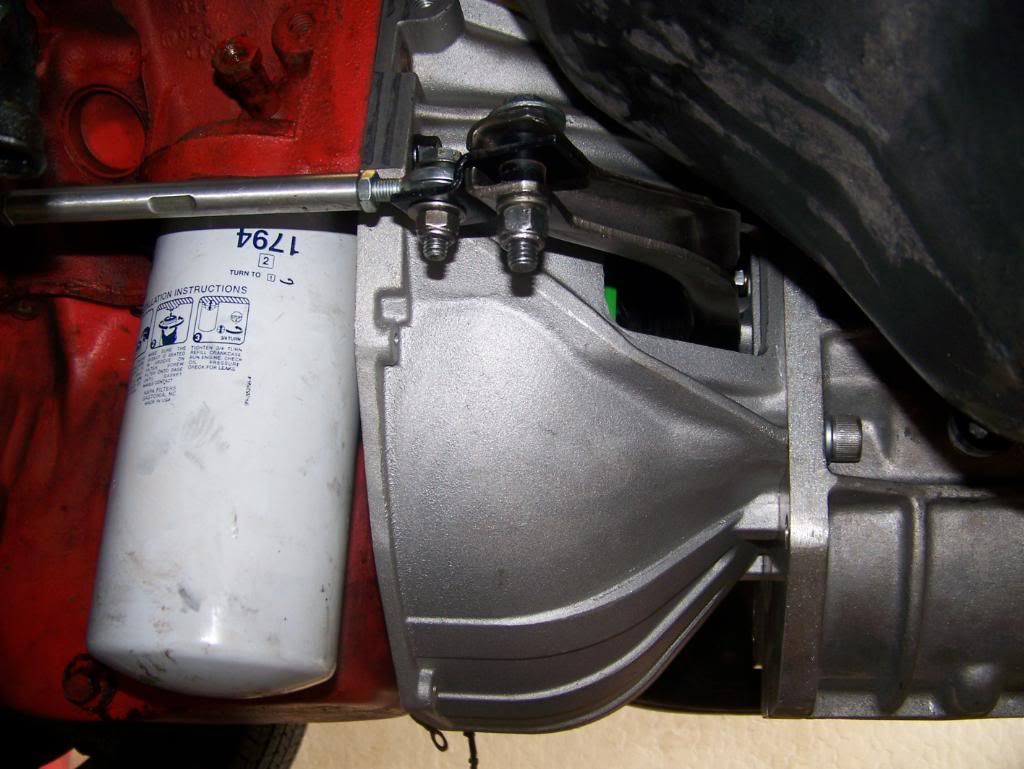 [/IMG]
http://cmc.speeddirect.com/items.asp...atus=0&Tp=&Bc=
[IMG]
 [/IMG]
http://cmc.speeddirect.com/items.asp...atus=0&Tp=&Bc=

Instructor

Joined: Jun 2010
Posts: 173
Likes: 0
From: Fritsla Sweden
Hi,
Hmm, we have a similar problem I think. See my thread:
http://forums.corvetteforum.com/c3-t...placement.html
I still have not sorted out this fully. But it appears as some of the aftermarket clutches has a pressure plate finger design that is not optimal for the Corvette clutch mechanism. My "original" clutch, brand unknown, releases quite good. The Sachs kit was total disaster, exactly as you described, the LUK kit had a warped pressure plate, otherwise I think that would have worked OK.
Martin
Hmm, we have a similar problem I think. See my thread:
http://forums.corvetteforum.com/c3-t...placement.html
I still have not sorted out this fully. But it appears as some of the aftermarket clutches has a pressure plate finger design that is not optimal for the Corvette clutch mechanism. My "original" clutch, brand unknown, releases quite good. The Sachs kit was total disaster, exactly as you described, the LUK kit had a warped pressure plate, otherwise I think that would have worked OK.
Martin








