



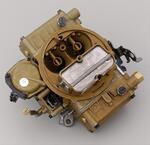

Quick Fuel Nightmare

Thread Starter
Drifting


Joined: Aug 2005
Posts: 1,443
Likes: 65
From: Wauconda IL
 Quick Fuel Nightmare
I'm hoping someone has a fair amount of experience with Quick Fuel carbs and how the castings are supposed to look-
I'm been messing with a brand new SS 830 for over a year now and have finally concluded that there is some sort of machining defect on the main body and/or metering plates.
This carb has never run properly out of the box-
It has always run pig rich and I can't drive the car with it because the engine drowns in fuel.
I've replace the gaskets numerous times, 3 power valves and re-jetted to no avail. The carb doesn't leak fuel outside the bowls or metering plate but I finally stumbled across that the extra fuel is being sucked into the intake via the vacuum ports on the bottom of the throttle plate that is supposed to supply vacuum to the power valve!
This is happening on BOTH sides of the carb!
It's not a power valve issue (no power valve on the secondary side).
So after trying multiple sets of gaskets (Quick Fuel, Holley, and even silicone gaskets), I cannot get the vacuum chambers to seal.
I even applied RTV to the area on both sides of the gasket (just as a test, I would never run a carb this way), and it still cannot hold a vaccum.
I am convinced the issue is due to poor machining on the main body and/or metering plates (The primary metering plate looks like it was machined with a hand drill). Before I drop this little gem back in Quick Fuel's lap, I wanted to compare the surface finish of my carb compared to ones that are know to run properly.
Pictures would be most appreciated!
The metering plate mounting surfaces on the main body look like it was machined on a belt sander- Please look at the photos and let me know if this is normal or if something is horribly wrong. The bottom of the main body (where the throttle plate bolts) has a nice, shiny finish and seals well- Not sure why the metering surfaces are so rough??


As I mentioned above, this was a brand new carb that was drop shipped directly from Quick Fuel so this was not some used junk or something that someone else was hacking on after it left Quick Fuel.
Any comments or insight would be most appreciated.
The complete folder of carb pictures is located here:
http://s1048.photobucket.com/user/Bu...uel%20SS%20830
Thanks!
Elm
I'm been messing with a brand new SS 830 for over a year now and have finally concluded that there is some sort of machining defect on the main body and/or metering plates.
This carb has never run properly out of the box-
It has always run pig rich and I can't drive the car with it because the engine drowns in fuel.
I've replace the gaskets numerous times, 3 power valves and re-jetted to no avail. The carb doesn't leak fuel outside the bowls or metering plate but I finally stumbled across that the extra fuel is being sucked into the intake via the vacuum ports on the bottom of the throttle plate that is supposed to supply vacuum to the power valve!
This is happening on BOTH sides of the carb!
It's not a power valve issue (no power valve on the secondary side).
So after trying multiple sets of gaskets (Quick Fuel, Holley, and even silicone gaskets), I cannot get the vacuum chambers to seal.
I even applied RTV to the area on both sides of the gasket (just as a test, I would never run a carb this way), and it still cannot hold a vaccum.
I am convinced the issue is due to poor machining on the main body and/or metering plates (The primary metering plate looks like it was machined with a hand drill). Before I drop this little gem back in Quick Fuel's lap, I wanted to compare the surface finish of my carb compared to ones that are know to run properly.
Pictures would be most appreciated!
The metering plate mounting surfaces on the main body look like it was machined on a belt sander- Please look at the photos and let me know if this is normal or if something is horribly wrong. The bottom of the main body (where the throttle plate bolts) has a nice, shiny finish and seals well- Not sure why the metering surfaces are so rough??
As I mentioned above, this was a brand new carb that was drop shipped directly from Quick Fuel so this was not some used junk or something that someone else was hacking on after it left Quick Fuel.
Any comments or insight would be most appreciated.
The complete folder of carb pictures is located here:
http://s1048.photobucket.com/user/Bu...uel%20SS%20830
Thanks!
Elm

Race Director


Joined: May 2006
Posts: 18,771
Likes: 2,596
Seems like all the pictures show either black or brownish RTV blocking passages. I assume you adjusted the float levels correctly? What power value are you using and how radical a cam is in this engine? What size engine? What do you have the intial timing set for? What size jets? What is your fuel pressure?
Last edited by MelWff; Sep 10, 2013 at 10:51 AM.
Thread Starter
Drifting
Joined: Aug 2005
Posts: 1,443
Likes: 65
From: Wauconda IL
Seems like all the pictures show either black or brownish RTV blocking passages. I assume you adjusted the float levels correctly? What power value are you using and how radical a cam is in this engine? What size engine? What do you have the intial timing set for? What size jets? What is your fuel pressure?
Passage (accelerator pump port) was blocked by design for my tests as this is where the fuel was coming from that would get sucked directly into the vacuum cavity and out into the intake.
Float level has nothing to do with why the gasket isn't sealing around the vacuum chamber- It leaks with a dry carb and no fuel.
Cam, jet size, timing and power valve selection has nothing to do with this issue- I can't hold a vacuum on the secondary side that has NO power valve!
But to answer your question, yes, the floats were set properly on the car and fuel pressure is 6.5 PSI. This is not a float/fuel pressure issue, this is a gasket sealing surface issue.
I have a Holley 750 that is on the car now that works perfectly-
The carb is the issue, not the engine configuration.
Elm
Thread Starter
Drifting
Joined: Aug 2005
Posts: 1,443
Likes: 65
From: Wauconda IL
I didn't 'wait' a whole year. Unfortunately, I have a life outside of working on my C3 that takes priority so I can only work on this at random weekends.
I also had multiple projects running concurrently.
The carb has been an issue since day one but hindsight is 20/20-
I spent time going through EVERYTHING else with the motor and ignition system to rule those out first as suspecting a brand new, out of the box carb being defective was the last thing to expect.
I'm not trying to re-hash what I already know-
The carb is defective.
I've done the exhaustive testing to confirm that.
I wanted to get some pictures of a known, running QF carb to compare the surface roughness before I ship it off to Quick Fuel for a personal sanity check.
I did call Quick Fuel tech support and explained what I found and all I heard were crickets on the other end. All they could offer was to send the carb back to them on my dime and they would 'Take a Look'.
All I want to do is have my documentation ready in case they come back with something stupid and try to pawn it off on a bad power valve etc.
Back to my original question:
Does anyone have any pictures to share of a Quick Fuel carb that has been disassembled?
Thanks!
Elm
I also had multiple projects running concurrently.
- New engine top end
- New Exhaust
- New transmission
- A/C Install
The carb has been an issue since day one but hindsight is 20/20-
I spent time going through EVERYTHING else with the motor and ignition system to rule those out first as suspecting a brand new, out of the box carb being defective was the last thing to expect.
I'm not trying to re-hash what I already know-
The carb is defective.
I've done the exhaustive testing to confirm that.
I wanted to get some pictures of a known, running QF carb to compare the surface roughness before I ship it off to Quick Fuel for a personal sanity check.
I did call Quick Fuel tech support and explained what I found and all I heard were crickets on the other end. All they could offer was to send the carb back to them on my dime and they would 'Take a Look'.
All I want to do is have my documentation ready in case they come back with something stupid and try to pawn it off on a bad power valve etc.
Back to my original question:
Does anyone have any pictures to share of a Quick Fuel carb that has been disassembled?
Thanks!
Elm
Last edited by ezobens; Sep 10, 2013 at 12:47 PM.
Race Director
Joined: May 2006
Posts: 18,771
Likes: 2,596
Thread Starter
Drifting
Joined: Aug 2005
Posts: 1,443
Likes: 65
From: Wauconda IL
Thank you for the link-
Unfortunately, in all the photos contained in this link, there is not a single shot that shows the surface finish of the main body from an actual customer's carb.
Most of these shots are either promotional / advertising shots (which are useless for this exercise) or pictures of completely assembled carbs.
The search continues!
Elm
Corvette Stories
The Best of Corvette for Corvette Enthusiasts

5 Best & 5 Worst Corvette Daily Drivers
Joe Kucinski
The Headlights of Every Corvette Generation Explained
Joe Kucinski
5 Best & 5 Most Overrated Corvette Track Packages of All Time!
Joe Kucinski
Every 2027 Corvette Engine Explained
Joe Kucinski
Designer Imagines A Corvette That Looks More Like a Corvette Than the Corvette
Verdad Gallardo
10 Ugly Corvettes That We Still Kinda Love
Joe Kucinski
Top 10 Most Expensive Corvettes Ever Sold on Bring A Trailer
Brett Foote
10 Things Every Corvette Owner Needs (2026 Edition)
Michael S. Palmer
8 Most "Only Corvette Owners Understand" Quirks and Problems
Pouria Savadkouei
Heel & Toe

Joined: Aug 2012
Posts: 22
Likes: 0
From: Belton tx

 I had the exact same issue on my 1971 454 using a quick fuel 850.. I asked everyone. I got all kinda of ideas. My car would stumble in traffic or at the track. I thought I was having fuel problems. but like you I checked everthing distr... Fuel pump... lines...Jetting... Crazy they issue would not show up on dyno. Finally thought that we were getting fuel spilling out of the vent tubes flooding the car at launch or driving when i hit a small bump ... it would just die. Everyone I talk to and everyone that gave me advise missed. The actual problem was heat. Driving in traffic a lot of stop and go was not heating my coolent up.. my temp was high but ok. It was trapping heat under the hood and heating up the carb and the air under the hood. One night while at a total loss at the track I was upset the car was running bad... after setting for over an hour next to the starting line I jump in the car... pulled up on the line with no burn out.. and launched... car ran 12.1 at 112... If i pull up and do a burn out and heat the air temp under the hood before the run it run 15s... Daily driving the car is fine as long as it is not stop and go traffic.. that will kill the circulation under the hood and next thing you know it is running bad.... run it down the road for 1 min and everthing is fine...It appear Heat is the issue... not sure if it is the air or the actuall carb getting hot but has me looking for a cold air intake for car.... Have not found one yet
Thread Starter
Drifting
Joined: Aug 2005
Posts: 1,443
Likes: 65
From: Wauconda IL
David,
Thank you for sharing your experience.
I too thought for the longest time that my issue was heat related.
Car would run OK when cold but as soon as it warmed up, it would burn my eyes out and just die from gagging on all the fuel.
In retrospect, it makes sense knowing what I know now-
Fuel was being sucked into the engine through the vacuum port and when the engine is cold, it needs extra fuel to run (that's what the choke is for). Once the engine gets up to temp, it doesn't need all the fuel and it runs worse and worse until it up and dies because it can't burn it all.
I can't even get the car out of the driveway with this carb!
The hood is off and I have a Mark VIII fan with a new 4-row copper radiator so engine temp is not an issue.
The 4779 Holley I have on it right now runs like a champ so it's 100% carburetor related in my situation.
Elm.
Thank you for sharing your experience.
I too thought for the longest time that my issue was heat related.
Car would run OK when cold but as soon as it warmed up, it would burn my eyes out and just die from gagging on all the fuel.
In retrospect, it makes sense knowing what I know now-
Fuel was being sucked into the engine through the vacuum port and when the engine is cold, it needs extra fuel to run (that's what the choke is for). Once the engine gets up to temp, it doesn't need all the fuel and it runs worse and worse until it up and dies because it can't burn it all.
I can't even get the car out of the driveway with this carb!
The hood is off and I have a Mark VIII fan with a new 4-row copper radiator so engine temp is not an issue.
The 4779 Holley I have on it right now runs like a champ so it's 100% carburetor related in my situation.
Elm.

Le Mans Master


Joined: Oct 2010
Posts: 6,945
Likes: 851
From: melbourne florida
2023 C3 of the Year Finalist - Modified
i am not sure what you have engine wise cam timing , intake , compression , exhaust etc all play into tuning a carburetor . one thing that positively needs to be adjusted are the transfer slots,primary and secondary you may need a bigger shooter both if a double pumper. with a big duration cam you need to close your primary transfer slot a little and open your secondary slot a little. this could be why its running rich. i have found the quick fuel tech line to be most helpful, but i don't know how you interact with them. silicone is a giant no no on a carburetor. send it back tell them what its doing what your engine is like and ask for their help. they make an excellent product
Thread Starter
Drifting
Joined: Aug 2005
Posts: 1,443
Likes: 65
From: Wauconda IL
Engine dynamics are not a factor with issue.
The issue is with the carb, not the engine or the environment it's running in.
I can bolt this carb on any engine and it would exhibit the same behavior.
The vacuum port for the power valve chambers should hold a vacuum- Period.
I don't need to put the carb on an engine at this point to confirm the issue, I see it on the bench.
I agree that most people have positive experiences with QF carbs (including my engine builder who swears by them and is still shaking his head at my misfortune with this one) and they do have really nice features. Unfortunately, QF doesn't have to adhere to OEM specs or tolerances so their production quality control is obviously lacking-
They don't even have any serial or model numbers stamped on their parts as a paper trail in the event they do produce a run of carbs with defective parts so they can't even tell me if this is a know defect.
At least Holley has a list number and date stamp to give you some clue to what it is and when it was made.
Still looking for actual customer pictures of a disassembled QF unit to compare against mine.
Anybody??
The issue is with the carb, not the engine or the environment it's running in.
I can bolt this carb on any engine and it would exhibit the same behavior.
The vacuum port for the power valve chambers should hold a vacuum- Period.
I don't need to put the carb on an engine at this point to confirm the issue, I see it on the bench.
I agree that most people have positive experiences with QF carbs (including my engine builder who swears by them and is still shaking his head at my misfortune with this one) and they do have really nice features. Unfortunately, QF doesn't have to adhere to OEM specs or tolerances so their production quality control is obviously lacking-
They don't even have any serial or model numbers stamped on their parts as a paper trail in the event they do produce a run of carbs with defective parts so they can't even tell me if this is a know defect.
At least Holley has a list number and date stamp to give you some clue to what it is and when it was made.
Still looking for actual customer pictures of a disassembled QF unit to compare against mine.
Anybody??
Last edited by ezobens; Sep 10, 2013 at 10:55 PM.

Thread Starter
Drifting
Joined: Aug 2005
Posts: 1,443
Likes: 65
From: Wauconda IL
The choke reduces air volume which increases the fuel ratio in relation to that air volume = more fuel to the engine.
The fact that a choke accomplishes this by reducing the air volume vs increasing the fuel volume is irrelevant in this conversation.
Fuel injection systems increase the fuel during cold start, they don't reduce the air volume but the net result is the same.
Apparently you don't know everything either...

The fact that a choke accomplishes this by reducing the air volume vs increasing the fuel volume is irrelevant in this conversation.
Fuel injection systems increase the fuel during cold start, they don't reduce the air volume but the net result is the same.
Apparently you don't know everything either...
Last edited by ezobens; Sep 12, 2013 at 07:50 AM.
Le Mans Master
Joined: Oct 2010
Posts: 6,945
Likes: 851
From: melbourne florida
2023 C3 of the Year Finalist - Modified
so lets get this right, i said a choke doesn't ADD fuel . then you change and say it restricts airflow, which will result in a richer mixture. proving my point and then claim you are right and then declare victory. then you talk about fuel injection systems, which is Irrelevant to this conversation.
are you sure your mechanic is laughing at your carburetor ?
being your from illinois, are you by chance a community organizer?
are you sure your mechanic is laughing at your carburetor ?
being your from illinois, are you by chance a community organizer?
Thread Starter
Drifting
Joined: Aug 2005
Posts: 1,443
Likes: 65
From: Wauconda IL
The net result for this conversation is the same.
A choke is a fuel enrichment device, how it performs that function is irrelevant to this conversation. You're so wrapped up in semantics that you're missing the entire point of this thread.
I'm looking for pictures of surface finishes of a carb, not to argue how a choke works. The comments of where I reside only confirms the narrow scope of your technical expertise.
Honestly, is this all you can contribute to this conversation?
If I had the access to a surface analyzer I wouldn't have to deal with folks harping on irrelevant details. Unfortunately, I don't.

A choke is a fuel enrichment device, how it performs that function is irrelevant to this conversation. You're so wrapped up in semantics that you're missing the entire point of this thread.
I'm looking for pictures of surface finishes of a carb, not to argue how a choke works. The comments of where I reside only confirms the narrow scope of your technical expertise.
Honestly, is this
all you can contribute to this conversation?If I had the access to a surface analyzer I wouldn't have to deal with folks harping on irrelevant details. Unfortunately, I don't.

Heel & Toe
Joined: Sep 2013
Posts: 22
Likes: 0
The net result for this conversation is the same.
A choke is a fuel enrichment device, how it performs that function is irrelevant to this conversation. You're so wrapped up in semantics that you're missing the entire point of this thread.
I'm looking for pictures of surface finishes of a carb, not to argue how a choke works. The comments of where I reside only confirms the narrow scope of your technical expertise.
Honestly, is this all you can contribute to this conversation?
If I had the access to a surface analyzer I wouldn't have to deal with folks harping on irrelevant details. Unfortunately, I don't.
A choke is a fuel enrichment device, how it performs that function is irrelevant to this conversation. You're so wrapped up in semantics that you're missing the entire point of this thread.
I'm looking for pictures of surface finishes of a carb, not to argue how a choke works. The comments of where I reside only confirms the narrow scope of your technical expertise.
Honestly, is this
all you can contribute to this conversation?If I had the access to a surface analyzer I wouldn't have to deal with folks harping on irrelevant details. Unfortunately, I don't.
Last edited by nflo4385; Sep 11, 2013 at 11:18 AM.
Thread Starter
Drifting
Joined: Aug 2005
Posts: 1,443
Likes: 65
From: Wauconda IL
The only thing i have to say is you can't just throw any carb on an engine and expect it to run, every car/engine needs a certain amount of cfm that it can handle to run properly. i would really like to hear more information on you engine set up including compression ratios. Why did you get the quick fuel 830? was it recommended from the factory when you bought it? just curious. Sounds to me if your holley 750 works fine and this 830 doesnt then its because this 830 flows way to much for what your engine can handle and is causing your problems. One thing you should or may already know is the quick fuel are the top of the line carbs & thats because they outflow alot of crap, you dont need a big quick fuel carb as you would with an edelbrock. Just my two cents.
I'm not asking for advice on if my carb is the appropriate size for my engine. That's not even remotely the issue or the point of this thread.
The size of the carb is irrelevant to this conversation-
If I had a 600 CFM on a 327 or a 1150 on a *****-out Hemi, THE POWER VALVE VACUUM CHAMBER SHOULD NOT BE INTRODUCING FUEL INTO THE INTAKE TRACT - PERIOD!
Fuel getting into this vacuum chamber is the issue with this carb, not sizing or jetting so PLEASE stop asking about my engine configuration.
I am simply looking for pictures of the main body (metering block attachment surfaces specifically) from a known, running Quick Fuel carb. I'm not sure now much clearer I can be?

Race Director
Joined: May 2006
Posts: 18,771
Likes: 2,596
If you place a straight edge on the main body or metering block can you visually see a gap or using a thin piece of paper find areas that are warped. Really think you should give QF a call to see what they say about your issue, good luck.
Heel & Toe
Joined: Sep 2013
Posts: 22
Likes: 0
Again, folks are missing the point entirely-
I'm not asking for advice on if my carb is the appropriate size for my engine. That's not even remotely the issue or the point of this thread.
The size of the carb is irrelevant to this conversation-
If I had a 600 CFM on a 327 or a 1150 on a *****-out Hemi, THE POWER VALVE VACUUM CHAMBER SHOULD NOT BE INTRODUCING FUEL INTO THE INTAKE TRACT - PERIOD!
Fuel getting into this vacuum chamber is the issue with this carb, not sizing or jetting so PLEASE stop asking about my engine configuration.
I am simply looking for pictures of the main body (metering block attachment surfaces specifically) from a known, running Quick Fuel carb. I'm not sure now much clearer I can be?
I'm not asking for advice on if my carb is the appropriate size for my engine. That's not even remotely the issue or the point of this thread.
The size of the carb is irrelevant to this conversation-
If I had a 600 CFM on a 327 or a 1150 on a *****-out Hemi, THE POWER VALVE VACUUM CHAMBER SHOULD NOT BE INTRODUCING FUEL INTO THE INTAKE TRACT - PERIOD!
Fuel getting into this vacuum chamber is the issue with this carb, not sizing or jetting so PLEASE stop asking about my engine configuration.
I am simply looking for pictures of the main body (metering block attachment surfaces specifically) from a known, running Quick Fuel carb. I'm not sure now much clearer I can be?

Last edited by nflo4385; Sep 11, 2013 at 12:18 PM.