




Internal exhaust ceramic coating test

Thread Starter
Burning Brakes


Joined: Mar 2011
Posts: 969
Likes: 1
From: NJ
 Internal exhaust ceramic coating test
So during my little project I decided to use the Eastwood internal exhaust coating on the inside of the headers and all of the pipes.
Post # 51 --> http://forums.corvetteforum.com/c3-g...project-3.html
I decided to do a little test. I left one pipe section (one that runs under the spring) uncoated, ran the motor for 10-15min and used a heat gun to see the temp difference.
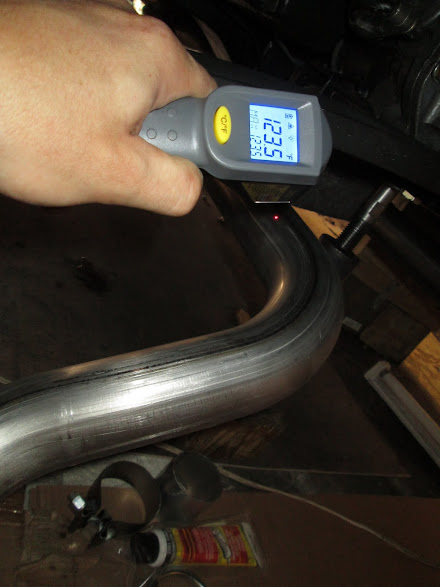
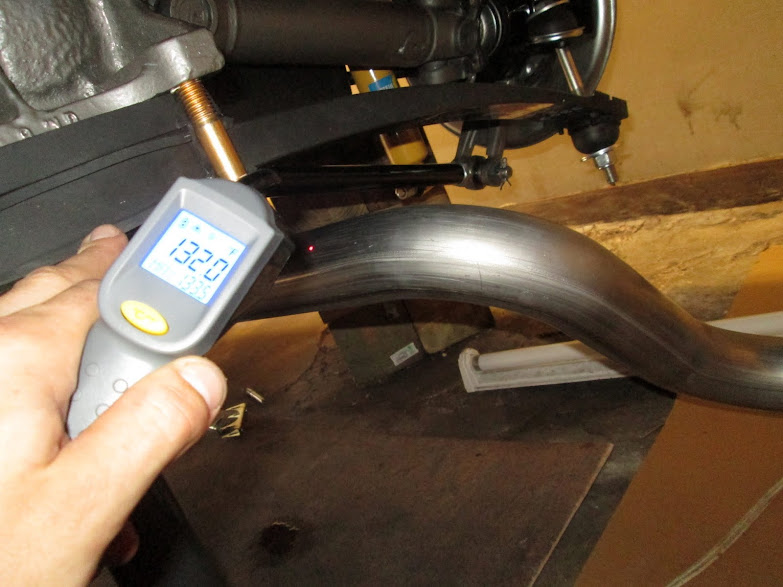
Picture 1, coated. Picture 2 uncoated.
While the motor was running, the uncoated side gave a reading of anywhere from 5 to 12 F hotter, depending where I pointed the gun. Not sure if the differences were due to the different locations on the pipe or the gun being a cheap HF gun.
The interesting thing was that after shutting the motor off, things started cooling off and the UNCOATED side was cooling quicker than the coated side. Constantly giving a reading of 5 - 10 F cooler. I was a little surprised by these results but then did some research and found out that ceramic heats up slower but also cools down slower therefore not cracking as easy from the heat cycles. Whether true or not...whether this coating is working or not.... who the hell knows, I can just go by what the cheap gun showed me.
Post # 51 --> http://forums.corvetteforum.com/c3-g...project-3.html
I decided to do a little test. I left one pipe section (one that runs under the spring) uncoated, ran the motor for 10-15min and used a heat gun to see the temp difference.
Picture 1, coated. Picture 2 uncoated.
While the motor was running, the uncoated side gave a reading of anywhere from 5 to 12 F hotter, depending where I pointed the gun. Not sure if the differences were due to the different locations on the pipe or the gun being a cheap HF gun.
The interesting thing was that after shutting the motor off, things started cooling off and the UNCOATED side was cooling quicker than the coated side. Constantly giving a reading of 5 - 10 F cooler. I was a little surprised by these results but then did some research and found out that ceramic heats up slower but also cools down slower therefore not cracking as easy from the heat cycles. Whether true or not...whether this coating is working or not.... who the hell knows, I can just go by what the cheap gun showed me.
Thread Starter
Burning Brakes
Joined: Mar 2011
Posts: 969
Likes: 1
From: NJ
Only took them at the rear as only that one right section was left uncoated. Everything else was already coated. I wanted to compare similar sections which were identical distance from the motor to have a like-to-like comparison especially with the X-pipe helping to distribute the heat more evenly towards the rear

Pro

Joined: Nov 2012
Posts: 672
Likes: 0
From: Chesapeake Virginia
the thing with the ceramic is called "thermal mass", granted it's not a lot of mass but it's still mass, the same concept is used in heating homes with sunlight, lots of thermal mass (i.e. bricks, stone, tile), the sun heats is during the day then the material releases it slowly thoughout the night. different process/same concept.
Le Mans Master


Joined: Mar 2008
Posts: 5,948
Likes: 72
From: Oxford MA-----You just lost the game!!!!
LOL! I looked at the first pic and said "1235 degrees F? Damn, that's hot!!" Obviously, it must be 123.5 degrees. Those little temp guns seem pretty cool, I'm thinking about getting one, how do you like it?
Scott
Scott
Thread Starter
Burning Brakes
Joined: Mar 2011
Posts: 969
Likes: 1
From: NJ
I only got the gun for this one purpose..... I'll probably end up returning it as I cant think of any other use for it

1st Gear

Joined: Sep 2013
Posts: 1
Likes: 0
So during my little project I decided to use the Eastwood internal exhaust coating on the inside of the headers and all of the pipes.
Post # 51 --> http://forums.corvetteforum.com/c3-g...project-3.html
I decided to do a little test. I left one pipe section (one that runs under the spring) uncoated, ran the motor for 10-15min and used a heat gun to see the temp difference.
Picture 1, coated. Picture 2 uncoated.
While the motor was running, the uncoated side gave a reading of anywhere from 5 to 12 F hotter, depending where I pointed the gun. Not sure if the differences were due to the different locations on the pipe or the gun being a cheap HF gun.
The interesting thing was that after shutting the motor off, things started cooling off and the UNCOATED side was cooling quicker than the coated side. Constantly giving a reading of 5 - 10 F cooler. I was a little surprised by these results but then did some research and found out that ceramic heats up slower but also cools down slower therefore not cracking as easy from the heat cycles. Whether true or not...whether this coating is working or not.... who the hell knows, I can just go by what the cheap gun showed me.
Post # 51 --> http://forums.corvetteforum.com/c3-g...project-3.html
I decided to do a little test. I left one pipe section (one that runs under the spring) uncoated, ran the motor for 10-15min and used a heat gun to see the temp difference.
Picture 1, coated. Picture 2 uncoated.
While the motor was running, the uncoated side gave a reading of anywhere from 5 to 12 F hotter, depending where I pointed the gun. Not sure if the differences were due to the different locations on the pipe or the gun being a cheap HF gun.
The interesting thing was that after shutting the motor off, things started cooling off and the UNCOATED side was cooling quicker than the coated side. Constantly giving a reading of 5 - 10 F cooler. I was a little surprised by these results but then did some research and found out that ceramic heats up slower but also cools down slower therefore not cracking as easy from the heat cycles. Whether true or not...whether this coating is working or not.... who the hell knows, I can just go by what the cheap gun showed me.
Unfortunately, there are likely many reasons why this test isn't going to yield useful results.
1) First and foremost there is little to no "ceramic" in an over the counter $10.00 - $20.00 thermal coating or header paint. At best it’s a silicone based coating that may hold up to some heat. Or perhaps a few specs of ceramic to prevent false advertising.
2) How did you clean out and prep the pipes for coating. Commercially they would be burned at about 700F-900F for 4-5 hours to burn off any organics (mandrel grease / oil). Then they would be internally blasted / profiled so that the coating has something to bite in to. If the ID of the pipe is still contaminated the coating will separate as if you were trying to paint an oily panel.
3) Once you insure that you actually have coating on the ID of the pipe you need to measure a consistent area of straight pipe as the bends will thinned out in different areas.
4) A cheap IR temp gun will NOT yield accurate temps from a reflective substrate. More expensive guns can be calibrated to do this. As a general rule you will see variances of 50F – 150F+ below your actual temps. Its best to put paint on your test site to eliminate the reflection.
5) As for the function of actual exhaust thermal barriers / ceramics, they will reduce the rate at which temps permeate the coating / substrate. Once they are heat soaked they will actually dissipate heat quicker than the raw substrate. For example, if you have ceramic coated headers you will notice that you can actually put your hands on the coated headers very soon after shutting the engine off. In the case of your pipes being hotter after they are were off this can be the result of not being coated and or denser substrates like SS as opposed to mild steel.
Corvette Stories
The Best of Corvette for Corvette Enthusiasts

Top 10 Most Expensive Corvettes Ever Sold on Bring A Trailer
Brett Foote
10 Things Every Corvette Owner Needs (2026 Edition)
Michael S. Palmer
8 Most "Only Corvette Owners Understand" Quirks and Problems
Pouria Savadkouei
10 Reasons the C6 Z06 is Still A Performance Benchmark After 20 Years
Joe Kucinski
How Much Horsepower Every Corvette Engine "LOST" in 1972
Joe Kucinski
Top 10 DOs and DON'Ts for Protecting Your Convertible Top!
Michael S. Palmer
Top 10 Most Explosive Corvettes Ever Made: Power-to-Weight Ratio Ranked!
Joe Kucinski
150 hp to 1,250 hp: Every Corvette Generation Compared by the Specs That Matter
Joe Kucinski
8 Coolest Corvette Pace Cars (and Replicas) of All Time
Verdad Gallardo
Burning Brakes


Joined: Apr 2007
Posts: 1,039
Likes: 62
From: Kona Hawaii
Temp gun can also be used as a tuning-troubleshooting tool.Found a bad spark plug that was causing a miss at times.Started the motor ,while it was warming up checked each cylinder's temp.Found one that was cooler than the others,replaced that plug no more miss!! Was a new plug !!

Thread Starter
Burning Brakes
Joined: Mar 2011
Posts: 969
Likes: 1
From: NJ
Temp gun can also be used as a tuning-troubleshooting tool.Found a bad spark plug that was causing a miss at times.Started the motor ,while it was warming up checked each cylinder's temp.Found one that was cooler than the others,replaced that plug no more miss!! Was a new plug !!



Le Mans Master
Joined: Mar 2008
Posts: 5,948
Likes: 72
From: Oxford MA-----You just lost the game!!!!
I think the main thing about a cheap IR temp gun (Harbor Freight has 'em for about 25 bucks) is that, even though it may not give an accurate temperature, it should still give you a fairly accurate way to judge temp differences. How often do you really care about the exact temp, as opposed to making a change, and noting the temp difference it makes?
Scott
Scott

Le Mans Master


Joined: Oct 2000
Posts: 8,897
Likes: 1,357
From: Santa Ana CA
I decided to do a little test. I left one pipe section (one that runs under the spring) uncoated, ran the motor for 10-15min and used a heat gun to see the temp difference.
Picture 1, coated. Picture 2 uncoated.
While the motor was running, the uncoated side gave a reading of anywhere from 5 to 12 F hotter, depending where I pointed the gun. Not sure if the differences were due to the different locations on the pipe or the gun being a cheap HF gun.
The interesting thing was that after shutting the motor off, things started cooling off and the UNCOATED side was cooling quicker than the coated side. Constantly giving a reading of 5 - 10 F cooler.
The coating acts as a barrier. When you are making heat in the pipe, the barrier keeps some of this heat from getting through before making its way out the tail pipe. But the metal pipe coated in ceramic still gets damn hot.
So when it starts to cool down you've removed the heat source from inside the pipe but you still have hot metal. Now the coating is acting as a barrier to keep the heat from escaping the metal into the air, at least on the coated side.
Thread Starter
Burning Brakes
Joined: Mar 2011
Posts: 969
Likes: 1
From: NJ
This is exactly what I would expect to happen.
The coating acts as a barrier. When you are making heat in the pipe, the barrier keeps some of this heat from getting through before making its way out the tail pipe. But the metal pipe coated in ceramic still gets damn hot.
So when it starts to cool down you've removed the heat source from inside the pipe but you still have hot metal. Now the coating is acting as a barrier to keep the heat from escaping the metal into the air, at least on the coated side.
The coating acts as a barrier. When you are making heat in the pipe, the barrier keeps some of this heat from getting through before making its way out the tail pipe. But the metal pipe coated in ceramic still gets damn hot.
So when it starts to cool down you've removed the heat source from inside the pipe but you still have hot metal. Now the coating is acting as a barrier to keep the heat from escaping the metal into the air, at least on the coated side.
All I wanted is to keep the cabin cooler and the fiberglass spring safe and with the coating starting with the headers all the way back, lizard skin, new transmission tunnel insulation, and heat shield right around the spring area I think I should be just fine.

Team Owner


Joined: Jan 2008
Posts: 30,894
Likes: 1,189
From: chicago
Team Owner
Joined: Jan 2008
Posts: 30,894
Likes: 1,189
From: chicago
Le Mans Master
Joined: Oct 2000
Posts: 8,897
Likes: 1,357
From: Santa Ana CA
Thats exactly what I learned about ceramic when I looked it up after seeing these results. So I guess the verdict is that the coating does work. Is it worth the 10-15 degree difference? Would I have seen more of a difference if I ran the motor longer? Maybe.
All I wanted is to keep the cabin cooler and the fiberglass spring safe and with the coating starting with the headers all the way back, lizard skin, new transmission tunnel insulation, and heat shield right around the spring area I think I should be just fine.
All I wanted is to keep the cabin cooler and the fiberglass spring safe and with the coating starting with the headers all the way back, lizard skin, new transmission tunnel insulation, and heat shield right around the spring area I think I should be just fine.
Thread Starter
Burning Brakes
Joined: Mar 2011
Posts: 969
Likes: 1
From: NJ
I took some more measurements today. After a long drive I parked and kept the motor running. Here is what I got (averaged the readings as I could not get one steady reading)
At the header primaries:
Cylinder #
1-240 F
2-280 F
3-310 F
4-240 F
5-250 F
6-240 F
7-250 F
8-310 F
At the exhaust pipe right under the rear spring: 140 F
Bottom of fiberglass spring right over the exhaust pipe: 120 F
So the internal coating along with the heat shield, keeps the spring around 20 F cooler that the pipe right under.
At the header primaries:
Cylinder #
1-240 F
2-280 F
3-310 F
4-240 F
5-250 F
6-240 F
7-250 F
8-310 F
At the exhaust pipe right under the rear spring: 140 F
Bottom of fiberglass spring right over the exhaust pipe: 120 F
So the internal coating along with the heat shield, keeps the spring around 20 F cooler that the pipe right under.

Team Owner
Joined: Oct 2004
Posts: 81,241
Likes: 3,063
From: altered state
St. Jude Donor '05
W/Scotty they will give you a general idea
They will only read surface temp not whats inside
Wonder if plumbing the coolant front to rear on the intake would change cyl temps any always bugged me how some cyls run so much warmer than others.
Id think if someones tuning from general A/F ratio #s the hotter cyls would be running leaner too
or at least be more prone to detonation.
They will only read surface temp not whats inside
Wonder if plumbing the coolant front to rear on the intake would change cyl temps any always bugged me how some cyls run so much warmer than others.
Id think if someones tuning from general A/F ratio #s the hotter cyls would be running leaner too
or at least be more prone to detonation.
Old Pro Solo Guy


Joined: Dec 2017
Posts: 8,088
Likes: 4,446
From: Marlton NJ
Wonder if plumbing the coolant front to rear on the intake would change cyl temps any always bugged me how some cyls run so much warmer than others.
Id think if someones tuning from general A/F ratio #s the hotter cyls would be running leaner too
or at least be more prone to detonation.