


Update: Rough running solved (Long post)


Thread Starter
Melting Slicks


Joined: Dec 2009
Posts: 3,224
Likes: 652
From: Thunder Bay
 Update: Rough running solved (Long post)
I have been fighting with a rough running problem on my '79 for months and finally solved the problem. Had a lot of help, suggestions, and support from this forum, so I thought I should share what I found.
The car started running rough back in June. Air/fuel gauge indicated a lean condition when it was running rough. As well I had a lean surge at cruise. I started by looking for vacuum leaks, but everything checked out OK. (I found a couple of minor leaks, but fixing them didn't cure the problem.) Next I plugged the PCV line and it ran fine, but it turns out this was just masking the problem. The PCV valve is a metered air leak and the carb is calibrated taking this into account. I spent a lot of time chasing this one, thinking it had something to do with the calibration of the PCV. Turned out to be a red herring.
I figured I better start from scratch and did a compression test. Everything was 175-180 lbs except for one cylinder that measured 165. Not perfect, but not enough to be causing the problem I was having.
Next, at the suggestion of a number of members on this forum, I swapped the ignition system for another known good one. Several members made the point that a lot of suspected carb problems turn out to be ignition. The swap didn't change anything. Still ran like crap.
Next I pulled the carburetor and went through it.. I didn't do a full rebuild at this point. Still no change.
Running out of ideas, I figured the only other place I could have a vacuum leak was the intake manifold. So, off came the manifold and reinstalled with a new gasket. Used the same Fel-Pro 1205 gasket I had on there before. I could see evidence of oil leaking past the gasket but no major breaches. While I was disassembling, I discovered evidence of fuel leaking past the carb base gaskets. I say gaskets because I have a phenolic spacer as well as an aluminum plate under the carb to control a heat soak problem. The gaskets had dried up over the years and having so many gaskets didn't help matters. I also had a metal plate under there that Holley supplied with the carburetor to ensure the bottom of the carb is properly sealed. I determined I really didn't need it. I also siliconed the phenolic spacer and the aluminum plate together to eliminate one more potential leak, and reassembled with new gaskets. This time there was an improvement. The air fuel gauge now indicated a more normal ratio. Unfortunately the car was still running like crap.
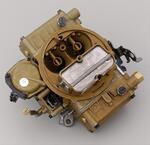
Back to the drawing board. I finally broke down and decided to do a full rebuild on the carb. (Its a Holley 770 Street Avenger.) When I pulled it apart it looked perfect inside. Absolutely spotless, but I disassembled, cleaned, and reassembled it with new parts anyway.
Eureka! The cars runs perfectly. I'm not sure exactly what combination of things I did solved the problem, but if I had to make an educated guess, I would say it was a combination of leaking intake and carb base gaskets, and a carb that was leaking internally. I also suspect the primary needle and seat may have been leaking as well. One of the few things I didn't check was the float level, and in retrospect, part of the problem may have been a high fuel level in the primary float bowl.
Unfortunately I didn't get to drive the car all summer because I was working on it every spare minute, but it feels good to have finally solved it. Not sure what the moral of this story is, but I hope it helps someone else.
The car started running rough back in June. Air/fuel gauge indicated a lean condition when it was running rough. As well I had a lean surge at cruise. I started by looking for vacuum leaks, but everything checked out OK. (I found a couple of minor leaks, but fixing them didn't cure the problem.) Next I plugged the PCV line and it ran fine, but it turns out this was just masking the problem. The PCV valve is a metered air leak and the carb is calibrated taking this into account. I spent a lot of time chasing this one, thinking it had something to do with the calibration of the PCV. Turned out to be a red herring.
I figured I better start from scratch and did a compression test. Everything was 175-180 lbs except for one cylinder that measured 165. Not perfect, but not enough to be causing the problem I was having.
Next, at the suggestion of a number of members on this forum, I swapped the ignition system for another known good one. Several members made the point that a lot of suspected carb problems turn out to be ignition. The swap didn't change anything. Still ran like crap.
Next I pulled the carburetor and went through it.. I didn't do a full rebuild at this point. Still no change.
Running out of ideas, I figured the only other place I could have a vacuum leak was the intake manifold. So, off came the manifold and reinstalled with a new gasket. Used the same Fel-Pro 1205 gasket I had on there before. I could see evidence of oil leaking past the gasket but no major breaches. While I was disassembling, I discovered evidence of fuel leaking past the carb base gaskets. I say gaskets because I have a phenolic spacer as well as an aluminum plate under the carb to control a heat soak problem. The gaskets had dried up over the years and having so many gaskets didn't help matters. I also had a metal plate under there that Holley supplied with the carburetor to ensure the bottom of the carb is properly sealed. I determined I really didn't need it. I also siliconed the phenolic spacer and the aluminum plate together to eliminate one more potential leak, and reassembled with new gaskets. This time there was an improvement. The air fuel gauge now indicated a more normal ratio. Unfortunately the car was still running like crap.
Back to the drawing board. I finally broke down and decided to do a full rebuild on the carb. (Its a Holley 770 Street Avenger.) When I pulled it apart it looked perfect inside. Absolutely spotless, but I disassembled, cleaned, and reassembled it with new parts anyway.
Eureka! The cars runs perfectly. I'm not sure exactly what combination of things I did solved the problem, but if I had to make an educated guess, I would say it was a combination of leaking intake and carb base gaskets, and a carb that was leaking internally. I also suspect the primary needle and seat may have been leaking as well. One of the few things I didn't check was the float level, and in retrospect, part of the problem may have been a high fuel level in the primary float bowl.
Unfortunately I didn't get to drive the car all summer because I was working on it every spare minute, but it feels good to have finally solved it. Not sure what the moral of this story is, but I hope it helps someone else.


Le Mans Master

Joined: Mar 2008
Posts: 5,948
Likes: 72
From: Oxford MA-----You just lost the game!!!!
How old is the carb? The word on the street is that Holleys need to be freshened up every 3-5 years. There is a little cork gasket around the idle mixture needles that can dry up and leak air, stuff like that. It's no big deal, Holleys are easy to rebuild, I actually kind of enjoy it.
Scott
Scott

Race Director


Joined: Apr 2000
Posts: 17,673
Likes: 199
From: Who says "Nothing is impossible" ? I've been doing nothing for years.
How old is the carb? The word on the street is that Holleys need to be freshened up every 3-5 years. There is a little cork gasket around the idle mixture needles that can dry up and leak air, stuff like that. It's no big deal, Holleys are easy to rebuild, I actually kind of enjoy it.
Scott
Scott

If you change your carb and use the same gasket there is an imprint from the old gasket that will not seal the carb base of the new carb unless it's the exact same carb, the gaskets are a buck and will save you problems.
I'm betting the needle and seat of the primary or secondary had trash in it and was dripping gas, in the case of the original poster

Thread Starter
Melting Slicks
Joined: Dec 2009
Posts: 3,224
Likes: 652
From: Thunder Bay
How old is the carb? The word on the street is that Holleys need to be freshened up every 3-5 years. There is a little cork gasket around the idle mixture needles that can dry up and leak air, stuff like that. It's no big deal, Holleys are easy to rebuild, I actually kind of enjoy it.
Scott
Scott




Melting Slicks

Joined: Jul 2005
Posts: 3,389
Likes: 83
From: Norfolk Virginia
Welcome
Hello, it's actually pretty easy to do it. There's basically a tutorial on this on Youtube called "automotive software" you can watch. It's like a 10-minute video, and they explain how to do it in a reasonably straightforward way. However, if you still haven't figured out how to do it after watching it, let me know, and I'll help. Also, you could check automotive software company for more information about how this system works with design and car's stuff. Let me know how it goes, and don't hesitate to reach out. Good luck with your software buddy!









