



idle stop solenoid

Le Mans Master


Joined: Apr 2011
Posts: 6,284
Likes: 1,171
From: Hermosa

My 73 with the original 454 has the solenoid and needs it. Without it, she diesels. It's needed because in order to adjust to the correct idle speed, the primaries on the Q-Jet are open far enough to uncover the transition slots which means fuel is still pulled into the in hot chambers on shut down, which causes the dieseling.

Race Director


Joined: Feb 2001
Posts: 11,252
Likes: 2,073
From: Grapevine Tx
2018 C3 of Year Finalist
2016 C3 of the Year Finalist
I can see where it might help if you're running an automatic, especially if your torque converter is a lower RPM set up. I wasn't really trying to argue about it.
Sorry man, I sent it to another member a few years back.
It's out of an '80 manual. I'm sure that if you want the perfect NCRS type '73, you have to have it. I just don't believe that you need it to have a good running car. Like I said, I can see where it would help, but believe that you can get by without it on a well tuned car.

Sorry man, I sent it to another member a few years back.
It's out of an '80 manual. I'm sure that if you want the perfect NCRS type '73, you have to have it. I just don't believe that you need it to have a good running car. Like I said, I can see where it would help, but believe that you can get by without it on a well tuned car.
Sorry that's so long...

Thread Starter
Racer


Joined: Sep 2002
Posts: 389
Likes: 0
From: san diego ca
AIM is the Assembly Manual, no? I never can find my way around that thing too well. If someone has the section/page reference that would be cool.
So about that tan wire...where does it come out of the wiring harness? I looked, but couldn't see anything obvious dangling there (would have been too easy, I know).
Race Director
Joined: Feb 2001
Posts: 11,252
Likes: 2,073
From: Grapevine Tx
2018 C3 of Year Finalist
2016 C3 of the Year Finalist
Thanks everybody for the details and info. Factory included it, so I'll probably try to get it hooked up again. If nothing else to see if it's better/worse/whatever. I found some write-up about it in the '73 Service Manual, which will help with the tuning of it.
AIM is the Assembly Manual, no? I never can find my way around that thing too well. If someone has the section/page reference that would be cool.
So about that tan wire...where does it come out of the wiring harness? I looked, but couldn't see anything obvious dangling there (would have been too easy, I know).
AIM is the Assembly Manual, no? I never can find my way around that thing too well. If someone has the section/page reference that would be cool.
So about that tan wire...where does it come out of the wiring harness? I looked, but couldn't see anything obvious dangling there (would have been too easy, I know).

Burning Brakes


Joined: Mar 2013
Posts: 1,018
Likes: 581
From: West Monroe Louisiana
2023 C3 of the Year Finalist - Unmodified
Try pages 399 and 433 in the 73 AIM.
Not too detailed but the best that I could find.
Look at the wiring harness that comes out behind the wiper motor as described above.
There should be a brown/tan wire that comes out of it. That is the one on my 73.
Donnie
Not too detailed but the best that I could find.
Look at the wiring harness that comes out behind the wiper motor as described above.
There should be a brown/tan wire that comes out of it. That is the one on my 73.
Donnie
Last edited by DonnieP73; Dec 23, 2013 at 11:30 PM.
Thread Starter
Racer
Joined: Sep 2002
Posts: 389
Likes: 0
From: san diego ca
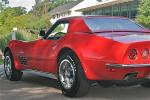
Excellent - thanks Donnie & Gary! Because of your descriptions and p 399 I found this wire...nice-n-neatly tucked up and over the brake booster, tied down like it was supposed to be there. It even still has the ISS connector on it. I guess the previous owner made a conscious decision not to use it.
Burning Brakes
Joined: Jan 2009
Posts: 766
Likes: 97
From: Lake Norman, NC
Excellent - thanks Donnie & Gary! Because of your descriptions and p 399 I found this wire...nice-n-neatly tucked up and over the brake booster, tied down like it was supposed to be there. It even still has the ISS connector on it. I guess the previous owner made a conscious decision not to use it.
Corvette Stories
The Best of Corvette for Corvette Enthusiasts

10 Reasons the C6 Z06 is Still A Performance Benchmark After 20 Years
Joe Kucinski
How Much Horsepower Every Corvette Engine "LOST" in 1972
Joe Kucinski
Top 10 DOs and DON'Ts for Protecting Your Convertible Top!
Michael S. Palmer
Top 10 Most Explosive Corvettes Ever Made: Power-to-Weight Ratio Ranked!
Joe Kucinski
150 hp to 1,250 hp: Every Corvette Generation Compared by the Specs That Matter
Joe Kucinski
8 Coolest Corvette Pace Cars (and Replicas) of All Time
Verdad Gallardo
Top 10 Corvette Engines RANKED by Peak Torque (70+ Years of Muscle!)
Joe Kucinski
Corvette ZR1X Will Be Pacing the Indy 500, And Could Probably Race, Too!
Verdad Gallardo
Top 10 Corvettes Coming to Mecum Indy 2026!
Brett Foote
Race Director
Joined: Jul 2001
Posts: 15,892
Likes: 42
I doubt the emissions label would mention this. The solenoid is not part of the anti-pollution set up, it's a drivability issue.
Le Mans Master
Joined: Apr 2011
Posts: 6,284
Likes: 1,171
From: Hermosa
Was doing some reading last night on the Q-jet and it sounds to me like the 73 and some others does not have Idle air bypass passages.
So in order for it to idle the butterfly valve (throttle) has to be opened just a little to allow the idle passages to be exposed to vacuum to get idle fuel to flow to the engine. In hind sight I did remember reading about q-jets that didn't have idle bypass air passages in Cliff Ruggles' book, just didn't pay much attention since it didn't apply to mine at the time.
The q-jet can be modded to have idle bypass air added if a guy wanted to eliminate the solenoid.
Maybe this has been done to yours Johnnybrewmeister. How well does it idle without the solenoid?
So in order for it to idle the butterfly valve (throttle) has to be opened just a little to allow the idle passages to be exposed to vacuum to get idle fuel to flow to the engine. In hind sight I did remember reading about q-jets that didn't have idle bypass air passages in Cliff Ruggles' book, just didn't pay much attention since it didn't apply to mine at the time.
The q-jet can be modded to have idle bypass air added if a guy wanted to eliminate the solenoid.
Maybe this has been done to yours Johnnybrewmeister. How well does it idle without the solenoid?
Thread Starter
Racer
Joined: Sep 2002
Posts: 389
Likes: 0
From: san diego ca
Was doing some reading last night on the Q-jet and it sounds to me like the 73 and some others does not have Idle air bypass passages.
So in order for it to idle the butterfly valve (throttle) has to be opened just a little to allow the idle passages to be exposed to vacuum to get idle fuel to flow to the engine. In hind sight I did remember reading about q-jets that didn't have idle bypass air passages in Cliff Ruggles' book, just didn't pay much attention since it didn't apply to mine at the time.
The q-jet can be modded to have idle bypass air added if a guy wanted to eliminate the solenoid.
Maybe this has been done to yours Johnnybrewmeister. How well does it idle without the solenoid?
So in order for it to idle the butterfly valve (throttle) has to be opened just a little to allow the idle passages to be exposed to vacuum to get idle fuel to flow to the engine. In hind sight I did remember reading about q-jets that didn't have idle bypass air passages in Cliff Ruggles' book, just didn't pay much attention since it didn't apply to mine at the time.
The q-jet can be modded to have idle bypass air added if a guy wanted to eliminate the solenoid.
Maybe this has been done to yours Johnnybrewmeister. How well does it idle without the solenoid?

Drifting

Joined: Mar 2011
Posts: 1,886
Likes: 9
The 73 and 74 cars (among others) were designed to run with NO vacuum advance at idle, for emissions. Vacuum advance was enabled only on third and forth gear(for manual trans cars), or high gear only (for automatics). GM called it TCS, for Transmission Controlled Spark.
To get a decent idle speed with very little ignition advance, the throttle plates had to be cracked open quite a bit. This can allow the engine to run on, especially on hot days. If you have modified your engine to run full time distributor vacuum advance, the solonoid is no longer needed , because the throttle butterflies will be very nearly closed.
To get a decent idle speed with very little ignition advance, the throttle plates had to be cracked open quite a bit. This can allow the engine to run on, especially on hot days. If you have modified your engine to run full time distributor vacuum advance, the solonoid is no longer needed , because the throttle butterflies will be very nearly closed.
Last edited by gcusmano74; Dec 26, 2013 at 09:44 PM.

Race Director


Joined: Jul 2004
Posts: 12,696
Likes: 329
From: Scottsdale Arizona
I think that part of the confusion is caused by the function being year specific. In my 81 the solenoid was activated when the A/C was turned on. On my 73, the solenoid is activated when you turn the ignition on. It's referred to on the 73 as an anti-dieseling solenoid. Essentially the same part with a different function, though functioning in the same manner.
Le Mans Master
Joined: Apr 2011
Posts: 6,284
Likes: 1,171
From: Hermosa
The 73 and 74 cars (among others) were designed to run with NO vacuum advance at idle, for emissions. Vacuum advance was enabled only on third and forth gear(for manual trans cars), or high gear only (for automatics). GM called it TCS, for Transmission Controlled Spark.
To get a decent idle speed with very little ignition advance, the throttle plates had to be cracked open quite a bit. This can allow the engine to run on, especially on hot days. If you have modified your engine to run full time distributor vacuum advance, the solonoid is no longer needed , because the throttle butterflies will be very nearly closed.
To get a decent idle speed with very little ignition advance, the throttle plates had to be cracked open quite a bit. This can allow the engine to run on, especially on hot days. If you have modified your engine to run full time distributor vacuum advance, the solonoid is no longer needed , because the throttle butterflies will be very nearly closed.

Safety Car

Joined: Jun 2000
Posts: 4,711
Likes: 552
From: St. Louis MO
2020 Corvette of the Year (appearance mods)
C2 of Year Winner (appearance mods) 2019
CI 4-5-7-9-10-11 Car Show Winner
CI 2-3-4-5-6-7-9-10-11 Vet

Thread Starter
Racer
Joined: Sep 2002
Posts: 389
Likes: 0
From: san diego ca
Out here in SoCal I run the cheapest 87 I can find.

Does it matter?

2026 Loser of the Year


Joined: Sep 2013
Posts: 36,582
Likes: 7,030
From: New Or-leens Loo-z-anna
It wouldn't hurt to pour a bottle of Lucas fuel treatment(injector cleaner) in your fuel tank on your carbed engine at every oil change to keep crud from building up in the combustion chambers.
Drifting
Joined: Mar 2011
Posts: 1,886
Likes: 9
Only if it pings on regular. If it doesn't ping, you're fine.

Team Owner


Joined: Jun 2000
Posts: 38,923
Likes: 1,481
From: Southbound
Cruise-In II Veteran
Yes. An acronym for Assembly Instruction Manual.
You haven't looked through it often enough. The more you use it, the easier it becomes to find things. Pick a quiet time; get the FCB of your choice, sit down, and page through the AIM looking at the diagrams, reading the Notes, etc. In an hour, you can go from front to back.

...I never can find my way around that thing too well...
Race Director
Joined: Jul 2001
Posts: 15,892
Likes: 42
Here's another common point of confusion. The octane rating scale in North America changed in the mid-70s. The old system rated fuel by Research Octane Number (RON), the new system by Anti Knock Index (AKI).
91 RON (as mentioned in your manual) is the same as 87 AKI.
All Corvettes from '71 onwards were federally mandated to run on regular gas. That's why the compression ratios dropped substantially and ignition curves became so conservative.