




idle stop solenoid

Thread Starter
Racer


Joined: Sep 2002
Posts: 389
Likes: 0
From: san diego ca
 idle stop solenoid
I know this topic has come up before (what hasn't?), and I've searched the archives a bit, but this sucker seems to be very year/option/opinion specific. My ISS has been disconnected for the 13 years I've had the car (didn't know what it was until now!). Its a '73 350 auto with A/C, but I yanked out the A/C years ago. There is no wire leading to the ISS, and the plunger is in the retracted position. The car has never dieseled, and if anything I've always felt that it does idle a bit faster than it should (seems opposite than should be with the plunger retracted, no?).
Anyway, 2 questions:
1) do I really need the ISS?
2) If I really should connect it, anybody know color of wire, and where it goes?
Anybody got a pic handy?
Thanks! Awesome bunch of people & info here, couldn't live without it.
Anyway, 2 questions:
1) do I really need the ISS?
2) If I really should connect it, anybody know color of wire, and where it goes?
Anybody got a pic handy?
Thanks! Awesome bunch of people & info here, couldn't live without it.

Burning Brakes


Joined: Sep 2005
Posts: 1,050
Likes: 205
From: Lewes Delaware
Do a search for this as you should have it connected. It has nothing to do with the AC. It's purpose is to prevent run on or dieseling after you shut the ignition off. It is connected to a brown wire shown in the picture just below it.the wire goes to a 12v source that is hot when the ignition is on - can't remember the exact location. The AIM has the exact details.
Check this: http://forums.corvetteforum.com/c3-t...-solenoid.html
Fran

Check this: http://forums.corvetteforum.com/c3-t...-solenoid.html
Fran

Last edited by Blue73Shark; Dec 23, 2013 at 07:08 AM.
Le Mans Master


Joined: Jan 2003
Posts: 6,575
Likes: 1
From: Tuttle OK
Cruise-In VIII Veteran

No A/C and if your car is set up right, I don't think you need it.

2026 Loser of the Year


Joined: Sep 2013
Posts: 36,597
Likes: 7,046
From: New Or-leens Loo-z-anna
Mail it to me if you don't want it/I'll pay the shipping/postage (I could use it on my '36/'92 truck SBC non-choke-carb to help the engine warm up on chilly Southern mornings)

Race Director

Joined: Jul 2001
Posts: 15,892
Likes: 42
Do a search for this as you should have it connected. It has nothing to do with the AC. It's purpose is to prevent run on or dieseling after you shut the ignition off. It is connected to a brown wire shown in the picture just below it.the wire goes to a 12v source that is hot when the ignition is on - can't remember the exact location. The AIM has the exact details.

Like many things people remove them because they don't know what they're for or how they work.
The curb idle speed is adjusted with the hex head on the piston, not with the screw on the carb.

Le Mans Master
Joined: Apr 2011
Posts: 6,284
Likes: 1,171
From: Hermosa
Mine is connected to the A/C circuit, same power that actuates the electro magnet clutch for the compressor, and actuates when the A/C is selected on to increase the throttle deflection while the A/C is running due to the increased load from the compressor. The brass screw on the ISS is adjustable to change it's effect while actuated.
When the A/C is off there is no power to the ISS and the throttle adjustment screw on the carb takes over for the idle stop. Every carburetor operated auto I have ever owned with A/C has functioned in this manner.
The ISS is nothing more than an electro magnet coil with a rod that protrudes when powered by 12V DC. I guess you can use it however you want to.

Race Director


Joined: Feb 2001
Posts: 11,295
Likes: 2,094
From: Grapevine Tx
2018 C3 of Year Finalist
2016 C3 of the Year Finalist
You sure about that? I have a different understanding.
Mine is connected to the A/C circuit, same power that actuates the electro magnet clutch for the compressor, and actuates when the A/C is selected on to increase the throttle deflection while the A/C is running due to the increased load from the compressor. The brass screw on the ISS is adjustable to change it's effect while actuated.
When the A/C is off there is no power to the ISS and the throttle adjustment screw on the carb takes over for the idle stop. Every carburetor operated auto I have ever owned with A/C has functioned in this manner.
The ISS is nothing more than an electro magnet coil with a rod that protrudes when powered by 12V DC. I guess you can use it however you want to.
Mine is connected to the A/C circuit, same power that actuates the electro magnet clutch for the compressor, and actuates when the A/C is selected on to increase the throttle deflection while the A/C is running due to the increased load from the compressor. The brass screw on the ISS is adjustable to change it's effect while actuated.
When the A/C is off there is no power to the ISS and the throttle adjustment screw on the carb takes over for the idle stop. Every carburetor operated auto I have ever owned with A/C has functioned in this manner.
The ISS is nothing more than an electro magnet coil with a rod that protrudes when powered by 12V DC. I guess you can use it however you want to.
But, that's not how it came from the factory. That tan wire in the above picture does not go to the A/C compressor. I added a wire from the A/C compressor in order to use it the way you and I do.
The way it is supposed to be set up, is 500 RPM with the solenoid disconnected and 900 RPM (or whatever your decal says for idle) with the solenoid connected. It is powered whenever the ignition is on.
Corvette Stories
The Best of Corvette for Corvette Enthusiasts

Top 10 Most Expensive Corvettes Ever Sold on Bring A Trailer
Brett Foote
10 Things Every Corvette Owner Needs (2026 Edition)
Michael S. Palmer
8 Most "Only Corvette Owners Understand" Quirks and Problems
Pouria Savadkouei
10 Reasons the C6 Z06 is Still A Performance Benchmark After 20 Years
Joe Kucinski
How Much Horsepower Every Corvette Engine "LOST" in 1972
Joe Kucinski
Top 10 DOs and DON'Ts for Protecting Your Convertible Top!
Michael S. Palmer
Top 10 Most Explosive Corvettes Ever Made: Power-to-Weight Ratio Ranked!
Joe Kucinski
150 hp to 1,250 hp: Every Corvette Generation Compared by the Specs That Matter
Joe Kucinski
8 Coolest Corvette Pace Cars (and Replicas) of All Time
Verdad Gallardo
Race Director
Joined: Jul 2001
Posts: 15,892
Likes: 42
You sure about that? I have a different understanding.
Mine is connected to the A/C circuit, same power that actuates the electro magnet clutch for the compressor, and actuates when the A/C is selected on to increase the throttle deflection while the A/C is running due to the increased load from the compressor. The brass screw on the ISS is adjustable to change it's effect while actuated.
When the A/C is off there is no power to the ISS and the throttle adjustment screw on the carb takes over for the idle stop. Every carburetor operated auto I have ever owned with A/C has functioned in this manner.
The ISS is nothing more than an electro magnet coil with a rod that protrudes when powered by 12V DC. I guess you can use it however you want to.
Mine is connected to the A/C circuit, same power that actuates the electro magnet clutch for the compressor, and actuates when the A/C is selected on to increase the throttle deflection while the A/C is running due to the increased load from the compressor. The brass screw on the ISS is adjustable to change it's effect while actuated.
When the A/C is off there is no power to the ISS and the throttle adjustment screw on the carb takes over for the idle stop. Every carburetor operated auto I have ever owned with A/C has functioned in this manner.
The ISS is nothing more than an electro magnet coil with a rod that protrudes when powered by 12V DC. I guess you can use it however you want to.
Le Mans Master
Joined: Apr 2011
Posts: 6,284
Likes: 1,171
From: Hermosa
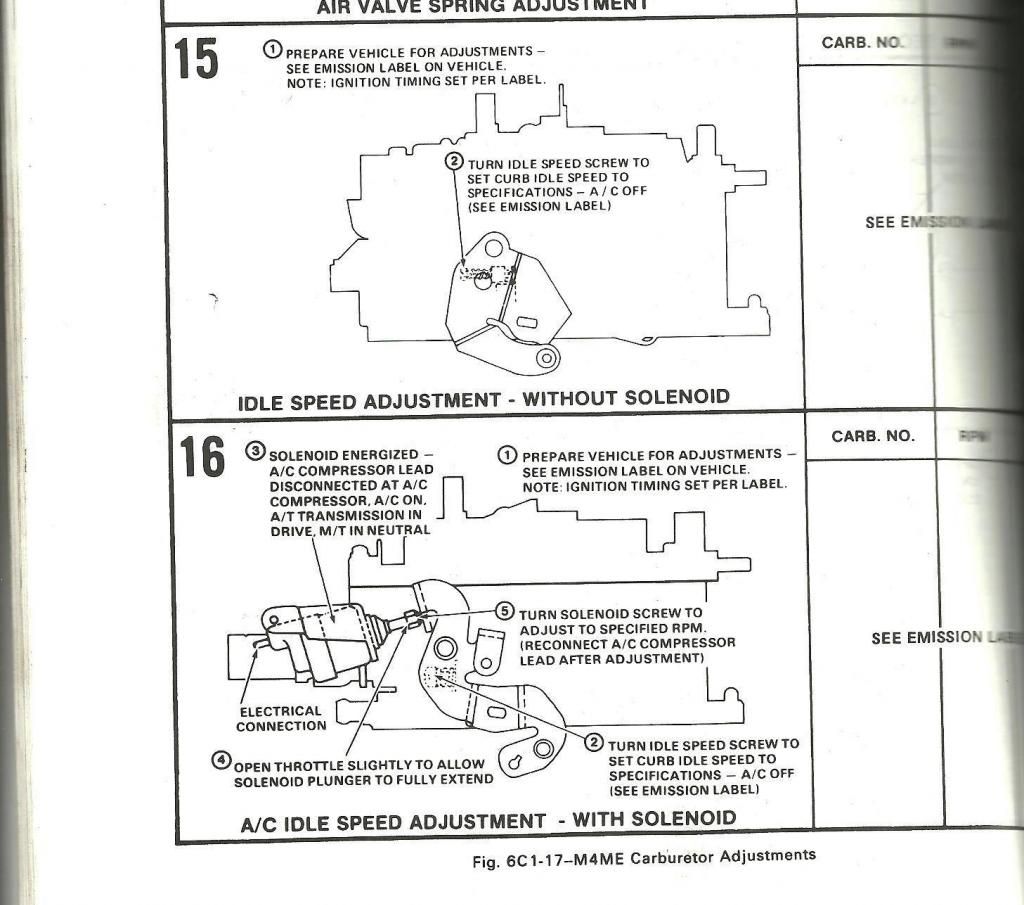
No, don't have a 73. Does the 73 incorporate a fuel shut-off solenoid with the Idle solenoid? I haven't owned a 73 anything so this could be the case I suppose.
Mine is like the one pictured by blue shark and ones I have owned or worked on are like that as well.
Mine is like the one pictured by blue shark and ones I have owned or worked on are like that as well.
Le Mans Master
Joined: Jan 2003
Posts: 6,575
Likes: 1
From: Tuttle OK
Cruise-In VIII Veteran
Race Director
Joined: Jul 2001
Posts: 15,892
Likes: 42
Le Mans Master
Joined: Jan 2003
Posts: 6,575
Likes: 1
From: Tuttle OK
Cruise-In VIII Veteran
Not sure why you choose to be a dick.
The OP has a '73 with no AC. I'm just saying that he does not have to have it without A/C.
Prove me to be incorrect and I'll be glad to admit it.
The OP has a '73 with no AC. I'm just saying that he does not have to have it without A/C.
Prove me to be incorrect and I'll be glad to admit it.
Race Director
Joined: Jul 2001
Posts: 15,892
Likes: 42
A simple review of the AIM will indicate that ALL '73s came with the idle stop solenoid, A/C or not. A review of the '73 wiring diagram will show that there is no electrical connection between the solenoid and the A/C compressor.
My own non-A/C '73 small block has this very solenoid. It can and has dieseled on hot summer days if the solenoid is defeated by adjusting the mechanical stop on the carb.
Don't think I'm the one being the dick here..................
My own non-A/C '73 small block has this very solenoid. It can and has dieseled on hot summer days if the solenoid is defeated by adjusting the mechanical stop on the carb.
Don't think I'm the one being the dick here..................
Race Director
Joined: Feb 2001
Posts: 11,295
Likes: 2,094
From: Grapevine Tx
2018 C3 of Year Finalist
2016 C3 of the Year Finalist

Melting Slicks

Joined: Mar 2005
Posts: 2,838
Likes: 10
From: Austin TX
My 73 with the original 454 has the solenoid and needs it. Without it, she diesels. It's needed because in order to adjust to the correct idle speed, the primaries on the Q-Jet are open far enough to uncover the transition slots which means fuel is still pulled into the in hot chambers on shut down, which causes the dieseling.
Its actually a slick solution to the problem, plus it makes idle adjustments much easier.
FWIW
Its actually a slick solution to the problem, plus it makes idle adjustments much easier.
FWIW
Burning Brakes
Joined: Jan 2009
Posts: 766
Likes: 97
From: Lake Norman, NC
Just a point of clarity. The 1973 Rochester Quadrajet idle speed adjustment is accomplished by turning the hex head on the anti diesel solenoid's piston. This is in accordance with the instructions and specifications listed on the 1973 Engine Emissions and Tune Up decal, located on the LH engine bay bulkhead.
I do not have a '73, however, I think they are carry over in that regard from '72. Someone here should be able to confirm or correct this. I can say that when I bought my '72 (350/4 spd/no AC), the solenoid and mounting bracket were in a box of "extra parts." The tan wire was coiled up and taped to the bulkhead harness. Note: my car is a factory non-AC car and it has the solenoid. I restored the entire car, and wanted it to be 100% factory. I re-installed the unit and adjusted the idle speed as per the Emissions and Tune Up decal. the system works perfectly and the car runs great.
Whether you want it or not seems to me to be your choice. The factory chose to include it, which is why I did.
I do not have a '73, however, I think they are carry over in that regard from '72. Someone here should be able to confirm or correct this. I can say that when I bought my '72 (350/4 spd/no AC), the solenoid and mounting bracket were in a box of "extra parts." The tan wire was coiled up and taped to the bulkhead harness. Note: my car is a factory non-AC car and it has the solenoid. I restored the entire car, and wanted it to be 100% factory. I re-installed the unit and adjusted the idle speed as per the Emissions and Tune Up decal. the system works perfectly and the car runs great.
Whether you want it or not seems to me to be your choice. The factory chose to include it, which is why I did.
Le Mans Master
Joined: Jan 2003
Posts: 6,575
Likes: 1
From: Tuttle OK
Cruise-In VIII Veteran
I can see where it might help if you're running an automatic, especially if your torque converter is a lower RPM set up. I wasn't really trying to argue about it.
Sorry man, I sent it to another member a few years back.
It's out of an '80 manual. I'm sure that if you want the perfect NCRS type '73, you have to have it. I just don't believe that you need it to have a good running car. Like I said, I can see where it would help, but believe that you can get by without it on a well tuned car.

It's out of an '80 manual. I'm sure that if you want the perfect NCRS type '73, you have to have it. I just don't believe that you need it to have a good running car. Like I said, I can see where it would help, but believe that you can get by without it on a well tuned car.