



 .
. 



Low idle vacuum

Drifting


Joined: Apr 2007
Posts: 1,970
Likes: 45
From: Cameron Park CA


Pete

2026 Loser of the Year


Joined: Sep 2013
Posts: 36,600
Likes: 7,046
From: New Or-leens Loo-z-anna
Well....for sure, the square gasket is not the correct one because there is no strip of gasket material in the middle of the square opening---causing an internal leak between the D.P. wall and the spacer---causing the divider wall to be useless....(but that problem should not cause a vacuum loss)
ask me how I know.................................... ..
and yes....some folks like a dual plane "leak"....similar to an exhaust system with a cross-over pipe.
ask me how I know.................................... ..
and yes....some folks like a dual plane "leak"....similar to an exhaust system with a cross-over pipe.
Last edited by doorgunner; Feb 10, 2014 at 12:52 AM.

Thread Starter
Instructor


Joined: Nov 2012
Posts: 209
Likes: 7
some how gas was getting out of those gaskets and pooling up in the intake manifold "valleys". Both gaskets were completely soaked. Should a guy be using a gasket sealer on these?
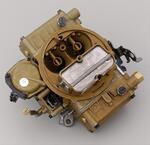
I can see now i've got a compatibility issue. The holley and intake were on the car when i bought it, the gasket set between the two before was cobbled terribly. I wonder if i could just use another "4 hole" gasket on the bottom and be ok. I see there's some adapter kits, but i haven't read anything good about them. But it doesn't look like this is my problem anyway?
I do need the 1/2" spacer to clear the brass fitting you see between the intake port and the distributor.
I would have gone to a C5, but i was having a hard time selling it to the old lady despite the fact she told me i could have a corvette. So i had to trade my 99 firebird for a corvette that i could get bought for equal value. But i wanted something to work on anyway, there isn't much to mess with on a newer corvette.
I can see now i've got a compatibility issue. The holley and intake were on the car when i bought it, the gasket set between the two before was cobbled terribly. I wonder if i could just use another "4 hole" gasket on the bottom and be ok. I see there's some adapter kits, but i haven't read anything good about them. But it doesn't look like this is my problem anyway?
I do need the 1/2" spacer to clear the brass fitting you see between the intake port and the distributor.
I would have gone to a C5, but i was having a hard time selling it to the old lady despite the fact she told me i could have a corvette. So i had to trade my 99 firebird for a corvette that i could get bought for equal value. But i wanted something to work on anyway, there isn't much to mess with on a newer corvette.

Race Director


Joined: Dec 2004
Posts: 10,332
Likes: 63
From: PARADISE
St. Jude Donor '09-'11-'12-'13-'14
In addition to the great advice available here, check out this primer on reading a vacuum gauge:
http://www.secondchancegarage.com/public/186.cfm
http://www.secondchancegarage.com/public/186.cfm
Drifting
Joined: Apr 2007
Posts: 1,970
Likes: 45
From: Cameron Park CA
From what I can see you need an adapter to mount a Holley carb to that manifold. Like this one:http://www.summitracing.com/search/b...-bore-4-barrel
That should solve your vacuum leak and your clearance for the vacuum fitting problems.
Pete
That should solve your vacuum leak and your clearance for the vacuum fitting problems.
Pete

Tech Contributor


Joined: Aug 1999
Posts: 14,380
Likes: 6,391
From: At my Bar drinking and wrenching in Lafayette Colorado
The manifold shown is a dual-pattern manifold intended to mount either a Q-Jet or a Holley (note the 8 mountning stud locations for the dual pattern). Either carb can be used without an adapter, as long as the gasket used seals around the perimeter of the flange with full contact and no air gap. This can be a problem around the secondary side, though.
No, you don't use a sealer. The gasket has nothing to do with the wetting issue. If the gasket is fuel soaked, it is because your carb is dripping fuel after shutdown from the main discharge orifices or from the accel pump shooters. This fuel will puddle on the throttle plates and wick out the shafts and onto your manifold, wetting the gasket in the process. You need to identify and fix your carb fuel leakage problem.
Lars
Lars
Last edited by lars; Feb 11, 2014 at 10:24 AM.
Thread Starter
Instructor
Joined: Nov 2012
Posts: 209
Likes: 7
Having reviewed the link claysmoker provided under scenario 12 is exactly where I'm at. I took a small gamble and bought two new identical carb gaskets that have the 4 round holes. Install proved slight results, the vacuum gauge no longer bounce between 3 & 5 but still on 3. Increasing engine speed brings it up to 8, but solid. I have my timing now set to 18/36.
It started perfectly, barely any choke, and with a slight tweak of my distributor ran better than ever. But still no vacuum, I've been suggested to just install an electric vacuum pump. It might be masking the problem, but I don't know how big of a problem we're taking about when the engine starts and runs great.
It started perfectly, barely any choke, and with a slight tweak of my distributor ran better than ever. But still no vacuum, I've been suggested to just install an electric vacuum pump. It might be masking the problem, but I don't know how big of a problem we're taking about when the engine starts and runs great.
Corvette Stories
The Best of Corvette for Corvette Enthusiasts

Top 10 Most Expensive Corvettes Ever Sold on Bring A Trailer
Brett Foote
10 Things Every Corvette Owner Needs (2026 Edition)
Michael S. Palmer
8 Most "Only Corvette Owners Understand" Quirks and Problems
Pouria Savadkouei
10 Reasons the C6 Z06 is Still A Performance Benchmark After 20 Years
Joe Kucinski
How Much Horsepower Every Corvette Engine "LOST" in 1972
Joe Kucinski
Top 10 DOs and DON'Ts for Protecting Your Convertible Top!
Michael S. Palmer
Top 10 Most Explosive Corvettes Ever Made: Power-to-Weight Ratio Ranked!
Joe Kucinski
150 hp to 1,250 hp: Every Corvette Generation Compared by the Specs That Matter
Joe Kucinski
8 Coolest Corvette Pace Cars (and Replicas) of All Time
Verdad Gallardo
Safety Car

Joined: Jan 2009
Posts: 4,000
Likes: 299
From: New York

Melting Slicks

Joined: Mar 2008
Posts: 2,666
Likes: 289
From: Spring Park MN
I'll repeat myself from post no. 14.
The one thing I would add is do a compression test or leak down test to make sure you have a healthy engine. If the compression is way low or leak down is way high, you are beating your head against the wall.
The one thing I would add is do a compression test or leak down test to make sure you have a healthy engine. If the compression is way low or leak down is way high, you are beating your head against the wall.
Le Mans Master

Joined: Mar 2008
Posts: 5,948
Likes: 72
From: Oxford MA-----You just lost the game!!!!
I have the same intake manifold (Performer 2101) and a square bore carb (Holley 1850). If you take a good look at the impression on the gasket below the spacer, I am sure that you will notice a spot on the driver's side, where the secondaries are, that just barely covers the intake manifold, probably by less than 1/8", maybe even less...maybe not at all. You really need an adapter, like this:
http://www.summitracing.com/parts/sum-g1420/overview/
I couldn't find one that wasn't open, so I made one with 4 holes, and also made my own gasket, to keep both sides of the manifold separated. Also, I know a lot of folks say don't use a gasket sealer on carb gaskets, but I have had good luck with this:
http://www.permatex.com/products-2/p...sealant-detail
Good luck, and definitely let us know when you figure it out.
Scott
Scott
http://www.summitracing.com/parts/sum-g1420/overview/
I couldn't find one that wasn't open, so I made one with 4 holes, and also made my own gasket, to keep both sides of the manifold separated. Also, I know a lot of folks say don't use a gasket sealer on carb gaskets, but I have had good luck with this:
http://www.permatex.com/products-2/p...sealant-detail
Good luck, and definitely let us know when you figure it out.
Scott
Scott
Thread Starter
Instructor
Joined: Nov 2012
Posts: 209
Likes: 7
I purchased a compression gauge, all cylinders are between 150-155, actually better than I expected, but the car only has 60k miles so the cylinders or valves shouldn't be toast. I didn't pick anything up to do the leak down test.
Yeah Scotty I see what you're talking about on the driver side of the manifold, it its close.
After doing my compression test I ran it, this time I put the vacuum gauge on the brake booster line, and I get an erratic 5-8 inches, if I rev the motor up I can get it almost to 20. But it doesn't hang in there. But, prior to before, removing the primary vacuum line off the carb did nothing, but now if I remove it the engine revs up. This whole thing doesn't make sense.
Yeah Scotty I see what you're talking about on the driver side of the manifold, it its close.
After doing my compression test I ran it, this time I put the vacuum gauge on the brake booster line, and I get an erratic 5-8 inches, if I rev the motor up I can get it almost to 20. But it doesn't hang in there. But, prior to before, removing the primary vacuum line off the carb did nothing, but now if I remove it the engine revs up. This whole thing doesn't make sense.
Le Mans Master
Joined: Mar 2008
Posts: 5,948
Likes: 72
From: Oxford MA-----You just lost the game!!!!
I like Holley carbs, but they can get a little wonky after a few years, and need a rebuild. How long has it been? Also, why would you paint a nice-looking aluminum intake manifold?
Scott
Scott
Thread Starter
Instructor
Joined: Nov 2012
Posts: 209
Likes: 7
I have not rebuilt this carb, and if I had to guess its never been redone. It was installed in 1992. I suppose it wouldn't hurt to do it...
Le Mans Master
Joined: Mar 2008
Posts: 5,948
Likes: 72
From: Oxford MA-----You just lost the game!!!!
It's your intake, you can do whatever your heart desires with it!
If you've never rebuilt a Holley before, here's a great article describing the disassembly, cleaning, and reassembly of a double pumper. It's easy. If Holley carbs were any easier to disassemble and reassemble, they'd have to be made of Legos.
http://www.fordmuscle.com/archives/1.../index.php#mid
It may not fix your problem, but at least you'll have ruled out one more thing, and it probably needs it anyway. Plus, it's kinds fun, I think. Like a jigsaw puzzle...sorta.
Scott
If you've never rebuilt a Holley before, here's a great article describing the disassembly, cleaning, and reassembly of a double pumper. It's easy. If Holley carbs were any easier to disassemble and reassemble, they'd have to be made of Legos.
http://www.fordmuscle.com/archives/1.../index.php#mid
It may not fix your problem, but at least you'll have ruled out one more thing, and it probably needs it anyway. Plus, it's kinds fun, I think. Like a jigsaw puzzle...sorta.
Scott
Last edited by scottyp99; Feb 15, 2014 at 10:02 PM.
Drifting
Joined: Apr 2007
Posts: 1,970
Likes: 45
From: Cameron Park CA
It's your intake, you can do whatever your heart desires with it!
If you've never rebuilt a Holley before, here's a great article describing the disassembly, cleaning, and reassembly of a double pumper. It's easy. If Holley carbs were any easier to disassemble and reassemble, they'd have to be made of Legos.
http://www.fordmuscle.com/archives/1.../index.php#mid
It may not fix your problem, but at least you'll have ruled out one more thing, and it probably needs it anyway. Plus, it's kinds fun, I think. Like a jigsaw puzzle...sorta.
Scott
If you've never rebuilt a Holley before, here's a great article describing the disassembly, cleaning, and reassembly of a double pumper. It's easy. If Holley carbs were any easier to disassemble and reassemble, they'd have to be made of Legos.
http://www.fordmuscle.com/archives/1.../index.php#mid
It may not fix your problem, but at least you'll have ruled out one more thing, and it probably needs it anyway. Plus, it's kinds fun, I think. Like a jigsaw puzzle...sorta.
Scott
Pete
Safety Car
Joined: Jan 2009
Posts: 4,000
Likes: 299
From: New York
Can you check to see if the carb bowl is resting on that rear brass vacuum fitting , It can fool you on some cars in that the carb will feel 100% down when in fact it is a wee bit up on that vacuum connection
Le Mans Master
Joined: Mar 2008
Posts: 5,948
Likes: 72
From: Oxford MA-----You just lost the game!!!!
Not to rain on your parade Scott, but that article is flat wrong out of the box. Third paragraph states that both mechanical secondary AND vacuum secondary 4150 carbs have dual accelerator pumps. Not so. Double pumpers all have mechanical secondaries; vacuum secondary carbs don't. When an article makes that gross an error, I tend to distrust the entire article. And I like Fords
Pete
Pete
Yes, the sentence before the one you are criticizing even states this, contradicting itself. It's a minor error, the OP has a double pumper and knows it, so it shouldn't cause him any confusion during the rebuild. Still, bad info is bad info.
Scott
Scott
Thread Starter
Instructor
Joined: Nov 2012
Posts: 209
Likes: 7
i'm going to have to pull it off again, she's leaking gas just sitting there again, i'll just rebuild this carb as i get time. Before i pull it off, any chance i could find a vacuum leak around where the distributor goes through the intake manifold? There was a gasket i installed for it but maybe that's not sealing? I keep forgetting to get some carb cleaner bought to check the thing...