






'69 Manual Trans./Steering Column Cable

Thread Starter
Racer


Joined: Feb 2007
Posts: 315
Likes: 9
From: Cocoa Beach Florida

Any ideas??
Thanks!

Former Vendor
Joined: Aug 2006
Posts: 76,656
Likes: 1,852
From: Jeffersonville Indiana 812-288-7103
St. Jude Donor '08-'09-'10-'11-'12-'13-'14-'15
Have you removed the cable to see how free the lever is on the steering column?
Do you have both the brackets in place?

Thread Starter
Racer
Joined: Feb 2007
Posts: 315
Likes: 9
From: Cocoa Beach Florida
If you look at the trans. mount bracket and the shifter mount pin, you will see a small "elevation" change when the shifter linkage rotates. I think this was a design mistake. I think a cable is to be PULLED...not PUSHED.
So, I thank your wisdom and hope you have more info to help me figure out this problem
Thanks again!!

Team Owner


Joined: Sep 2006
Posts: 31,267
Likes: 4,362
From: Westminster Maryland
Hi,
I think you're mistaken about THIS cable being designed to either 'push' or 'pull'
With a lever at each end the cable is performing the same task no matter which way it is traveling unless one of the lever's takes more force to move than it was intended to.
Is there ANY chance the cable is on backwards?
Does either swaged fitting need to be 'twisted' in order to make it's connection? This might cause some binding of the cable in the sheath.
Regards,
Alan
Transmission end.
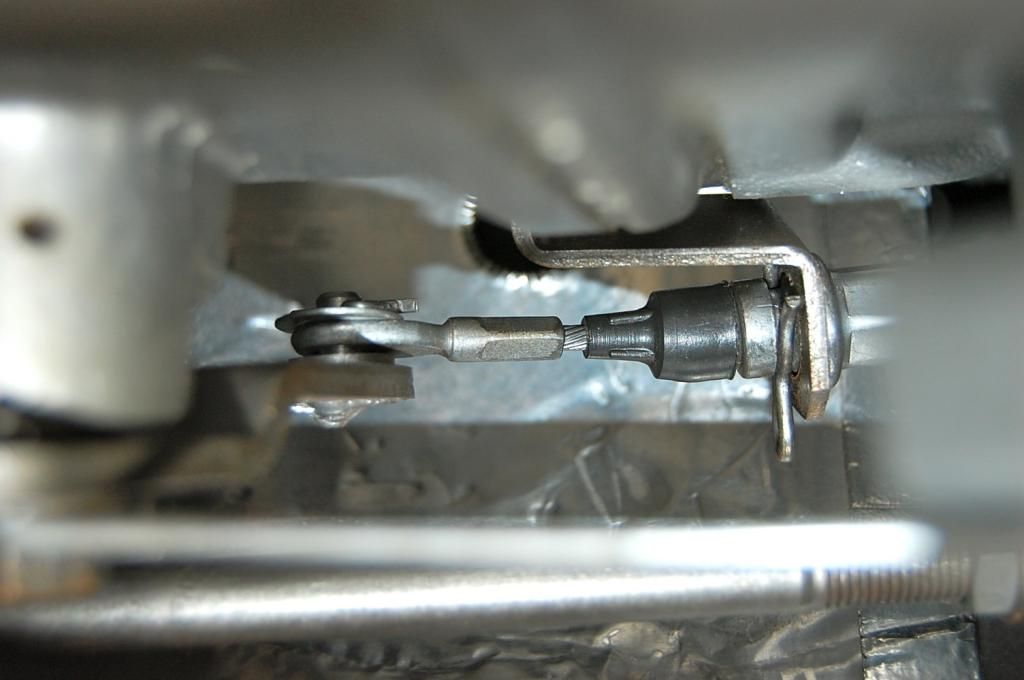
Firewall.

Column Lever.
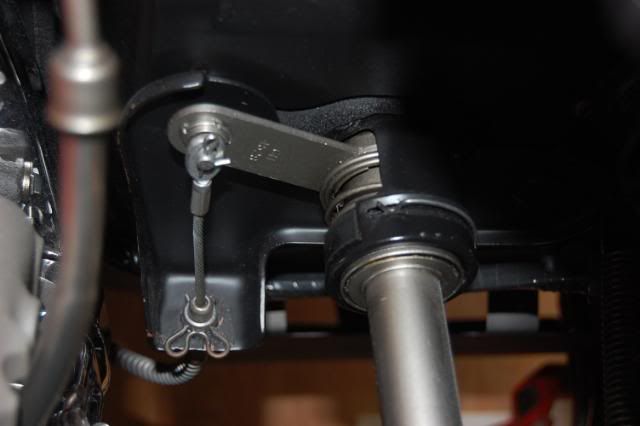
I think you're mistaken about THIS cable being designed to either 'push' or 'pull'
With a lever at each end the cable is performing the same task no matter which way it is traveling unless one of the lever's takes more force to move than it was intended to.
Is there ANY chance the cable is on backwards?
Does either swaged fitting need to be 'twisted' in order to make it's connection? This might cause some binding of the cable in the sheath.
Regards,
Alan
Transmission end.
Firewall.
Column Lever.
Thread Starter
Racer
Joined: Feb 2007
Posts: 315
Likes: 9
From: Cocoa Beach Florida
Hi,
I think you're mistaken about THIS cable being designed to either 'push' or 'pull'
With a lever at each end the cable is performing the same task no matter which way it is traveling unless one of the lever's takes more force to move than it was intended to.
Is there ANY chance the cable is on backwards?
Does either swaged fitting need to be 'twisted' in order to make it's connection? This might cause some binding of the cable in the sheath.
Regards,
Alan
Transmission end.
Firewall.
Column Lever.
I think you're mistaken about THIS cable being designed to either 'push' or 'pull'
With a lever at each end the cable is performing the same task no matter which way it is traveling unless one of the lever's takes more force to move than it was intended to.
Is there ANY chance the cable is on backwards?
Does either swaged fitting need to be 'twisted' in order to make it's connection? This might cause some binding of the cable in the sheath.
Regards,
Alan
Transmission end.
Firewall.
Column Lever.
I understand the cable! What I was saying was that the cable is pushed to lock the column...and that is when the problem happens. Again, cable is NOT designed to push something...it can bend! Try it!
The column lever never has been designed to push or pull...the reverse lever is the one that does the push and pull.
Both ends of the cable are exactly the same, so it can not be backwards. The ends of the cable align perfectly. If you look at the housing beside the reverse lever and the reverse lever, you will see the reverse lever "pin" rotating. When you see any rotation, you will see the end of the cable will raise and lower the elevation. This can be part is the problem.
Also, thanks for the message from Willcox! When I checked the transmission brackets, I noticed the front transmission bracket is missing! So, if the bracket is not there, the rear end of the housing possibly can change the elevation or maybe sideways. That can also be part of the problem. I communicated with Willcox to see it they have the bracket, but I have not received their response.
Thanks again for your thought Alan!!! I will let you know more when I finally fix it!
John

Racer

Joined: Sep 2010
Posts: 302
Likes: 14
From: Northern Ca.
Hi,
I think you're mistaken about THIS cable being designed to either 'push' or 'pull'
With a lever at each end the cable is performing the same task no matter which way it is traveling unless one of the lever's takes more force to move than it was intended to.
Is there ANY chance the cable is on backwards?
Does either swaged fitting need to be 'twisted' in order to make it's connection? This might cause some binding of the cable in the sheath.
Regards,
Alan
Transmission end.
Firewall.
Column Lever.
I think you're mistaken about THIS cable being designed to either 'push' or 'pull'
With a lever at each end the cable is performing the same task no matter which way it is traveling unless one of the lever's takes more force to move than it was intended to.
Is there ANY chance the cable is on backwards?
Does either swaged fitting need to be 'twisted' in order to make it's connection? This might cause some binding of the cable in the sheath.
Regards,
Alan
Transmission end.
Firewall.
Column Lever.

Corvette Stories
The Best of Corvette for Corvette Enthusiasts

Top 10 Most Expensive Corvettes Ever Sold on Bring A Trailer
Brett Foote
10 Things Every Corvette Owner Needs (2026 Edition)
Michael S. Palmer
8 Most "Only Corvette Owners Understand" Quirks and Problems
Pouria Savadkouei
10 Reasons the C6 Z06 is Still A Performance Benchmark After 20 Years
Joe Kucinski
How Much Horsepower Every Corvette Engine "LOST" in 1972
Joe Kucinski
Top 10 DOs and DON'Ts for Protecting Your Convertible Top!
Michael S. Palmer
Top 10 Most Explosive Corvettes Ever Made: Power-to-Weight Ratio Ranked!
Joe Kucinski
150 hp to 1,250 hp: Every Corvette Generation Compared by the Specs That Matter
Joe Kucinski
8 Coolest Corvette Pace Cars (and Replicas) of All Time
Verdad Gallardo
Team Owner
Joined: Sep 2006
Posts: 31,267
Likes: 4,362
From: Westminster Maryland
Hi t,
Here's the forward clamp installed.
Even with that much 'kink' in the cable it moves the levers at each end in either direction.
Regards,
Alan

Here's the normal curve in the cable as it travels from the column bracket to the first clamp on the transmission.
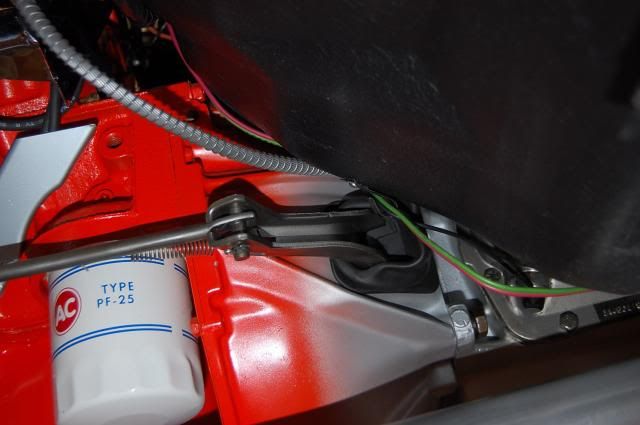
Here's the forward clamp installed.
Even with that much 'kink' in the cable it moves the levers at each end in either direction.
Regards,
Alan
Here's the normal curve in the cable as it travels from the column bracket to the first clamp on the transmission.

Burning Brakes


Joined: Aug 2004
Posts: 802
Likes: 1
Alan,
I understand the cable! What I was saying was that the cable is pushed to lock the column...and that is when the problem happens. Again, cable is NOT designed to push something...it can bend! Try it!
The column lever never has been designed to push or pull...the reverse lever is the one that does the push and pull.
Both ends of the cable are exactly the same, so it can not be backwards. The ends of the cable align perfectly. If you look at the housing beside the reverse lever and the reverse lever, you will see the reverse lever "pin" rotating. When you see any rotation, you will see the end of the cable will raise and lower the elevation. This can be part is the problem.
Also, thanks for the message from Willcox! When I checked the transmission brackets, I noticed the front transmission bracket is missing! So, if the bracket is not there, the rear end of the housing possibly can change the elevation or maybe sideways. That can also be part of the problem. I communicated with Willcox to see it they have the bracket, but I have not received their response.
Thanks again for your thought Alan!!! I will let you know more when I finally fix it!
John
I understand the cable! What I was saying was that the cable is pushed to lock the column...and that is when the problem happens. Again, cable is NOT designed to push something...it can bend! Try it!
The column lever never has been designed to push or pull...the reverse lever is the one that does the push and pull.
Both ends of the cable are exactly the same, so it can not be backwards. The ends of the cable align perfectly. If you look at the housing beside the reverse lever and the reverse lever, you will see the reverse lever "pin" rotating. When you see any rotation, you will see the end of the cable will raise and lower the elevation. This can be part is the problem.
Also, thanks for the message from Willcox! When I checked the transmission brackets, I noticed the front transmission bracket is missing! So, if the bracket is not there, the rear end of the housing possibly can change the elevation or maybe sideways. That can also be part of the problem. I communicated with Willcox to see it they have the bracket, but I have not received their response.
Thanks again for your thought Alan!!! I will let you know more when I finally fix it!
John
Steve L
73 coupe since new
Team Owner
Joined: Sep 2006
Posts: 31,267
Likes: 4,362
From: Westminster Maryland
Hi Steve,
I mentioned about turning the cable if it's installed backwards because I wondered if the fittings swaged to each of it's ends were 'clocked' in a certain position so that if installed backward the inner cable would have a 'twist' in it.
Regards,
Alan
I mentioned about turning the cable if it's installed backwards because I wondered if the fittings swaged to each of it's ends were 'clocked' in a certain position so that if installed backward the inner cable would have a 'twist' in it.
Regards,
Alan
Thread Starter
Racer
Joined: Feb 2007
Posts: 315
Likes: 9
From: Cocoa Beach Florida
When I did more research, I found out the cable is a "replacement" cable (Ecklers #46267) NOT a "reproduction" cable (Ecklers #53310).
That is why I said both ends are the same for the "replacement" cable. Obviously, the reproduction cable has different ends. I see two differences with the transmission end of the two cables...the "housing" female diameter and the shape of the "tip" of the housing.
I am waiting for my reproduction cable and hope to get it Tuesday.
John