


Hydroboost with Borgeson Steering Box

Thread Starter
Instructor

Joined: Jul 2007
Posts: 150
Likes: 0
From: Lewisville Texas
 Hydroboost with Borgeson Steering Box
I recently installed a Borgeson Steering Box. I already had a hydroboost installed and worked fine. I've been trying to bleed the system but can’t seem to get all the air out. Has anyone else had trouble bleeding this combination? Are there any tricks or just keep pumping the breaks and turning the wheels till it all works?

Burning Brakes

Joined: Oct 2008
Posts: 1,037
Likes: 14
From: Mobile Alabama
I jack the front end up and turn the wheels back and forth, and brake. Sometimes it takes a while. Double check the return lines - for sucking air. Sometimes if the reservoir gets all foamy - (I use real GM power steering fluid) you have to wait for it to clear up.


Le Mans Master


Joined: Jul 2000
Posts: 6,001
Likes: 112
From: Saginaw Michigan
You didn't mention if you are trying to get the air out with your engine on or engine off. I recommend performing about two dozen full lock to full lock steering wheel rotations with the front wheels off the ground and the engine off. The rack piston inside the steering gear box will act as a pump and move fluid throughout the system and large air bubbles will migrate up into the pump reservoir and out to atmosphere. After this procedure, go for a short 10 mile drive.
I am not real familiar with the effect of the hydroboost unit in the system. I know that there is an accumulator in the unit. I'm not sure as to how the accumulator gets charged. I assume that it requires the engine to be turned on. But I would think that the amount of air in the accumulator would be minimal.
The problem with trying to get the air out with the engine on is that the pump will whip air and oil into a milky froth and the millions of tiny air bubbles take a long time to work their way out of the system.
I also recommend genuine GM power steering fluid. It has very good anti-foaming properties.
Jim
I am not real familiar with the effect of the hydroboost unit in the system. I know that there is an accumulator in the unit. I'm not sure as to how the accumulator gets charged. I assume that it requires the engine to be turned on. But I would think that the amount of air in the accumulator would be minimal.
The problem with trying to get the air out with the engine on is that the pump will whip air and oil into a milky froth and the millions of tiny air bubbles take a long time to work their way out of the system.
I also recommend genuine GM power steering fluid. It has very good anti-foaming properties.
Jim

Drifting

Joined: Jul 2002
Posts: 1,944
Likes: 20
From: The only Corvettes in Highett Victoria
You didn't mention if you are trying to get the air out with your engine on or engine off. I recommend performing about two dozen full lock to full lock steering wheel rotations with the front wheels off the ground and the engine off. The rack piston inside the steering gear box will act as a pump and move fluid throughout the system and large air bubbles will migrate up into the pump reservoir and out to atmosphere. After this procedure, go for a short 10 mile drive.
I am not real familiar with the effect of the hydroboost unit in the system. I know that there is an accumulator in the unit. I'm not sure as to how the accumulator gets charged. I assume that it requires the engine to be turned on. But I would think that the amount of air in the accumulator would be minimal.
The problem with trying to get the air out with the engine on is that the pump will whip air and oil into a milky froth and the millions of tiny air bubbles take a long time to work their way out of the system.
I also recommend genuine GM power steering fluid. It has very good anti-foaming properties.
Jim
I am not real familiar with the effect of the hydroboost unit in the system. I know that there is an accumulator in the unit. I'm not sure as to how the accumulator gets charged. I assume that it requires the engine to be turned on. But I would think that the amount of air in the accumulator would be minimal.
The problem with trying to get the air out with the engine on is that the pump will whip air and oil into a milky froth and the millions of tiny air bubbles take a long time to work their way out of the system.
I also recommend genuine GM power steering fluid. It has very good anti-foaming properties.
Jim

I have both a Hydroboost and a Borgeson box in my '74 coupe. The most important thing to remember is this: Air is "lighter" than liquid." For bubles in brake fluid, if you can get the front of the car up in the air say, a couple of feet, then let gravity be your friend. With engine off, slowly pump the brakes and the bubbles will rise from the rear wheels to the MC.
For bubbles in the PS Fluid, do you have one or two INLETS to the pump reservoir? I made the mistake of initially putting a return line into the neck of the reservoir. When the PS Fluid returned to the reservoir, it came in ABOVE the fluid level and aerated the PSF in the reservoir. This caused air bubbles to exit the pump and enter both the steering box and HB unit.
If you have two return lines, try to get both of them to enter the pump BELOW the fluid level and this should eliminate your aeration problems. Again, if you can get the front of your car raised so that the pump is higher than the steering box, this will help you, but the HB unit is always higher, so look at the positioning of the return line(s).
If you have only one return line and the HB return line is "teed" into the Borgeson return line, this might be the cause of your aeration, so consider a separate return line direct to the pump reservoir as described abaove and this should cure your woes.
I'm in los Angeles until 11:00 tonight before my flight home, ring me on 1-714-273-1199 if you wish.
Regards from Down Under.

aussiejohn
Le Mans Master
Joined: Jul 2000
Posts: 6,001
Likes: 112
From: Saginaw Michigan
I am afraid that Ausiejohn has simplified the power steering pump reservoir return spout location just a bit too much.
One of the features of correct PS pump reservoir design is that the fluid returning to the pump should not only arrive below the fluid level in the reservoir, it also should arrive away from the intake location designed into the pump housing casting. One feature of correct reservoir design is that returning fluid should arrive into a "calming" area that would allow air bubbles to combine and float to the reservoir fluid surface. The following is a generic Saginaw PS pump reservoir. Note that there are only a couple acceptable locations for the return spout(s).
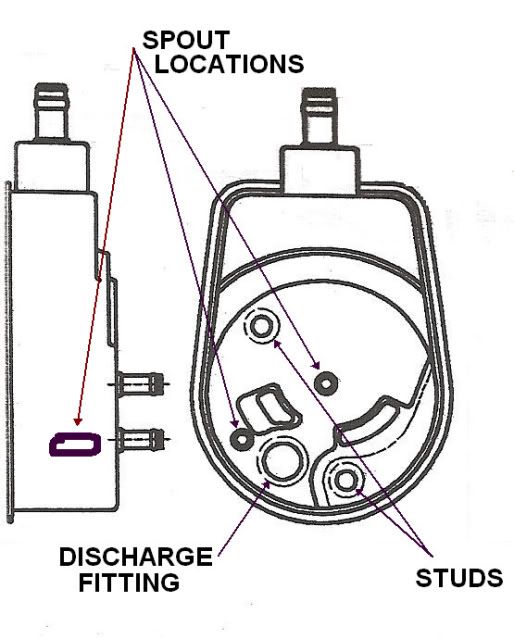
Other locations may result in returning fluid being immediately "sucked" back into the pump intake and not allowing any air bubbles to seperate and float up to the reservoir fluid surface and back to atmosphere.
I am sure that there are aftermarket remote pump reservoirs that do not take into account this needed "calming" effect on returning fluid.
Jim
One of the features of correct PS pump reservoir design is that the fluid returning to the pump should not only arrive below the fluid level in the reservoir, it also should arrive away from the intake location designed into the pump housing casting. One feature of correct reservoir design is that returning fluid should arrive into a "calming" area that would allow air bubbles to combine and float to the reservoir fluid surface. The following is a generic Saginaw PS pump reservoir. Note that there are only a couple acceptable locations for the return spout(s).

Other locations may result in returning fluid being immediately "sucked" back into the pump intake and not allowing any air bubbles to seperate and float up to the reservoir fluid surface and back to atmosphere.
I am sure that there are aftermarket remote pump reservoirs that do not take into account this needed "calming" effect on returning fluid.
Jim
Racer
Joined: May 2012
Posts: 254
Likes: 3
From: Owensboro Kentucky
I am afraid that Ausiejohn has simplified the power steering pump reservoir return spout location just a bit too much.
One of the features of correct PS pump reservoir design is that the fluid returning to the pump should not only arrive below the fluid level in the reservoir, it also should arrive away from the intake location designed into the pump housing casting. One feature of correct reservoir design is that returning fluid should arrive into a "calming" area that would allow air bubbles to combine and float to the reservoir fluid surface. The following is a generic Saginaw PS pump reservoir. Note that there are only a couple acceptable locations for the return spout(s).
http://i2.photobucket.com/albums/y38/JIML82/ReservoirSpoutLocations-1.jpg[/IMG]
Other locations may result in returning fluid being immediately "sucked" back into the pump intake and not allowing any air bubbles to seperate and float up to the reservoir fluid surface and back to atmosphere.
I am sure that there are aftermarket remote pump reservoirs that do not take into account this needed "calming" effect on returning fluid.
Jim
One of the features of correct PS pump reservoir design is that the fluid returning to the pump should not only arrive below the fluid level in the reservoir, it also should arrive away from the intake location designed into the pump housing casting. One feature of correct reservoir design is that returning fluid should arrive into a "calming" area that would allow air bubbles to combine and float to the reservoir fluid surface. The following is a generic Saginaw PS pump reservoir. Note that there are only a couple acceptable locations for the return spout(s).
http://i2.photobucket.com/albums/y38/JIML82/ReservoirSpoutLocations-1.jpg[/IMG]
Other locations may result in returning fluid being immediately "sucked" back into the pump intake and not allowing any air bubbles to seperate and float up to the reservoir fluid surface and back to atmosphere.
I am sure that there are aftermarket remote pump reservoirs that do not take into account this needed "calming" effect on returning fluid.
Jim











