




Problem with caliper replacement

Thread Starter
Pro


Joined: Jan 2001
Posts: 511
Likes: 66
From: Timnath, CO
 Problem with caliper replacement
My first time doing this so I am probably doing something stupid but I am at my wits end. Problem is that after putting new o-ring caliper on right front the brakes are dragging. There is a lot of resistance turning the wheel by hand. On the left side, the wheel is easy to turn, so the problem is limited to the side with the new caliper.
Here's some other observations.
- I went for a short test drive and the rotor got pretty hot
- I opened the bleeder to see if relieving any pressure would help and it did not - wheel still hard to turn.
- I had removed the rotor from the hub briefly. I'm not sure I reinstalled in the same position. Mentioning just in case it is an issue.
I removed the pads again to make sure I did not switch inner/outer and they were correct. Had to open bleeder again to get them out. Had a extremely hard time getting the pistons retracted to get the pads back in, even with the bleeder opened. Even loosened the brake line to relieve pressure on that side to see if that would help and it did not.
- kind of strange but as I tightened the wheel lug nuts the wheel got harder to turn (like it is pressing the rotor harder against the inboard brake pads).
Would appreciate any insights into what is going on. Seems like the caliper pistons just do not want to retract enough to prevent dragging. I am tempted to put the old leaky caliper back on to see if the problem goes away.
Thanks
Here's some other observations.
- I went for a short test drive and the rotor got pretty hot
- I opened the bleeder to see if relieving any pressure would help and it did not - wheel still hard to turn.
- I had removed the rotor from the hub briefly. I'm not sure I reinstalled in the same position. Mentioning just in case it is an issue.
I removed the pads again to make sure I did not switch inner/outer and they were correct. Had to open bleeder again to get them out. Had a extremely hard time getting the pistons retracted to get the pads back in, even with the bleeder opened. Even loosened the brake line to relieve pressure on that side to see if that would help and it did not.
- kind of strange but as I tightened the wheel lug nuts the wheel got harder to turn (like it is pressing the rotor harder against the inboard brake pads).
Would appreciate any insights into what is going on. Seems like the caliper pistons just do not want to retract enough to prevent dragging. I am tempted to put the old leaky caliper back on to see if the problem goes away.
Thanks

Safety Car


Joined: Dec 2012
Posts: 3,801
Likes: 1,712
From: Summerville SC
Are any of the pistons stuck? With no pads in the caliper see if they are all in the same position.Maybe in moving things back and forth one of them got cocked. Usually when things get really hot it's because a pad is dragging. Let us know what you find.
Thread Starter
Pro
Joined: Jan 2001
Posts: 511
Likes: 66
From: Timnath, CO
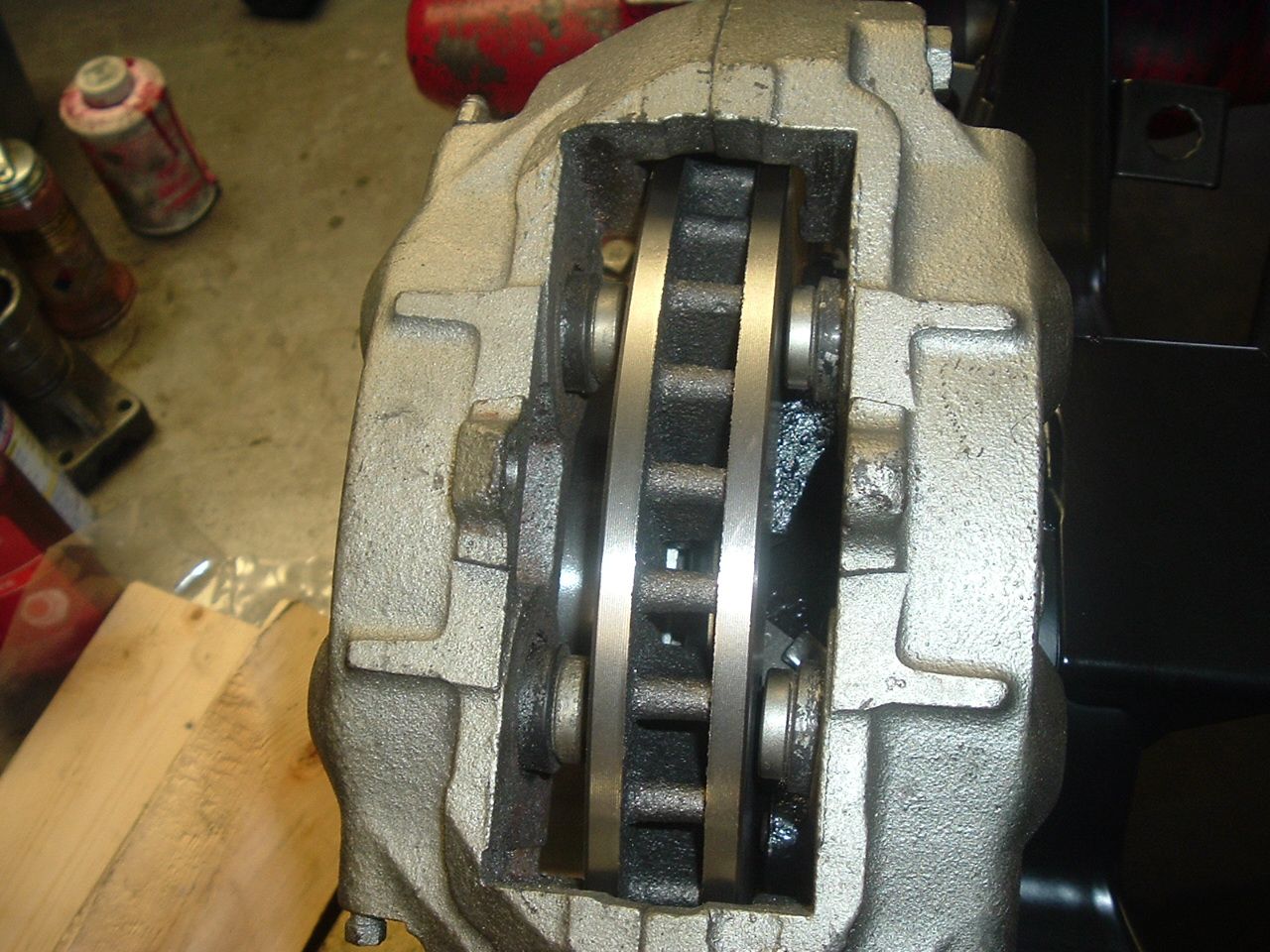
So I don't think the pistons are stuck.
Le Mans Master


Joined: May 2003
Posts: 8,876
Likes: 3,556
From: Fernandina Beach FL
2023 Restomod of the Year finalist
2020 C3 of the Year Winner - Modified
My first time doing this so I am probably doing something stupid but I am at my wits end. Problem is that after putting new o-ring caliper on right front the brakes are dragging. There is a lot of resistance turning the wheel by hand. On the left side, the wheel is easy to turn, so the problem is limited to the side with the new caliper.
Here's some other observations.
- I went for a short test drive and the rotor got pretty hot
- I opened the bleeder to see if relieving any pressure would help and it did not - wheel still hard to turn.
- I had removed the rotor from the hub briefly. I'm not sure I reinstalled in the same position. Mentioning just in case it is an issue.
I removed the pads again to make sure I did not switch inner/outer and they were correct. Had to open bleeder again to get them out. Had a extremely hard time getting the pistons retracted to get the pads back in, even with the bleeder opened. Even loosened the brake line to relieve pressure on that side to see if that would help and it did not.
- kind of strange but as I tightened the wheel lug nuts the wheel got harder to turn (like it is pressing the rotor harder against the inboard brake pads).
Would appreciate any insights into what is going on. Seems like the caliper pistons just do not want to retract enough to prevent dragging. I am tempted to put the old leaky caliper back on to see if the problem goes away.
Thanks
Here's some other observations.
- I went for a short test drive and the rotor got pretty hot
- I opened the bleeder to see if relieving any pressure would help and it did not - wheel still hard to turn.
- I had removed the rotor from the hub briefly. I'm not sure I reinstalled in the same position. Mentioning just in case it is an issue.
I removed the pads again to make sure I did not switch inner/outer and they were correct. Had to open bleeder again to get them out. Had a extremely hard time getting the pistons retracted to get the pads back in, even with the bleeder opened. Even loosened the brake line to relieve pressure on that side to see if that would help and it did not.
- kind of strange but as I tightened the wheel lug nuts the wheel got harder to turn (like it is pressing the rotor harder against the inboard brake pads).
Would appreciate any insights into what is going on. Seems like the caliper pistons just do not want to retract enough to prevent dragging. I am tempted to put the old leaky caliper back on to see if the problem goes away.
Thanks
I'm going to guess that the rotor is NOT seated correctly-or the brake caliper mount is bent.
Pull out the pads and see if the rotor is centered AND parallel in the caliper. If not- that's were to start looking for your problem.
Let us know what you find-
Richard

Race Director

Joined: Dec 1999
Posts: 19,610
Likes: 778
From: Forked River NJ
I have done so many of these I forgot what the answer was on a similar problem. As I recall someone had ground the mounting tab some and it was not picked up by the rebuilder. I eventually sent the caliper back and they confirmed it was a bad caliper.
Now remove the pads and measure with a caliper from the housing to the rotor in at least the 4 corners. I do various locations. They should all be similar. If not you have the caliper "cocked" or the mounting bracket is bent or the caliper has been ground or screwed up. You have to make sure the caliper is "square" to the rotor.
Richard beat me to it
Now remove the pads and measure with a caliper from the housing to the rotor in at least the 4 corners. I do various locations. They should all be similar. If not you have the caliper "cocked" or the mounting bracket is bent or the caliper has been ground or screwed up. You have to make sure the caliper is "square" to the rotor.
Richard beat me to it
Safety Car
Joined: Dec 2012
Posts: 3,801
Likes: 1,712
From: Summerville SC
Might be a good idea putting the old one back in. If you didn't have the problem before, then it would be the new caliper. Or, you might find something that you overlooked putting the new caliper in by repeating the process ( like the rotor isn't on straight). Sometimes you can't see the simple obvious things.
Melting Slicks

Joined: Mar 2005
Posts: 2,094
Likes: 298
From: Midlothian VA
When I take the pads out, the pistons move in various positions. If I push one piston back in, the other moves out. If I push both pistons on one side back in, the ones on the other side move out. That is why it was so hard to get the pads back in - the pistons do not stay put. I tried using screwdrivers and a wooden block to keep the pistons retracted, but it was not easy. I had to use a rubber mallet to tap the pads in the rest of the way after I got them started.
So I don't think the pistons are stuck.
So I don't think the pistons are stuck.
Get yourself a 6" wide flat putty/drywall joint knife.
Better if the blade depth over 5" - 6" optimal.
Use this to install the pads.
Simply put the pad against the putty knife near the handle.
Then insert the knife blade against the two pistons and pull/push them into the caliper. When the pistons are retracted enough simply push the knife+pad between the pistons and rotor. Pull out the knife and do the other side the same way. WAY easier.
Go here - about half way down this thread he shows how this looks/works.
Last edited by Hammerhead Fred; Nov 14, 2014 at 08:29 PM.
Corvette Stories
The Best of Corvette for Corvette Enthusiasts

Top 10 Most Explosive Corvettes Ever Made: Power-to-Weight Ratio Ranked!
Joe Kucinski
150 hp to 1,250 hp: Every Corvette Generation Compared by the Specs That Matter
Joe Kucinski
8 Coolest Corvette Pace Cars (and Replicas) of All Time
Verdad Gallardo
Top 10 Corvette Engines RANKED by Peak Torque (70+ Years of Muscle!)
Joe Kucinski
Corvette ZR1X Will Be Pacing the Indy 500, And Could Probably Race, Too!
Verdad Gallardo
Top 10 Corvettes Coming to Mecum Indy 2026!
Brett Foote
Top 10 C9 Corvette MUST-HAVES to Fix These C8 Generation Flaws!
Michael S. Palmer
10 Revolutionary 'Corvette Firsts' Most People Don't Know
Joe Kucinski
5 Reasons to Upgrade to an LS6-Powered Corvette; 5 Reasons to Stay LT2
Michael S. Palmer
Safety Car
Joined: Dec 2012
Posts: 3,801
Likes: 1,712
From: Summerville SC
https://www.corvetteforum.com/forums...ies/iagree.gif
Do what Hammerhead said and maybe open up the bleeder to let the pressure out as you are pushing the pistons back in.
Do what Hammerhead said and maybe open up the bleeder to let the pressure out as you are pushing the pistons back in.

Le Mans Master

Joined: Aug 2005
Posts: 6,529
Likes: 1,962
From: Temple Terrace Florida
Rubber brake line
Check your rubber brake line. Although the line may look OK, they can get clogged from the inside and trap fluid in the caliper which can keep pressure on the pads. This a common problem with old lines. Jerry

Race Director
Joined: Jul 2001
Posts: 15,892
Likes: 42
- I opened the bleeder to see if relieving any pressure would help and it did not - wheel still hard to turn.
...........
Had a extremely hard time getting the pistons retracted to get the pads back in, even with the bleeder opened. Even loosened the brake line to relieve pressure on that side to see if that would help and it did not.
...........
Had a extremely hard time getting the pistons retracted to get the pads back in, even with the bleeder opened. Even loosened the brake line to relieve pressure on that side to see if that would help and it did not.
Melting Slicks


Joined: Apr 2005
Posts: 2,777
Likes: 105
If you have a original design lip seal caliper on one side and an O Ring seal type caliper on the other side your problem may occur.
The O Ring caliper's pistons do not move back and forth as easily as the lip seals did, they are in there pretty snug and don't retract easily. (Especially when they are just installed) They put more pressure initially on the rotor.
The pistons with the lip seals ride loosely in the caliper bores. The O Ring ones don't.
In my experience you have to drive for a awhile for everything to break in and settle.
IMO, put a O Ring seal caliper on the other side (Left) and drive the car for a while. It won't pull with O Ring Calipers on both sides. The are designed to run in pairs, not separately. Give it a shot......
Additional thought - Since you say you removed the rotor, If your rotor rivets were already removed from the hub and all you did is simply pull the rotor off the hub then all you do is make sure the rotor is sitting back flush on the hub and then put the wheel back on and tighten the lug nuts.
I rebuilt my existing calipers and replaced all of my caliper Lip seals with O Ring Seals years ago and remember that the wheels were actually a bit harder to turn after I replaced them before driving the car. Additionally I had to replace the pistons as well (included with the O ring caliper rebuild kits). And yes the rotors did get very hot initially until everything "Settled" in. To date they are working perfectly; no leaks, no pulling and the car stops on a dime!.......
The O Ring caliper's pistons do not move back and forth as easily as the lip seals did, they are in there pretty snug and don't retract easily. (Especially when they are just installed) They put more pressure initially on the rotor.
The pistons with the lip seals ride loosely in the caliper bores. The O Ring ones don't.
In my experience you have to drive for a awhile for everything to break in and settle.
IMO, put a O Ring seal caliper on the other side (Left) and drive the car for a while. It won't pull with O Ring Calipers on both sides. The are designed to run in pairs, not separately. Give it a shot......
Additional thought - Since you say you removed the rotor, If your rotor rivets were already removed from the hub and all you did is simply pull the rotor off the hub then all you do is make sure the rotor is sitting back flush on the hub and then put the wheel back on and tighten the lug nuts.
I rebuilt my existing calipers and replaced all of my caliper Lip seals with O Ring Seals years ago and remember that the wheels were actually a bit harder to turn after I replaced them before driving the car. Additionally I had to replace the pistons as well (included with the O ring caliper rebuild kits). And yes the rotors did get very hot initially until everything "Settled" in. To date they are working perfectly; no leaks, no pulling and the car stops on a dime!.......
Last edited by babbah; Nov 16, 2014 at 03:58 PM.
Thread Starter
Pro
Joined: Jan 2001
Posts: 511
Likes: 66
From: Timnath, CO
If you have a original design lip seal caliper on one side and an O Ring seal type caliper on the other side your problem may occur.
The O Ring caliper's pistons do not move back and forth as easily as the lip seals did, they are in there pretty snug and don't retract easily. (Especially when they are just installed) They put more pressure on the rotor.
The lip seal types ride loosely in the caliper bores. The O Ring ones don't.
In my experience you have to drive for a awhile for everything to break in and settle.
IMO, put a O Ring seal caliper on the other side (Left) and drive the car for a while. It won't pull with O Ring Calipers on both sides. The are designed to run in pairs, not separately. Give it a shot......
Additional thought - Since you say you removed the rotor, If your rotor rivets were already removed from the hub and all you did is simply pull the rotor off the hub then all you do is make sure the rotor is sitting back flush on the hub and then put the wheel back on and tighten the lug nuts.
I replaced ALL of my caliper seals with O Ring Seals years ago and remember that the wheels were actually a bit harder to turn after I replaced them before driving the car. And yes the rotors did get very hot initially until everything "Settled" in. To date they are working perfectly; no leaks, no pulling and the car stops on a dime!.......
The O Ring caliper's pistons do not move back and forth as easily as the lip seals did, they are in there pretty snug and don't retract easily. (Especially when they are just installed) They put more pressure on the rotor.
The lip seal types ride loosely in the caliper bores. The O Ring ones don't.
In my experience you have to drive for a awhile for everything to break in and settle.
IMO, put a O Ring seal caliper on the other side (Left) and drive the car for a while. It won't pull with O Ring Calipers on both sides. The are designed to run in pairs, not separately. Give it a shot......
Additional thought - Since you say you removed the rotor, If your rotor rivets were already removed from the hub and all you did is simply pull the rotor off the hub then all you do is make sure the rotor is sitting back flush on the hub and then put the wheel back on and tighten the lug nuts.
I replaced ALL of my caliper seals with O Ring Seals years ago and remember that the wheels were actually a bit harder to turn after I replaced them before driving the car. And yes the rotors did get very hot initially until everything "Settled" in. To date they are working perfectly; no leaks, no pulling and the car stops on a dime!.......
So I think babbah may be on to something as I have lip seal on one side and o-ring on the other. Perhaps the thing to do is put the new caliper back on and drive it for a while to see if it settles in / loosens up. Other than the possibility of pulling do you see any harm driving with one of each type caliper for a while?
Thanks again!https://www.corvetteforum.com/forums...s/thumbsup.gif
Melting Slicks
Joined: Apr 2005
Posts: 2,777
Likes: 105
IMO, I would do one of the following to fix your problem:
1. Rebuild the original caliper that was leaking with a lip seal caliper repair kit. Or just purchase another lip seal caliper.
2. Keep the ORing caliper installed and replace the other side with a ORing seal caliper.
Bottom line IMO use the same type calipers in pairs. My 2 cents worth. :-)
Racer


Joined: Oct 2013
Posts: 307
Likes: 94
From: VT
question
i am definiterly missing something this sunday morning.
bob p
Thread Starter
Pro
Joined: Jan 2001
Posts: 511
Likes: 66
From: Timnath, CO
I'll try and drive it and let you guys know what happens. When I did my short test drive it seemed it might be pulling ever so slightly to the o-ring side - perhaps the added heat on that side created some brake fade.

Race Director
Joined: Apr 2009
Posts: 19,294
Likes: 2,753
From: Charlotte NC
The O Ring caliper's pistons do not move back and forth as easily as the lip seals did, they are in there pretty snug and don't retract easily. (Especially when they are just installed) They put more pressure initially on the rotor.
The pistons with the lip seals ride loosely in the caliper bores. The O Ring ones don't.
The pistons with the lip seals ride loosely in the caliper bores. The O Ring ones don't.
 Having the two different designed caliper piston seals in the front is a problem. NOT worth waiting for them to 'free-up'.
Make a choice and get the front caliper seals to be the same design from one side to the other.
I prefer to use the lip sealed design.,.,.and it takes a bit more effort to make sure the bearings/rotor run-out are well within specs.
DUB
Thread Starter
Pro
Joined: Jan 2001
Posts: 511
Likes: 66
From: Timnath, CO
For those that may be interested I am posting how things turned out. I reinstalled the new o-ring caliper (it is getting easier now that I've done this three times). Not sure what I did differently, but the wheel was much easier to turn this time. I've driven the car several times now, and the rotor does not get any hotter than the other wheels. Also, there is no pull when applying the brakes despite having one lip seal and one o-ring in the front (I will replace the other so they match). Many thanks for all your suggestions. The tip about using a putty knife to retract the pistons was particularly helpful.

Burning Brakes

Joined: Oct 2001
Posts: 911
Likes: 5
From: TN
1968
Only time I have had a problem with a brake caliper not releasing was because of the rubber hose connecting to the brake caliper. The right front brake was smoking and got me attention, easy fix. The brake hose had collapsed on the inside preventing the bake fluid pressure from releasing from the caliper.