




Performer air gap vs performer
Thread Starter
Drifting


Joined: Jun 2006
Posts: 1,912
Likes: 12
From: Schaumburg (Chicago) Illinois
 Performer air gap vs performer
Thinking about changing out my stock intake on my 383 to a performer air gap or the regular performer from Edlebrock. I am going to also be using a Holley carb.
Questions:
Is there really that much gain in performance with the air gap?
If I use a air gap can I use the stock SB hood and one of those low height air cleaners? If so which one have you used to accomplish the task?
I have a LT-1 hood that I can put in. How much can I get from that?
Thanks in advance for any help.
Questions:
Is there really that much gain in performance with the air gap?
If I use a air gap can I use the stock SB hood and one of those low height air cleaners? If so which one have you used to accomplish the task?
I have a LT-1 hood that I can put in. How much can I get from that?
Thanks in advance for any help.
Le Mans Master


Joined: Mar 2005
Posts: 6,776
Likes: 2
From: Troutman NC
Thinking about changing out my stock intake on my 383 to a performer air gap or the regular performer from Edlebrock. I am going to also be using a Holley carb.
Questions:
Is there really that much gain in performance with the air gap?
If I use a air gap can I use the stock SB hood and one of those low height air cleaners? If so which one have you used to accomplish the task?
I have a LT-1 hood that I can put in. How much can I get from that?
Thanks in advance for any help.
Questions:
Is there really that much gain in performance with the air gap?
If I use a air gap can I use the stock SB hood and one of those low height air cleaners? If so which one have you used to accomplish the task?
I have a LT-1 hood that I can put in. How much can I get from that?
Thanks in advance for any help.
Drifting


Joined: Jul 2004
Posts: 1,695
Likes: 65
From: Kissimmee fl
Finalist 2021 C3 of the Year - Modified
2017 C3 of Year Finalist
Cruise-In VIII Veteran
St. Jude Donor '07
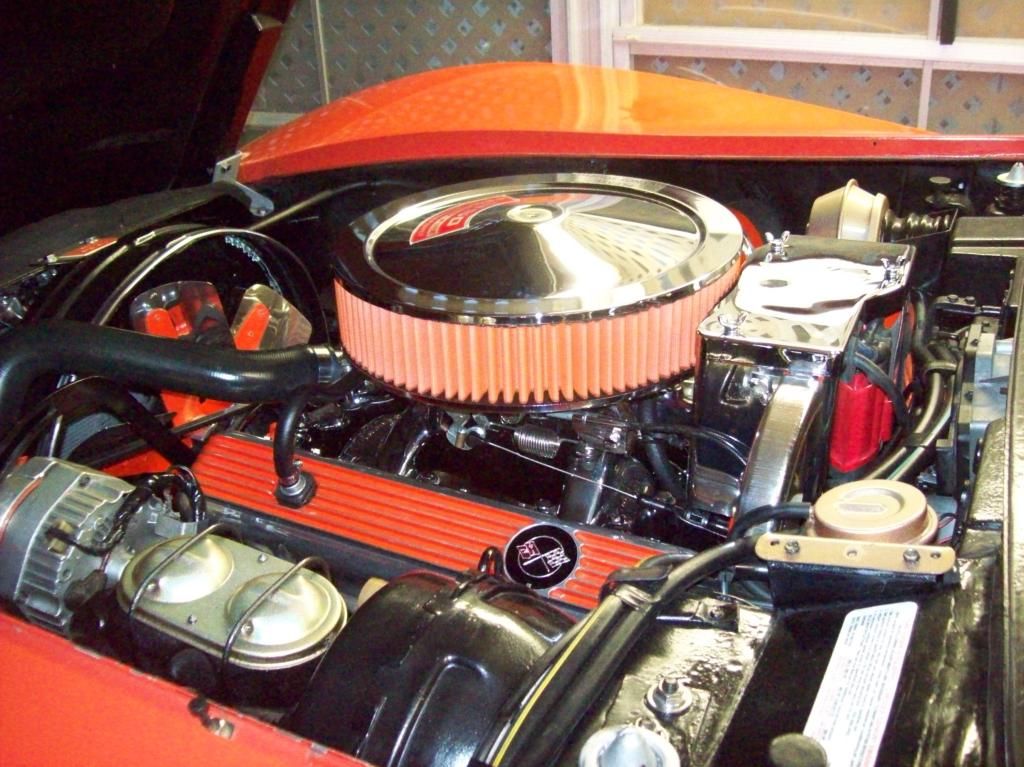
I run a performer air gap on my 69 SB with Q-jet, LT-1 hood and stock 3" filter with a stock air cleaner base and aftermarket chrome cover. I also run a flat hold down screw, not a wing nut.
Before this motor went in I ran a performer RPM with Edelbrock carb and aftermarket drop base air cleaner with 2 1/2" high filter and flat hold down bolt. This was also under the LT-1 hood and it did not touch.
Be really careful when making intake changes and using a stud in the carb. for holding the air cleaner on. You do not want that hole in the middle of the hood. I use lightly balled up wads of aluminum foil for checking clearances when making changes.
Before this motor went in I ran a performer RPM with Edelbrock carb and aftermarket drop base air cleaner with 2 1/2" high filter and flat hold down bolt. This was also under the LT-1 hood and it did not touch.
Be really careful when making intake changes and using a stud in the carb. for holding the air cleaner on. You do not want that hole in the middle of the hood. I use lightly balled up wads of aluminum foil for checking clearances when making changes.

Last edited by c69vete; Dec 8, 2014 at 08:51 AM.
Le Mans Master
Joined: Mar 2005
Posts: 6,776
Likes: 2
From: Troutman NC
I run a performer air gap on my 69 SB with Q-jet, LT-1 hood and stock 3" filter with a stock air cleaner base and aftermarket chrome cover. I also run a flat hold down screw, not a wing nut.
Before this motor went in I ran a performer RPM with Edelbrock carb and aftermarket drop base air cleaner with 2 1/2" high filter and flat hold down bolt. This was also under the LT-1 hood and it did not touch.
Be really careful when making intake changes and using a stud in the carb. for holding the air cleaner on. You do not want that hole in the middle of the hood. I use lightly balled up wads of aluminum foil for checking clearances when making changes.
Before this motor went in I ran a performer RPM with Edelbrock carb and aftermarket drop base air cleaner with 2 1/2" high filter and flat hold down bolt. This was also under the LT-1 hood and it did not touch.
Be really careful when making intake changes and using a stud in the carb. for holding the air cleaner on. You do not want that hole in the middle of the hood. I use lightly balled up wads of aluminum foil for checking clearances when making changes.

Pro


Joined: Oct 2009
Posts: 664
Likes: 89
From: Marysville Ohio
Are you looking at the Air gap vs Performer or the RPM Perfornmer? - - What is the intake part number? There is a difference between the Performer and the RPM version. Depending on the engine specifics and the specific intake, you may not get a lot more out of an RPM Performer vs an Air Gap.
Air Gap vs a regular (base-model) Performer should be a pretty noticable difference. RPM vs Air Gap, less so.
On my 383, I actually preferred the 7104 RPM intake over my Air Gap - only because it had a littel more torque down low, and still let the motor breathe well enough - but it was not a huge difference. The Air Gap was a little better at higher revs. Overall, both worked well with the 383 and AFR heads, but I tend to prefer torque over revs.
My results also had a lot to do with my overall build, so have to consider that factor in your situation.
The base model Performer would have been a little too resrictive IMO.
Air Gap vs a regular (base-model) Performer should be a pretty noticable difference. RPM vs Air Gap, less so.
On my 383, I actually preferred the 7104 RPM intake over my Air Gap - only because it had a littel more torque down low, and still let the motor breathe well enough - but it was not a huge difference. The Air Gap was a little better at higher revs. Overall, both worked well with the 383 and AFR heads, but I tend to prefer torque over revs.
My results also had a lot to do with my overall build, so have to consider that factor in your situation.
The base model Performer would have been a little too resrictive IMO.
Race Director

Joined: Mar 2003
Posts: 11,608
Likes: 780
From: Eustis ( Area 51 Bat Cave ) Fl
According the manufacture the Base performer be it low or air gap is good for idle to 5500.
Then they rate the RPM models low or air gap at 1500-6500
The RPM models have a bit larger runners and plenum and the divider is cut or notched a little, this equals a bit of ectra RPM HP at the cost on low end torque.
In general the intake needs to match the rest of your build when choosing base or RPM model,
383's are popular and are built many different ways some are for high rpm torque like the one I had and didn't like others are built to be stump pullers, and other builds in between,
If you are running a stock cast iron GM intake then either base or RPM will be better,
If you have stock heads and cam or small cam then in most cases I would still go with the base model, however, if you like revving your engine over the low end move ya out torque then the RPM is the one for you...nicer if you have a stick.
In almost any situation the cooler air into the carb from the air gap is better but some cars/hoods just can't go that way, as far as can you "feel" it in the seat of your pants over the low model I would be rather skeptical, the place it would show is in 10th's of seconds on 1/4 mile time slips, or perhaps a mindset, wow my car runs better now...
Example, my 454 had an open plenum intake ironally called a "torker" ironic because it hurt the torque, my engine liked the base Performer far better, and if I saw one cheap I would grab the air gap, and if it was the RPM model I wouldn't worry it wouldn't hurt me like that full open plenum did.
On a 68-72 hood I would have to wonder if the BB / LT-1 will add any extra room, the small block hood might actually be a hair taller where you need it,
Good excuse to score an L-88 hood.
Then they rate the RPM models low or air gap at 1500-6500
The RPM models have a bit larger runners and plenum and the divider is cut or notched a little, this equals a bit of ectra RPM HP at the cost on low end torque.
In general the intake needs to match the rest of your build when choosing base or RPM model,
383's are popular and are built many different ways some are for high rpm torque like the one I had and didn't like others are built to be stump pullers, and other builds in between,
If you are running a stock cast iron GM intake then either base or RPM will be better,
If you have stock heads and cam or small cam then in most cases I would still go with the base model, however, if you like revving your engine over the low end move ya out torque then the RPM is the one for you...nicer if you have a stick.
In almost any situation the cooler air into the carb from the air gap is better but some cars/hoods just can't go that way, as far as can you "feel" it in the seat of your pants over the low model I would be rather skeptical, the place it would show is in 10th's of seconds on 1/4 mile time slips, or perhaps a mindset, wow my car runs better now...
Example, my 454 had an open plenum intake ironally called a "torker" ironic because it hurt the torque, my engine liked the base Performer far better, and if I saw one cheap I would grab the air gap, and if it was the RPM model I wouldn't worry it wouldn't hurt me like that full open plenum did.
On a 68-72 hood I would have to wonder if the BB / LT-1 will add any extra room, the small block hood might actually be a hair taller where you need it,
Good excuse to score an L-88 hood.

Le Mans Master
Joined: Aug 2008
Posts: 5,578
Likes: 61
From: Austin TX
Corvette Stories
The Best of Corvette for Corvette Enthusiasts

Top 10 Most Expensive Corvettes Ever Sold on Bring A Trailer
Brett Foote
10 Things Every Corvette Owner Needs (2026 Edition)
Michael S. Palmer
8 Most "Only Corvette Owners Understand" Quirks and Problems
Pouria Savadkouei
10 Reasons the C6 Z06 is Still A Performance Benchmark After 20 Years
Joe Kucinski
How Much Horsepower Every Corvette Engine "LOST" in 1972
Joe Kucinski
Top 10 DOs and DON'Ts for Protecting Your Convertible Top!
Michael S. Palmer
Top 10 Most Explosive Corvettes Ever Made: Power-to-Weight Ratio Ranked!
Joe Kucinski
150 hp to 1,250 hp: Every Corvette Generation Compared by the Specs That Matter
Joe Kucinski
8 Coolest Corvette Pace Cars (and Replicas) of All Time
Verdad Gallardo
Race Director
Joined: Mar 2003
Posts: 11,608
Likes: 780
From: Eustis ( Area 51 Bat Cave ) Fl
But do you believe the taller air gap would?
Is the rpm version taller than the base performer?
I have at the moment a base performer and edelbrock carb it wouldn't fit under a 73 hood,
I am really not so into the dropped air cleaners, if dropped too much they are restrictive,
I am running a big scoop so it's moot for me just trying to help the OP and others,
Is the rpm version taller than the base performer?
I have at the moment a base performer and edelbrock carb it wouldn't fit under a 73 hood,
I am really not so into the dropped air cleaners, if dropped too much they are restrictive,
I am running a big scoop so it's moot for me just trying to help the OP and others,
Last edited by The13Bats; Dec 8, 2014 at 06:34 PM.
Le Mans Master
Joined: Aug 2008
Posts: 5,578
Likes: 61
From: Austin TX
But do you believe the taller air gap would?
Is the rpm version taller than the base performer?
I have at the moment a base performer and edelbrock carb it wouldn't fit under a 73 hood,
I am really not so into the dropped air cleaners, if dropped too much they are restrictive,
I am running a big scoop so it's moot for me just trying to help the OP and others,
Is the rpm version taller than the base performer?
I have at the moment a base performer and edelbrock carb it wouldn't fit under a 73 hood,
I am really not so into the dropped air cleaners, if dropped too much they are restrictive,
I am running a big scoop so it's moot for me just trying to help the OP and others,
Interesting that the base Performer won't fit under your hood. I assume you have the standard flat hood?
Race Director
Joined: Mar 2003
Posts: 11,608
Likes: 780
From: Eustis ( Area 51 Bat Cave ) Fl
On your drop base how much room is between the carb top air inlet area and the air cleaner cover...
No hurry at all but would love pictures or links to the type air cleaner it is...
Drifting
Joined: Jul 2004
Posts: 1,695
Likes: 65
From: Kissimmee fl
Finalist 2021 C3 of the Year - Modified
2017 C3 of Year Finalist
Cruise-In VIII Veteran
St. Jude Donor '07
I have read many times that guys use clay or Play dough for checking clearances.
With no kids around I do not have a need to keep either sitting around. The foil also leaves nothing behind to clean up, and its always around and never dries up.
With no kids around I do not have a need to keep either sitting around. The foil also leaves nothing behind to clean up, and its always around and never dries up.
Le Mans Master
Joined: Mar 2005
Posts: 6,776
Likes: 2
From: Troutman NC
My kids are all grown up, Ive had the same package of Clay for 15-20 years The clay works well for checking piston to valve clearance among other things and it stays where you put it, to each his own but don't knock it till you try it
Thread Starter
Drifting
Joined: Jun 2006
Posts: 1,912
Likes: 12
From: Schaumburg (Chicago) Illinois
Are you looking at the Air gap vs Performer or the RPM Perfornmer? - - What is the intake part number? There is a difference between the Performer and the RPM version. Depending on the engine specifics and the specific intake, you may not get a lot more out of an RPM Performer vs an Air Gap.
Air Gap vs a regular (base-model) Performer should be a pretty noticable difference. RPM vs Air Gap, less so.
On my 383, I actually preferred the 7104 RPM intake over my Air Gap - only because it had a littel more torque down low, and still let the motor breathe well enough - but it was not a huge difference. The Air Gap was a little better at higher revs. Overall, both worked well with the 383 and AFR heads, but I tend to prefer torque over revs.
My results also had a lot to do with my overall build, so have to consider that factor in your situation.
The base model Performer would have been a little too resrictive IMO.
Air Gap vs a regular (base-model) Performer should be a pretty noticable difference. RPM vs Air Gap, less so.
On my 383, I actually preferred the 7104 RPM intake over my Air Gap - only because it had a littel more torque down low, and still let the motor breathe well enough - but it was not a huge difference. The Air Gap was a little better at higher revs. Overall, both worked well with the 383 and AFR heads, but I tend to prefer torque over revs.
My results also had a lot to do with my overall build, so have to consider that factor in your situation.
The base model Performer would have been a little too resrictive IMO.
Thread Starter
Drifting
Joined: Jun 2006
Posts: 1,912
Likes: 12
From: Schaumburg (Chicago) Illinois
Are you looking at the Air gap vs Performer or the RPM Perfornmer? - - What is the intake part number? There is a difference between the Performer and the RPM version. Depending on the engine specifics and the specific intake, you may not get a lot more out of an RPM Performer vs an Air Gap.
Air Gap vs a regular (base-model) Performer should be a pretty noticable difference. RPM vs Air Gap, less so.
On my 383, I actually preferred the 7104 RPM intake over my Air Gap - only because it had a littel more torque down low, and still let the motor breathe well enough - but it was not a huge difference. The Air Gap was a little better at higher revs. Overall, both worked well with the 383 and AFR heads, but I tend to prefer torque over revs.
My results also had a lot to do with my overall build, so have to consider that factor in your situation.
The base model Performer would have been a little too resrictive IMO.
Air Gap vs a regular (base-model) Performer should be a pretty noticable difference. RPM vs Air Gap, less so.
On my 383, I actually preferred the 7104 RPM intake over my Air Gap - only because it had a littel more torque down low, and still let the motor breathe well enough - but it was not a huge difference. The Air Gap was a little better at higher revs. Overall, both worked well with the 383 and AFR heads, but I tend to prefer torque over revs.
My results also had a lot to do with my overall build, so have to consider that factor in your situation.
The base model Performer would have been a little too resrictive IMO.
Pro
Joined: Oct 2009
Posts: 664
Likes: 89
From: Marysville Ohio
My 383 has:
AFR 195 heads (street version)
Edelbrock 7105 RPM intake
Scat rotator/KB pistons
Zero decked factory block
XR270HR Comp cam
2400-2600 stall
700r4 transmission
With this combo, I have run both 3:55 gears and 3:73 - not a huge difference between them just a little more agressive with the 3:73.
I also ran the Edelbrock RPM Air Gap for a while, that is where my observations above come from.
I think if you are never going to see 5500 RPM, the base model performer will probably work for you. I am not sure you will see any significant difference in perfromance between the base model ad your stock intake though.
I did fit both RPM intakes under the my hood with a drop-base air cleaner.
AFR 195 heads (street version)
Edelbrock 7105 RPM intake
Scat rotator/KB pistons
Zero decked factory block
XR270HR Comp cam
2400-2600 stall
700r4 transmission
With this combo, I have run both 3:55 gears and 3:73 - not a huge difference between them just a little more agressive with the 3:73.
I also ran the Edelbrock RPM Air Gap for a while, that is where my observations above come from.
I think if you are never going to see 5500 RPM, the base model performer will probably work for you. I am not sure you will see any significant difference in perfromance between the base model ad your stock intake though.
I did fit both RPM intakes under the my hood with a drop-base air cleaner.

Team Owner


Joined: Apr 1999
Posts: 21,953
Likes: 1,445
From: Reno Nevada
2024 C3 of the Year Finalist- Modified
imo... the Air Gap intakes are more marketing over actually decreasing carb/intake air temps. You can also verify this using high quality temp guns on a up to temp running motor.
A half inch wood four hole spacer is the best way to thermaly isolate your carb from manifold heat.
A half inch wood four hole spacer is the best way to thermaly isolate your carb from manifold heat.
Le Mans Master
Joined: Aug 2008
Posts: 5,578
Likes: 61
From: Austin TX
imo... the Air Gap intakes are more marketing over actually decreasing carb/intake air temps. You can also verify this using high quality temp guns on a up to temp running motor.
A half inch wood four hole spacer is the best way to thermaly isolate your carb from manifold heat.
A half inch wood four hole spacer is the best way to thermaly isolate your carb from manifold heat.
The air gap manifold has the advantage of not having hot oil splash the bottom of the plenum. Unless you can get a temp gun underneath the manifold, you can't really measure a temp difference of the plenum floor.
As with everything, it's all incremental. H-pipes, X-pipes, Air Gap manifolds.. they all add up and the car will run better.

Le Mans Master
Joined: May 2002
Posts: 5,086
Likes: 786
From: Lebanon Township New Jersey
At one point in my car's evolutuion I changed from a Performer (not RPM) to an RPM air gap. The performance difference shown at track, on time slips, was maybe .05 sec improvement. Nothing you could feel on the street. BTW - the air gap, plus a 3/4 inch adapter with a drop base air cleaner and 3 inch element (barely) fits under the hood of my 77.
Team Owner
Joined: Apr 1999
Posts: 21,953
Likes: 1,445
From: Reno Nevada
2024 C3 of the Year Finalist- Modified
I'm going to have to disagree with this.
The air gap manifold has the advantage of not having hot oil splash the bottom of the plenum. Unless you can get a temp gun underneath the manifold, you can't really measure a temp difference of the plenum floor.
As with everything, it's all incremental. H-pipes, X-pipes, Air Gap manifolds.. they all add up and the car will run better.
The air gap manifold has the advantage of not having hot oil splash the bottom of the plenum. Unless you can get a temp gun underneath the manifold, you can't really measure a temp difference of the plenum floor.
As with everything, it's all incremental. H-pipes, X-pipes, Air Gap manifolds.. they all add up and the car will run better.
Last edited by gkull; Dec 9, 2014 at 12:24 PM. Reason: ff