




Vacuum timing

Advanced

Joined: Sep 2014
Posts: 98
Likes: 0
From: piney flats tn

Yes 69427 is correct. That link only has a guide for idle mixture screw adjustments. It dont have anything anyone could use for actually setting the intitial timing or timing curve. Though i did see a caution not to use max vac reading nothing else as to what to use the vac reading for timing adjustments. What a waste of time. I caution other members to save their efforts and read something else that could be worthwhile.
What a farce.
What a farce.
Use the vacuum gauge with your ignition system as a guide and for further testing using proper equipment.

Thread Starter
Burning Brakes


Joined: Jul 2009
Posts: 1,240
Likes: 294
From: ESCONDIDO CA
2025 C2 of the Year ('63 and '67) Finalist - Unmodified
C2 of Year Finalist (appearance mods) 2019
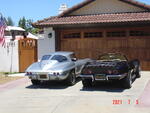
Well certainly as you open the throttle but when I held it steady at 2500 rpm (parked in the driveway) the vacuum settled at 21; at 3000, it settled at 22 or thereabouts. Are these numbers relevant to any vacuum gauge tuners?

Le Mans Master

Joined: Apr 2011
Posts: 6,284
Likes: 1,171
From: Hermosa
If we had timing numbers from a timing light to work with it may be easier to advise on what your timing should be, roughly. Without that information were kind of shooting in the dark.
If it doesn't detonate under WOT on a warmish to hot day then it's likely not too advanced.
If it doesn't run excessively hot on a warmish to hot day then it's likely it's not too retarded.
How is the throttle response? Nice and crisp. Problably good tune. Lazy response, timing might be a bit retarded or carb rich.
Mixture and timing work together. One is not exclusively in charge of the idle, cruise or WOT performance over the other. They have to work in concert to achieve optimum performance.
Short of you tuning the car yourself, I would take the tuner at his word unless you have symptoms of a timing or carb problem.
Yes, your vacuum will increase as you idle up the engine while parked. How high it gets is dependent on various factors, not the least of which is your cam, which won't be changed on a tune and has to be accommodated to match your timing and mixture tune.
I think Cardo is thinking about WOT operation or high load, large throttle deflections when he mentions the vacuum dropping as the throttle blades are opened.

Drifting


Joined: Oct 2008
Posts: 1,901
Likes: 10
From: Woodstock GA
FWIW, you're not the only poster over the years who has made the let it fall statement.
When you set the timing at 36* @WOT & 3000 RPM (or whatever point you choose), you are making a best guess adjustment of the timing where the engine will spend 1% of its time. Your engine (assuming it's not a race engine in a race car at a race track) spends 99% of its time at less than 100% throttle and less than 3000 RPM. Letting the lower load, lower RPM timing fall "where it may" just results in lower fuel mileage, crappier idle quality and drivability, and hotter exhaust valve and coolant temperatures.
Playing with the idle and low RPM timing to get higher/highest manifold vacuum and best drivability will give you the "other side" of your engine's desired timing curve. There's then members on this forum who can refurbish/recurve your distributor to match the total spectrum of your engine's timing requirements.
When you set the timing at 36* @WOT & 3000 RPM (or whatever point you choose), you are making a best guess adjustment of the timing where the engine will spend 1% of its time. Your engine (assuming it's not a race engine in a race car at a race track) spends 99% of its time at less than 100% throttle and less than 3000 RPM. Letting the lower load, lower RPM timing fall "where it may" just results in lower fuel mileage, crappier idle quality and drivability, and hotter exhaust valve and coolant temperatures.
Playing with the idle and low RPM timing to get higher/highest manifold vacuum and best drivability will give you the "other side" of your engine's desired timing curve. There's then members on this forum who can refurbish/recurve your distributor to match the total spectrum of your engine's timing requirements.
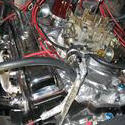
Actually Lars has a Sun machine who has written technical specs on this subject. He is one of the best of the best ! I would reach out to him. He can curve your distributor up to the cam/motor specs if thats what you choose to do. Or ask for one of his papers for secrets...
Le Mans Master

Joined: Oct 2002
Posts: 7,098
Likes: 378
From: Las Vegas - Just stop perpetuating myths please.
Sorry folks but i have a vac gauge mounted right in front of me on my camaro and its calibrated to. Vacuum decreases as the throrrle opens. If your vac increases with rpm and throttle opening your on the wrong port. BTW reving to 3000rpm is not "idling up". U/he must not be on a port on the intake plenum but on one of the carb venturies (ported vac). As flow increases in the venturi yes vac will increase there (thats how the older aircraft get a vac source for vac opereated instruments). The principle is of absolute press becomes lower as fluid velocity in the pipe/venturi increases - static pressure decreases while dynamic pressure increases. Press less than atmospheric is what we call vacuum.
BTW i do understand that links writer is tuning with vac for idle circuit - but nothing for the mid range or WOT. Nothing. If u can find something that that author says then copy and post it. But u wont because it really was a farce to say so in the first place.
BTW i do understand that links writer is tuning with vac for idle circuit - but nothing for the mid range or WOT. Nothing. If u can find something that that author says then copy and post it. But u wont because it really was a farce to say so in the first place.

Pro

Joined: Oct 2009
Posts: 664
Likes: 89
From: Marysville Ohio
My 383 and 406 both idled with about 15 Hg of vacuum (no load) - but at cruise (steady RPM above idle), they could exceed 20 Hg. However, during the act of acceleration, vacuum clearly decreased. So higher (steady) RPMS does not always = lower vacuum. I think the OP is saying this. Sounds like a but of confusion whether the statements above are about higher RPM at cruise vs acceleration?
The total timing curve should take into all-around use (cruising vs WOT, for instance) for best results.
The total timing curve should take into all-around use (cruising vs WOT, for instance) for best results.

Drifting
Joined: Feb 2005
Posts: 1,879
Likes: 38
From: Los Gatos CA
Cruising is a low load (high manifold vacuum) condition. At least that's what I was taught. Vacuum advance compliments this condition because engine rpm is low (offering little mechanical advance).
Le Mans Master
Joined: Apr 2011
Posts: 6,284
Likes: 1,171
From: Hermosa
her good read for vacuum tuning.
http://www.gregsengine.com/using-a-vacuum-gauge.html
Note the section about exhaust restriction if you have decreasing vacuum to 3000 RPM.
Also notice the statement on vacuum indications, reduced initially then rebounds.
So quick or under load throttle defelctions will reduce idle initially then rebound as conditions are eaquilized.
A certain amount of vacuum at idle is associated with a certain idle speed. So if you are ldling at 500 rpm then you're gonna see lower vacuum vs idling at 800 rpm.
Is your idle rpm pretty low?
http://www.gregsengine.com/using-a-vacuum-gauge.html
Note the section about exhaust restriction if you have decreasing vacuum to 3000 RPM.
Exhaust Back Pressure
Starting with the engine at idle, slowly increase engine speed to 3,000 RPM, engine vacuum should be equal to or higher than idle vacuum at 3,000 RPM. If vacuum decreases at higher engine RPM's, an excessive exhaust back pressure is probably present.
Starting with the engine at idle, slowly increase engine speed to 3,000 RPM, engine vacuum should be equal to or higher than idle vacuum at 3,000 RPM. If vacuum decreases at higher engine RPM's, an excessive exhaust back pressure is probably present.
At idling speed, an engine at sea level should show a steady vacuum reading between 17" and 21" HG. A quick opening and closing of the throttle should cause vacuum to drop below 5" then rebound to 21" or more.
A certain amount of vacuum at idle is associated with a certain idle speed. So if you are ldling at 500 rpm then you're gonna see lower vacuum vs idling at 800 rpm.
Is your idle rpm pretty low?
Corvette Stories
The Best of Corvette for Corvette Enthusiasts

Top 10 Most Expensive Corvettes Ever Sold on Bring A Trailer
Brett Foote
10 Things Every Corvette Owner Needs (2026 Edition)
Michael S. Palmer
8 Most "Only Corvette Owners Understand" Quirks and Problems
Pouria Savadkouei
10 Reasons the C6 Z06 is Still A Performance Benchmark After 20 Years
Joe Kucinski
How Much Horsepower Every Corvette Engine "LOST" in 1972
Joe Kucinski
Top 10 DOs and DON'Ts for Protecting Your Convertible Top!
Michael S. Palmer
Top 10 Most Explosive Corvettes Ever Made: Power-to-Weight Ratio Ranked!
Joe Kucinski
150 hp to 1,250 hp: Every Corvette Generation Compared by the Specs That Matter
Joe Kucinski