




Adjusting Hydraulic Lifters

Melting Slicks

Joined: Apr 2009
Posts: 2,632
Likes: 112
From: Great Plains Iowa

Yes, they often have many valves; mostly pneumatic but some have hydraulic valves and many air cylinders. Its common for machines to hit several million dollars because of the extensive use of type 304 stainless steel and "wash down construction".

Melting Slicks


Joined: Mar 2008
Posts: 2,989
Likes: 198
From: Meriden CT
Can you do something about the wrappers on those cheese and cracker packages? Damn near impossible to open without crushing two of the crackers.

Safety Car

Joined: Jan 2009
Posts: 3,736
Likes: 56
From: anchorage ak
Hello all, I finally decided to go after a noisy lifter so I pulled my valve covers and decided to adjust all valves (probably the first mistake). I followed the procedure and set the engine with no. 1 cylinder at TDC and adjusted the valves according the to prescribed order. Finished the other valves by rotating the engine another 360.
After doing that I went back and checked the push rods again and found them loose, so I tightened again. Well I got concerned that I might be over tightening so I loosened everything up a repeated.
This time I went again and closed up the engine and started it and it ran very rough, would hardly idle and I think I'm not building up much vacuum. So I assume to have not adjusted the valves correctly and I'm not building up compression.
Question is do I continue to go back and check the push rods after setting them one time? I going 1/2 turn after it stops rotating.
What's the deal?
After doing that I went back and checked the push rods again and found them loose, so I tightened again. Well I got concerned that I might be over tightening so I loosened everything up a repeated.
This time I went again and closed up the engine and started it and it ran very rough, would hardly idle and I think I'm not building up much vacuum. So I assume to have not adjusted the valves correctly and I'm not building up compression.
Question is do I continue to go back and check the push rods after setting them one time? I going 1/2 turn after it stops rotating.
What's the deal?
Last edited by bluedawg; Jul 31, 2015 at 02:01 PM. Reason: Invasion of the killer robots....

Le Mans Master

Joined: May 2007
Posts: 5,029
Likes: 1,120
From: North tonawanda NY
The first question that comes to my mind when I saw this.. I'm surprised no one asked yet..
Are you using a flat tappet ZDDP additive or equivalent in your engine oil?? If not theres a possibility your wiping your cam lobes...
Are you using a flat tappet ZDDP additive or equivalent in your engine oil?? If not theres a possibility your wiping your cam lobes...
Safety Car
Joined: Jan 2009
Posts: 3,736
Likes: 56
From: anchorage ak
No it crossed my mind as well, I was hoping to lead the op into a ficus soon as to the history and events that lead to the lifter adjusting. In my l48 with the 262h I never ran any additive and the cam looked as good 15k moles later although I'd think that the additive pack would be added insurance.

Thread Starter
Intermediate

Joined: Mar 2014
Posts: 30
Likes: 1
From: Laveen, AZ
I have finally cut open my old valve covers and will try to adjust with the engine running. I will reply once that is done. I have attached a photo of one of the covers, it was easier than I thought cutting with a plasma cutter.
Corvette Stories
The Best of Corvette for Corvette Enthusiasts

Top 10 Most Expensive Corvettes Ever Sold on Bring A Trailer
Brett Foote
10 Things Every Corvette Owner Needs (2026 Edition)
Michael S. Palmer
8 Most "Only Corvette Owners Understand" Quirks and Problems
Pouria Savadkouei
10 Reasons the C6 Z06 is Still A Performance Benchmark After 20 Years
Joe Kucinski
How Much Horsepower Every Corvette Engine "LOST" in 1972
Joe Kucinski
Top 10 DOs and DON'Ts for Protecting Your Convertible Top!
Michael S. Palmer
Top 10 Most Explosive Corvettes Ever Made: Power-to-Weight Ratio Ranked!
Joe Kucinski
150 hp to 1,250 hp: Every Corvette Generation Compared by the Specs That Matter
Joe Kucinski
8 Coolest Corvette Pace Cars (and Replicas) of All Time
Verdad Gallardo
Le Mans Master

Joined: Mar 2001
Posts: 5,738
Likes: 644
From: Lincoln, CA
I'd have to do it with a grinding cutter. Takes a hell of a lot longer


Burning Brakes


Joined: Mar 2014
Posts: 904
Likes: 46
From: Crestline CA
After doing that I went back and checked the push rods again and found them loose, so I tightened again.
the whole object of adjusting hydraulic lifters is to APPROXIMATELY center the plunger in the lifter body
We actually have it easy with Chevys, I spent a while messing with Oldsmobile V8s with non-adjustable valve trains. On those unless the valve stem height is pretty close to stock you have to shim or shave the rocker pedestal and then figure out the correct length pushrod to center the lifter plunger in its travel, royal PITA!
Thread Starter
Intermediate
Joined: Mar 2014
Posts: 30
Likes: 1
From: Laveen, AZ
Ok so I proceeded to adjust the valves with the engine running and that definitely worked well. The engine runs better 
Now for the bad news I noticed that one of my rocker arms had worn into the valve cover bolt guide so I pulled out the pushrod and found it was bent. So I replaced it and reassembled. I tighten down the rocker arm in the correct position and it eventually migrates off center again. Would it help to replace the spring assembly or is the top of the valve stem which means I need to remove the head to replace that valve? Photo of the rocker arm as it moves off center.
Now for the bad news
I noticed that one of my rocker arms had worn into the valve cover bolt guide so I pulled out the pushrod and found it was bent. So I replaced it and reassembled. I tighten down the rocker arm in the correct position and it eventually migrates off center again. Would it help to replace the spring assembly or is the top of the valve stem which means I need to remove the head to replace that valve? Photo of the rocker arm as it moves off center.
Burning Brakes
Joined: Mar 2014
Posts: 904
Likes: 46
From: Crestline CA
Cant really tell from the pics but looks like you have the late style(87-later) heads with the large hole for the pushrod to pass through. If that is the case then youll need self-aligning rockers or guideplates. If you go the guide plate route you'll also need hardened pushrods.

Race Director

Joined: Apr 2007
Posts: 11,152
Likes: 890
From: South Western Ontario
Take a couple of rockers off and look at the valve contact area. A self aligning rocker will look like this. It might be fooling my eyes, but it sure looks like the stamping indents are there to create the alignment bumps. That one might be the wrong one or worn out and needing replacement.
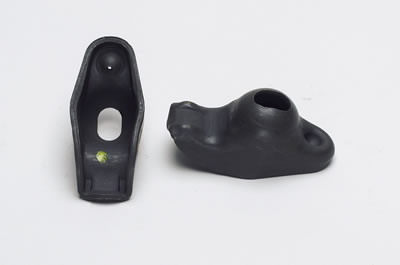
For adjustment. I always just lift up on the valve end of the rocker and then tap on it as I tighten the bolt. The slack is taken out when it quits ticking. But then I pretty much only adjust them once.
For adjustment. I always just lift up on the valve end of the rocker and then tap on it as I tighten the bolt. The slack is taken out when it quits ticking. But then I pretty much only adjust them once.
Melting Slicks
Joined: Apr 2009
Posts: 2,632
Likes: 112
From: Great Plains Iowa
Ok so I proceeded to adjust the valves with the engine running and that definitely worked well. The engine runs better
Now for the bad news I noticed that one of my rocker arms had worn into the valve cover bolt guide so I pulled out the pushrod and found it was bent. So I replaced it and reassembled. I tighten down the rocker arm in the correct position and it eventually migrates off center again. Would it help to replace the spring assembly or is the top of the valve stem which means I need to remove the head to replace that valve? Photo of the rocker arm as it moves off center.
Now for the bad news
I noticed that one of my rocker arms had worn into the valve cover bolt guide so I pulled out the pushrod and found it was bent. So I replaced it and reassembled. I tighten down the rocker arm in the correct position and it eventually migrates off center again. Would it help to replace the spring assembly or is the top of the valve stem which means I need to remove the head to replace that valve? Photo of the rocker arm as it moves off center.Uh oh, the crooked rocker arm is most likely being cause by the tip of the valve stem worn at an angle which would mean the valve guide is severely egg shaped and the valve seat is in need of repairing. I have rebuilt at least 1000 cylinder heads and that is very common among small block Chevrolets and Fords. Its one of the bad traits of stamped steel rocker arms that aren't self aligning.
Thread Starter
Intermediate
Joined: Mar 2014
Posts: 30
Likes: 1
From: Laveen, AZ
Uh oh, the crooked rocker arm is most likely being cause by the tip of the valve stem worn at an angle which would mean the valve guide is severely egg shaped and the valve seat is in need of repairing. I have rebuilt at least 1000 cylinder heads and that is very common among small block Chevrolets and Fords. Its one of the bad traits of stamped steel rocker arms that aren't self aligning.

Melting Slicks

Joined: Jul 2004
Posts: 3,092
Likes: 120
From: orlando florida
St. Jude Donor '15
Hello all, I finally decided to go after a noisy lifter so I pulled my valve covers and decided to adjust all valves (probably the first mistake). I followed the procedure and set the engine with no. 1 cylinder at TDC and adjusted the valves according the to prescribed order. Finished the other valves by rotating the engine another 360.
After doing that I went back and checked the push rods again and found them loose, so I tightened again. Well I got concerned that I might be over tightening so I loosened everything up a repeated.
This time I went again and closed up the engine and started it and it ran very rough, would hardly idle and I think I'm not building up much vacuum. So I assume to have not adjusted the valves correctly and I'm not building up compression.
Question is do I continue to go back and check the push rods after setting them one time? I going 1/2 turn after it stops rotating.
What's the deal?
After doing that I went back and checked the push rods again and found them loose, so I tightened again. Well I got concerned that I might be over tightening so I loosened everything up a repeated.
This time I went again and closed up the engine and started it and it ran very rough, would hardly idle and I think I'm not building up much vacuum. So I assume to have not adjusted the valves correctly and I'm not building up compression.
Question is do I continue to go back and check the push rods after setting them one time? I going 1/2 turn after it stops rotating.
What's the deal?
if the pushrod can't rotate by finger, you have adjusted too far and the valves will be open. what you need to feel is a tiny bit of resistance as you find zero lash. then 1/2 turn.
another way to do this is pull up on the nose of the rocker. once you can no longer lift it up off the pushrod, that should be zero lash.

Drifting

Joined: Mar 2011
Posts: 1,886
Likes: 9
FWIW, I ALWAYS set them while the engine is HOT, as well as running. However, tightening the lash beyond "zero" while the engine is running, can cause the engine to run rough, until the lash "normalizes".
Therefore, I loosen the locknut until the lifter starts to clatter, SLOWLY tighten the nut just until the clatter stops. Then move on to the next valve and do the same thing. After ALL 16 have been set this way, shut the engine off, tighten all of the nuts 1/2 turn, put the valve covers back on, clean up and splashed oil, and call it a day....
Therefore, I loosen the locknut until the lifter starts to clatter, SLOWLY tighten the nut just until the clatter stops. Then move on to the next valve and do the same thing. After ALL 16 have been set this way, shut the engine off, tighten all of the nuts 1/2 turn, put the valve covers back on, clean up and splashed oil, and call it a day....

Race Director
Joined: Apr 2007
Posts: 11,152
Likes: 890
From: South Western Ontario
Ya, if that self aligning bump has been over the stem opening the valve I can imagine the tip would be chewed up. I was thinking maybe some filing and a lash cap could work if you just wanted to try patching it until the fall but it's likely best to just pull the head and fix it before that valve drops.