




Engine Type
Thread Starter
Intermediate

Joined: Aug 2015
Posts: 44
Likes: 0
 Engine Type
I'm trying to figure out what engine in my '79. I found a thread that showed where to find the ID near the front of the passenger side valve cover. I found the spot where I think it should be but it is blank. Are there any pictures that might help. I'll try to get some pictures up soon. It does not appear to be an aluminum intake so I'm guessing L48.
Also, my fixer upper didn't have an air cleaner on it when I got it so I'm planning to put something aftermarket on. Any recommendations?
Thanks,
Rod
Also, my fixer upper didn't have an air cleaner on it when I got it so I'm planning to put something aftermarket on. Any recommendations?
Thanks,
Rod

Pro


Joined: Oct 2009
Posts: 664
Likes: 89
From: Marysville Ohio
You only had 2 choices in 79 - Base L48 or (slightly) higher performance L82. The VIN can tell you. Here is a link to VIN decoder for C3s:
VIN Decoder
This link has basic info on what that means:
VetteFacts
VIN Decoder
This link has basic info on what that means:
VetteFacts
Last edited by cooper9811; Sep 5, 2015 at 07:38 AM.
Drifting


Joined: Oct 2005
Posts: 1,615
Likes: 150
From: Forth Worth TX
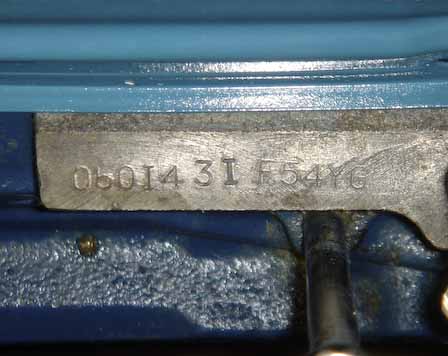
Is your stamp pad blank or just covered with paint?
If your engine stamp pad is covered with paint, take a rag and some lacquer/paint thinner and remove the paint. Don't use anything abrasive on the stamp pad.
This isn't a 1978, but you should see something like this.
If your engine stamp pad is covered with paint, take a rag and some lacquer/paint thinner and remove the paint. Don't use anything abrasive on the stamp pad.
This isn't a 1978, but you should see something like this.
Pro
Joined: Oct 2009
Posts: 664
Likes: 89
From: Marysville Ohio
My 70 was born an L48 too - interesting thing about the base model is that it actually produced more torque than the L82 - implying it was probably a bit quicker off the line in stock form. I read somewhere the 0-60 time was better than the L82 (but both were pretty slow by today's standards).
The other thing about having a base model 79 - It was the most-produced C3. With a relatively low market value (since there are so many of them) they really aren't an "investment" type of car. To me this means they make a great starting point if you want to modify it for better performance.
The other thing about having a base model 79 - It was the most-produced C3. With a relatively low market value (since there are so many of them) they really aren't an "investment" type of car. To me this means they make a great starting point if you want to modify it for better performance.
Le Mans Master

Joined: May 2007
Posts: 5,028
Likes: 1,120
From: North tonawanda NY
I pulled mine and built another engine for my car.... not that an l48 cant make power its just it has little going for it... smaller valve heads, small stock passenger car cam, cast dished pistons, cast crank and 2 bolt main.... you see where im going with this?
The L82 only had like 10 more hp but had the potewntial for way more reliable power for much less upgrade costs.. everything was forged and it had better heads and pistons for making power (although not as ideal for high mileage)
and yes the l48 made better torque at a lower rpm which reacted better with the cars stock gearing... but it also ran out of steam much earlier... it basically felt more powerful from stop light to stoplight than the L82 though.
thats why car and driver picked it over the l82 at the time.
OP whats your cars vin# that will tell you what you should have... its very unlikely an l82 made its way under the hood if it came with an l48 stock... maybe a different (and better) engine though..
Last edited by augiedoggy; Sep 5, 2015 at 09:27 AM.

Melting Slicks


Joined: Sep 2004
Posts: 3,226
Likes: 667
From: Northeast
This is a 78 pad:
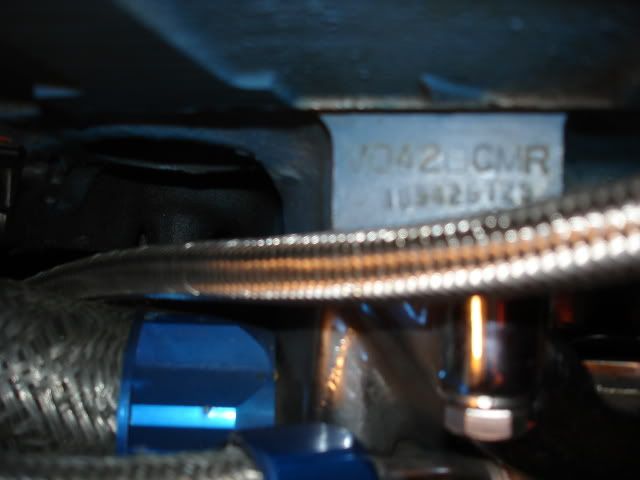
One code left out in the vette facts link is ZAJ= automatic, Calif.
Corvette Stories
The Best of Corvette for Corvette Enthusiasts

Top 10 Most Expensive Corvettes Ever Sold on Bring A Trailer
Brett Foote
10 Things Every Corvette Owner Needs (2026 Edition)
Michael S. Palmer
8 Most "Only Corvette Owners Understand" Quirks and Problems
Pouria Savadkouei
10 Reasons the C6 Z06 is Still A Performance Benchmark After 20 Years
Joe Kucinski
How Much Horsepower Every Corvette Engine "LOST" in 1972
Joe Kucinski
Top 10 DOs and DON'Ts for Protecting Your Convertible Top!
Michael S. Palmer
Top 10 Most Explosive Corvettes Ever Made: Power-to-Weight Ratio Ranked!
Joe Kucinski
150 hp to 1,250 hp: Every Corvette Generation Compared by the Specs That Matter
Joe Kucinski
8 Coolest Corvette Pace Cars (and Replicas) of All Time
Verdad Gallardo
Melting Slicks
Joined: May 2015
Posts: 2,365
Likes: 428
From: Cape Girardeau Missouri
Rod:
As a fellow new (about 9 months) and first-time Corvette ('79) owner let me offer some friendly advice:
1) Unless you have lots of spare $,$$$s prepare to do as much of the work yourself as possible. Definitely get service and assembly manuals (both digital and print are available).
2) Expect to do a lot more working on the car than driving!!!!!! Mine when presented to me was running, moving, inspected, licensed, fairly sharp looking (exterior) and fully intact (save a jack) with low miles for the age (50k) but not really road worthy. Since I'm self-employed and semi-retired I was able to devote lots of hours for a few months to the car (not to count the $3K or so in parts plus some work from an experienced Corvette mechanic). BUT I am still reluctant to take it only about 100 miles away for a visit with my uncle who bought a new C3 every 2-3 years. At least I'm beyond the phase where something would fail or break nearly every time I drove it Since you call yours a "fixer upper" I suspect your experience will involve significantly more labor and significantly less driving...
3) Regarding cost and value a previous poster was correct in saying that a '79 is not one you can expect to have a high value no matter how nice or how original you make it. The good thing though is that most parts (both replacement and used originals) are abundant and inexpensive. You are however relatively free to make modifications without any impact on value with the understanding that highly modified=highly troublesome. While collectors love the early C3s with high HP big blocks and hate the emission control era cars after the mid '70s, I've read some very objective sounding reviews which conclude that the 78+ C3s were in fact the best with regards to handling. While my '79 may be an outlier (L82 with all options + original paint) I was rather surprised when the appraiser my insurance company insisted upon gave a value within a few hundred of the original sticker price. My '99 Seville STS that cost 53k new and 15k since will hardly sell for the cost of the shocks and struts I put in a couple years ago...
Moral: Keep things sane and you can enjoy working on your fixer-upper, enjoy some driving and sell without loosing your a$$ unless you make wild and crazy modifications that will only turn off prospective buyers.
As a fellow new (about 9 months) and first-time Corvette ('79) owner let me offer some friendly advice:
1) Unless you have lots of spare $,$$$s prepare to do as much of the work yourself as possible. Definitely get service and assembly manuals (both digital and print are available).
2) Expect to do a lot more working on the car than driving!!!!!! Mine when presented to me was running, moving, inspected, licensed, fairly sharp looking (exterior) and fully intact (save a jack) with low miles for the age (50k) but not really road worthy. Since I'm self-employed and semi-retired I was able to devote lots of hours for a few months to the car (not to count the $3K or so in parts plus some work from an experienced Corvette mechanic). BUT I am still reluctant to take it only about 100 miles away for a visit with my uncle who bought a new C3 every 2-3 years. At least I'm beyond the phase where something would fail or break nearly every time I drove it
Since you call yours a "fixer upper" I suspect your experience will involve significantly more labor and significantly less driving...3) Regarding cost and value a previous poster was correct in saying that a '79 is not one you can expect to have a high value no matter how nice or how original you make it. The good thing though is that most parts (both replacement and used originals) are abundant and inexpensive. You are however relatively free to make modifications without any impact on value with the understanding that highly modified=highly troublesome. While collectors love the early C3s with high HP big blocks and hate the emission control era cars after the mid '70s, I've read some very objective sounding reviews which conclude that the 78+ C3s were in fact the best with regards to handling. While my '79 may be an outlier (L82 with all options + original paint) I was rather surprised when the appraiser my insurance company insisted upon gave a value within a few hundred of the original sticker price. My '99 Seville STS that cost 53k new and 15k since will hardly sell for the cost of the shocks and struts I put in a couple years ago...
Moral: Keep things sane and you can enjoy working on your fixer-upper, enjoy some driving and sell without loosing your a$$ unless you make wild and crazy modifications that will only turn off prospective buyers.
Thread Starter
Intermediate
Joined: Aug 2015
Posts: 44
Likes: 0
Rod:
As a fellow new (about 9 months) and first-time Corvette ('79) owner let me offer some friendly advice:
1) Unless you have lots of spare $,$$$s prepare to do as much of the work yourself as possible. Definitely get service and assembly manuals (both digital and print are available).
2) Expect to do a lot more working on the car than driving!!!!!! Mine when presented to me was running, moving, inspected, licensed, fairly sharp looking (exterior) and fully intact (save a jack) with low miles for the age (50k) but not really road worthy. Since I'm self-employed and semi-retired I was able to devote lots of hours for a few months to the car (not to count the $3K or so in parts plus some work from an experienced Corvette mechanic). BUT I am still reluctant to take it only about 100 miles away for a visit with my uncle who bought a new C3 every 2-3 years. At least I'm beyond the phase where something would fail or break nearly every time I drove it Since you call yours a "fixer upper" I suspect your experience will involve significantly more labor and significantly less driving...
3) Regarding cost and value a previous poster was correct in saying that a '79 is not one you can expect to have a high value no matter how nice or how original you make it. The good thing though is that most parts (both replacement and used originals) are abundant and inexpensive. You are however relatively free to make modifications without any impact on value with the understanding that highly modified=highly troublesome. While collectors love the early C3s with high HP big blocks and hate the emission control era cars after the mid '70s, I've read some very objective sounding reviews which conclude that the 78+ C3s were in fact the best with regards to handling. While my '79 may be an outlier (L82 with all options + original paint) I was rather surprised when the appraiser my insurance company insisted upon gave a value within a few hundred of the original sticker price. My '99 Seville STS that cost 53k new and 15k since will hardly sell for the cost of the shocks and struts I put in a couple years ago...
Moral: Keep things sane and you can enjoy working on your fixer-upper, enjoy some driving and sell without loosing your a$$ unless you make wild and crazy modifications that will only turn off prospective buyers.
As a fellow new (about 9 months) and first-time Corvette ('79) owner let me offer some friendly advice:
1) Unless you have lots of spare $,$$$s prepare to do as much of the work yourself as possible. Definitely get service and assembly manuals (both digital and print are available).
2) Expect to do a lot more working on the car than driving!!!!!! Mine when presented to me was running, moving, inspected, licensed, fairly sharp looking (exterior) and fully intact (save a jack) with low miles for the age (50k) but not really road worthy. Since I'm self-employed and semi-retired I was able to devote lots of hours for a few months to the car (not to count the $3K or so in parts plus some work from an experienced Corvette mechanic). BUT I am still reluctant to take it only about 100 miles away for a visit with my uncle who bought a new C3 every 2-3 years. At least I'm beyond the phase where something would fail or break nearly every time I drove it
Since you call yours a "fixer upper" I suspect your experience will involve significantly more labor and significantly less driving...3) Regarding cost and value a previous poster was correct in saying that a '79 is not one you can expect to have a high value no matter how nice or how original you make it. The good thing though is that most parts (both replacement and used originals) are abundant and inexpensive. You are however relatively free to make modifications without any impact on value with the understanding that highly modified=highly troublesome. While collectors love the early C3s with high HP big blocks and hate the emission control era cars after the mid '70s, I've read some very objective sounding reviews which conclude that the 78+ C3s were in fact the best with regards to handling. While my '79 may be an outlier (L82 with all options + original paint) I was rather surprised when the appraiser my insurance company insisted upon gave a value within a few hundred of the original sticker price. My '99 Seville STS that cost 53k new and 15k since will hardly sell for the cost of the shocks and struts I put in a couple years ago...
Moral: Keep things sane and you can enjoy working on your fixer-upper, enjoy some driving and sell without loosing your a$$ unless you make wild and crazy modifications that will only turn off prospective buyers.
I expect to make no wild modifications but enough that it handles traffic well and turns heads. I do hope to drive it often.
Thread Starter
Intermediate
Joined: Aug 2015
Posts: 44
Likes: 0
L48 is the base station wagon /sedan engine offered by gm at the time... (not sure what you mean by piece of junk but they didnt make anything else less appealing as far as a 350 sbc goes...)
I pulled mine and built another engine for my car.... not that an l48 cant make power its just it has little going for it... smaller valve heads, small stock passenger car cam, cast dished pistons, cast crank and 2 bolt main.... you see where im going with this?
The L82 only had like 10 more hp but had the potewntial for way more reliable power for much less upgrade costs.. everything was forged and it had better heads and pistons for making power (although not as ideal for high mileage)
and yes the l48 made better torque at a lower rpm which reacted better with the cars stock gearing... but it also ran out of steam much earlier... it basically felt more powerful from stop light to stoplight than the L82 though.
thats why car and driver picked it over the l82 at the time.
OP whats your cars vin# that will tell you what you should have... its very unlikely an l82 made its way under the hood if it came with an l48 stock... maybe a different (and better) engine though..
I pulled mine and built another engine for my car.... not that an l48 cant make power its just it has little going for it... smaller valve heads, small stock passenger car cam, cast dished pistons, cast crank and 2 bolt main.... you see where im going with this?
The L82 only had like 10 more hp but had the potewntial for way more reliable power for much less upgrade costs.. everything was forged and it had better heads and pistons for making power (although not as ideal for high mileage)
and yes the l48 made better torque at a lower rpm which reacted better with the cars stock gearing... but it also ran out of steam much earlier... it basically felt more powerful from stop light to stoplight than the L82 though.
thats why car and driver picked it over the l82 at the time.
OP whats your cars vin# that will tell you what you should have... its very unlikely an l82 made its way under the hood if it came with an l48 stock... maybe a different (and better) engine though..
Thanks Augie, My Vin is 1Z8789S44XXXX so that is an L48 if I am correct. I expect I'll be doing just enough under the hood to get it and keep it running well. If I ever need more power, then it sounds like a swap would be the way to go. Of course, to much under the hood just tears everything else apart.

Burning Brakes

Joined: Oct 2008
Posts: 1,037
Likes: 14
From: Mobile Alabama
Just something to think about. If you dont know the complete history of the car - it has been a long time since 79. With no numbers on the engine pad, the engine has - been decked and rebuilt, or changed out for something different.
In 79 so many were made, and with less than 200 horsepower, it would probably take many decades to be really valuable as "original". You could add 100HP without really overpowering the rest of the drive train - if it is in decent shape. With more power (to me) it would be a lot more fun and valuable.
I hope you enjoy your new car, and my advice is to treat it as a hobby, not an investment. Do with it what makes you happy.
In 79 so many were made, and with less than 200 horsepower, it would probably take many decades to be really valuable as "original". You could add 100HP without really overpowering the rest of the drive train - if it is in decent shape. With more power (to me) it would be a lot more fun and valuable.
I hope you enjoy your new car, and my advice is to treat it as a hobby, not an investment. Do with it what makes you happy.

Le Mans Master
Joined: Oct 2007
Posts: 7,453
Likes: 976
From: RI, Now Franklin/Nashville TN
My 70 was born an L48 too - interesting thing about the base model is that it actually produced more torque than the L82 - implying it was probably a bit quicker off the line in stock form. I read somewhere the 0-60 time was better than the L82 (but both were pretty slow by today's standards).
The other thing about having a base model 79 - It was the most-produced C3. With a relatively low market value (since there are so many of them) they really aren't an "investment" type of car. To me this means they make a great starting point if you want to modify it for better performance.
The other thing about having a base model 79 - It was the most-produced C3. With a relatively low market value (since there are so many of them) they really aren't an "investment" type of car. To me this means they make a great starting point if you want to modify it for better performance.
Nope...0-60 for the L-82 4 speed and auto in 78/79 was significantly quicker than the L-48 even with a 4 speed, worse for the L-48/automatic. The L-48 made slightly more torque at a much lower rpm than the L-82 making it better matched than for an auto in everyday driving, but the L-48 would run out of gas very quickly once revved past 4,000 rpm unlike the L-82 that would pull to 6,000 RPM. A friend of mine had an 80 L-48 auto which I drove way back when and it was a complete dog compared to my 78 L-82 4 speed...no comparison. The L-82 is MUCH quicker than an L-48 in 78-80. Just want to set the record straight since this myth comes up periodically. There is very little difference between a 71/72 Lt-1 other than emissions and a late 70's L-82.
78/79 L-82 4 speed 0-60 mph 6.5 secs
79 Auto L-82 0-60 mph 6.6 sec
78/79 L-48/auto 0-60 mph 7.8 seconds.....http://www.caranddriver.com/reviews/...ette-road-test
1.3 seconds is a BIG difference going 0-60 MPH..an enternity
Last edited by jb78L-82; Sep 7, 2015 at 01:06 PM.

Race Director


Joined: Apr 2000
Posts: 17,676
Likes: 201
From: Who says "Nothing is impossible" ? I've been doing nothing for years.

Pro
Joined: Oct 2009
Posts: 664
Likes: 89
From: Marysville Ohio
nope...0-60 for the l-82 4 speed and auto in 78/79 was significantly quicker than the l-48 even with a 4 speed, worse for the l-48/automatic. The l-48 made slightly more torque at a much lower rpm than the l-82 making it better matched than for an auto in everyday driving, but the l-48 would run out of gas very quickly once revved past 4,000 rpm unlike the l-82 that would pull to 6,000 rpm. A friend of mine had an 80 l-48 auto which i drove way back when and it was a complete dog compared to my 78 l-82 4 speed...no comparison. The l-82 is much quicker than an l-48 in 78-80. Just want to set the record straight since this myth comes up periodically. There is very little difference between a 71/72 lt-1 other than emissions and a late 70's l-82.
78/79 l-82 4 speed 0-60 mph 6.5 secs
79 auto l-82 0-60 mph 6.6 sec
78/79 l-48/auto 0-60 mph 7.8 seconds.....http://www.caranddriver.com/reviews/...ette-road-test
1.3 seconds is a big difference going 0-60 mph..an enternity
78/79 l-82 4 speed 0-60 mph 6.5 secs
79 auto l-82 0-60 mph 6.6 sec
78/79 l-48/auto 0-60 mph 7.8 seconds.....http://www.caranddriver.com/reviews/...ette-road-test
1.3 seconds is a big difference going 0-60 mph..an enternity