When you click on links to various merchants on this site and make a purchase, this can result in this site earning a commission. Affiliate programs and affiliations include, but are not limited to, the eBay Partner Network.
3D printers are good for making prototype parts and individuallized parts for special applications. They will probably NEVER be used for volume manufacturing...unless that part cannot be made by any other method.
Printing plastic parts takes considerable time when compared to hot injection molding. And, in the auto making business, time is MONEY. Unless printing parts makes them faster (and less expensive), don't hold your breath on auto makers jumping into the 3D printer field (except for making development prototypes).
Big corporations are spending millions on developing this manufacturing method. Not for the run of the mill typical machine parts, but for complicated or small parts it makes since. I don't see OEM auto companies doing this much for the reasons you mentioned, but the gas turbine companies (GE, P&W, etc.) are seriously looking at this technology for complicated cast & fabricated components. The biggest hurdle is material properties and the research involved with testing these parts to make sure they are equivalent to their machined/fabbed parts they are replacing.
Soon, once more commercially available steels become common, this tech could be really useful for smaller aftermarket companies that deal in smaller volumes. If SAE or ASTM ever publishes specifications and guidelines on how to use this tech, I bet it will change how aftermarket companies make components for ever (where it makes since of course). Doubt anything will totally replace the good old tried and true mill and lathe for years to come. But it will be a nice option to add to your shop.
Last edited by Jason Staley; Jul 17, 2016 at 12:39 PM.
Watching an F1 pre race show, it said that each team is using 3D printing at the track. I can imagine what some of the customizers will produce using this technology - should be some very cool things produced.
Any chance this could be made without the Corvette Logo?
I am building a custom 72 Road Race Replica and I think this would be stunning on the car for two additional gauges. I will put three toggles where the corvette logo is located, hence my request.
Or could "Road Shark" be added where the work "Corvette" is located?
Interested, quite interested.
David Howard
AllC34Me
AllC34Me, space permitting, the wording can be whatever you want. I also toyed with adding provisions for switches and indicator lights and there is some space available to do that. 3 toggles may be a stretch depending on the style, but could probably be worked out. I think my cost on the printed parts would be about $200-250. Not sure if that seems reasonable or not, but to me it's a priceless addition and you're not likely to have another vette show pull up next to you at a cars show sporting the same console!
Last edited by gbarmore; Jul 18, 2016 at 02:41 PM.
It would in the future a ways, but I could see if a part breaks, you buy the one time use program online from summit or who ever, load it and the material into the 3d printer and produce the needed part couple hours right there in your home, no more waiting for FedEx or usps to deliver the part. Like I said it's probably 20 or 30 years off into the future. They can 3d print 1/3 of a human liver, won't be long and if you need a heart transplant, the doctor uses small piece of your DNA and produces a brand new biological identical heart for the transplant. Crazy times we live in .
Hey first post here I've got a 3D printer (Lulzbot Mini) that I'd be glad to help folks with including drawing up parts and linking them for the community to use. The drawing is really the hardest part, but depending on what the part is like it's not hard. I use AutoCAD 2016.
There are several problems with 3D printers; The tolerances on a part are quite variable; they are no where near the strength of an injection molded part; lattice work is near impossible; the finish isn't smooth; and they take a long time to print.
So basically they are only good for aesthetic parts that will either have a finish over the top of or that are ok looking grainy. They could also be good as replacement parts for things that are only in compression and not subject to significant heat.
Cutting edge is still a ways off, and I think that w/o a modeling program to determine the correct intake configuration a 3D printed custom intake is not likely for reasonable people in the next 5 to 10 years. At the rate of change in the industry there's no way to know what's over the horizon though.
Here is a Facebook group about 3D printing car parts. I’ve seen intakes for LSs, and even flatheads, but searching through it I didn’t see anything for a SBC. Lots of creative stuff though!
Not much yet. Made a USB adaptor to connect my laptop up to my Sniper 2 can bus hub
Currently designing a display holder to clamp on my steering column. This is a prototype. I've got the final version pretty much dialed in just needs a few little tweaks then print it out in PETG or ASA
I think the reason people shy away from small/big block Chevy intakes is because they need a valley cover to keep the hot oil and crankcase vapors away, as well as the coolant crossover. There are solutions to this, but generally it’s easier to start with an engine that came with one in the first place.
Most of the cheaper 3D printers are printing in PLA (polylactic acid). It's biodegradable, rigid and IMO shrinks a lot.
More sophisticated printers with a hot plate can print in ABS.
My printer can do PLA, ABS, ASA, TPU, PETG, Nylon I've only printed with PLA since I just go into the hobby and still learning. PLA is the most forgiven but is brittle and not good for anything needed some strength. I'm going to dial in PETG this weekend to get another material setup.
Priya, and all, the source files are important when using the 3D printers to print any part, but changes are already happening to make this easier. I saw a demonstration in late September of a hand held 3D scanner that can be used to scan an existing part, save the data in a source file, then allow you to print the 3D image in ABS plastic. I also saw a demonstration of PET plastic equipment being developed to make tougher parts. Nylon is available as well, and it is tough, so as suggested it is only a matter of time before you will have access to this technology in either your home, or in a local store.
Just think, if you have a rare car part that is broken but have the broken parts you could glue them together, scan the part, build a new one, install it, be as good as new. For us car enthusiasts it has great promise and I for one look forward to what it can do to assist us all.
Good post folks.
David
I've been looking into a 3D scanner to compliment my 3D printing hobby.
If only GM could take everything they learned with the Gen 1 SBC and design an engine that does NOT run exhaust gas through the intake, does NOT run coolant through the intake, and does NOT touch oil, or have to support any always moving parts (distributor). I bet they could make stock intakes out of plastic if they did this.
Wait, they did!
Thingiverse has a bunch of 3D printed car parts, too. I may have used these when I painted a block.
If only GM could take everything they learned with the Gen 1 SBC and design an engine that does NOT run exhaust gas through the intake, does NOT run coolant through the intake, and does NOT touch oil, or have to support any always moving parts (distributor). I bet they could make stock intakes out of plastic if they did this.
Wait, they did!
Thingiverse has a bunch of 3D printed car parts, too. I may have used these when I painted a block.
I not sure if I'd use PLA for that application on a running engine.
Don't worry. The listed application is "LS engine storage". I used it instead of painters tape when painting a block. The water pump goes there on a running engine.
I've had good luck with 3D printing ABS for production parts. Lately I only use PETG and ASA (Amazon Link). I haven't bought PLA in many years.
I'm suppressed someone hasn't 3D printed the adapter / spacer for a C4 fan assembly into a factory C3 a/c car. If it was reasonably price it should sell.
I'm suppressed someone hasn't 3D printed the adapter / spacer for a C4 fan assembly into a factory C3 a/c car. If it was reasonably price it should sell.
I prefer when folks just post the file. I'll print it myself.
Finally got back to this,
My new motor along side original unit.
Measured cavity depth and made a spacer 15mm thick, that will hold the fan off the cavity wall about 3mm so it wont rub. (it sits closer than the original)
Always wanted to try Carbon Fiber filament in my 3D printer, so I tried some PA-CF (nylon carbon fiber).
You have to print slower with CF, so it took just under 2hrs to complete, came out a little rough due to me trying different settings, but it's out of sight.
Made a couple of changes to the Vettemod drawing, added 2 countersunk screws to attach it to the original housing permanently,
then added 2 motor locating pins to help align and hold it whilst you install the 5 mounting screws.
Had some black seam sealer putty, so put a bead around the ring, pressed and screwed it into position, and a smear of silicon on the motor side.
Even printed a cooling hose adapter to press into the motor and use the original hose. (the things you do when you have a 3D printer)
Blows heaps of air now.
Very easy to do on my '72 as you can remove the side vent and have a lot of access from below.
I saw this at the Corvette Museum in KY last fall.
This is a full sized entire C8 prototype frame that was 3-D printed in plastic.
Just to train the robots how to assemble the individual pieces.
COOL!




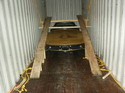









 I've got a 3D printer (Lulzbot Mini) that I'd be glad to help folks with including drawing up parts and linking them for the community to use. The drawing is really the hardest part, but depending on what the part is like it's not hard. I use AutoCAD 2016.














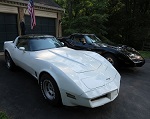




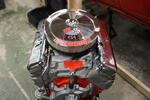



 That is super cool for sure :- )