When you click on links to various merchants on this site and make a purchase, this can result in this site earning a commission. Affiliate programs and affiliations include, but are not limited to, the eBay Partner Network.
Yesterday I was doing some work on my SBC 350 (details below). Specifically, I was re-jetting my Holley 770 SA, changing out the power valve and switching to a bigger squirter. - so not doing anything with the valve train. I was testing throttle response, and then moved on to readjusting the Air/fuel mix screws. I just completed that process, got the A/F mix as good as I could and was again testing the throttle. I then held the engine at around 2000 - 2300 RPM to see if a miss had cleared up and suddenly, a rocker started clicking on the driver's side. Its loud enough to hear over the engine, from either side, and was not gradual - one second there was typical SBC engine noise, then suddenly the click of a badly adjusted rocker. Since I was standing right over the engine at the time, I took note of the vacuum readings, timing and engine "attitude" immediately after the clicking started....no change - if I didn't hear the clicking, I'm not sure I'd know anything was different.
I'm going to look at it tonight, there wasn't time to dig into it last night. On other engines I've had a clicking rocker that came on gradually, I've had ones that gradually got worse / louder or got better / quieter when the engine was warm. I've had rockers that you needed to keep adjusting to keep the tap-tap from coming back, but I've never had one go from "just fine" to "clearly needing adjusted" in the blink of an eye. Last week, I adjusted that entire bank (warm, engine running) to zero lash + 1/4 turn (I originally had them at 1/2 turn but the engine runs better at 1/4 - not sure why, I've always done 1/2 but this motor likes 1/4) so my hope is I somehow forgot to tighten a poly-lock and the nut has simply backed off - but I'm usually pretty good about that. So, aside from "nut backed off, you're an idiot", what else might explain a rocker that goes from adjusted fine to suddenly "doesn't sound adjusted at all"?
Engine details and other info that might be useful
Block: New 4-bolt main from GM. Lucky if it has 5 miles on it. Estimated 9.4:1 CR
Heads: Dart Iron Eagle, 180 runner, 64cc chamber
Cam: Comp Cams, 227@050 Intake, 241 @050 exhaust. 107 LSA, Valve lift: .479 / .465 (I /E)
Valve Train: Magnum push-rods, Roller tip rocker (standard ratio), Comp Camps lifters
Other: Edlebrock EPS intake W/ Holley 770 Street Avenger
Other issues: While likely unrelated, I thought I'd detail other issues it has:
- Timing: Timing mark likes to jump around 2 degrees, randomly. I have two timing lights, same design, does it with both lights. I've checked for vacuum leaks and tested the timing chain ( new, but tested anyway) only have 5 degrees of crank movement before the rotor moves - so within spec. Shimmed the distributor gear to 0.18. This helped, but not a solution. Distributor is also new, and issue was generally the same with three separate distributors, caps, coils modules and two sets of plug wires, three sets of plugs. Same condition regardless of initial advance, vacuum advance or mechanical advance settings. Confirmed balancer is not slipping ( its new, plus added a paint mark to check for a slip)
- Miss - Has a miss somewhere. Very difficult to pin down. It got much better when I switched to different plug wires and plugs, but not completely resolved. Miss occurs at all RPM, including idle. Engine improved when I adjusted the rockers to lash +1/4, as did vacuum.
Vacuum: Once warm, vacuum reads around 11 hg @1000 RPM idle . This is actually a very good reading for this cam, most report 9HG. The reading is not steady however. It has a rapid fluctuation of perhaps 1 HG. I've attributed this to the 107 Cam LSA - larger overlap playing with the vacuum signal. I've been able to vastly improve and steady the vacuum reading with valve adjustment, timing and carb changes, but cannot make it rock steady. Otherwise, it acts like any vacuum should when you rev the motor, etc.
I was just about to reset my timing curve (again) when the rocker suddenly started its tapping. I know a wiped cam will be a common suspect, but I really doubt that based on the consistent and even rocker action across all valves just the week before, with only brief running periods between.
It does sound like an adjustment nut backed off so I would check that first. But your flat tappet hydraulic lifters require 1 turn down after zero lash to center the lifter's plunger. Flat tapped hydraulic lifters have .150" of plunger travel and to center the plunger it actually takes 1-1/8 turns down from zero lash to get .075". But to make things simple G.M. just specs 1 turn down.
There is no gain whatsoever to adjust them hot and running as its such a coarse adjustment. One turn down is one turn down whether the engine is hot, cold, running, or not running.
Torque the set screw to 10 ft/lbs (120 in/lbs) and slap the valve covers back on.
Last edited by toobroketoretire; Nov 24, 2015 at 07:05 PM.
Comp cam lifters??? It can be sticking. I have been burned by them in the past and refuse to use them myself.
Hopefully it is not that...and something simple like a poly-lock not staying put.
If your lifters are flat tappet...then the cam can be suspect. I have had cam lobes wipe out during cam break-in before. And that is even when the engine was pre-oiled so every rocker had oil coming out of it and CORRECT break in oil being used. Sometimes it is in the part itself....and knowing that it is Comp Cams...I would look into it. I know my machinist WILL NOT use anything from them any longer the consistency in the parts are not three for him.
It does sound like an adjustment nut backed off so I would check that first. But your flat tappet hydraulic lifters require 1 turn down after zero lash to center the lifter's plunger. Flat tapped hydraulic lifters have .150" of plunger travel and to center the plunger it actually takes 1-1/8 turns down from zero lash to get .075". But to make things simple G.M. just specs 1 turn down.
There is no gain whatsoever to adjust them hot and running as its such a coarse adjustment. One turn down is one turn down whether the engine is hot, cold, running, or not running.
Torque the set screw to 10 ft/lbs (120 in/lbs) and slap the valve covers back on.
I swear there are more theories on turns after lash than I can shake a stick at...and I can shake a stick, I've done it.
So I've typically read and seen 1/2 turn after lash as the "right thing". Some say 1/3, and others 1/4. I've not seen a full turn recommended. I'd be willing to try it, only the engine definitely ran better at 1/4 turn than 1/2.
I basically hate it when there are three versions of "the truth".
Still, none of that matters much until I figure out my lifter tap. Someone suggested either a broken valve spring or cracked rocker might cause "sudden tap onset". Well, I'll find out in a few hours....unless its one of those "nothing obvious but still makes a noise" issues.
Comp cam lifters??? It can be sticking. I have been burned by them in the past and refuse to use them myself.
Hopefully it is not that...and something simple like a poly-lock not staying put.
If your lifters are flat tappet...then the cam can be suspect. I have had cam lobes wipe out during cam break-in before. And that is even when the engine was pre-oiled so every rocker had oil coming out of it and CORRECT break in oil being used. Sometimes it is in the part itself....and knowing that it is Comp Cams...I would look into it. I know my machinist WILL NOT use anything from them any longer the consistency in the parts are not three for him.
DUB
Yes, flat tappet. I also pre-oiled before start-up, made sure every rocker had oil. Used proper break-in lube on the cam and even lifter faces and special break-in oil, which was changed after the initial break-in 25-min run at varied RPM 2200 - 3500, replaced with more of the same break-in oil. The car hasn't run but maybe 3 miles. I doubt its the cam, but certainly open the that possibility. If it is, I may bite the spendy bullet and retro-fit a roller - not sure what that entails, other than lots of cash I mean.
In addition to the proper oil you need molly lube on the cam and lifter face.polish the lifter bores with something like 3k grit paper and clean it good make sure the lifters rotate smoothly in their bore. And have the engine ready to fire.I've seen guys crank an engine for 20 min and couldn't get it to start and run.
I agree the is some real garbage in flat tapped cams anymore that's why now days you have to go to such extremes. It may be simple like the adjusting nut backed out or a rocker stud pulled or a bent pushrod or flat lobe. Satch the valve covers off and start there.
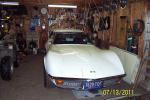
LOL - yes - thanks for searching. I'm never sure where to post such a generic "350 Chevy engine" question, but the HAMB is usually responsive and the engine is sitting in my 78 corvette, so, I figured I'd hit both resources.
LOL - yes - thanks for searching. I'm never sure where to post such a generic "350 Chevy engine" question, but the HAMB is usually responsive and the engine is sitting in my 78 corvette, so, I figured I'd hit both resources.
I can DIG IT !!!.. When something like this 'pops up'... any all USEFUL information is a help.....and I know how it can be.
Hope you find it rather quickly and easily and the repair is an easy one.
I've dealt with the same clicking issue just twice in my life. First was when I had a rocker arm crack under the pivot ball on my '67 Camaro w/350. I replaced the rocker arm and all was well. It was a lot more than just a clicking, though. The engine stopped firing on that cylinder and the miss was profound. The other time I had the experience of a clicking lifter was when I took my '72 out of storage in the spring of 1974. Upon startup, there was one lifter that just loudly clicked and wouldn't stop. The neighbor whose barn the car was stored in was a Thunderbird collector and knew a great deal about engines. He told me not to shut her down, but to let it keep running because a lifter had collapsed over the winter from sitting. He was right. After maybe 10 minutes, the lifter pumped up and the noise went away. That was over 40 years ago, and I've never had trouble with lifters since then.
Possibly one of your lifters collapsed (bled down) or got a piece of dirt in it. Give it a little run time if you don't find anything else wrong. Good luck.
Duane
I have a handful of guys I know that would dispute your claims that the 'one full turn' valve adjustment is the way to go.
DUB
No, your ignorant friends aren't disputing me; they're disputing the Chevrolet shop manuals printed since the 1960's that say to turn the adjustment nuts ONE TURN DOWN FROM ZERO LASH.
Prior to the 1960's the correct adjustment was 1-1/2 turns down from zero lash. Why is it people insist on ignoring the factory specs and doing it their own way?
2025 c3 ('74-'82) of the Year Finalist - Unmodified
2019 C3 of Year Finalist (appearance mods)
Originally Posted by toobroketoretire
No, your ignorant friends aren't disputing me; they're disputing the Chevrolet shop manuals printed since the 1960's that say to turn the adjustment nuts ONE TURN DOWN FROM ZERO LASH.
Prior to the 1960's the correct adjustment was 1-1/2 turns down from zero lash. Why is it people insist on ignoring the factory specs and doing it their own way?
You might find these comments from Lars interesting.
Valve Train: Magnum push-rods, Roller tip rocker (standard ratio), Comp Camps lifters
This caught my eye. I had the Magnum comp cam roller tip rockers and had to constantly adjust them. I though at first it was the nut backing off. Turns out the pivot ***** wear quickly and that causes your lash to get loose. Especially if you only run 1/4 turn down.
Do you know your open spring pressure? The roller tips are not good for the advertised spring pressure. Maybe about 300 lbs vs the advertised 350 lbs. Also look for bluing on the rocker pivot point.
So in short - I just didn't adjust it right. I was able to move the polylock nut very easily and it was clearly too loose. So I understand why the lifter was clicking..Somehow I messed up the adjustment.....But I don't understand exactly how I managed it...here's what I mean:
The rocker on the right is the one that was clicking. You can clearly see that the lock nut is at least two threads further down into the polylock than the one next to it, and the one next to it is consistent with the rest, at about 4 threads showing. By my thinking, the only way I could have gotten the lock nut two turns further into the polylock, is if the polylock itself was two turns further out (so looser) which would have brought it up off the stud by two extra turns, creating the space needed to turn he lock nut in by two extra turns before contacting the stud and locking the polylock. HOWEVER.....if the polylock was a full two turns looser than the rest, it would have been clicking like mad the entire time, not after a good hour or so of run time. I check and double check each rocker when adjusting and there's simply no way it was making any noise at all. If the polylock simply backed out, I also don't believe there is any way for the lock nut to have spun itself in the opposite direction and go further in - surely it would just follow the polylock in an anti-clockwise direction. The only possibility would be that the polylock spun itself up off the stud by two turns at the same time it spun itself up further onto the lock nut - but that seems highly unlikely.
In any case, the clicking is gone. The annoying miss and fouling out of #3 plug more than the rest is still the same. I'm really close to crushing my formerly beloved corvette into a cube of fiberglass and making it a table.
@ HP Hunter: I like the cam, sounds good but vacuum signal is low - as should be expected. I installed both a vacuum can and a vacuum pump just to be sure I'd have brakes. Unfortunately, due to the carb issues (resolved by going Holley) the miss and timing issues, I've yet to drive the car any meaningful distance and performance is far from peak under current conditions. This is easily the most frustrating engine build I've ever done - I'm not new at this, not an expert by any means, but this isn't my first rodeo....but I tell ya, I think I might be beaten this time.
@ REELA8R - The springs are Comp Cams 981, standard for the Dart Iron Eagle head, spring rate I believe is 370Lbs/in. with an open load of 273lbs.
No, your ignorant friends aren't disputing me; they're disputing the Chevrolet shop manuals printed since the 1960's that say to turn the adjustment nuts ONE TURN DOWN FROM ZERO LASH.
Prior to the 1960's the correct adjustment was 1-1/2 turns down from zero lash. Why is it people insist on ignoring the factory specs and doing it their own way?
Ignoring manuals, like when you say driving in figure 8's after a rear end lube change is a waste of time even when the TSB's say to drive in figure 8's?
Don't give up. If you have to pull the motor apart to figure it out. You could let us know what was wrong and save a lot of people the same grief. I am a retired Gm mechanic and the problems I ran into I could not even count. One time we had customer come in and had a 1967 Impala that he had a 454 installed by another shop. The motor was rebuilt by a performance re builder. His complaint was the rocker arms were noisy and the shop could not resolve the problem. One of are mechanics worked on it and could not fix it. The customer picked up his car and I struck up a conversation with him. i told him to drop it off at my house and I would dig into it. I did every test I could think of with no luck. I felt that the oil pressure must be dropping off in the lifter galley. So said to my self I am going to take the timing chain cover and chain off an screw my oil pressure gauge in one of the lifter galley ports and run the oil pressure up with my Adapter and a drill to see what the oil pressure was at the lifter galley. What found was when I removed the galley plug I noticed there was a hole drilled in it. I checked the other galley plug and was the same. Now this is a mod that is done to supply more oil to the back of the timing gear so as not to wear the block. I have done this my self. I put a .043 drill hole in one galley plug. The plugs I took out had 1/8" holes drilled in each one. This was the problem. Losing oil pressure at the end of the galley. Engine oil pressure was good at the bottom end. I replaced the plugs drilling one small .043 hole in one galley plug. Put every thing together and valve train was quiet as a mouse. I don't know how many hours it took to get there but it was a lot. The point is there is a solution. Just don't give up.







 Sudden lifter / Rocker noise - potential causes?


 I basically hate it when there are three versions of "the truth".











 I can DIG IT !!!.. When something like this 'pops up'... any all USEFUL information is a help.....and I know how it can be.