



Alternator - EXTREMELY HOT!

Thread Starter
Pro


Joined: Sep 2011
Posts: 613
Likes: 11
From: EVANSVILLE Wisconsin
 Alternator - EXTREMELY HOT!
Just bought a new alternator to replace my other new alternator that died very prematurely due to excessive heat. Figured it was just undersized at 100 amps as I have about 120 - 130 amp draw with all electrical accessories, lights, fans, etc running. Replaced it with another new 150 amp Powermaster single wire amplifier and it too is overheating badly within minutes of starting the car. Battery is less than a year old Yellow Top, voltage is right where it needs to be..
Thinking the alternator is overheating because it is charging continuously for some reason , but with an internal regulator is that possible? I have the original 2 wire harness plugged into the alternator, a 6ga wire off the positive alternator post running directly to a distribution block and back to the battery, and a good ground wire from the main harness to the Alternator ground post. Pretty standard stuff. Car is a 1980, all other wiring is stock.
Does something else control the charge cycling of the alternator in these cars other than the Alternator regulator? When I unplug the factory 2 wire plug from the alternator, it continues to register on the Gauge as full voltage and the alternator is still charging, is that right? Could there be something wrong with the electronics in the storage bay behind the seats that is causing this??
At a loss here, any help is greatly appreciated!
Thinking the alternator is overheating because it is charging continuously for some reason , but with an internal regulator is that possible? I have the original 2 wire harness plugged into the alternator, a 6ga wire off the positive alternator post running directly to a distribution block and back to the battery, and a good ground wire from the main harness to the Alternator ground post. Pretty standard stuff. Car is a 1980, all other wiring is stock.
Does something else control the charge cycling of the alternator in these cars other than the Alternator regulator? When I unplug the factory 2 wire plug from the alternator, it continues to register on the Gauge as full voltage and the alternator is still charging, is that right? Could there be something wrong with the electronics in the storage bay behind the seats that is causing this??
At a loss here, any help is greatly appreciated!

Race Director


Joined: Apr 2009
Posts: 19,294
Likes: 2,753
From: Charlotte NC
Contact the manufacturer of the alternator you purchased and talk to their tech dept...that is what they are there for.
As for your alternator...you alternator is always charging when it is spinning or at least it should...and if my memory serves me correctly...the SINGLE WIRE alternators have an 'exciter' that requires you to rev the engine a little bit to activate it and get it to start to charge...or at least that is how I remember it numerous years ago when I installed these single wire alternators.
What is your alternator charging when you have it running??? And I do not mean by the gauge...but by checking it at the battery.
DUB
As for your alternator...you alternator is always charging when it is spinning or at least it should...and if my memory serves me correctly...the SINGLE WIRE alternators have an 'exciter' that requires you to rev the engine a little bit to activate it and get it to start to charge...or at least that is how I remember it numerous years ago when I installed these single wire alternators.
What is your alternator charging when you have it running??? And I do not mean by the gauge...but by checking it at the battery.
DUB
Drifting

Joined: Jun 2015
Posts: 1,340
Likes: 753
From: Doctors Inlet Florida
If you have a 120 amp draw at idle,your 6ga wire may be too small. You may want to try a 2 ga or 1/0 AWG for the charge wire AND the ground wire.


Last edited by Crimson Thunder; May 28, 2016 at 12:16 PM.

Race Director

Joined: Apr 2007
Posts: 11,150
Likes: 890
From: South Western Ontario
How the heck are you getting 120-130A of draw?
How hot is it?
If the new alternator is the same case design as your original then it's a ****-poor design. You need to be using an alternator that started life as a CS144 or AD244.
No alternator produces its rated current when the engine is idling. It's a numbers game. You can get the current at a higher rpm but you can only get 50% to 75% of that current at idle rpm. If you really have a 120-130A load then you need at least a 200A alternator. A GOOD one too. Use a 3-wire with the voltage sensing connected to you main distribution block.
How hot is it?
If the new alternator is the same case design as your original then it's a ****-poor design. You need to be using an alternator that started life as a CS144 or AD244.
No alternator produces its rated current when the engine is idling. It's a numbers game. You can get the current at a higher rpm but you can only get 50% to 75% of that current at idle rpm. If you really have a 120-130A load then you need at least a 200A alternator. A GOOD one too. Use a 3-wire with the voltage sensing connected to you main distribution block.
Race Director
Joined: Apr 2009
Posts: 19,294
Likes: 2,753
From: Charlotte NC
I do agree that increasing the wire size would be a benefit.
From the graph posted by 'Crimson Thunder'...11 feet of 6 gauge wire is good for 100 amps.
And I also wonder if you are actually using the amount of amps with everything running like you posted....and I am sure that if your have some massive amp for a stereo..that can do it...
I have used alternators for some special builds that came out of an ambulance and they were stout.
DUB
From the graph posted by 'Crimson Thunder'...11 feet of 6 gauge wire is good for 100 amps.
And I also wonder if you are actually using the amount of amps with everything running like you posted....and I am sure that if your have some massive amp for a stereo..that can do it...
I have used alternators for some special builds that came out of an ambulance and they were stout.
DUB
Thread Starter
Pro
Joined: Sep 2011
Posts: 613
Likes: 11
From: EVANSVILLE Wisconsin
Contact the manufacturer of the alternator you purchased and talk to their tech dept...that is what they are there for.
As for your alternator...you alternator is always charging when it is spinning or at least it should...and if my memory serves me correctly...the SINGLE WIRE alternators have an 'exciter' that requires you to rev the engine a little bit to activate it and get it to start to charge...or at least that is how I remember it numerous years ago when I installed these single wire alternators.
What is your alternator charging when you have it running??? And I do not mean by the gauge...but by checking it at the battery.
DUB
As for your alternator...you alternator is always charging when it is spinning or at least it should...and if my memory serves me correctly...the SINGLE WIRE alternators have an 'exciter' that requires you to rev the engine a little bit to activate it and get it to start to charge...or at least that is how I remember it numerous years ago when I installed these single wire alternators.
What is your alternator charging when you have it running??? And I do not mean by the gauge...but by checking it at the battery.
DUB
 I believe the battery read 12.7 volts with the car off and 14.7 volts with the car running / charging.
 How the heck are you getting 120-130A of draw?
How hot is it?
If the new alternator is the same case design as your original then it's a ****-poor design. You need to be using an alternator that started life as a CS144 or AD244.
No alternator produces its rated current when the engine is idling. It's a numbers game. You can get the current at a higher rpm but you can only get 50% to 75% of that current at idle rpm. If you really have a 120-130A load then you need at least a 200A alternator. A GOOD one too. Use a 3-wire with the voltage sensing connected to you main distribution block.
How hot is it?
If the new alternator is the same case design as your original then it's a ****-poor design. You need to be using an alternator that started life as a CS144 or AD244.
No alternator produces its rated current when the engine is idling. It's a numbers game. You can get the current at a higher rpm but you can only get 50% to 75% of that current at idle rpm. If you really have a 120-130A load then you need at least a 200A alternator. A GOOD one too. Use a 3-wire with the voltage sensing connected to you main distribution block.
Thanks for all the input guys, I'll make a call to PowerMaster and see what they say. Anyone have any idea if there are factors that control the charging other than the internal regulator of the alternator? In looking at the wiring diagram for my car there are wires tracing back to the 'electronics' behind the passenger seat, but I'm not sure what they do. Could there be something there that's faulty and causing a continuous charge signal to be sent to the alternator via the original 2 wire GM alternator connector?
Thanks for all the help!
Race Director
Joined: Apr 2007
Posts: 11,150
Likes: 890
From: South Western Ontario
FYI, good winding insulation can withstand 165*C all day long.
IF the alternator is producing around 14V then it's working correctly. The regulator can't force current to flow without increasing the voltage.
IF the alternator is producing around 14V then it's working correctly. The regulator can't force current to flow without increasing the voltage.
Corvette Stories
The Best of Corvette for Corvette Enthusiasts

Corvette ZR1X Will Be Pacing the Indy 500, And Could Probably Race, Too!
Verdad Gallardo
Top 10 Corvettes Coming to Mecum Indy 2026!
Brett Foote
Top 10 C9 Corvette MUST-HAVES to Fix These C8 Generation Flaws!
Michael S. Palmer
10 Revolutionary 'Corvette Firsts' Most People Don't Know
Joe Kucinski
5 Reasons to Upgrade to an LS6-Powered Corvette; 5 Reasons to Stay LT2
Michael S. Palmer
2027 Corvette vs The World: Every C8 vs Its Closest Competitor
Joe Kucinski
10 Most Common Corvette Problems of the Last 20 Years!
Joe Kucinski
5 MOST and 5 LEAST Popular Corvette Model Years in History!
Joe Kucinski
2027 Corvette Buyer's Guide: Everything You Need to Know!
Joe Kucinski
Race Director
Joined: Apr 2009
Posts: 19,294
Likes: 2,753
From: Charlotte NC
To answer your question about the electrical stuff behind the passenger seat. If my memory serves me correctly. On your 1980...all that will be back there is a black square box that is your theft deterrent control module...and if you have intermittent wipers...that control module is also there.
AS for you unplugging the TWO wire connector on your alternator and your VOLT meter stays put....I wonder if your GEN light is working in your gauge cluster.
I am ASSUMING that when you engine is NOT running the alternator is not so blistering hot as you described.
ALSO...if you increase the gauge size of the red wire that runs throguh your frame from the junction block in the battery box and goes to the alternator....MAKE SURE that the pigtail wire coming off your POSITIVE BATTERY CABLE going to the junction block is also increased.
NOW...I prefer NEVER cutting the nice red molded cable end to do a modification IF AT ALL POSSIBLE....so ...in this case..I would go to a stereo shop and get one of those gold plated terminal bolts that allow you to attach a wire to it WITHOUT hacking up the factory cable end. And YES...I have cut the end off the cable and bought one of the replacement side mount battery cable ends and use the red covers for it in some special custom applications....SO ..I have done it...but if I do not have to...I don't. I get those from American Autowire....just in case you need it.
DUB
AS for you unplugging the TWO wire connector on your alternator and your VOLT meter stays put....I wonder if your GEN light is working in your gauge cluster.
I am ASSUMING that when you engine is NOT running the alternator is not so blistering hot as you described.
ALSO...if you increase the gauge size of the red wire that runs throguh your frame from the junction block in the battery box and goes to the alternator....MAKE SURE that the pigtail wire coming off your POSITIVE BATTERY CABLE going to the junction block is also increased.
NOW...I prefer NEVER cutting the nice red molded cable end to do a modification IF AT ALL POSSIBLE....so ...in this case..I would go to a stereo shop and get one of those gold plated terminal bolts that allow you to attach a wire to it WITHOUT hacking up the factory cable end. And YES...I have cut the end off the cable and bought one of the replacement side mount battery cable ends and use the red covers for it in some special custom applications....SO ..I have done it...but if I do not have to...I don't. I get those from American Autowire....just in case you need it.
DUB
Thread Starter
Pro
Joined: Sep 2011
Posts: 613
Likes: 11
From: EVANSVILLE Wisconsin
To answer your question about the electrical stuff behind the passenger seat. If my memory serves me correctly. On your 1980...all that will be back there is a black square box that is your theft deterrent control module...and if you have intermittent wipers...that control module is also there.
AS for you unplugging the TWO wire connector on your alternator and your VOLT meter stays put....I wonder if your GEN light is working in your gauge cluster.
I am ASSUMING that when you engine is NOT running the alternator is not so blistering hot as you described.
ALSO...if you increase the gauge size of the red wire that runs throguh your frame from the junction block in the battery box and goes to the alternator....MAKE SURE that the pigtail wire coming off your POSITIVE BATTERY CABLE going to the junction block is also increased.
NOW...I prefer NEVER cutting the nice red molded cable end to do a modification IF AT ALL POSSIBLE....so ...in this case..I would go to a stereo shop and get one of those gold plated terminal bolts that allow you to attach a wire to it WITHOUT hacking up the factory cable end. And YES...I have cut the end off the cable and bought one of the replacement side mount battery cable ends and use the red covers for it in some special custom applications....SO ..I have done it...but if I do not have to...I don't. I get those from American Autowire....just in case you need it.
DUB
AS for you unplugging the TWO wire connector on your alternator and your VOLT meter stays put....I wonder if your GEN light is working in your gauge cluster.
I am ASSUMING that when you engine is NOT running the alternator is not so blistering hot as you described.
ALSO...if you increase the gauge size of the red wire that runs throguh your frame from the junction block in the battery box and goes to the alternator....MAKE SURE that the pigtail wire coming off your POSITIVE BATTERY CABLE going to the junction block is also increased.
NOW...I prefer NEVER cutting the nice red molded cable end to do a modification IF AT ALL POSSIBLE....so ...in this case..I would go to a stereo shop and get one of those gold plated terminal bolts that allow you to attach a wire to it WITHOUT hacking up the factory cable end. And YES...I have cut the end off the cable and bought one of the replacement side mount battery cable ends and use the red covers for it in some special custom applications....SO ..I have done it...but if I do not have to...I don't. I get those from American Autowire....just in case you need it.
DUB
The alternator is not hot when the engine is off, so nothing weird there. The 2 wire GM plug has 12.8 volts when the car is off and when ignition is turned on to ACC, it drops to 1/4 volt. Is that normal? I did not start the car to see what it reads at that point, should it read 12+ volts?
Just no clue what's going on here but I don't want to fry another alternator in short order. The new higher output unit is getting even hotter than the old one, and doing it faster.
Can a bad / undersized ground wire cause an alternator to overheat? As I said before, it's mounted to the heads / block with an aluminum bracket and I cannot imagine that it's not well grounded.
I'll contact Powermaster tomorrow to get their take on all of this.
Thanks guys.
Race Director
Joined: Apr 2007
Posts: 11,150
Likes: 890
From: South Western Ontario
I'm just pointing out how hot parts can get without damage and that many people don't understand the design limits of the different parts. The rectifier diodes can handle easily 100*C. Bearing about 90*C. The regulator is mounted in a little case that is behind the rotor in the cooling air flow to try and try and keep it cooler than the case mounted components. Still, it's likely using high temperature components capable of operating in the 100*C range too.
Your 2-wire plug should have a red and brown wire. The red wire should have voltage all the time. The brown wire should have a voltage that is switched with the ignition switch.
The new alternator being a "1-wire" design means it shouldn't need the red wire and can optionally work with the brown wire. But, it shouldn't hurt anything to hook up the red wire anyways.
What is the output voltage at idle when it's getting so hot?
Your 2-wire plug should have a red and brown wire. The red wire should have voltage all the time. The brown wire should have a voltage that is switched with the ignition switch.
The new alternator being a "1-wire" design means it shouldn't need the red wire and can optionally work with the brown wire. But, it shouldn't hurt anything to hook up the red wire anyways.
What is the output voltage at idle when it's getting so hot?


Race Director

Joined: Apr 2000
Posts: 17,665
Likes: 194
From: Who says "Nothing is impossible" ? I've been doing nothing for years.
Have you tried using a heat gun and measuring the alternator and then the components and surfaces around the alternator.
Could be everything is hot under the hood. Mine gets really hot and every part in the engine bay is scorching after a drive in 80degs temperature.
Could be everything is hot under the hood. Mine gets really hot and every part in the engine bay is scorching after a drive in 80degs temperature.

Burning Brakes


Joined: Apr 2008
Posts: 1,222
Likes: 93
From: shelbyville West Michigan
where did you get that chart of amperage draw from?
I don't see how you could be running that many amps, but even so, the alternator would only put out it's rated capacity. if you ran everything at full power at exactly the same time with all the electric motors drawing start-up load at the same time (which is pretty much impossible), it would just drain the battery faster than the alternator could replenish it. like a house with a 200 amp service, you have a service factor % figured in, you never run 200 amps at home at the same time or the main would trip, which is something you could certainly wire in your car to verify (or just use an ammeter to verify your load).
the only way it would get hot is if you were shorting it out without it running, or the bearings are bad/dry and creating heat, or the alternator being connected to aluminum bracket on aluminum head already running hot is acting as a heat sink, which may be a distinct possibility....
as stated before, if you have a one-wire setup, the two prong plug should have a rubber block-off inside blocking those two terminals. it is installed inside of the alternator to keep from hooking anything to them.
have you determined why the old alternator went bad? did the winding get hot enough to melt the varnish coating? bearings seize? regulator or diodes burn out due to heat?
and forgot to add, the CS series have better designed fans on them and is a better base to build a high amp alternator from if you are not already using one...
I don't see how you could be running that many amps, but even so, the alternator would only put out it's rated capacity. if you ran everything at full power at exactly the same time with all the electric motors drawing start-up load at the same time (which is pretty much impossible), it would just drain the battery faster than the alternator could replenish it. like a house with a 200 amp service, you have a service factor % figured in, you never run 200 amps at home at the same time or the main would trip, which is something you could certainly wire in your car to verify (or just use an ammeter to verify your load).
the only way it would get hot is if you were shorting it out without it running, or the bearings are bad/dry and creating heat, or the alternator being connected to aluminum bracket on aluminum head already running hot is acting as a heat sink, which may be a distinct possibility....
as stated before, if you have a one-wire setup, the two prong plug should have a rubber block-off inside blocking those two terminals. it is installed inside of the alternator to keep from hooking anything to them.
have you determined why the old alternator went bad? did the winding get hot enough to melt the varnish coating? bearings seize? regulator or diodes burn out due to heat?
and forgot to add, the CS series have better designed fans on them and is a better base to build a high amp alternator from if you are not already using one...
Last edited by gungatim; May 31, 2016 at 01:46 PM.
Race Director
Joined: Apr 2009
Posts: 19,294
Likes: 2,753
From: Charlotte NC
The ONE WIRE alternators I have installed have also had a rubber plug so the two wire connector could NOT be installed....and the ONE WIRE alternator had to be revved up to get it to charge due to an 'exciter' inside the alternator.
I believe your alternator is grounded OK but I would like to hear what you found out when you talked with the company....AND this is ASSUMING that your FRAME to ENGINE BLOCK ground wire is intact and GOOD. It is located on the passenger side of the engine where it attaches to the engine block frame perch for the motor mount and then goes over to where the support bracket for the starter is bolted to the side of the engine block
I am wondering that due to this alternator is putting out much more than the facotry set-up....that the red wire is under sized and needs to be changed to a larger gauge.
AND...is the red wire on the back of your alternator getting really hot when you follow it back towards the firewall area????
DUB
I believe your alternator is grounded OK but I would like to hear what you found out when you talked with the company....AND this is ASSUMING that your FRAME to ENGINE BLOCK ground wire is intact and GOOD. It is located on the passenger side of the engine where it attaches to the engine block frame perch for the motor mount and then goes over to where the support bracket for the starter is bolted to the side of the engine block
I am wondering that due to this alternator is putting out much more than the facotry set-up....that the red wire is under sized and needs to be changed to a larger gauge.
AND...is the red wire on the back of your alternator getting really hot when you follow it back towards the firewall area????
DUB
Drifting

Joined: Mar 2011
Posts: 1,347
Likes: 121
From: Kernersville NC
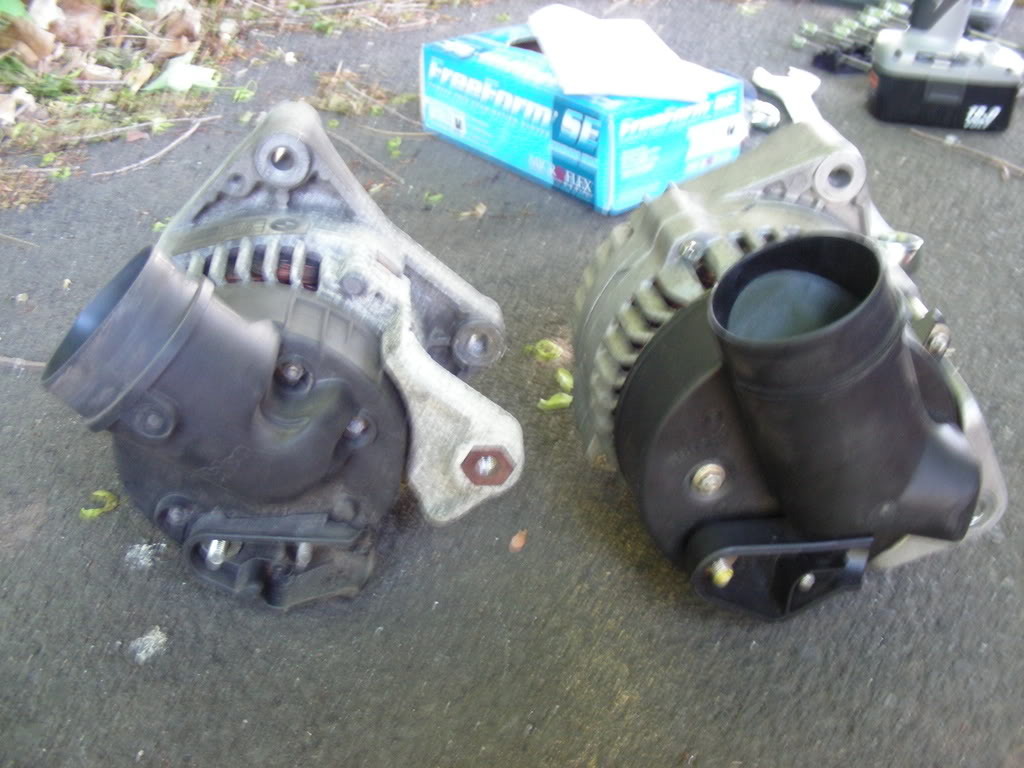
Something to think about here. Buddy installed new radiator and dual electric fans. Removed mechanical fan obviously. Alternator got so hot you could not touch it due to low airflow around it. Electric fans point down. Reinstalled flex fan, electric fans still in place, and the alternator stayed cool. Well cool by comparison anyway. I don't think the flex fan did any good for engine cooling but it moved the air under the hood around. Point is, see if you can get some air flow. I have seen alternators with a shroud and air ducted to it.
Last edited by flyeri; May 31, 2016 at 08:56 PM.
Le Mans Master


Joined: May 2003
Posts: 8,872
Likes: 3,548
From: Fernandina Beach FL
2023 Restomod of the Year finalist
2020 C3 of the Year Winner - Modified
Yep- BMW's use duct work on the alternator and even have a watercooled one...
water cooled housing-

If you are not running any accessories- the alternator should not get that hot-PERIOD. If you have nothing "big" running it won't matter what size wire -OK within reason - say 10GU.
As far as a bad ground- you should still check the resistance from the chassis to the alternator case...if you are not having any problems starting- you very well could have a good motor ground to chassis- but maybe a bad ground off the case of the alternator to the engine.
If the continuity to ground checks out-I'm thinking the alt is just bad- I'd get one that is not a single wire...
water cooled housing-
If you are not running any accessories- the alternator should not get that hot-PERIOD. If you have nothing "big" running it won't matter what size wire -OK within reason - say 10GU.
As far as a bad ground- you should still check the resistance from the chassis to the alternator case...if you are not having any problems starting- you very well could have a good motor ground to chassis- but maybe a bad ground off the case of the alternator to the engine.
If the continuity to ground checks out-I'm thinking the alt is just bad- I'd get one that is not a single wire...
Thread Starter
Pro
Joined: Sep 2011
Posts: 613
Likes: 11
From: EVANSVILLE Wisconsin
I'm just pointing out how hot parts can get without damage and that many people don't understand the design limits of the different parts. The rectifier diodes can handle easily 100*C. Bearing about 90*C. The regulator is mounted in a little case that is behind the rotor in the cooling air flow to try and try and keep it cooler than the case mounted components. Still, it's likely using high temperature components capable of operating in the 100*C range too.
Your 2-wire plug should have a red and brown wire. The red wire should have voltage all the time. The brown wire should have a voltage that is switched with the ignition switch.
The new alternator being a "1-wire" design means it shouldn't need the red wire and can optionally work with the brown wire. But, it shouldn't hurt anything to hook up the red wire anyways.
What is the output voltage at idle when it's getting so hot?
Your 2-wire plug should have a red and brown wire. The red wire should have voltage all the time. The brown wire should have a voltage that is switched with the ignition switch.
The new alternator being a "1-wire" design means it shouldn't need the red wire and can optionally work with the brown wire. But, it shouldn't hurt anything to hook up the red wire anyways.
What is the output voltage at idle when it's getting so hot?
where did you get that chart of amperage draw from?
I don't see how you could be running that many amps, but even so, the alternator would only put out it's rated capacity. if you ran everything at full power at exactly the same time with all the electric motors drawing start-up load at the same time (which is pretty much impossible), it would just drain the battery faster than the alternator could replenish it. like a house with a 200 amp service, you have a service factor % figured in, you never run 200 amps at home at the same time or the main would trip, which is something you could certainly wire in your car to verify (or just use an ammeter to verify your load).
the only way it would get hot is if you were shorting it out without it running, or the bearings are bad/dry and creating heat, or the alternator being connected to aluminum bracket on aluminum head already running hot is acting as a heat sink, which may be a distinct possibility....
as stated before, if you have a one-wire setup, the two prong plug should have a rubber block-off inside blocking those two terminals. it is installed inside of the alternator to keep from hooking anything to them.
have you determined why the old alternator went bad? did the winding get hot enough to melt the varnish coating? bearings seize? regulator or diodes burn out due to heat?
and forgot to add, the CS series have better designed fans on them and is a better base to build a high amp alternator from if you are not already using one...
I don't see how you could be running that many amps, but even so, the alternator would only put out it's rated capacity. if you ran everything at full power at exactly the same time with all the electric motors drawing start-up load at the same time (which is pretty much impossible), it would just drain the battery faster than the alternator could replenish it. like a house with a 200 amp service, you have a service factor % figured in, you never run 200 amps at home at the same time or the main would trip, which is something you could certainly wire in your car to verify (or just use an ammeter to verify your load).
the only way it would get hot is if you were shorting it out without it running, or the bearings are bad/dry and creating heat, or the alternator being connected to aluminum bracket on aluminum head already running hot is acting as a heat sink, which may be a distinct possibility....
as stated before, if you have a one-wire setup, the two prong plug should have a rubber block-off inside blocking those two terminals. it is installed inside of the alternator to keep from hooking anything to them.
have you determined why the old alternator went bad? did the winding get hot enough to melt the varnish coating? bearings seize? regulator or diodes burn out due to heat?
and forgot to add, the CS series have better designed fans on them and is a better base to build a high amp alternator from if you are not already using one...
The ONE WIRE alternators I have installed have also had a rubber plug so the two wire connector could NOT be installed....and the ONE WIRE alternator had to be revved up to get it to charge due to an 'exciter' inside the alternator.
I believe your alternator is grounded OK but I would like to hear what you found out when you talked with the company....AND this is ASSUMING that your FRAME to ENGINE BLOCK ground wire is intact and GOOD. It is located on the passenger side of the engine where it attaches to the engine block frame perch for the motor mount and then goes over to where the support bracket for the starter is bolted to the side of the engine block
I am wondering that due to this alternator is putting out much more than the facotry set-up....that the red wire is under sized and needs to be changed to a larger gauge.
AND...is the red wire on the back of your alternator getting really hot when you follow it back towards the firewall area????
DUB
I believe your alternator is grounded OK but I would like to hear what you found out when you talked with the company....AND this is ASSUMING that your FRAME to ENGINE BLOCK ground wire is intact and GOOD. It is located on the passenger side of the engine where it attaches to the engine block frame perch for the motor mount and then goes over to where the support bracket for the starter is bolted to the side of the engine block
I am wondering that due to this alternator is putting out much more than the facotry set-up....that the red wire is under sized and needs to be changed to a larger gauge.
AND...is the red wire on the back of your alternator getting really hot when you follow it back towards the firewall area????
DUB
Yep- BMW's use duct work on the alternator and even have a watercooled one...
If you are not running any accessories- the alternator should not get that hot-PERIOD. If you have nothing "big" running it won't matter what size wire -OK within reason - say 10GU.
As far as a bad ground- you should still check the resistance from the chassis to the alternator case...if you are not having any problems starting- you very well could have a good motor ground to chassis- but maybe a bad ground off the case of the alternator to the engine.
If the continuity to ground checks out-I'm thinking the alt is just bad- I'd get one that is not a single wire...
If you are not running any accessories- the alternator should not get that hot-PERIOD. If you have nothing "big" running it won't matter what size wire -OK within reason - say 10GU.
As far as a bad ground- you should still check the resistance from the chassis to the alternator case...if you are not having any problems starting- you very well could have a good motor ground to chassis- but maybe a bad ground off the case of the alternator to the engine.
If the continuity to ground checks out-I'm thinking the alt is just bad- I'd get one that is not a single wire...
Thanks for all the input guys, really appreciate it. I'm at a loss at this point, what we've tried so far simply does not seem to be having any effect on lowering the temps. I've not been driving the car because I didn't want to burn up another brand new alternator before I figured this out, but at this point I need to get her out of the garage and on the road. Summer is short here in Wisconsin.. Any additional ideas are welcome however!
Burning Brakes
Joined: Apr 2008
Posts: 1,222
Likes: 93
From: shelbyville West Michigan
well then you've got to figure out where it is coming from by elimination.
friction
convection
conduction
if it's not electrically generated, and it sounds like it's not, you're going to have to do some more testing, like disconnect it completely and run the motor straight off the battery, no charging at all, and see if it gets hot.
then do the same thing with no belt on it.
then connect it to another car.
friction
convection
conduction
if it's not electrically generated, and it sounds like it's not, you're going to have to do some more testing, like disconnect it completely and run the motor straight off the battery, no charging at all, and see if it gets hot.
then do the same thing with no belt on it.
then connect it to another car.
Race Director
Joined: Apr 2009
Posts: 19,294
Likes: 2,753
From: Charlotte NC
I honestly feel that 15.2 volts is a bit high....you are getting really close to 16 Volts which can cause a battery to pop....and that is just my thoughts on that...I may be wrong. I prefer to see 14.4 Volts and not much more than that...but that is on facotry alternators. Normally the volt meter reads about 13.4 v to 13.6v when there is a good battery and all ease is good.
Worth check just in case you have not and that is the NEGATIVE battery cable where it is bolted to the frame under the battery box.
'gungatim's' advice seems solid. I would take the electrical of the alternator out of the equation and see if it gets hot not doing anything but spinning.
Lastly...if you can...I would double up on the 6 gauge wire to your junction block and add another one....because with the chart provided above....I would try a larger gauge wire (more than 6 gauge myself)
And for what it is worth...when I am using my IR gun on a surface that seems to be reflective...I apply a dab of black paint and check it there....or actually use a probe thermometer.
DUB
Worth check just in case you have not and that is the NEGATIVE battery cable where it is bolted to the frame under the battery box.
'gungatim's' advice seems solid. I would take the electrical of the alternator out of the equation and see if it gets hot not doing anything but spinning.
Lastly...if you can...I would double up on the 6 gauge wire to your junction block and add another one....because with the chart provided above....I would try a larger gauge wire (more than 6 gauge myself)
And for what it is worth...when I am using my IR gun on a surface that seems to be reflective...I apply a dab of black paint and check it there....or actually use a probe thermometer.
DUB

