







How to Replace Rear Leaf Spring Step-by-Step?

Thread Starter
Melting Slicks

Joined: Jun 2016
Posts: 2,979
Likes: 332
From: Woodinville WA
 How to Replace Rear Leaf Spring Step-by-Step?
I've come across a couple of threads with some high-level overview of the steps required to replace a rear leaf spring, but no videos and no articles with pictures.
Anyone happen to come across a thread or article with pictures or videos that a newb like me can follow?
Do I need to remove the rear sway arm bracket to do this?
Is there anything else that I should be replacing while I'm doing this? (Does it make it a lot easier to replace the rear shocks while I'm at it?)
High level overview of steps from memory from other threads for old spring removal:
1. Spray every bolt with penetrating oil / PBlaster the night before
2. Jack up rear of car as high as possible- put on stands- blocks in front of front tires
3. Take off wheels, spare tire and remove spring heat shield
4. Jack up the driver's side of the spring to take the pressure off- attach a C clamp between the spring and the rear trailing arm (wish I had a picture of this)
5. Remove the cotter pin and castle nut sticking out the bottom of the end link -put a wrench on the top to stop it from spinning
6. Remove C clamp (assuming it's just a backup safety mechanism of some kind?) -slowly let jack down
7. Do the passenger's side same as driver's
8. Get a helper to hold one side of the spring- hold the other side with jack (I only have 1 helper tops) & remove the two main bolts holding the rear spring to the rear end cover- then get that thing outta there
Cleanup stage:
1. Pull out the wire brush and clean all mounting locations & get any previous rubber bushing residue out
Eventually, I'll post proposed steps to install the new spring but I want to confirm these now.
I've got some homework to do before I tackle this too:
1. Are the diff bolts that came with my spring an appropriate length for my year C3? (VB&P said that the difference in the simple OEM-style mount between the years is simply the length of the bolts that they come with) -Note: Call VB&P; previous owner wasn't sure what year range spring kit was made for...
2. Ask VB&P for an email copy of the original install instructions (mine did not come with instructions)
3. Determine whether the bushings that I have are rubber or poly -anyone know a good way to tell?
4. Check whether I have new castle nuts and cotter pins -I don't think so...
5. Figure out whether to do new shocks at the same time...
6. Figure out whether I'll need to remove the sway bar brackets to do this
Thanks CF!
Adam
P.S. It looks like there was a great article on doing this with pictures and everything, but like pretty much anything on CF from before 2012 all the images are long gone... ;-( -I found a youtube video, too but it skips most of the rear leaf spring removal and installation steps as just "yada, yada, yada". -I'm a newb; I need those steps! lol!
Anyone happen to come across a thread or article with pictures or videos that a newb like me can follow?
Do I need to remove the rear sway arm bracket to do this?
Is there anything else that I should be replacing while I'm doing this? (Does it make it a lot easier to replace the rear shocks while I'm at it?)
High level overview of steps from memory from other threads for old spring removal:
1. Spray every bolt with penetrating oil / PBlaster the night before
2. Jack up rear of car as high as possible- put on stands- blocks in front of front tires
3. Take off wheels, spare tire and remove spring heat shield
4. Jack up the driver's side of the spring to take the pressure off- attach a C clamp between the spring and the rear trailing arm (wish I had a picture of this)
5. Remove the cotter pin and castle nut sticking out the bottom of the end link -put a wrench on the top to stop it from spinning
6. Remove C clamp (assuming it's just a backup safety mechanism of some kind?) -slowly let jack down
7. Do the passenger's side same as driver's
8. Get a helper to hold one side of the spring- hold the other side with jack (I only have 1 helper tops) & remove the two main bolts holding the rear spring to the rear end cover- then get that thing outta there
Cleanup stage:
1. Pull out the wire brush and clean all mounting locations & get any previous rubber bushing residue out
Eventually, I'll post proposed steps to install the new spring but I want to confirm these now.
I've got some homework to do before I tackle this too:
1. Are the diff bolts that came with my spring an appropriate length for my year C3? (VB&P said that the difference in the simple OEM-style mount between the years is simply the length of the bolts that they come with) -Note: Call VB&P; previous owner wasn't sure what year range spring kit was made for...
2. Ask VB&P for an email copy of the original install instructions (mine did not come with instructions)
3. Determine whether the bushings that I have are rubber or poly -anyone know a good way to tell?
4. Check whether I have new castle nuts and cotter pins -I don't think so...
5. Figure out whether to do new shocks at the same time...
6. Figure out whether I'll need to remove the sway bar brackets to do this
Thanks CF!
Adam
P.S. It looks like there was a great article on doing this with pictures and everything, but like pretty much anything on CF from before 2012 all the images are long gone... ;-( -I found a youtube video, too but it skips most of the rear leaf spring removal and installation steps as just "yada, yada, yada". -I'm a newb; I need those steps! lol!
Last edited by NewbVetteGuy; Jan 17, 2017 at 12:38 PM.

Safety Car


Joined: Oct 2004
Posts: 3,920
Likes: 731
From: Youngstown Ohio
I got a great DVD from VB&P ....free for the asking. Covers all suspension work and more. Here...https://www.vbandp.com/videos.html
Also, great step by step from Vansteel....http://www.vansteel.com/PDFs/RearSpringInstructions.pdf
Also, great step by step from Vansteel....http://www.vansteel.com/PDFs/RearSpringInstructions.pdf

Team Owner


Joined: Sep 2006
Posts: 31,164
Likes: 4,242
From: Westminster Maryland
Hi NVB,
Question #4.
Here'a a photo of how I position the jack, position the block to raise/lower the spring, and place protection for the spring and clamp on the spring.
I put an addition block in the jack 'cup' to prevent the bottom of the block from moving.
You still need to be careful because of the tension stored in the spring until it's completely released.
Question #6.
You need to remove the sway bar mounts on the trailing arms to get the spring bolts up out of the trailing arms.
Question #8.
I use the jack in the center of the spring (with a block of wood) to support the jack while I'm taking it off or putting it back in place. (I work alone.) Remember to put the spring bracket in place on the jack before putting the spring on the jack.
Regards,
Alan
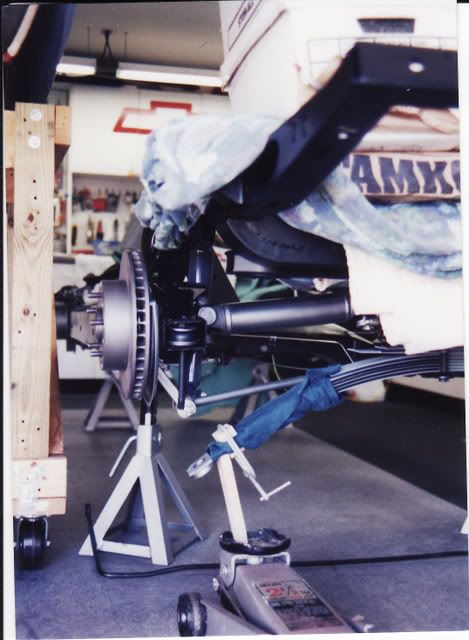
Question #4.
Here'a a photo of how I position the jack, position the block to raise/lower the spring, and place protection for the spring and clamp on the spring.
I put an addition block in the jack 'cup' to prevent the bottom of the block from moving.
You still need to be careful because of the tension stored in the spring until it's completely released.
Question #6.
You need to remove the sway bar mounts on the trailing arms to get the spring bolts up out of the trailing arms.
Question #8.
I use the jack in the center of the spring (with a block of wood) to support the jack while I'm taking it off or putting it back in place. (I work alone.) Remember to put the spring bracket in place on the jack before putting the spring on the jack.
Regards,
Alan
Last edited by Alan 71; Jan 17, 2017 at 03:15 PM.
Thread Starter
Melting Slicks
Joined: Jun 2016
Posts: 2,979
Likes: 332
From: Woodinville WA
Wait... so the point of the C-clamps is to clamp the spring to the floor jack so the jack doesn't slide sideways?!?
#3 here: http://www.vansteel.com/PDFs/RearSpringInstructions.pdf
???
I really don't understand the purpose of the C-clamps / vice grips or what exactly I'm supposed to do with them. Many descriptions say that they're there to prevent the jack from slipping but I don't see how they could possibly do that... The picture above shows the entire rear spring pressure being suspended by the jack balanced on a wooden board so that when you remove the castle nut it doesn't violently let loose breaking your arm or skull?!? --While balancing on a board standing up vertical like this?!? I must be seriously misunderstanding something...
#3 here: http://www.vansteel.com/PDFs/RearSpringInstructions.pdf
???
I really don't understand the purpose of the C-clamps / vice grips or what exactly I'm supposed to do with them. Many descriptions say that they're there to prevent the jack from slipping but I don't see how they could possibly do that... The picture above shows the entire rear spring pressure being suspended by the jack balanced on a wooden board so that when you remove the castle nut it doesn't violently let loose breaking your arm or skull?!? --While balancing on a board standing up vertical like this?!? I must be seriously misunderstanding something...
Last edited by NewbVetteGuy; Jan 17, 2017 at 03:21 PM.
Thread Starter
Melting Slicks
Joined: Jun 2016
Posts: 2,979
Likes: 332
From: Woodinville WA
Adam
Team Owner
Joined: Sep 2006
Posts: 31,164
Likes: 4,242
From: Westminster Maryland
Hi Adam,
You can't put the jack right at the end of the spring because you then can't get the nut, washer, and bushing off.
The jack needs to be towards the center of the car just past the bushing cup on the spring.
The tremendous pressure on the jack will slide it up the spring toward the center of the car and you won't be able to stop it.
Also remember, the jack arm doesn't raise straight up… it raises in an arc so the jack has to roll as the arm goes up or down.
I value my head and the car.
Regards,
Alan
You can't put the jack right at the end of the spring because you then can't get the nut, washer, and bushing off.
The jack needs to be towards the center of the car just past the bushing cup on the spring.
The tremendous pressure on the jack will slide it up the spring toward the center of the car and you won't be able to stop it.
Also remember, the jack arm doesn't raise straight up… it raises in an arc so the jack has to roll as the arm goes up or down.
I value my head and the car.
Regards,
Alan
Corvette Stories
The Best of Corvette for Corvette Enthusiasts

Top 10 Corvette Engines RANKED by Peak Torque (70+ Years of Muscle!)
Joe Kucinski
Corvette ZR1X Will Be Pacing the Indy 500, And Could Probably Race, Too!
Verdad Gallardo
Top 10 Corvettes Coming to Mecum Indy 2026!
Brett Foote
Top 10 C9 Corvette MUST-HAVES to Fix These C8 Generation Flaws!
Michael S. Palmer
10 Revolutionary 'Corvette Firsts' Most People Don't Know
Joe Kucinski
5 Reasons to Upgrade to an LS6-Powered Corvette; 5 Reasons to Stay LT2
Michael S. Palmer
2027 Corvette vs The World: Every C8 vs Its Closest Competitor
Joe Kucinski
10 Most Common Corvette Problems of the Last 20 Years!
Joe Kucinski
5 MOST and 5 LEAST Popular Corvette Model Years in History!
Joe Kucinski
Pro

Joined: Oct 2010
Posts: 695
Likes: 55
From: Palm Desert California
Hey Newbvetteguy;
I just did this on my '73 last summer and this is what I recommend on your install and is very important. I don't know what year your car is but I think they are the same for all C3's.
No.1 Measure the thickness of your old spring where it would bolt up to the diff cover and the thickness of your new spring making sure they are the same. The reason is the bolts on the rear of the spring will protrude through the ears of the diff cover but the bolts on the front of the diff cover will not and could bottom out when torqueing down the bolts if the new spring is less thick than the old spring resulting in the front bolts busting through the cover into the diff compromising the cover and causing a major leak.
No. 2 Mount the spring and just snug up the bolts so that the spring can move if it needs to. DO NOT TORQUE THE BOLTS AT THIS TIME.
No. 3 Install your bolt and bushings in the correct order on one side then using your jack and clamp raise the spring up onto the bolt and install the nut. Moving to the other side do the same BUT THIS IS WHERE I HAD A PROBLEM . When you raise the spring it may not line up with the bolt and bushings and be off by an inch or more. The suspension moves when the car is up and everything is removed. What I did was go back to the other side and move the spring so that it is offset to the opposite side bringing it more in line, it still was not completely in line but a whack with a hammer brought it in so the spring could be installed on the bolt and then the nut to hold it. This is why you don't torque the bolts on the diff cover , the spring needs to have some wiggle room.
No. 4 When everything is installed let the car down role the car back and forth or just down the driveway and let the suspension settle, the spring will move a little on it's axis and settle into position and will line up properly then go back under and torque the bolts to proper specs. If the bolts are torqued before you let the car down the spring can't move and could and probably will bust the ears off the diff cover .
If you are going to replace the shocks now is the time , when they are off you can move the trailing arm up and down by hand to help with installing the bolts and bushings.
Hope this wasn't to confusing . I bought my spring from Wilcox Corvette and they were very helpful during my install.
I just did this on my '73 last summer and this is what I recommend on your install and is very important. I don't know what year your car is but I think they are the same for all C3's.
No.1 Measure the thickness of your old spring where it would bolt up to the diff cover and the thickness of your new spring making sure they are the same. The reason is the bolts on the rear of the spring will protrude through the ears of the diff cover but the bolts on the front of the diff cover will not and could bottom out when torqueing down the bolts if the new spring is less thick than the old spring resulting in the front bolts busting through the cover into the diff compromising the cover and causing a major leak.
No. 2 Mount the spring and just snug up the bolts so that the spring can move if it needs to. DO NOT TORQUE THE BOLTS AT THIS TIME.
No. 3 Install your bolt and bushings in the correct order on one side then using your jack and clamp raise the spring up onto the bolt and install the nut. Moving to the other side do the same BUT THIS IS WHERE I HAD A PROBLEM . When you raise the spring it may not line up with the bolt and bushings and be off by an inch or more. The suspension moves when the car is up and everything is removed. What I did was go back to the other side and move the spring so that it is offset to the opposite side bringing it more in line, it still was not completely in line but a whack with a hammer brought it in so the spring could be installed on the bolt and then the nut to hold it. This is why you don't torque the bolts on the diff cover , the spring needs to have some wiggle room.
No. 4 When everything is installed let the car down role the car back and forth or just down the driveway and let the suspension settle, the spring will move a little on it's axis and settle into position and will line up properly then go back under and torque the bolts to proper specs. If the bolts are torqued before you let the car down the spring can't move and could and probably will bust the ears off the diff cover .
If you are going to replace the shocks now is the time , when they are off you can move the trailing arm up and down by hand to help with installing the bolts and bushings.
Hope this wasn't to confusing . I bought my spring from Wilcox Corvette and they were very helpful during my install.
Team Owner
Joined: Sep 2006
Posts: 31,164
Likes: 4,242
From: Westminster Maryland
Hi Brian,
Typically the paint on the rear spring and the paint on the shock absorbers was quite different.
These examples aren't exact but show the difference.
The flash makes the color look a bit lighter/brighter than the color actually is.
The vendors sell shock paint and rear spring paint that's satisfactory for most folk's use.
Regards,
Alan


Typically the paint on the rear spring and the paint on the shock absorbers was quite different.
These examples aren't exact but show the difference.
The flash makes the color look a bit lighter/brighter than the color actually is.
The vendors sell shock paint and rear spring paint that's satisfactory for most folk's use.
Regards,
Alan
Thread Starter
Melting Slicks
Joined: Jun 2016
Posts: 2,979
Likes: 332
From: Woodinville WA
Hi Adam,
You can't put the jack right at the end of the spring because you then can't get the nut, washer, and bushing off.
The jack needs to be towards the center of the car just past the bushing cup on the spring.
The tremendous pressure on the jack will slide it up the spring toward the center of the car and you won't be able to stop it.
Also remember, the jack arm doesn't raise straight up… it raises in an arc so the jack has to roll as the arm goes up or down.
I value my head and the car.
Regards,
Alan
You can't put the jack right at the end of the spring because you then can't get the nut, washer, and bushing off.
The jack needs to be towards the center of the car just past the bushing cup on the spring.
The tremendous pressure on the jack will slide it up the spring toward the center of the car and you won't be able to stop it.
Also remember, the jack arm doesn't raise straight up… it raises in an arc so the jack has to roll as the arm goes up or down.
I value my head and the car.
Regards,
Alan
Adam
Team Owner
Joined: Sep 2006
Posts: 31,164
Likes: 4,242
From: Westminster Maryland
Hi Adam.
Although I've done the front and rear springs more than a few times I'm still very cautious in working with them.
When the springs are 'loaded' there's a lot of stored energy in the spring so it's essential to be very careful when working with them.
The most important thing is to not get hurt.
Good Luck!
Regards,
Alan
Although I've done the front and rear springs more than a few times I'm still very cautious in working with them.
When the springs are 'loaded' there's a lot of stored energy in the spring so it's essential to be very careful when working with them.
The most important thing is to not get hurt.
Good Luck!
Regards,
Alan
Last edited by Alan 71; Jan 18, 2017 at 01:10 PM.

Team Owner

Joined: Apr 1999
Posts: 21,953
Likes: 1,444
From: Reno Nevada
2024 C3 of the Year Finalist- Modified
You guys seem to make an easy job into something hard. I've changed the rear spring in a matter of minutes at a track with air, hand tools, and two floor jacks.
put the bigger floor jack from the rear straight up under the front differential cross member to be out of the way of the springs center bolts enough to clear an air ratchet. Lift the tires just barely above the ground.
Some times you have to pull the rear wheels depending on back spacing. then put a couple safety jacks under the frame rails forward of the rear tires. Take the smaller 1.5 ton floor jack and just snag the spring edge outside the spring bolt. jack the jack up just enough to to take some spring weight off the bottom nylock nut. put a box end wrench to the top of the bolt and hit the air ratchet to blow the bottom nut off.
Lower that smaller jack and repeat on the far side.
Then zip out the center spring bolts. wrestle the spring over the exhaust. some vettes you have to unbolt the rear muffer hanger bolts.
When you keep the jack out on the end of the spring it doesn't slip anywhere. The worst thing that ever happened to me was a light burn on my arm from bumping the hot pipes on the back of my arm getting the spring out and back in.
Fiber springs are even faster than steel, just a matter of minutes and you are going again.
put the bigger floor jack from the rear straight up under the front differential cross member to be out of the way of the springs center bolts enough to clear an air ratchet. Lift the tires just barely above the ground.
Some times you have to pull the rear wheels depending on back spacing. then put a couple safety jacks under the frame rails forward of the rear tires. Take the smaller 1.5 ton floor jack and just snag the spring edge outside the spring bolt. jack the jack up just enough to to take some spring weight off the bottom nylock nut. put a box end wrench to the top of the bolt and hit the air ratchet to blow the bottom nut off.
Lower that smaller jack and repeat on the far side.
Then zip out the center spring bolts. wrestle the spring over the exhaust. some vettes you have to unbolt the rear muffer hanger bolts.
When you keep the jack out on the end of the spring it doesn't slip anywhere. The worst thing that ever happened to me was a light burn on my arm from bumping the hot pipes on the back of my arm getting the spring out and back in.
Fiber springs are even faster than steel, just a matter of minutes and you are going again.

Team Owner
Joined: Sep 2006
Posts: 31,164
Likes: 4,242
From: Westminster Maryland
Hi gk,
Perhaps you're confidence is due to experience you've gained from the number of times you've apparently done this compared to us that have done this job only a few times, or those of us that are doing it for the first time.
The method I described is based on the procedure given in the 71 CSM, 4-19/4-21, which uses a block of wood and clamp on the spring to prevent the jack from slipping.
Regards,
Alan
Perhaps you're confidence is due to experience you've gained from the number of times you've apparently done this compared to us that have done this job only a few times, or those of us that are doing it for the first time.
The method I described is based on the procedure given in the 71 CSM, 4-19/4-21, which uses a block of wood and clamp on the spring to prevent the jack from slipping.
Regards,
Alan

Team Owner
Joined: Apr 1999
Posts: 21,953
Likes: 1,444
From: Reno Nevada
2024 C3 of the Year Finalist- Modified
Alan, I can see where the rag, wood, and wood block would not even scratch the paint on a new spring.
Mono springs have so little arch that for me to change from the 420# to 520# that I folded some oil rags over my smaller floor jack to not damage the spring. I jacked it inboard from the end nuts to remove and replace. Then you don't even have to remove the tires.
At the track we had sets of front and rear springs. Some tracks have higher curbing or just plain rough enough that the owner was scraping the pipes going around. So we were changing springs during practice two people with air guns can really change stuff fast
Mono springs have so little arch that for me to change from the 420# to 520# that I folded some oil rags over my smaller floor jack to not damage the spring. I jacked it inboard from the end nuts to remove and replace. Then you don't even have to remove the tires.
At the track we had sets of front and rear springs. Some tracks have higher curbing or just plain rough enough that the owner was scraping the pipes going around. So we were changing springs during practice two people with air guns can really change stuff fast