




Insulation / Sound deadening

Thread Starter
Instructor

Joined: Apr 2017
Posts: 205
Likes: 4
 Insulation / Sound deadening
1975 Coupe
I finally got the old A/C system out of the car. So now its sitting there nice and naked.
The vintage air unit just arrived, but I'm thinking that before I go down that road, now would be a good time to add some sound deadening and insulation.
In the past I've used fat mat, g-mat, and EZ cool. In every case I found it next to impossible to know if any of these products actually had much (if any) effect on noise and or heat transfer.
That said, the jute insulation (or whatever it is), seems to be rather useless.
Has anyone have and good success stories to share???
Thanks,
Len
I finally got the old A/C system out of the car. So now its sitting there nice and naked.
The vintage air unit just arrived, but I'm thinking that before I go down that road, now would be a good time to add some sound deadening and insulation.
In the past I've used fat mat, g-mat, and EZ cool. In every case I found it next to impossible to know if any of these products actually had much (if any) effect on noise and or heat transfer.
That said, the jute insulation (or whatever it is), seems to be rather useless.
Has anyone have and good success stories to share???
Thanks,
Len

Team Owner


Joined: Jan 2006
Posts: 37,637
Likes: 3,118
From: Crossville TN
Old (compressed) jute insulation is pretty useless. But, when it was new it worked VERY well. The sound deadener used in new C3's was a tar-soaked cardboard material (at least, that's what it looked like). It worked well at removing high frequency sounds.
You can spend lots of money buying hi-tech products. But, I'm not sure they are any better than what came on the new C3's.
It's been over 10 years and 20K miles since I redid my interior, and it's probably due to get it again. When I do, I will use jute insulation for heat rejection. I will probably put foil layer on it to also reject radiated heat, also. I'll find something for sound deadening that is similar to factory stuff, too.
P.S. Don't worry about heat rejection in the storage area. The exhaust system is too far below to cause any heating problems there...unless you just sit idle for long period of time.
You can spend lots of money buying hi-tech products. But, I'm not sure they are any better than what came on the new C3's.
It's been over 10 years and 20K miles since I redid my interior, and it's probably due to get it again. When I do, I will use jute insulation for heat rejection. I will probably put foil layer on it to also reject radiated heat, also. I'll find something for sound deadening that is similar to factory stuff, too.
P.S. Don't worry about heat rejection in the storage area. The exhaust system is too far below to cause any heating problems there...unless you just sit idle for long period of time.

Drifting


Joined: Jun 2012
Posts: 1,990
Likes: 183
From: Port St. Lucie Fl
I used Al's heat and noise reducer on the bottom of my car after a good clean. I did it more for the heat as I have uncoated headers. I did from around the seam on the firewall to the diff. I think it helped but I didn't drive the car much after that before I pulled the dash and its been sitting since.

Advanced
Joined: Sep 2011
Posts: 73
Likes: 4
From: New York
I used a variation of dynamat called Raodkill...same stuff. Then over that I put a product I bought at Lowes, It is a sandwich of aluminum with bubble wrap material in the middle. When I took off the jute padding, this combination was about the same size. I have a thread Vintage air in a 68...tight fit ! Many people have problems fitting all their hoses behind the dash, might be interesting reading. Good Luck

Le Mans Master


Joined: Oct 2007
Posts: 7,455
Likes: 977
From: RI, Now Franklin/Nashville TN
I used a variation of dynamat called Raodkill...same stuff. Then over that I put a product I bought at Lowes, It is a sandwich of aluminum with bubble wrap material in the middle. When I took off the jute padding, this combination was about the same size. I have a thread Vintage air in a 68...tight fit ! Many people have problems fitting all their hoses behind the dash, might be interesting reading. Good Luck
Last edited by jb78L-82; May 7, 2017 at 02:25 PM.

Safety Car


Joined: Mar 2007
Posts: 3,518
Likes: 37
Two problems, heat and noise. Heat more in the front with the engine and noise more in the back with the fiberglass tub vibrating with tire and exhaust sounds.
Solution:
Fatmat or similar (and in your case need to scrub out the front panels so the butyl rubber will get a solid hold on the panel.) Single layer for sound in front to back of seats then DOUBLE layer in back
Frost King from Lowes for heat. DOUBLE layer in front to back of seats and single layer in back.
Also for sound put the Fatmat (It is better than Dynamat) on the outer door skin with the door panel removed and window up. Cover as much as you can with the butyl rubber mats. Makes the doors close with a solid feel and much less road noise. While it is apart try to replace the rubber anti rattle sleeves that are on the door lock rods so there is no rattle when you close the door. Might just have to reposition the ones you have in there.
That treatment will last the life of the car with it not being changed with time or compression.
Solution:
Fatmat or similar (and in your case need to scrub out the front panels so the butyl rubber will get a solid hold on the panel.) Single layer for sound in front to back of seats then DOUBLE layer in back
Frost King from Lowes for heat. DOUBLE layer in front to back of seats and single layer in back.
Also for sound put the Fatmat (It is better than Dynamat) on the outer door skin with the door panel removed and window up. Cover as much as you can with the butyl rubber mats. Makes the doors close with a solid feel and much less road noise. While it is apart try to replace the rubber anti rattle sleeves that are on the door lock rods so there is no rattle when you close the door. Might just have to reposition the ones you have in there.
That treatment will last the life of the car with it not being changed with time or compression.
Safety Car
Joined: Mar 2007
Posts: 3,518
Likes: 37
With it apart that far you can get the material way up to the dash on the firewall and that really should help.
Also with it apart like that it is a perfect time to replace the brake booster. Easy right now and not so easy when it is together. If it is original it is time to replace it.
Also with it apart like that it is a perfect time to replace the brake booster. Easy right now and not so easy when it is together. If it is original it is time to replace it.
Le Mans Master
Joined: Oct 2007
Posts: 7,455
Likes: 977
From: RI, Now Franklin/Nashville TN
Two problems, heat and noise. Heat more in the front with the engine and noise more in the back with the fiberglass tub vibrating with tire and exhaust sounds.
Solution:
Fatmat or similar (and in your case need to scrub out the front panels so the butyl rubber will get a solid hold on the panel.) Single layer for sound in front to back of seats then DOUBLE layer in back
Frost King from Lowes for heat. DOUBLE layer in front to back of seats and single layer in back.
Also for sound put the Fatmat (It is better than Dynamat) on the outer door skin with the door panel removed and window up. Cover as much as you can with the butyl rubber mats. Makes the doors close with a solid feel and much less road noise. While it is apart try to replace the rubber anti rattle sleeves that are on the door lock rods so there is no rattle when you close the door. Might just have to reposition the ones you have in there.
That treatment will last the life of the car with it not being changed with time or compression.
Solution:
Fatmat or similar (and in your case need to scrub out the front panels so the butyl rubber will get a solid hold on the panel.) Single layer for sound in front to back of seats then DOUBLE layer in back
Frost King from Lowes for heat. DOUBLE layer in front to back of seats and single layer in back.
Also for sound put the Fatmat (It is better than Dynamat) on the outer door skin with the door panel removed and window up. Cover as much as you can with the butyl rubber mats. Makes the doors close with a solid feel and much less road noise. While it is apart try to replace the rubber anti rattle sleeves that are on the door lock rods so there is no rattle when you close the door. Might just have to reposition the ones you have in there.
That treatment will last the life of the car with it not being changed with time or compression.
Last edited by jb78L-82; May 7, 2017 at 02:23 PM.
Corvette Stories
The Best of Corvette for Corvette Enthusiasts

Top 10 Most Expensive Corvettes Ever Sold on Bring A Trailer
Brett Foote
10 Things Every Corvette Owner Needs (2026 Edition)
Michael S. Palmer
8 Most "Only Corvette Owners Understand" Quirks and Problems
Pouria Savadkouei
10 Reasons the C6 Z06 is Still A Performance Benchmark After 20 Years
Joe Kucinski
How Much Horsepower Every Corvette Engine "LOST" in 1972
Joe Kucinski
Top 10 DOs and DON'Ts for Protecting Your Convertible Top!
Michael S. Palmer
Top 10 Most Explosive Corvettes Ever Made: Power-to-Weight Ratio Ranked!
Joe Kucinski
150 hp to 1,250 hp: Every Corvette Generation Compared by the Specs That Matter
Joe Kucinski
8 Coolest Corvette Pace Cars (and Replicas) of All Time
Verdad Gallardo
Thread Starter
Instructor
Joined: Apr 2017
Posts: 205
Likes: 4
Thanks all,,,,
For some reason I wasn't getting notices of replies until today.
Anyway, I have a fat mat like material on order - will also pick up some insulation from Home Depot this week.
There is a thick black tar like material that is around the inside firewall where the heater core was and it extends up and over the front top of the center tunnel.
I presume that black stuff should come out as well???
For some reason I wasn't getting notices of replies until today.
Anyway, I have a fat mat like material on order - will also pick up some insulation from Home Depot this week.
There is a thick black tar like material that is around the inside firewall where the heater core was and it extends up and over the front top of the center tunnel.
I presume that black stuff should come out as well???
Advanced
Joined: Sep 2011
Posts: 73
Likes: 4
From: New York
the vintage air unit has to sit right against the inner firewall, space is extremely limited as you will soon see. You even have to trim off a piece of your bottom passenger dash pad so it will clear the unit. I did mine a few years ago and they did not include that fact in the instructions. I am sure the fatmat will do a better job than anything the factory had back then. I put it everywhere I could along with the reflex heat shield. Took a few days of cutting and fitting and the using spray glue to adhere the reflex to the fatmat (I used something called roadkill)

Le Mans Master


Joined: May 2003
Posts: 8,877
Likes: 3,556
From: Fernandina Beach FL
2023 Restomod of the Year finalist
2020 C3 of the Year Winner - Modified
http://web.archive.org/web/201107110...Instresult.asp
Otherwise every house built would use it. Does claim a higher value IF you have a barrier of air 3/4" between . Air makes an excellent insulator till it moves!!!
I used it on my 73- I taped the seams w/ 3M foil tape to stop the air movement. It does make for a tight fit- as the seat belts/seat are snug.
I drove the car about 3000 miles (one week- Hotrod Power tour) and compared the the year before. There was a difference- from unbearable to bearable but not like a newer car.
I also blocked/shut off BOTH sides of the heater core-as thanks to convection the heater WILL get hot if only one side is stopped as the factory did it. ( just takes a little longer)
On my 71 - I'm taking a little bit different approach- Lizard skin on the interior -Thermo tec's-"Cool it" on the exterior of the car-exhaust heat shielding and really just for looks carbon fiber heat shields...
The 73

The 71


Le Mans Master

Joined: Mar 2001
Posts: 5,738
Likes: 644
From: Lincoln, CA
My thoughts if the heat has already made it inside the car the interior kits won't do much.
I found like Richard did is that you have to address the heat from the underside.
I used the DEI firewall sheets. It's thick aluminum with glass core. This made most of the difference at my feet.
For the inside I used Vette Nuts kit.


I found like Richard did is that you have to address the heat from the underside.
I used the DEI firewall sheets. It's thick aluminum with glass core. This made most of the difference at my feet.
For the inside I used Vette Nuts kit.


Le Mans Master
Joined: Oct 2007
Posts: 7,455
Likes: 977
From: RI, Now Franklin/Nashville TN
Good point Richard:
https://www.reflectixinc.com/about-r...bout-r-values/
I have not used Reflectix on my cars but have used it in my house....The reason it is not used in homes routinely is that reflectix is 2X as expensive as conventional insulation not because it does not work well in the right application....
https://www.reflectixinc.com/about-r...bout-r-values/
I have not used Reflectix on my cars but have used it in my house....The reason it is not used in homes routinely is that reflectix is 2X as expensive as conventional insulation not because it does not work well in the right application....
Safety Car
Joined: Mar 2007
Posts: 3,518
Likes: 37
The best way is to put shielding on the outside for same reason the space shuttle has heat shield tiles on the outside and not the inside to keep it cool. But unless you remove the engine and trans it is difficult to do that.
One a C5 I had that had a supercharger and was very hot I had very nice results with the usual Dynamat inside but then one inch of ceramic blanket that blocks up to 3000 degrees. No heat came through but the carpets were a bit fluffed up, didn't notice it but did notice a very cool and quiet car.
One a C5 I had that had a supercharger and was very hot I had very nice results with the usual Dynamat inside but then one inch of ceramic blanket that blocks up to 3000 degrees. No heat came through but the carpets were a bit fluffed up, didn't notice it but did notice a very cool and quiet car.
Advanced
Joined: Sep 2011
Posts: 73
Likes: 4
From: New York
Another thing about the vintage air, I hope you are using a stock radio, I am not and it hit the unit and I had to get a new short radio that did not interfere. Hope to have the air charged soon so I can benefit from all my hard labors.
Burning Brakes

Joined: Dec 2010
Posts: 945
Likes: 10
From: Winston Salem NC
I redid the interior of my 76 a few years ago. I used to get so hot in there that my calves and ankles would sweat.
I pulled out the interior and put down hushmat or something similar. I then put down reflectix. The cabin is now quieter and cooler.
In addition I redid the AC system and added a hot water shut off valve. I have the C4 blower motor and a pro6ten compresser.
The cabin is now better insulated and I can cool it down too.
No more sweaty calves.
John
I pulled out the interior and put down hushmat or something similar. I then put down reflectix. The cabin is now quieter and cooler.
In addition I redid the AC system and added a hot water shut off valve. I have the C4 blower motor and a pro6ten compresser.
The cabin is now better insulated and I can cool it down too.
No more sweaty calves.
John

Racer
Joined: Apr 2016
Posts: 493
Likes: 65
For whatever reasons, we all have our own ways, and I'm sure they all work pretty good.
About 6 years ago, I did the entire interior in my 69. We cleaned it down to bare fiberglass. I put DynaMat Xtreme from the firewall all the way to the top of the turtle deck. I had a 69 Corvette that made no squeaks or rattles, except for the plastic over the gauges in the center console, which has been fixed now. I installed all the "stock" carpet and insulation on top of that.
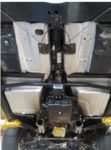
Almost 2 years ago, I pulled the motor and trans for a complete rebuild. I added all the insulation/heat reflectors under the floor. The tunnel insulation with each floorboard insulations then the (at least mine were) steel plates on the front and bottom of the floor boards too.
My wife couldn't think about going in the car without full shoes on, and now she wears flip flops (like always) in the car and is very comfortable. She can even go barefooted and not be hot at all.
Like I said, we all do what we think is the best, I'm just sharing what worked for me and our 69. I have headers and full underneath exhaust, not side pipes too.
About 6 years ago, I did the entire interior in my 69. We cleaned it down to bare fiberglass. I put DynaMat Xtreme from the firewall all the way to the top of the turtle deck. I had a 69 Corvette that made no squeaks or rattles, except for the plastic over the gauges in the center console, which has been fixed now. I installed all the "stock" carpet and insulation on top of that.
Almost 2 years ago, I pulled the motor and trans for a complete rebuild. I added all the insulation/heat reflectors under the floor. The tunnel insulation with each floorboard insulations then the (at least mine were) steel plates on the front and bottom of the floor boards too.
My wife couldn't think about going in the car without full shoes on, and now she wears flip flops (like always) in the car and is very comfortable. She can even go barefooted and not be hot at all.
Like I said, we all do what we think is the best, I'm just sharing what worked for me and our 69. I have headers and full underneath exhaust, not side pipes too.
Le Mans Master
Joined: Oct 2007
Posts: 7,455
Likes: 977
From: RI, Now Franklin/Nashville TN
For whatever reasons, we all have our own ways, and I'm sure they all work pretty good.
About 6 years ago, I did the entire interior in my 69. We cleaned it down to bare fiberglass. I put DynaMat Xtreme from the firewall all the way to the top of the turtle deck. I had a 69 Corvette that made no squeaks or rattles, except for the plastic over the gauges in the center console, which has been fixed now. I installed all the "stock" carpet and insulation on top of that.
Almost 2 years ago, I pulled the motor and trans for a complete rebuild. I added all the insulation/heat reflectors under the floor. The tunnel insulation with each floorboard insulations then the (at least mine were) steel plates on the front and bottom of the floor boards too.
My wife couldn't think about going in the car without full shoes on, and now she wears flip flops (like always) in the car and is very comfortable. She can even go barefooted and not be hot at all.
Like I said, we all do what we think is the best, I'm just sharing what worked for me and our 69. I have headers and full underneath exhaust, not side pipes too.
About 6 years ago, I did the entire interior in my 69. We cleaned it down to bare fiberglass. I put DynaMat Xtreme from the firewall all the way to the top of the turtle deck. I had a 69 Corvette that made no squeaks or rattles, except for the plastic over the gauges in the center console, which has been fixed now. I installed all the "stock" carpet and insulation on top of that.
Almost 2 years ago, I pulled the motor and trans for a complete rebuild. I added all the insulation/heat reflectors under the floor. The tunnel insulation with each floorboard insulations then the (at least mine were) steel plates on the front and bottom of the floor boards too.
My wife couldn't think about going in the car without full shoes on, and now she wears flip flops (like always) in the car and is very comfortable. She can even go barefooted and not be hot at all.
Like I said, we all do what we think is the best, I'm just sharing what worked for me and our 69. I have headers and full underneath exhaust, not side pipes too.
Great point...
I agree there are many ways to tackle the heat issue and there are many solutions that all will work. The point is with very little real effort and modern materials in conjunction with the OEM carpet parts, these cars can be made VERY comfortable in the heat. Any one who thinks the OEM carpet and insulation was adequate frankly does not understand the magnitude of the improvements that can be made....