When you click on links to various merchants on this site and make a purchase, this can result in this site earning a commission. Affiliate programs and affiliations include, but are not limited to, the eBay Partner Network.
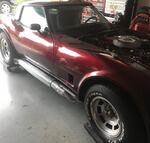
So my 79 has always had a very strong gas/exhaust smell. Finally decided to start figuring it out. Turns out I don't have the Evap canister, so im gonna purchase one. My question is, where should the lines on it run ?
I have worked on numerous Corvettes where the vapor line on the drivers side of the car rs plugged and some actually have the steel line split. Thus...fuel smell.
So..simply installing a charcoal canister is not always the only thing that is needed.
I do not have a diagram for the emission/charcoal system here at the house.
I am sure it is in the assembly manual...and I believe it is on the emissions decal that the car is supposed to have stuck on the firewall area....or possibly Willcox Corvette has it in the tech section of the website.
I have worked on numerous Corvettes where the vapor line on the drivers side of the car rs plugged and some actually have the steel line split. Thus...fuel smell.
So..simply installing a charcoal canister is not always the only thing that is needed.
I do not have a diagram for the emission/charcoal system here at the house.
I am sure it is in the assembly manual...and I believe it is on the emissions decal that the car is supposed to have stuck on the firewall area....or possibly Willcox Corvette has it in the tech section of the website.
I think this may work.
DUB
Thanks for the info! So is the steel line the one that runs to the fuel tank?
Also, I do not have an EGR valve on my car. Is it necessary or can I just not route that line?
Thanks for the info! So is the steel line the one that runs to the fuel tank?
Also, I do not have an EGR valve on my car. Is it necessary or can I just not route that line?
The steel line on the drivers side which runs to the gas tank.
I removed my EGR valve so I only use the outlet on the canister labelled "to Carb" and tee'ed this into the line from the PCV valve which goes to the base of the carb. Now this line only opens if there is vacuum on the small port connected to the valve, so connect it to the nearest vacuum.
I did not hook up the line "from Carb", since I really only wanted to burn fumes stored in the canister.
Yes, the steel line would be the one marked "To fuel tank" in the diagram Dub posted.
There is also a fuel vapor separator valve at the left front (I think, it's been a long time since I've been back there but it's on the left side of the tank) of the tank that is suppose to keep raw fuel from going into this line. Hopefully yours is ok and not leaking.
Last edited by theandies; Sep 6, 2017 at 06:35 PM.
On some carbs...there is a 3/8" port that comes of thee front of the carb and at a slight downward angle that has a hose from the charcoal canister that attaches to it. I like to make sure that this hose is attached due to that port is a point where gas fumes can escape...and not being within the air filter area...I just feel safer that it has the hose attached to it.
SO...it depends on the carb design...because not all QuadraJet carbs have it....due to the charcoal canisters changed a lot through the years also.
The main thing to remember is that...if my memory serves me correctly..and I believe in this scenario I am correct. The small vacuum hose that goes to your charcoal canister that you will attach to your carb...you want to make sure that that hose goes on a port that is 'ported vacuum' and NOT constant vacuum. And the way you can tell if it is 'ported vacuum' port (in case you do not know) is that when the engine is running and idling that there is NO vacuum on that hose UNTIL you increase the throttle. Obviously a constant vacuum port will have vacuum on it when the engine is at idle.
The reason for this is that you only what the charcoal canister to be able to pull fumes out of the fuel tank when you are above idle...that way...the increase in fuel vapors being drawn into the carb and burned will not be detected. IF you attach the small hose to a constant vacuum port...then that can effect your curb idle due to an additional fuel vapor introduction that you can not control.
The steel vapor line has a hose that attaches to the end of it...and it then goes to a 'T' fitting that is threaded into the fuel tank itself ...and then another piece of hose that then goes to the vapor line on the sending unit. This is due to the facotry fuel tank has a bladder in it.
The steel vapor line has a hose that attaches to the end of it...and it then goes to a 'T' fitting that is threaded into the fuel tank itself ...and then another piece of hose that then goes to the vapor line on the sending unit. This is due to the facotry fuel tank has a bladder in it.
Ok so my canister has 3 ports : one marked air, tank, and purge. Obviously tank goes to the fuel tank, which of the other two should I T into PCV valve? And should i plug the remaining?
Designer Imagines A Corvette That Looks More Like a Corvette Than the Corvette
Slideshow: A Jaguar designer's personal project imagines what a modern front-engined Corvette might look like if Chevrolet revisited the golden age of the Stingray.






 Evap cannister