






Wire connector on replacement brake proportioning valve

Thread Starter
Intermediate

Joined: Oct 2017
Posts: 43
Likes: 1
 Wire connector on replacement brake proportioning valve
I replaced the brake proportioning valve on my 1969 350 convertible. The folks at Ecklers assured me the replacement was identical to the original. Now that it's installed, I find the original wire connector to the switch doesn't fit. I called Ecklers and they were no help. Does anyone know what type of connector I need to find in order to connect to the new valve? Thanks.
Thread Starter
Intermediate
Joined: Oct 2017
Posts: 43
Likes: 1
I'll try. The original connector was "inset" and slipped over the original switch. The original connector is too small to fit over the new terminal. The new terminal does not stick out as much as the original. If worse comes to worse, my thought was to trim the "skirt" off the original plug. Let me see if I can get some pictures. The new valve is already installed and it may be difficult to get a clear picture.

Pro


Joined: Sep 2016
Posts: 720
Likes: 205
From: Michigan
Mine was snipped off close to the valve by the P.O.
Probably was getting a BRAKE light that he was getting tired of looking at.
I still have the pigtail with the connector that was left on the valve, but I'd like to hook it back up again.
Where does the other end of that wire eventually connect to? The circuit diagram is hard to read for this circuit, as it also includes the park brake lever switch.
It looks like the wire should route up to the main wire bundle on the left fender inner, but it's not clear where it was snipped off at, and then where it would terminate.
Ultimately, I want to be able to confirm that the valve and sensor are functioning properly.
I've heard that if the valve gets stuck, the light will come on, and you will have dis-proportionate brake pressure front-to-rear.
If the P.O. snipped the wire to make the warning light quit, there may still be the underlying issue remaining.
Probably was getting a BRAKE light that he was getting tired of looking at.
I still have the pigtail with the connector that was left on the valve, but I'd like to hook it back up again.
Where does the other end of that wire eventually connect to? The circuit diagram is hard to read for this circuit, as it also includes the park brake lever switch.
It looks like the wire should route up to the main wire bundle on the left fender inner, but it's not clear where it was snipped off at, and then where it would terminate.
Ultimately, I want to be able to confirm that the valve and sensor are functioning properly.
I've heard that if the valve gets stuck, the light will come on, and you will have dis-proportionate brake pressure front-to-rear.
If the P.O. snipped the wire to make the warning light quit, there may still be the underlying issue remaining.
Thread Starter
Intermediate
Joined: Oct 2017
Posts: 43
Likes: 1
I'd feel better if there were some way to see the switch function. By that I mean under normal pressure read one way and under low pressure read the other way. When you had the sender out of the housing did the plunger end move in and out? Thanks again.
Thread Starter
Intermediate
Joined: Oct 2017
Posts: 43
Likes: 1
Okay, I pulled the sender out. In this "low pressure" configuration, I'm thinking the switch should allow the wire lead to go to ground and light the brake warning light in the dash. Sitting on the table, my unit is "open." And try as I might, even with pliers, I can't get movement in the switch. The switch should only be open when under pressure, right? Low pressure, circuit closes, dash light goes on. I'm thinking this is a bad unit. Back to trying to find a way to connect the new one. Thanks again, Ed.
Corvette Stories
The Best of Corvette for Corvette Enthusiasts

Top 10 Most Expensive Corvettes Ever Sold on Bring A Trailer
Brett Foote
10 Things Every Corvette Owner Needs (2026 Edition)
Michael S. Palmer
8 Most "Only Corvette Owners Understand" Quirks and Problems
Pouria Savadkouei
10 Reasons the C6 Z06 is Still A Performance Benchmark After 20 Years
Joe Kucinski
How Much Horsepower Every Corvette Engine "LOST" in 1972
Joe Kucinski
Top 10 DOs and DON'Ts for Protecting Your Convertible Top!
Michael S. Palmer
Top 10 Most Explosive Corvettes Ever Made: Power-to-Weight Ratio Ranked!
Joe Kucinski
150 hp to 1,250 hp: Every Corvette Generation Compared by the Specs That Matter
Joe Kucinski
8 Coolest Corvette Pace Cars (and Replicas) of All Time
Verdad Gallardo
Thread Starter
Intermediate
Joined: Oct 2017
Posts: 43
Likes: 1
Thread Starter
Intermediate
Joined: Oct 2017
Posts: 43
Likes: 1
The vinegar soak didn't do squat. I called Ecklers and asked to speak to a supervisor. I asked that they remove the proper sending unit from a 1969 brake proportioning valve in their stock and send it to me. They said they will. We'll see what they send and how difficult it will be to replace in the installed valve.
Team Owner


Joined: Sep 2006
Posts: 31,285
Likes: 4,375
From: Westminster Maryland
Hi,
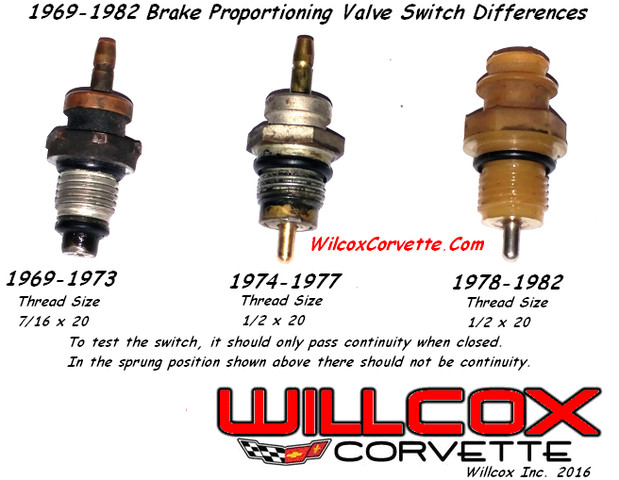
It appears Ecklers has sold you the later style switch.
Perhaps Willcox has the switches available if you're not successful with what Ecklers send now?
Regards,
Alan
It appears Ecklers has sold you the later style switch.
Perhaps Willcox has the switches available if you're not successful with what Ecklers send now?
Regards,
Alan
Last edited by Alan 71; Oct 24, 2017 at 04:39 PM.
Le Mans Master


Joined: Aug 2017
Posts: 8,336
Likes: 2,810
From: Cool Northern Michigan
Vinegar is for coffee makers. Hit that switch with some manly stuff such as PB Blaster.
Evidently that switch wire harness changed design some years ago. I don't believe the P Valve changed much, just the switch. In my opinon, they sent you the wrong P Valve but as I recall, I just swap out the switch with the one that your harness boot will get a weather proof seal on. No worries about brakefluid escaping when removing the switch.
Evidently that switch wire harness changed design some years ago. I don't believe the P Valve changed much, just the switch. In my opinon, they sent you the wrong P Valve but as I recall, I just swap out the switch with the one that your harness boot will get a weather proof seal on. No worries about brakefluid escaping when removing the switch.

Safety Car


Joined: Nov 2005
Posts: 3,532
Likes: 1,185
From: Arizona - If you don’t know CFI, STOP proliferating the myths around it...
I just replaced all my brake lines and the crossover line in the rear on my 82 and now my brake light stays lite. Trying to figure out how to get the light to go out. It appears that you just can't manually move the valve, but use compressed air and then bleed one front and one rear caliper at the same time to center valve on switch. Never heard of doing that nor is it in the GM manual or talk about this issue. Maybe my switch needs replacing? It appears that my rear brakes are locked out. Anybody familiar with this procedure? Thank you.
Last edited by Buccaneer; Oct 28, 2017 at 02:12 PM.
Thread Starter
Intermediate
Joined: Oct 2017
Posts: 43
Likes: 1
My new sender has continuity between its tip and plug when not installed, but no continuity between the tip and the attaching nut. So does this mean that under this "low pressure condition" the circuit is open? Is someone willing to put a VOM on a properly functioning switch to see if its tip is grounded? That would mean the brake light comes on when the circuit is broken, right? Then pulling the wire off the sender should turn the brake light on and a broken wire would also turn on the light. I'm soo confused.
Le Mans Master
Joined: Aug 2017
Posts: 8,336
Likes: 2,810
From: Cool Northern Michigan
You can cancel a stuck brake lite issue by removing the wire. But only as a test. The Prop valve should self-center if there is no difference in pressures between front & back systems by jamming on the pedal, rapidly. To hold it centered while performing brake bleeding you will need the little tool ($12) that replaces the prop valve Switch temporarily.
Last edited by HeadsU.P.; Nov 3, 2017 at 03:35 PM.
Thread Starter
Intermediate
Joined: Oct 2017
Posts: 43
Likes: 1
Le Mans Master
Joined: Aug 2017
Posts: 8,336
Likes: 2,810
From: Cool Northern Michigan
I wish I knew how to post pictures of the inards of the Prop valve. Try Google for pix. The valve moves front to back and when it does or I should say if it does due to issues, there is a little nub that triggers or pushes up on the switch (light on)
And the little tool is from PAR? Performance something-something? sorry. Google that too. Proportioning valve tool.
And the little tool is from PAR? Performance something-something? sorry. Google that too. Proportioning valve tool.
Last edited by HeadsU.P.; Oct 28, 2017 at 08:11 PM.
Thread Starter
Intermediate
Joined: Oct 2017
Posts: 43
Likes: 1

Boy did I have a Bass Ackwards understanding of this switch. I thought it was a low pressure indicator. It's actually an unbalanced pressure indicator. I see that it only closes when the pressure between the front and rear brake lines is out of balance and pushes the "plunger" up or down.. Only then does it ground its terminal and the wire coming off of it. Thanks guys, I learned a lot about brake line proportioning valves.