When you click on links to various merchants on this site and make a purchase, this can result in this site earning a commission. Affiliate programs and affiliations include, but are not limited to, the eBay Partner Network.
Have a question about the air filter, which I believe is stock for the '70 [except maybe the chrome lid?]
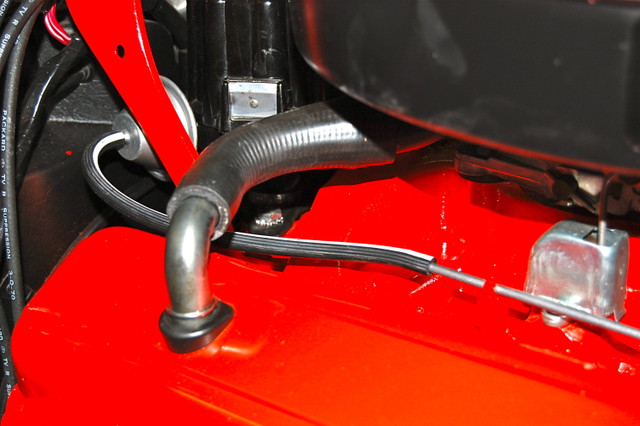
There is a fitting on the right rear of the filter where I assume a hose attached.
The car came to me like this and my question is where did the hose go to and do I even need it?
There are enough hoses in the engine compartment already! The fittling is dead center of the pic. Thanks
Hi S,
That air cleaner base was used in later 70 and 71-72 cars.
It's known as a closed type.
Some optional engines still used the simple round air cleaner with a chrome lid; but the base motor for example used that closed type.
On both the open and the closed base air cleaner there was a grommet and pipe in the rear of the left side valve cover that connected to the pipe you're seeing with a rubber hose.
The sequence number of your car will be an indication if it originally had the open or closed air cleaner.
Regards,
Alan
There is supposed to be a breather hose on there, that runs to a metal tube installed in the right (passenger) side valve cover. The hose has a 90 degree bend in it, and is a larger diameter at the air cleaner, then it is at the valve cover.
Hey Guys...thanks for your quick response. Doesnt surprise me that this may be a later model air filter, no biggie to me, car is not 100% original.
My right side valve cover does have an opening w/grommet and hose, but that hose goes to the front of the carb. What are your thoughts on that?
One other question: on the pics above, there is a chrome cover above the distributor, I do not have that. Guessing it is to keep water off?
Should the '70 model have that? If no, its it a simple add? [would like to add some chrome to the engine area to make the compartment look a little better]
Hi Steve,
Any engine that was installed in a Corvette had chrome plated steel 'radio shielding' to cut down on radio interference from the ignition system... if the car was ordered with the radio option
It consisted of a cover over the distributor, vertical shields that the spark-plug wires ran through, and horizontal shields for the spark plugs.
The configuration of the box over the distributor and coil evolved slightly over the years. If you look at the 2 photos carefully you can see the difference; the 2 piece is first and then the one piece.
Regards,
Alan
The radio shielding for a 71 sb car.
Here you can see the one piece distributor shield, (earlier cars boxes were 2 pieces and covered more of the distributor), the left side vertical shield, and the shield on the rear pair of spark plugs on the left side. (Earlier cars had a shield on the forward pair of spark plugs too.)
If you're not going to run a hose from that pipe to the valve cover I suggest you cap it. As it is right now it's a direct port for unfiltered air to enter the engine.
Hey Guys...thanks for your quick response. Doesnt surprise me that this may be a later model air filter, no biggie to me, car is not 100% original.
My right side valve cover does have an opening w/grommet and hose, but that hose goes to the front of the carb. What are your thoughts on that?
One other question: on the pics above, there is a chrome cover above the distributor, I do not have that. Guessing it is to keep water off?
Should the '70 model have that? If no, its it a simple add? [would like to add some chrome to the engine area to make the compartment look a little better]
Thanks in advance.
Per your valve cover hoses, there should be a PCV valve in the left valve cover and a hose going from this to the inlet manifold. The right valve cover hose should go to the air cleaner.
That's the fresh air intake for your PCV system. what is on your valve cover on the right side right now? And is there a PCV on the left side valve cover?
If these have been eliminated there should at least be a couple of vents, if not you are going to have lots of oil leaks.
If you're not going to run a hose from that pipe to the valve cover I suggest you cap it. As it is right now it's a direct port for unfiltered air to enter the engine.
That's the fresh air intake for your PCV system. what is on your valve cover on the right side right now? And is there a PCV on the left side valve cover?
If these have been eliminated there should at least be a couple of vents, if not you are going to have lots of oil leaks.
The PCV is on the right valve cover. It is connected to a hose that runs to the front of the carb. Thoughts?
The PCV is on the right valve cover. It is connected to a hose that runs to the front of the carb. Thoughts?
The idea behind having an air "in" supply on the right side and an air "out" (PCV) on the left side (standard configuration) is to remove unwanted comubstion byproducts from the crankcase area that get by the rings during combustion. These byproducts contaminate the oil and can pressurize the crankcase/engine if not allowed to escape.
So in your case, (and this depends on the level of blowby), your PCV will evacuate these gasses via intake vacuum but not replace the evacuated gasses with fresh air. So it will partially evacuate the blowby gasses and create a partial vacuum inside the crank case up to the point that blowby becomes greater than the available vacuum from the intake manifold.
Likely around 3/4 to 7/8 throttle and up blowby is going to exceed the vacuum at the intake manifold. This will pressurize your crankcase from the blowby gasses. Your PCV will no longer be evacuating the gasses since it has a one way valve on it and will not be allowed to function unless vacuum from the intake side is greater than the blowby pressure from the crankcase.
This is where the oil leaks come in. Since the crankcase, and largely the entire engine becomes pressurized that pressure has to go somewhere. That somewhere is everywhere a gasket exists that encloses the crankcase/engine. Oil pan gasket, valve cover gaskets, intake manifold china walls etc.
Normally on an engine with a fresh air intake the air flow that was going into the engine at lower throttle settings and higher intake vacuum levels reverses at high crankcase pressures with low intake manifold vacuum. The air intake on the right valve cover becomes a crankcase pressure relief hole. Depending on how much throttle, how long you are there and how good your ring seal is it may or may not be adequate and excessive crankcase pressure can develop, but at least there is some pressure relief vs the configuration of your engine where the gasket sealing surfaces become the only pressure relief.
Last edited by REELAV8R; Jan 22, 2018 at 11:11 AM.
Designer Imagines A Corvette That Looks More Like a Corvette Than the Corvette
Slideshow: A Jaguar designer's personal project imagines what a modern front-engined Corvette might look like if Chevrolet revisited the golden age of the Stingray.









 '70 350/300 Air filter question