When you click on links to various merchants on this site and make a purchase, this can result in this site earning a commission. Affiliate programs and affiliations include, but are not limited to, the eBay Partner Network.
Trying to most effectively vent the oil/gasses from my 72 Stingray crankcase. I've read many posts on how to do it - pcv valves, valve cover breathers, no pcv valves, etc.
In looking at the pcv valve solution, , does it really matter which valve cover you place a pcv valve into? I've heard that you should use the right (drivers side).
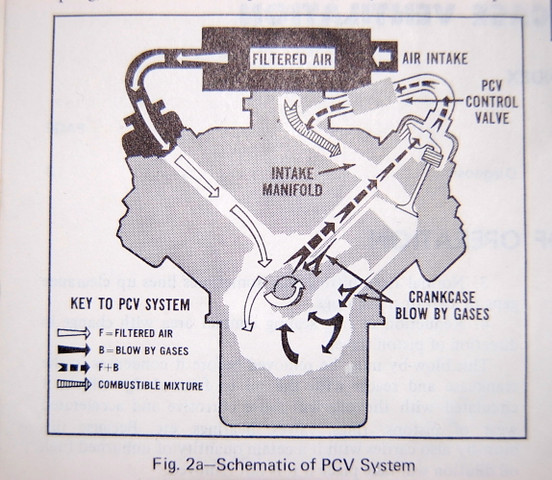
I've seen engine illustrations showing air movement in the engine flowing in a clockwise motion (as the engine is rotating in a clockwise motion) so it would seem that a pcv valve venting to the carb would be most effective from the left (passenger) side valve cover with a valve cover vent on the right valve cover...
I am trying to reduce the "misting" of oil residue under the hood and was wondering what other methods you guys are using.
FWIW I have 2 big blocks in trucks and run 1 PCV in drivers side and 1 in passenger side. kinda just happened that way. doesn't make a difference they both get a little oil out of the breather in the opposite valve cover.
I've read the "best" solution is to run the breather hose up to the air cleaner base rather than just an open element.
A earlier post this month showed the best idea yet. Oil Catch Can off of one valvecover then a return line to the carb base. The other valvecover received a common inlet breather.
Instead of burning that crap-oil-mist, which fouls plugs, carbons up the back of the valves, stains the intake runners, screws up the A/F ratio with the PCV system, just catch it in a can. Prices range from junk $15 to $450 elaborate units.
Check out YouTube for interesting videos of how much crap is NOT allowed into the intake. Its about a 3 oz a month. Thats 3 oz of gas, oil, water vapors.
Hi JT,
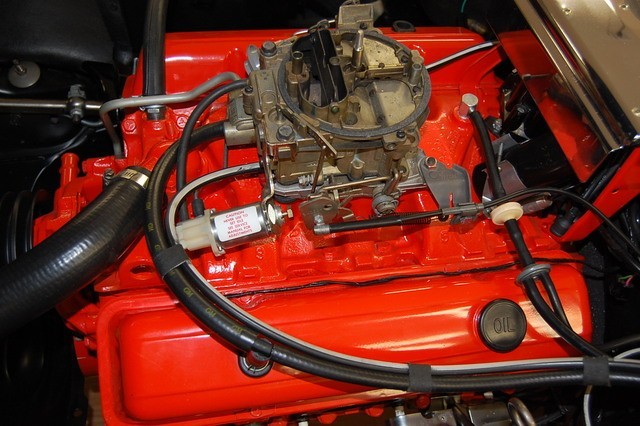
This the typical configuration using the pcv valve connected to the base of the carburetor and the breather connected to the air cleaner base.
In cars with a vapor recovery system this puts the pcv valve in a convenient location for routing those hoses too.
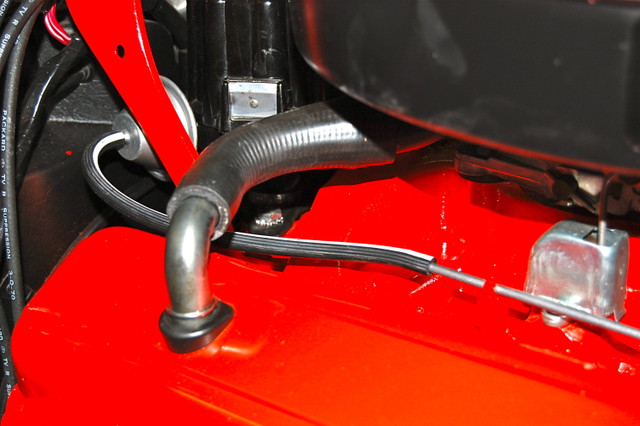
If the elbow for the connection to the air cleaner base is on the left side of the engine it can interfere with the throttle linkage.
Regards,
Alan
I believe this rating would be typical for your 72. (This is a 71)
have considered welding a baffle (underneath a single plane behind the carb). 3/4 or so hole and routing that up to the A/C base. Id thnk you could get rid of windage there rather than having it all blow up through the oil returns. Who knows if it would be good, bad or a waste of time. Could run old school valve covers though and a little neater appearance.
For most general purposes esp a stock stroke 350 the GM setup is plenty adequate. If you got a big stroke a very good pan is money well spent.
the engine does not know left from right, however front to back can have an impact on oil control for drag racing or road racing where G forces come into play.
the pcv cycle itself is more efficient the further away the 'in' and 'out' is.
to exaggerate if they were side by side on the same valve cover you can see how this would not do much of the engine any good.
Trying to most effectively vent the oil/gasses from my 72 Stingray crankcase. I've read many posts on how to do it - pcv valves, valve cover breathers, no pcv valves, etc.
In looking at the pcv valve solution, , does it really matter which valve cover you place a pcv valve into? I've heard that you should use the right (drivers side).
I've seen engine illustrations showing air movement in the engine flowing in a clockwise motion (as the engine is rotating in a clockwise motion) so it would seem that a pcv valve venting to the carb would be most effective from the left (passenger) side valve cover with a valve cover vent on the right valve cover...
I am trying to reduce the "misting" of oil residue under the hood and was wondering what other methods you guys are using.
When I installed an Edelbrock Performer intake, with the Q-jet on my 73, I installed a 70' LT-1 drop air filter assembly. Was able to route the gases into the air filter/carb area, with the flame arrester. Would the original 72 factory setup address your concerns? Might not work on different carb.
Left or right side does not matter, Pontiac pulled the PCV from under the carb through the manifold / valley pan from the valley between the heads.
Most manufactures use the front of the valve cover because during acceleration oil can be forced toward the rear of the engine in the valve covers and cause the PCV to pull oil into the system.
The current problem today is most PCV setups pull too much vacuum and thus oil into the engine.
I restrict the system by using a 1/8 (3/32) hose and have no issues / oil mist.
If I was to use a "regular PCV system I would use the Variable PCV valve and adjust it properly.
The catch can is used by many people to solve the problem of pulling crud into the combustion chamber. I have viewed everything from $300 cans to a Harbor Freight oil / water separator being used. The $9 harbor freight separator works well as does the cans, most have steel wool as the element for "catching the oil" . AS stated just be sure you have a drain for the can.
Also remember that you are pulling raw air (no fuel) through the PCV,, so you may have to richen the mixture.
Last edited by BLUE1972; Jan 30, 2018 at 09:28 PM.
Reason: hate auto spell
Trying to most effectively vent the oil/gasses from my 72 Stingray crankcase. I've read many posts on how to do it - pcv valves, valve cover breathers, no pcv valves, etc.
In looking at the pcv valve solution, , does it really matter which valve cover you place a pcv valve into? I've heard that you should use the right (drivers side).
I've seen engine illustrations showing air movement in the engine flowing in a clockwise motion (as the engine is rotating in a clockwise motion) so it would seem that a pcv valve venting to the carb would be most effective from the left (passenger) side valve cover with a valve cover vent on the right valve cover...
I am trying to reduce the "misting" of oil residue under the hood and was wondering what other methods you guys are using.
For future reference, driver’s side is left, passenger side is right.
Hi,
"For future reference, driver’s side is left, passenger side is right."
And.....when parts are in pairs.... right and left... the RIGHT side part's # ends in an EVEN digit, while the LEFT side's part # ends in an ODD digit.
I did not want to run a PCV being as I have a very low vacuum engine (6 in at idle) and have chosen to remove any variables relative to the idle vacuum.
I had a simple "breather widget" stuck on a valve cover, and didn't care for it. I just ended up with oil making a mess of things...dripping on my wires, and dripping on my exhaust when accelerating.
I chose to install a "catch can" under the driver's side fender. It required the removal of the vacuum accumulator vessel, the removal of which required the removal of the master cylinder, but I have been VERY, VERY pleased with the results.
This, of course, means that the headlights and wiper door no longer have the benefit of the vacuum accumulator which you may not like. I could not find another location for the catch can on my car given that the opposite fender is already occupied by my MSD 6AL box. If you don't have that as an impediment, perhaps you can put the catch can on that side and keep your vacuum stuff.
Nice clear photos. What do you have on the other valvecover? Breather for a "inlet"?
Negative. Oil filler bung.
I have never been advised that a 'inlet' is necessary. There is no check valve or anything on the catch-can setup I have, so the engine is welcome to "breathe" through that setup.
The big difference being, of course, that it's not coughing oil phlegm all over my MSD wires, my block, and my sidepipe headers. My wife DID NOT enjoy getting a shot of burned oil smoke every now and again.
From: Some days your the dog and some days your the hydrant.
Royal Canadian Navy
Originally Posted by keithinspace
...... it's not coughing oil phlegm all over my MSD wires, my block, and my sidepipe headers.
I don't run a pcv, just two valve cover breathers and have never experienced this. I also don't get any oil misting under the hood. Maybe you have excessive blowby?
I've tried the "no pcv" setup and still had the misting. I've fabricated vent "towers: filled with filter material, still had some misting, and several variations of pcv hose routing with the same result. I'm trying a catch can with a pcv and will see how that works..And yes probably have too much blowby...
The saga continues.
It's a 10.5:1 engine, so she's squeezing things down a bit more than your average bear. Professionally built by a VERY capable, ****-retentive, local engine builder under my supervision. The 10k-mile-old block was ball honed and the original LT-1 forged pistons fitted with new rings. Perhaps 6,000 miles on the clock. LOTS of cam. Whatever all that means. It's not a worn-out engine.
I've never experienced "misting", so much as "dripping". Basically, the breather element got saturated with oil over time, so the moment I get a hint of positive crankcase pressure (which is normal), it pushes air through the saturated breather, which then drips down onto the stuff below.
From: Some days your the dog and some days your the hydrant.
Royal Canadian Navy
For comparison, I'm running 10.7:1 scr and have about 30K miles on my bottom end and about 5K miles on my top end build built by myself. I'm just wondering why so many guys have problems with crankcase breathing leading to carbon buildup on intake valves, oil misting/dripping, to name a few. If at some point down the road I get problems like yours I will go the catch can route to keep the oil out of my intake manifold.
Last edited by resdoggie; Feb 2, 2018 at 10:16 AM.
Designer Imagines A Corvette That Looks More Like a Corvette Than the Corvette
Slideshow: A Jaguar designer's personal project imagines what a modern front-engined Corvette might look like if Chevrolet revisited the golden age of the Stingray.




 Engine breathing/PCV Venting