



160° thermostat.

Le Mans Master


Joined: Oct 2007
Posts: 7,446
Likes: 971
From: Tennessee/Rhode Island

Sounds like you need at least this Long/Dana 28,000 GVW cooler which is installed on my 2008 Chrysler 300:
Or
40,000 GVW Long Tru Cool max:
http://www.trucool.com/products/tru-cool-max
Last edited by jb78L-82; Jul 3, 2018 at 07:51 PM.

Melting Slicks


Joined: Oct 2010
Posts: 2,276
Likes: 337
From: "ɹǝpunuʍop", Adelaide, South Australia
you haven't said if you have the lip extension fitted under the front.
do you have the fan shroud fitted with correct thermo clutch assembly and fan blade spaced properly into the shroud?
do you have the foam / rubber seals around and across the top the fan shroud?
post some pics of your setup.
do you have the fan shroud fitted with correct thermo clutch assembly and fan blade spaced properly into the shroud?
do you have the foam / rubber seals around and across the top the fan shroud?
post some pics of your setup.
Last edited by riverracer au; Jul 3, 2018 at 08:41 PM. Reason: spelling

Thread Starter
Burning Brakes


Joined: Apr 2013
Posts: 1,072
Likes: 61
From: Saint clair shores Michigan
Yes to all of the above. Can't figure it out. A running hot 383. Who knows. It's just probably putting out more power than I thought. I've gotta get it dynoed.

Had a 1976 L-82, 4-sp


Joined: Mar 2011
Posts: 5,338
Likes: 1,213
From: Some days your the dog and some days your the hydrant.
Royal Canadian Navy
If you have everything in place like the front air dam, rad cooling fans, high flow water pump, correct timing, etc., then your aluminium radiator is too small for the heat generated by that 383 or you have a blockage somewhere in the cooling system. But do change out that 160* thermostat for a 180*. You don't want your oil temp too cool i.e. less than 180*.

Race Director

Joined: Apr 2009
Posts: 19,294
Likes: 2,753
From: Charlotte NC
Thanks.DUB. I do agree with everything you said. The exhaust is new. All the wires are new through out the car. The cluster guages are NOS. I guess that from the HP and TQ, that that's the way it's gonna be.. I can live with it. The car is nearly mit. Im just used to my C5Z. Everything is perfect.
thanks
John
thanks
John
I can totally understand on how your C5 was perfect and you got used to that.
But just consider this....and I am not trying to make excuses or say that you cannot achieve what you are wanting is not possible.
But. Comparing your C5 to this engine not quite the same. Aluminum engine block , heads and plastic intake manifold and design have a lot to do with it as you know. Because if you stop and think about it....could it be possible that when GM was designing the LS engine. That they chose a location in the engine that would give them a place for the temperature sender to be installed to show the coolant temperature that they wanted US to see...that would not allow us all to freak out if it got to... lets say...210 degrees F all the time??? But YET...in actuality...the coolant temps are higher...and they are just tricking us so we do not constantly take the car in for service when nothing is actually wrong with it.
Because as you know GM moved the temperature senders around on the small blocks.
DUB

Former Vendor
Joined: Jan 2000
Posts: 5,593
Likes: 631
From: Brighton
I read through this thread and ended with the same question! It is titled 160 thermostat and then changes to transmission cooling.
I think the OP is chasing problems that do not exist and possibly creating one in the process. Engines running 210-220 on a 90 degree day are fine. No problem at all.
As far as Transmission cooling goes, the ultimate method is the cool/warm method. This involves running the fluid to the air type cooler first, then back through the radiator, and return to the transmission. Air type coolers can actually over cool the fluid (without a bypass) and cause shift problems and damage to the transmission. The cooler inside the radiator was created to do two things....1. warm up the fluid in cold climates, and 2. reduce fluid temperature under heavy loads. Instead of coolers I like to think of them as maintainers. Transmissions like the fluid to be the same temperature all the time, even if that temperature is 230 degrees. Constant temperatures mean constant viscosity and that allows the transmission to shift as designed.
The cool/warm method works the best because the air type removes any excessive heat and the radiator warms it back up so the transmission runs the same all the time. One aftermarket transmission company reported this method reduced their warranty repairs from 10% to almost zero.
I think the OP is chasing problems that do not exist and possibly creating one in the process. Engines running 210-220 on a 90 degree day are fine. No problem at all.
As far as Transmission cooling goes, the ultimate method is the cool/warm method. This involves running the fluid to the air type cooler first, then back through the radiator, and return to the transmission. Air type coolers can actually over cool the fluid (without a bypass) and cause shift problems and damage to the transmission. The cooler inside the radiator was created to do two things....1. warm up the fluid in cold climates, and 2. reduce fluid temperature under heavy loads. Instead of coolers I like to think of them as maintainers. Transmissions like the fluid to be the same temperature all the time, even if that temperature is 230 degrees. Constant temperatures mean constant viscosity and that allows the transmission to shift as designed.
The cool/warm method works the best because the air type removes any excessive heat and the radiator warms it back up so the transmission runs the same all the time. One aftermarket transmission company reported this method reduced their warranty repairs from 10% to almost zero.
Last edited by Tom@Dewitt; Jul 4, 2018 at 11:37 AM.
Corvette Stories
The Best of Corvette for Corvette Enthusiasts

10 Reasons the C6 Z06 is Still A Performance Benchmark After 20 Years
Joe Kucinski
How Much Horsepower Every Corvette Engine "LOST" in 1972
Joe Kucinski
Top 10 DOs and DON'Ts for Protecting Your Convertible Top!
Michael S. Palmer
Top 10 Most Explosive Corvettes Ever Made: Power-to-Weight Ratio Ranked!
Joe Kucinski
150 hp to 1,250 hp: Every Corvette Generation Compared by the Specs That Matter
Joe Kucinski
8 Coolest Corvette Pace Cars (and Replicas) of All Time
Verdad Gallardo
Top 10 Corvette Engines RANKED by Peak Torque (70+ Years of Muscle!)
Joe Kucinski
Corvette ZR1X Will Be Pacing the Indy 500, And Could Probably Race, Too!
Verdad Gallardo
Top 10 Corvettes Coming to Mecum Indy 2026!
Brett Foote
Melting Slicks
Joined: Aug 2016
Posts: 2,343
Likes: 1,173
From: CLEVELAND STUCK IN OHIO
2024 C3 of the Year Finalist- Modified
 , , All great advice given,, and none of us want to "wast money " ,, so, don't waste your money on dyno, that won't help you get your eng temps down, ,,, unless you realize , your tune is way off, and producing heat,,,, oh well, it's not overheating, , ,get out and enjoy the money you spent on your favorite hobby, ,

Le Mans Master

Joined: Mar 2004
Posts: 7,477
Likes: 1,495
From: Little Rock AR
If you have everything in place like the front air dam, rad cooling fans, high flow water pump, correct timing, etc., then your aluminium radiator is too small for the heat generated by that 383 or you have a blockage somewhere in the cooling system. But do change out that 160* thermostat for a 180*. You don't want your oil temp too cool i.e. less than 180*.
The thermostat is not there to set the upper limit on temperature, it is there to set the LOWER limit on temperature. The thermostat prevents coolant flow to the radiator until the cooling system reaches the lower limit. Thermostat is there to speed up the warm up time and get the fluids up to a minimum operating temp as fast as possible to improve drivability and get the oil up to proper temp to lube the moving parts and drive off any oil contaminants that will need to be vaporized and removed by the PCV system. We want the engine to warm up faster to live longer and run right. Getting to warm faster is better here.
Once a t-stat opens at the minimum set point, the temperature regulating function is handled by other parts of the cooling system. Its work is done.
Had a 1976 L-82, 4-sp
Joined: Mar 2011
Posts: 5,338
Likes: 1,213
From: Some days your the dog and some days your the hydrant.
Royal Canadian Navy
This is true.
The thermostat is not there to set the upper limit on temperature, it is there to set the LOWER limit on temperature. The thermostat prevents coolant flow to the radiator until the cooling system reaches the lower limit. Thermostat is there to speed up the warm up time and get the fluids up to a minimum operating temp as fast as possible to improve drivability and get the oil up to proper temp to lube the moving parts and drive off any oil contaminants that will need to be vaporized and removed by the PCV system. We want the engine to warm up faster to live longer and run right. Getting to warm faster is better here.
Once a t-stat opens at the minimum set point, the temperature regulating function is handled by other parts of the cooling system. Its work is done.
The thermostat is not there to set the upper limit on temperature, it is there to set the LOWER limit on temperature. The thermostat prevents coolant flow to the radiator until the cooling system reaches the lower limit. Thermostat is there to speed up the warm up time and get the fluids up to a minimum operating temp as fast as possible to improve drivability and get the oil up to proper temp to lube the moving parts and drive off any oil contaminants that will need to be vaporized and removed by the PCV system. We want the engine to warm up faster to live longer and run right. Getting to warm faster is better here.
Once a t-stat opens at the minimum set point, the temperature regulating function is handled by other parts of the cooling system. Its work is done.
The TS sets the operating temperature of the coolant, not just for warm-up, in conjunction with the radiator so it remains near constant for the TS rating because that is what TS's do whether its in a car, your home, oven, freezer, refrigerator etc. They all require a TS to control temperature at a pre-determined set point in conjunction with heat exchanger(s) and pump(s). Without a thermostat, you CANNOT control the temperature of the fluid unless the ambient air/liquid removing the heat remains constant which is impossible for automobilies i.e. ambient air temperature is constantly changing, hence, the requirement for a TS. If the TS is removed, your coolant temperature will be all over the place. In sub-zero temps, the car will never warm up. In hotter temperatures, the car will eventually overheat. Try it!

Is my vette stock?? HAHA


Joined: Oct 2015
Posts: 20,185
Likes: 9,321
From: Im not allowed to tell you
2020 C3 of the Year Finalist - Modified
2020 Corvette of the Year Finalist (performance mods)
2019 C3 of Year Winner (performance mods)
2016 C3 of Year Finalist
whats your rear end gearing and what speeds are you driving. I have a 327 4spd with 3.70 gears and 165* thermostat. it will stay low on the gauge as long as I'm not doing above 75mph on the highway, then it goes to 195 ish but will stay there, it doesn't overheat, it just runs right near 200*. If I'm in the traffic idling at the beach its also up at 200* due to no airflow. Before I put in the electric fan it would get above 210* above 75 mph and would overheat at the beach, I had to pay attention. Now I can keep up with the mini vans at 80 mph and not worry. Are you just wanting to stay below 200* on the highway or are you seeing that on the side streets/ regular driving

2nd Gear

Joined: Jul 2018
Posts: 2
Likes: 0
A 15 degree increase in ambient air temp will not cause a 30-40 degree increase in coolant temperature.......impossible. I would double check your gauge.
Also....cooling the trans down more will have little effect on coolant temp as well.......I mean it will help some.....reduce underhood temps, but water temp is water temp......not the temp of the engine or the oil.......actually oil temp is much more important but nobody ever monitors it.
190-200 is fine.......but I prefer 170-180 in Texas as it is just hot outside.....this keeps the components of the engine cooler.
But lets go through a couple of things:
1) Spring in lower hose?
2) High flow Thompson-Stant style thermostat? (Lets your hi-flow pump be hi flow )
)
3) Do you have the lower front lip spoiler......(this is huge..bottom breather car )
4) Pop the headlights up......does it help? ( This helps determine if airflow is insuffcient....the headlights when retracted restrict airflow from the very front grilles)
5) Run with the hood popped...does that help?..(Old C2 trick.....is the air getting out?)
Just a few things......I may think of more....
Good luck
Jebby
Also....cooling the trans down more will have little effect on coolant temp as well.......I mean it will help some.....reduce underhood temps, but water temp is water temp......not the temp of the engine or the oil.......actually oil temp is much more important but nobody ever monitors it.
190-200 is fine.......but I prefer 170-180 in Texas as it is just hot outside.....this keeps the components of the engine cooler.
But lets go through a couple of things:
1) Spring in lower hose?
2) High flow Thompson-Stant style thermostat? (Lets your hi-flow pump be hi flow
)3) Do you have the lower front lip spoiler......(this is huge..bottom breather car )
4) Pop the headlights up......does it help? ( This helps determine if airflow is insuffcient....the headlights when retracted restrict airflow from the very front grilles)
5) Run with the hood popped...does that help?..(Old C2 trick.....is the air getting out?)
Just a few things......I may think of more....
Good luck
Jebby
Melting Slicks
Joined: Aug 2016
Posts: 2,343
Likes: 1,173
From: CLEVELAND STUCK IN OHIO
2024 C3 of the Year Finalist- Modified
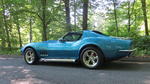
Do you at least have the small factory chin lip ( spoiler ) installed,, also, do your eng. temps increase when you are stopped? How hot is it getting?
2nd Gear
Joined: Jul 2018
Posts: 2
Likes: 0
Yes I have a spoiler installed and the temp will increase when stopped. In hot weather it could go as high as 205 to 210. It also has a 15 psi cap.
Thread Starter
Burning Brakes
Joined: Apr 2013
Posts: 1,072
Likes: 61
From: Saint clair shores Michigan
In 75° temperature with a trans cooler. The temp runs at 170°. The engine coolent runs at 170° . And that's with a 160° thermostat.. as soon as the temp reaches 85-90°, the trans temp goes up to 180°. Now. I've installed a toggle switch on the dash located below the steering column. I can then turn the fan on manually. Which in turn will keep the trans oil at a constant 180°. The engine oil will run at 190°, with the 160° thermostat.