










Brake disc rivets. What for?

Thread Starter
6th Gear

Joined: Jun 2019
Posts: 6
Likes: 0
 Brake disc rivets. What for?
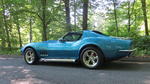
As I told you, this 1969 is new car for me.
I noticed, that the front brake discs still have 5 rivets each. Back discs do not have rivets any more.
Is this true: rivets are not ”functional”, and they were used for assembly line reasons only?
But the car is 50 years old, so the discs can not be that old, right?
But then, why somebody has riveted the new ones?
I noticed, that the front brake discs still have 5 rivets each. Back discs do not have rivets any more.
Is this true: rivets are not ”functional”, and they were used for assembly line reasons only?
But the car is 50 years old, so the discs can not be that old, right?
But then, why somebody has riveted the new ones?
Race Director


Joined: May 2006
Posts: 18,740
Likes: 2,583
You are correct that they are originally there for assembly line purposes. My 1969 still has the originals, I believe I had them surfaced once since 1973 when I bought the car.
Last edited by MelWff; Jul 13, 2019 at 12:08 PM.

Race Director
Joined: Jul 2015
Posts: 13,082
Likes: 3,399
From: SW Florida.
ok, so rivets are more than assy line convenience. the rotors need shimmed on these cars to remove runout. so they rivet the rotor to the hub and machine the runout out. so an orig riveted set SHOULD be flatter than a new replacement.
Corvette Stories
The Best of Corvette for Corvette Enthusiasts

Top 10 Most Expensive Corvettes Ever Sold on Bring A Trailer
Brett Foote
10 Things Every Corvette Owner Needs (2026 Edition)
Michael S. Palmer
8 Most "Only Corvette Owners Understand" Quirks and Problems
Pouria Savadkouei
10 Reasons the C6 Z06 is Still A Performance Benchmark After 20 Years
Joe Kucinski
How Much Horsepower Every Corvette Engine "LOST" in 1972
Joe Kucinski
Top 10 DOs and DON'Ts for Protecting Your Convertible Top!
Michael S. Palmer
Top 10 Most Explosive Corvettes Ever Made: Power-to-Weight Ratio Ranked!
Joe Kucinski
150 hp to 1,250 hp: Every Corvette Generation Compared by the Specs That Matter
Joe Kucinski
8 Coolest Corvette Pace Cars (and Replicas) of All Time
Verdad Gallardo
Drifting


Joined: Dec 2017
Posts: 1,306
Likes: 226
From: PA
organic pads forever
Adding my voice to the many miles on original rotors. Mine on my 1980 are at 90k. Rivets were on until I had the trailing arms rebuilt. At that time the original rotors were turned with no problem to meet factory spec thickness for post turning min thickness. Longevity in my opinion is due largely to the use of organic pads. When i see the wear on rotors from semi-metallic, metallic, and ceramic pads it is disturbing. Yes, I know they provide superior braking, but how much is that really needed on these older vettes in most cases. If my brakes get wet it's because I didn't expect rain. And the large surface area of vette brake pads coupled with large rotors will dissipate a lot of heat. Doing 60 mph and hitting the brakes just above the limit of locking up and going to a dead stop will literally create sufficient deceleration to give most people a head rush. So I'll continue to use the organics as long as someone makes them.
Last edited by vince vette 2; Jul 15, 2019 at 09:44 AM.