When you click on links to various merchants on this site and make a purchase, this can result in this site earning a commission. Affiliate programs and affiliations include, but are not limited to, the eBay Partner Network.
I irenstalled my brake booster and... the brake pedal does not go up as high as it used to. Indeed, the brake light is constantly on. Does the booster input rod unscrew and lengthen ? Are there perhaps two holes in the pedal arm ?
Not sure if this is related but, it took forever to bleed the brakes. (I had removed bot front calipers entirely.). I did notice that the passenger side does not seems to have the springs under the pistons. Not sure that affects the pedal height but it probably does affect the activation.
Not all model years have the optional pedal hole. Not all models have the adjustable Booster rod. Mine has nether.
What's the history here? New booster or same one? New master or same one?
If you are lucky, its just an adjustment like '75 said. If the booster rod is coming up short of touching the MC piston, then your brake pedal will be lower than before.
That also explains the lengthy bleeding procedure. Your master was never getting a FULL stroke. (no comment on that sentence, please)
How do you know the booster rod is not tight with the back of the MC piston? That's a silly question. Use Silly Putty. (do not use clay, messy)
By removing the MC two mounting nuts, carefully pull the MC away from the booster. You can usually leave the brake lines attached. Place a gob of putty on the end of the MC. Reinstall MC, snug the nuts, do not touch the pedal. Remove nuts, MC, pull putty out and measure imprint. The experts say you should have 0.060 gap.
But you should be able to eye-ball-it to see if you're in the ballpark.
And I believe only the rear caliper pistons have springs.
Last edited by HeadsU.P.; Sep 2, 2019 at 06:37 PM.
Not all model years have the optional pedal hole. Not all models have the adjustable Booster rod. Mine has nether.
What's the history here? New booster or same one? New master or same one?
If you are lucky, its just an adjustment like '75 said. If the booster rod is coming up short of touching the MC piston, then your brake pedal will be lower than before.
That also explains the lengthy bleeding procedure. Your master was never getting a FULL stroke. (no comment on that sentence, please)
How do you know the booster rod is not tight with the back of the MC piston? That's a silly question. Use Silly Putty. (do not use clay, messy)
By removing the MC two mounting nuts, carefully pull the MC away from the booster. You can usually leave the brake lines attached. Place a gob of putty on the end of the MC. Reinstall MC, snug the nuts, do not touch the pedal. Remove nuts, MC, pull putty out and measure imprint. The experts say you should have 0.060 gap.
But you should be able to eye-ball-it to see if you're in the ballpark.
And I believe only the rear caliper pistons have springs.
I will have to crawl back under the dash this evening. To check a few things. I can't see very well under there; I will try to snap a few pics with my smartphone.
There is a possibility that my daughter was not depressing the brake pedal all the way to the floor - I only discovered after fact that she had not noticed that the pedal had firmed up. I will bleed again soon - bubbles always bubble up in the calipers after a first bleed.
This is a Zip Corvette power brake conversion. However, I had installed it last year and, tho the travel was shortened at the time, it worked fine. The pedal did not come up as high is when it was manual. (Included in the kit was a new master cylinder in addition to the booster.) So I had to adjust the brake light switch to eliminate the slack.
When I reinstalled the assembly now... once again the pedal was not depressing the brake light switch As far as I know, nothing changed other than wrong hole of the yoke (pedal-to-booster-input) is adjustable and was shortened.
I thought I had checked the pedal side yoke to see if it was adjustable. It seemed not. (I will have to confirm this with pictures/visually.) As far as I know, adjustable yokes are threaded at the end and not inside the dust boot.
I did remove the clearance between the output pin of the booster and the master cylinder using the tool below and goodness... there was a good amount of slack there; see below
I see you purchased the special gap checking tool. That's good. But now I question how far that cap nut on the booster rod goes inside the MC. Mine is a lot different with no adjustment on the rod. Maybe its the camera angle, but it looks like the cap nut would be too far in. Maybe not.
I see you purchased the special gap checking tool. That's good. But now I question how far that cap nut on the booster rod goes inside the MC. Mine is a lot different with no adjustment on the rod. Maybe its the camera angle, but it looks like the cap nut would be too far in. Maybe not.
The gap checking tool works well and I got the rod-to-piston clearance to spec. Very easy.
The more I think about it... the more I am convinced I am using the wrong hole. Stay tuned later this evening. I can't get an eyeball up there, but I should get my smartphone in there.
The MC piston is different inside the mounting flange on a manual brake car than a PB car. One type is farther inside than the other. Its not usually an issue when replacing a standard MC. But when a owner converts from manual to power, or power to manual brakes, that change could really mess things up with the pedal height if:
Using the wrong MC
Using the wrong Booster.
Using the wrong brake pedal rod location hole.
All because of the MC piston location inside the mounting flange.
You are shooting 0.060 gap. I see how that tool sets the booster rod gap, but how does it check the MC piston depth? Flip the tool over?
Adding:
I see you have a GRD wire attached to the booster stud. If that wire terminal is 0.020 thick, that will change the 0.060 gap you need. I would not put a wire there.
Last edited by HeadsU.P.; Sep 3, 2019 at 09:07 AM.
Just some worthless info here:
You are shooting 0.060 gap. I see how that tool sets the booster rod gap, but how does it check the MC piston depth? Flip the tool over?
Yes, that is exactly how it works. For what it is, the tool is not cheap, but I am very pleased with it.
Just read this through completely and noted a couple of things that would be related to the power brake conversion.
1). Hopefully your conversion kit included a new brake switch striker plate. They are not the same for power and manual brakes.
2). Hopefully your conversion kit included a new clevis pushrod. They are not the same for power and manual brakes.
3). Assuming you have both of the above, they need to be in the opposite holes on the brake pedal that they were in.
4). Never seen the gauge tool for the output rod. Cool! Having this length correct won’t really affect pedal height though. The two rods are separated by the booster mechanism.
Last edited by CA-Legal-Vette; Sep 3, 2019 at 11:49 AM.
Just read this through completely and noted a couple of things that would be related to the power brake conversion.
1). Hopefully your conversion kit included a new brake switch striker plate. They are not the same for power and manual brakes.
2). Hopefully your conversion kit included a new clevis pushrod. They are not the same for power and manual brakes.
3). Assuming you have both of the above, they need to be in the opposite holes on the brake pedal that they were in.
.
Yes I checked. New sticker plate. New clevis. Swapped holes. And there are no additional holes under there.
Hmmmm. Does anyone know if this is an adjustable yoke ? If so, how ? I mean I can try unscrewing it and all to try and find out... but if anyone has experience with something that looks like this, that would be welcome.
IF it is, I’m guessing hold with a wrench and unscrew yoke counter clockwise to extend
Yes I checked. New sticker plate. New clevis. Swapped holes. And there are no additional holes under there.
Hmmmm. Does anyone know if this is an adjustable yoke ? If so, how ? I mean I can try unscrewing it and all to try and find out... but if anyone has experience with something that looks like this, that would be welcome.
IF it is, I’m guessing hold with a wrench and unscrew yoke counter clockwise to extend
It is adjustable but there doesn’t look like much rod sticking out. You loosen the jamb nut and then turn the clevis out. Doesn’t look like you have more than a turn or two though.
To be honest, I am not familiar with that yr model and the yoke. Is that the norm for that yr? It really looks homemade, almost butchered up and I find it hard to believe that is a GM part. Do you think someone modified that? That would explain a lot.
Yep - I think the easiest is going to be to cut off the threaded bit and weld on a longer one... it should be an easy fix. If too long, just trim a little.
The tool you have solves only 1/2 of the problem. You also need to verify that the depth of the recess in the M/C apply valve is correct for that tool. Your tool sets the amount of the rod extending from the booster. But that has to match the depth of the recess into which it fits...when it is all assembled.
That rod needs to be within 0 / -.010" of that apply valve when installed. You also need to account for any gasket that is installed between the M/C and the booster.
Designer Imagines A Corvette That Looks More Like a Corvette Than the Corvette
Slideshow: A Jaguar designer's personal project imagines what a modern front-engined Corvette might look like if Chevrolet revisited the golden age of the Stingray.




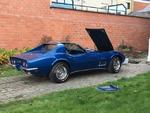


 Brake puzzler


 As far as I know, nothing changed other than wrong hole











 ) and figure out a way to make the rod adjustable.



