






PCV addition, Type engine

Thread Starter
Advanced

Joined: Feb 2020
Posts: 56
Likes: 13
From: South Carolina
 PCV addition, Type engine
Recently acquired my first Dream car and I need a little advice. Please, before asking me to do a search thread on the pro's and con's of a PCV. I have and the conversation can take a life time to get through. LOL
For starters, the engine I have is not a matching numbers engine, it has been changed out by a previous owner. The serial number on the right side(passengers side) of the block is completely bare except a Z4 stamped on it. I did some research on it and I am a little confused about the type engine. Anyone have any insight on what the Z4 represents? I have found a little info about a ZZ4, but not Z4.
Second, this engine does not have a PCV system, only two breathers and I want to install one to prevent the emission from entering the engine bay. The only available vac. port I can find on this Eldebrock intake and carb. is the one in the back where the vac. assist is connect to the break system. I had planned on installing a T junction here but I thought I would get you experts advice on doing so. Will it effect my braking system if I add a PCV connection to the hose from the brake canister? Dang, wouldn't you know I would find a tread on PCV after posting this thread. But please any new info would be appreciated.
For starters, the engine I have is not a matching numbers engine, it has been changed out by a previous owner. The serial number on the right side(passengers side) of the block is completely bare except a Z4 stamped on it. I did some research on it and I am a little confused about the type engine. Anyone have any insight on what the Z4 represents? I have found a little info about a ZZ4, but not Z4.
Second, this engine does not have a PCV system, only two breathers and I want to install one to prevent the emission from entering the engine bay. The only available vac. port I can find on this Eldebrock intake and carb. is the one in the back where the vac. assist is connect to the break system. I had planned on installing a T junction here but I thought I would get you experts advice on doing so. Will it effect my braking system if I add a PCV connection to the hose from the brake canister? Dang, wouldn't you know I would find a tread on PCV after posting this thread. But please any new info would be appreciated.
Last edited by Quackster; Feb 25, 2020 at 11:39 AM.
Thread Starter
Advanced
Joined: Feb 2020
Posts: 56
Likes: 13
From: South Carolina
Thanks for responding, How ever I did do a search on the PCV but so many yes I do and no I don't are confusing. Will try using a Y spltter on the brake vac. hose and see what happens.

Race Director


Joined: May 2006
Posts: 18,742
Likes: 2,583
why dont you donwload the installation manual for the particular Edelbrock carburetor you have. The manual will clearly explain to you what port to use for the PCV.
Last edited by MelWff; Feb 25, 2020 at 11:50 AM.

Le Mans Master

Joined: Sep 2001
Posts: 7,739
Likes: 630
From: Unreconstructed, South Carolina
https://www.corvetteforum.com/forums...post1601010517
the cover w/ PCV is plumbed to manifold
the other cover is plumbed to air cleaner assembly base.
the cover w/ PCV is plumbed to manifold
the other cover is plumbed to air cleaner assembly base.
Thread Starter
Advanced
Joined: Feb 2020
Posts: 56
Likes: 13
From: South Carolina
I will look into the installation manual for the Carb. it is just everything has been used up, I either have to add a 4 port fitting or Tee it into another. Thanks for the advice.
Thread Starter
Advanced
Joined: Feb 2020
Posts: 56
Likes: 13
From: South Carolina
I installed the PCV on the engine. I thought they were two crankcase breathers on the valve covers but actually there was just one, the other was a cap. After installing, the engine runs just fine and I am glad that I installed the valve. I know others run without it, but I like not dealing with the mess and the emissions I have in the engine bay.
Corvette Stories
The Best of Corvette for Corvette Enthusiasts

Top 10 Most Expensive Corvettes Ever Sold on Bring A Trailer
Brett Foote
10 Things Every Corvette Owner Needs (2026 Edition)
Michael S. Palmer
8 Most "Only Corvette Owners Understand" Quirks and Problems
Pouria Savadkouei
10 Reasons the C6 Z06 is Still A Performance Benchmark After 20 Years
Joe Kucinski
How Much Horsepower Every Corvette Engine "LOST" in 1972
Joe Kucinski
Top 10 DOs and DON'Ts for Protecting Your Convertible Top!
Michael S. Palmer
Top 10 Most Explosive Corvettes Ever Made: Power-to-Weight Ratio Ranked!
Joe Kucinski
150 hp to 1,250 hp: Every Corvette Generation Compared by the Specs That Matter
Joe Kucinski
8 Coolest Corvette Pace Cars (and Replicas) of All Time
Verdad Gallardo
Team Owner


Joined: Jan 2006
Posts: 37,637
Likes: 3,118
From: Crossville TN
The PCV system is harmless, simple and robs no power. It merely is a GOOD way to eliminate any engine-created oil vapors from messing up the engine compartment (oh, and from messing up the air  ). Whether you are "green" or not, the PCV system is a 'good' thing.
). Whether you are "green" or not, the PCV system is a 'good' thing.

Race Director


Joined: Jun 2000
Posts: 10,046
Likes: 675
From: FL
Thread Starter
Advanced
Joined: Feb 2020
Posts: 56
Likes: 13
From: South Carolina
 .
.
Team Owner
Joined: Apr 1999
Posts: 21,953
Likes: 1,445
From: Reno Nevada
2024 C3 of the Year Finalist- Modified
r
You really might want to read up on all the negatives of inducing a large vacuum leak like a 3/8ths fitting below the back of the carb from a valve cover breather!  It is a combination of burnt exhaust gasses, water, and oil mist. It's not an aid to healthy combustion like oxygen rich fresh air! LIke Exhaust gas recirculation The real problem is that it is variable on engine vacuum. You can't adjust and jet a carbs air fuel ratios with a variable vacuum leak of totally contaminated air.. To be correct at WOT with very little vacuum you would be lean at high vacuum. Don't ever claim that it Robs NO Power!
Problems. It also coats your intake valve stems with oil/carbon/sludge buildup. So over the life of the motor your have less and less port flow. They run additives in pump gas to try to clean the intake valves.
The most effective HP adders are crank case vacuum pumps. Run about 16 inches of vacuum in the crank case and out through a catch can and filter. You wouldn't believe the amount of water and sludge you suck out of the crank case.
It is a combination of burnt exhaust gasses, water, and oil mist. It's not an aid to healthy combustion like oxygen rich fresh air! LIke Exhaust gas recirculation The real problem is that it is variable on engine vacuum. You can't adjust and jet a carbs air fuel ratios with a variable vacuum leak of totally contaminated air.. To be correct at WOT with very little vacuum you would be lean at high vacuum. Don't ever claim that it Robs NO Power!Problems. It also coats your intake valve stems with oil/carbon/sludge buildup. So over the life of the motor your have less and less port flow. They run additives in pump gas to try to clean the intake valves.
The most effective HP adders are crank case vacuum pumps. Run about 16 inches of vacuum in the crank case and out through a catch can and filter. You wouldn't believe the amount of water and sludge you suck out of the crank case.
Last edited by gkull; Mar 11, 2020 at 02:36 PM.
Team Owner
Joined: Apr 1999
Posts: 21,953
Likes: 1,445
From: Reno Nevada
2024 C3 of the Year Finalist- Modified
If you really feel the need to go green my 79 came with the large valve cover vent to the base of the air filter. That way it is venting inside the air filter. I've also used those vent type air filter bases on open element K&N dropped base filters.
Le Mans Master
Joined: Sep 2001
Posts: 7,739
Likes: 630
From: Unreconstructed, South Carolina
uhhh ... should vent From ac base (not into it) ... then into VC ... then thru motor ... then out opposite VC ... thru PCV ... to Bottom of carb/manifold ,,, that way blowby is Not pulled thru carb & fouling it. That's how GM implemented it.
The OE GM vent in ac base typically has a small odd-shaped OE "filter"

The OE GM vent in ac base typically has a small odd-shaped OE "filter"
Team Owner
Joined: Apr 1999
Posts: 21,953
Likes: 1,445
From: Reno Nevada
2024 C3 of the Year Finalist- Modified
That thing you showed is for a stock type enclosed air cleaner base/assembly. Open element is into the bottom plate inside the air cleaner. right from the valve cover breather so it is sucking fumes from the crank case. they were used in conjunction with a PVC smaller dia off the passenger cover. I see what you are saying that it would be a fresh air draw...… If the small pcv valve is flowing enough to draw through the other valve cover which isn't the normal case. with any miles on a motor the blow by is pressurizing the crank case. So it ends up going out to the air cleaner also. I eliminated the PVC valve and just used the vent for many years.
Maybe at no load idle, pvc might be able to draw fresh air through. but not under a working load of less vacuum and more blowby
Maybe at no load idle, pvc might be able to draw fresh air through. but not under a working load of less vacuum and more blowby
Last edited by gkull; Mar 11, 2020 at 02:53 PM.
Le Mans Master
Joined: Sep 2001
Posts: 7,739
Likes: 630
From: Unreconstructed, South Carolina
Mr. George, me thinks your argument is with the General.
There's a lotta ways to skin the crankcase ventilation cat & I've re-engineered things as well; hasn't always been the best solution. I'm sure whatever you've come up with suits you.
Me and plenty others have plumbed breather hoses into header collectors ... bernoulli ... it works OK on race cars w/ lotsa velocity in collectors ... but Not good on street.
Race car ... go spend a small fortune on a 4-5 stage dry sump and/or vacuum pump ... race car.
Assuming motor's Not a smoker ... For a stock or non-race app, suggest GM's configuration works very well.
But if it's a smoker, motor's got bigger problems than an OE PCV system.
Assuming a properly working GM PCV "pull-thru" configuration ... suggest most crud on backside of valves is from worn seals/guides/rings.
FWIW ... motors w/ GDI don't wash ports w/ gas vapor & nor do GDI valves' backsides get washed ... so increased crud build-up is an unintended downside to GDI ...
... to help attenuate, some makers employing hybrid of both direct & port injection.
There's a lotta ways to skin the crankcase ventilation cat & I've re-engineered things as well; hasn't always been the best solution. I'm sure whatever you've come up with suits you.
Me and plenty others have plumbed breather hoses into header collectors ... bernoulli ... it works OK on race cars w/ lotsa velocity in collectors ... but Not good on street.
Race car ... go spend a small fortune on a 4-5 stage dry sump and/or vacuum pump ... race car.
Assuming motor's Not a smoker ... For a stock or non-race app, suggest GM's configuration works very well.
But if it's a smoker, motor's got bigger problems than an OE PCV system.
Assuming a properly working GM PCV "pull-thru" configuration ... suggest most crud on backside of valves is from worn seals/guides/rings.
FWIW ... motors w/ GDI don't wash ports w/ gas vapor & nor do GDI valves' backsides get washed ... so increased crud build-up is an unintended downside to GDI ...
... to help attenuate, some makers employing hybrid of both direct & port injection.
Le Mans Master
Joined: Sep 2001
Posts: 7,739
Likes: 630
From: Unreconstructed, South Carolina
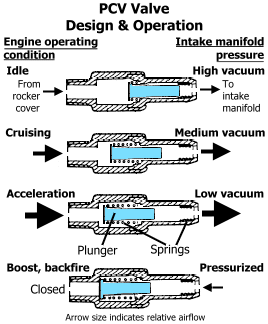
above PCV
Fat (Left) end sticks into valve cover: when manifoid vacuum Sucks valve Open, vapor is Pulled From Skinny (Right) end of that valve and into motor at carb or manifold via manifold vacuum.
---------------------------------------------------------------------------------------------------------------------------------------------------------------------------------------------------------------------------------------------------------------
There is typically much Less vacuum (negative pressure) at Periphery of Air Cleaner Base than at manifold vacuum port.
Manifold vacuum Pulls Fresh Air INTO the motor From that small odd breather filter that's typically Inside and at Periphery of AC Base.
https://www.autozone.com/repairguide...00c15280083688
First Four figures depict OE PCV systems
----------------------------------------------------------------------------------------
FWIW, the folks who designed the GM PCV system did so Before I fell off a turnip truck.