






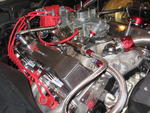

Locked Up Lifters...

Thread Starter
Racer


Joined: Jan 2020
Posts: 272
Likes: 69
From: Reno, NV
 Locked Up Lifters...
Hi, Need help with the motor for my 71 project. New 383 small block with OEM-style hydraulic roller lifters in a newer vortec/OEM roller block, and was looking to run it for the first time today on a run stand. Set the valve lash cold at zero lash plus 1/2 turn. Out of the box, the lifters (Sealed Power brand) had red fluid in them and would not collapse, so my setting beyond zero lash essentially pushed the valve down, did not collapse the lifter, and resulted in no compression even after turning the motor over several times with a breaker bar. Backed out the valve lash adjustment and the compression came back. Also, primed the oil pump with my drill and got very light flow of oil out of the top of the push rods.
Took all the lifters apart and drained the red fluid. Put them back in, set lash again with 1/2 turn after zero lash, and primed the pump. Again, the lifters filled up, locked up, and wouldn't collapse enough to let the valves close. No compression again and a very light dribble of oil coming from the top of the push rods.
My questions:
Cheers,
Brian
Took all the lifters apart and drained the red fluid. Put them back in, set lash again with 1/2 turn after zero lash, and primed the pump. Again, the lifters filled up, locked up, and wouldn't collapse enough to let the valves close. No compression again and a very light dribble of oil coming from the top of the push rods.
My questions:
- How long does it take lifters to "bleed out"?
- Should they be bleeding out right when you set them? Is that my problem as they are not?
- Shouldn't you be able to push on them by hand and feel some give or travel in the lifters?
- If mine are not bleeding out, and should, is there a check valve in the lifters that should be inspected and may be stuck?
- Am I setting the lash incorrectly? If they are not designed to rapidly bleed out, why then should you set them to zero, plus half a turn as that appears to only push the valve down, and not collapse the lifter?
- If I have faulty lifters that don't bleed out and just lock up, would that restrict the flow of oil out of my push rods, to a very small and concerning amount?
- Are those crap lifters and should I just go get a new set of better lifters?
Cheers,
Brian
Last edited by btwick; Jul 25, 2020 at 11:23 PM.

Race Director


Joined: Nov 2006
Posts: 13,177
Likes: 7,780
From: Sunshine Coast, Queensland, Australia
2025 C3 of the Year Finalist - Modified
2024 C3 of the Year Finalist- Modified
2022 C3 of the Year Finalist - Modified
Cruise-In VIII Veteran
I'm not there. So, are you adjusting just untill play is out of pushrod, then 1/2 turn?? Or are you bottoming the lifter and then 1/2 turn??
do you have the correct length pushrods??
Do you give your lifters 10 -15 minutes to bleed down before turning the engine? Do you make certain the pushrod spins nicely before turning the engine and??
I'm not there.
do you have the correct length pushrods??
Do you give your lifters 10 -15 minutes to bleed down before turning the engine? Do you make certain the pushrod spins nicely before turning the engine and??
I'm not there.

Race Director
Joined: Apr 2007
Posts: 11,150
Likes: 890
From: South Western Ontario
It sounds like your zero lash is the point the plunger bottoms out in the lifter. It is actually rather difficult to find zero lash on a hydraulic lifter. That spin the pushrod until you feel resistance and then go 1/2 turn more generally doesn't work as easy as it sounds. The rockers on the "closed" valves should still wiggle around if you don't have them too tight.
Try loosening off the rockers and then take two fingers of one hand and lightly hold up the valve end of the rocker you are setting. Then, with the other hand alternate between tightening the nut and tapping on the valve end of the rocker. The rocker will click against the end of the valve if there is still clearance.Once the clicking stops then go 1/2 turn. Change the amount you tighten based on the amount of click or clearance so you don't over do it. You may need to let it sit for a bit first after loosening off the rockers to ensure the plungers come back to the top of travel.
Try loosening off the rockers and then take two fingers of one hand and lightly hold up the valve end of the rocker you are setting. Then, with the other hand alternate between tightening the nut and tapping on the valve end of the rocker. The rocker will click against the end of the valve if there is still clearance.Once the clicking stops then go 1/2 turn. Change the amount you tighten based on the amount of click or clearance so you don't over do it. You may need to let it sit for a bit first after loosening off the rockers to ensure the plungers come back to the top of travel.
Thread Starter
Racer
Joined: Jan 2020
Posts: 272
Likes: 69
From: Reno, NV
Thanks everyone for your replies. Some clarification:
My zero lash setting is tightening the adjustment nut on the rocker until the rocker can still be wiggled, but just slightly. Because of the push rod guide plates with my ProMaxx heads, I cannot get my fingers to the push rod to spin it by hand. When I get to my zero lash, again with a tiny bit of wiggle and no compression of the lifter, I do my half turn. Thanks kanvasman for the basic question on order and sequence (you would never know what I may not know). Yes, it is always done in the right sequence when the lifter is at the base circle of the cam.
In my case, the half turn is actually depressing the valve, as my lifters in most cases do not compress. If the lifters don't move on the half turn, the valves have to drop that amount.
For the comment about bleed out, believe that is the crux of my question. I set the valves months ago, and when trying to fire it on the stand yesterday, they were still pumped up and would not compress -- hence the lack of cylinder compression. Or perhaps jammed fully extended somehow? Anyway, when I back off the rocker adjusters to being loose, the compression comes back in that cylinder. As mentioned, I took them apart to drain the existing fluid out of them and when empty and reassembled, they all compressed by hand in a normal fashion. When the oil pump was primed again, they became solid and would not compress. Even after priming and then letting them sit for an hour or more, they never get to the point they bled out, or would collapse. I could see getting a couple of those out of the box, but all 16? That is why I posted my question, instead of just replacing the bad ones.
I would really appreciate a better understanding of the pressure and bleed out process of hydraulic lifters. When oil is pressurized into the lifter, and it fills in the chamber in the plunger, I know it is supposed to stay that way as the valve is being pushed down to ensure the valve opens fully and has a check ball "valve" for that, but when does it bleed out? When the lifter is moving down off the cam lobe and pressure is being released? If so, would the pressure up and bleed down be on every cycle of the rocker?
How does the lifter end up pushing the oil up and out of the top of the push rod to get to the top end? If this is pressure inside the lifter, how does it send oil up the push rod, but also stay extended to ensure valves have the correct travel when opened? Could the fact I am getting hardly any oil out of the top of the push rod be related to the fact my lifters won't bleed down? Is it a constant flow of oil in from the side of the lifter bore, into the lifter plunger, which builds up pressure which is maintained through the check ball function, then gets past the disk at the top of the plunger to, and then through the push rod seat and up the push rod?
Apologies for all these questions, but if I can sort this out somehow vs. throwing away the money I spent on the first set of these lifters and purchasing a second set, I would really appreciate it.
Cheers,
Brian
My zero lash setting is tightening the adjustment nut on the rocker until the rocker can still be wiggled, but just slightly. Because of the push rod guide plates with my ProMaxx heads, I cannot get my fingers to the push rod to spin it by hand. When I get to my zero lash, again with a tiny bit of wiggle and no compression of the lifter, I do my half turn. Thanks kanvasman for the basic question on order and sequence (you would never know what I may not know). Yes, it is always done in the right sequence when the lifter is at the base circle of the cam.
In my case, the half turn is actually depressing the valve, as my lifters in most cases do not compress. If the lifters don't move on the half turn, the valves have to drop that amount.
For the comment about bleed out, believe that is the crux of my question. I set the valves months ago, and when trying to fire it on the stand yesterday, they were still pumped up and would not compress -- hence the lack of cylinder compression. Or perhaps jammed fully extended somehow? Anyway, when I back off the rocker adjusters to being loose, the compression comes back in that cylinder. As mentioned, I took them apart to drain the existing fluid out of them and when empty and reassembled, they all compressed by hand in a normal fashion. When the oil pump was primed again, they became solid and would not compress. Even after priming and then letting them sit for an hour or more, they never get to the point they bled out, or would collapse. I could see getting a couple of those out of the box, but all 16? That is why I posted my question, instead of just replacing the bad ones.
I would really appreciate a better understanding of the pressure and bleed out process of hydraulic lifters. When oil is pressurized into the lifter, and it fills in the chamber in the plunger, I know it is supposed to stay that way as the valve is being pushed down to ensure the valve opens fully and has a check ball "valve" for that, but when does it bleed out? When the lifter is moving down off the cam lobe and pressure is being released? If so, would the pressure up and bleed down be on every cycle of the rocker?
How does the lifter end up pushing the oil up and out of the top of the push rod to get to the top end? If this is pressure inside the lifter, how does it send oil up the push rod, but also stay extended to ensure valves have the correct travel when opened? Could the fact I am getting hardly any oil out of the top of the push rod be related to the fact my lifters won't bleed down? Is it a constant flow of oil in from the side of the lifter bore, into the lifter plunger, which builds up pressure which is maintained through the check ball function, then gets past the disk at the top of the plunger to, and then through the push rod seat and up the push rod?
Apologies for all these questions, but if I can sort this out somehow vs. throwing away the money I spent on the first set of these lifters and purchasing a second set, I would really appreciate it.
Cheers,
Brian

Melting Slicks

Joined: Apr 2019
Posts: 2,499
Likes: 1,165
From: Northern Wisconsin
Btwick, you have asked some good questions. Maybe I can help with some of it. The upward force generated by oil pressure in a hydraulic lifter will raise the plunger in the valve lifter until it contacts the pushrod and eliminates play in the valve train. The valve lifter stops extending at that point, and holds pressure due to the check valve in the valve lifter. The valve lifter does not generate enough force to continue extending so it can't lift the valve of the valve seat. That is how a hydraulic valve lifter automatically adjusts valve lash. During each cycle, a minute amount of oil is bled off from the valve lifter so that it will also refill automatically when at the base circle of the cam. So yes, as you asked, a hydraulic valve lifter automatically adjusts valve lash close to zero during every cycle.
Your Sealed Power valve lifters are likely just fine. Did they come with instructions for installation and startup? If so, I would read that over very carefully and maybe call Sealed Power if you still have questions. It may be that you are supposed to install them without oil inside so they will pump up to operating length during first startup.
Your Sealed Power valve lifters are likely just fine. Did they come with instructions for installation and startup? If so, I would read that over very carefully and maybe call Sealed Power if you still have questions. It may be that you are supposed to install them without oil inside so they will pump up to operating length during first startup.

Burning Brakes

Joined: Jun 2020
Posts: 881
Likes: 113
Next time, maybe try feeling/spinning lash & adjusting valves without manifold in place.
Without manifold, you can get a better grasp on pushrod and a close eye on lifter cup.
?? rockers; shaft mounted or stud mounted ?
Without manifold, you can get a better grasp on pushrod and a close eye on lifter cup.
?? rockers; shaft mounted or stud mounted ?
Last edited by 71chimera; Jul 26, 2020 at 05:08 PM.
Corvette Stories
The Best of Corvette for Corvette Enthusiasts

150 hp to 1,250 hp: Every Corvette Generation Compared by the Specs That Matter
Joe Kucinski
8 Coolest Corvette Pace Cars (and Replicas) of All Time
Verdad Gallardo
Top 10 Corvette Engines RANKED by Peak Torque (70+ Years of Muscle!)
Joe Kucinski
Corvette ZR1X Will Be Pacing the Indy 500, And Could Probably Race, Too!
Verdad Gallardo
Top 10 Corvettes Coming to Mecum Indy 2026!
Brett Foote
Top 10 C9 Corvette MUST-HAVES to Fix These C8 Generation Flaws!
Michael S. Palmer
10 Revolutionary 'Corvette Firsts' Most People Don't Know
Joe Kucinski
5 Reasons to Upgrade to an LS6-Powered Corvette; 5 Reasons to Stay LT2
Michael S. Palmer
2027 Corvette vs The World: Every C8 vs Its Closest Competitor
Joe Kucinski
Safety Car


Joined: Dec 2012
Posts: 3,797
Likes: 1,706
From: Summerville SC
I have another suggestion for you. Back off all of the lifters. See if you can sping the motor by hand. Then, starting with #1 cylinder, adjust that one, intake & exhaust. Then go to #2. If the engine is not getting more diffiuclt as you continue down the firing order, you have solved the issue. IF it starts getting harder to turn over, as said above, start from scratch looking for the wrong part.

Race Director
Joined: Nov 2006
Posts: 13,177
Likes: 7,780
From: Sunshine Coast, Queensland, Australia
2025 C3 of the Year Finalist - Modified
2024 C3 of the Year Finalist- Modified
2022 C3 of the Year Finalist - Modified
Cruise-In VIII Veteran
I remember, many, many years ago now, I learned to adjust lifters in a 283. Being tought by Bubba himself, I was but 16. Start engine with valve covers off, lossen rocker stud nut until it starts to click. Tighten slowly until the click stops, turn half turn, go to the next one. Primitive as all hell. But it does run when your done. If that doesn't work. Then by all means you have bad or the wrong lifters.

Dr. Detroit

Joined: Mar 2012
Posts: 10,095
Likes: 4,025
From: New Braunfels Texas
The lifter actually pumps oil through the pushrod on the down stroke of the lifter/lobe......this slightly releases the check valve inside and allows oil to come through. This is also how the lifters "stabilize" after a bit when they are full of fluid like you state.
You can take yours out, disassemble them and spray them out dry if you trust yourself......I have done it many times. Just pay attention as it has a spring on the bottom and **** can go flying.
As far as lash goes....I have stated this in many threads and the same still applies. I use poly-locs on everything......and with a new stud.....put a little moly on the stud then walk the poly-loc down with your fingers......when the lash is taken up, you will literally feel a slight resistance with your fingers as you are finger tightening. With your fingers roll the poly-loc back and forth, tight and loose at that "sweet spot".......you will feel it, take your time and have a light touch. From there....do your 1/2 turn. It is simple as hell to do but difficult to explain......I have had people here at my workshop and showed them this and they slap them selves in the forehead between that and the TDC firing order method for the lash order.......
It is best to do this with the intake off so you can eyeball what you are doing. Once you have this procedure down.....one can lash a hydraulic V8 in about 15 minutes
Another thing you want to do is lash BEFORE you prime the engine!
Jebby
You can take yours out, disassemble them and spray them out dry if you trust yourself......I have done it many times. Just pay attention as it has a spring on the bottom and **** can go flying.
As far as lash goes....I have stated this in many threads and the same still applies. I use poly-locs on everything......and with a new stud.....put a little moly on the stud then walk the poly-loc down with your fingers......when the lash is taken up, you will literally feel a slight resistance with your fingers as you are finger tightening. With your fingers roll the poly-loc back and forth, tight and loose at that "sweet spot".......you will feel it, take your time and have a light touch. From there....do your 1/2 turn. It is simple as hell to do but difficult to explain......I have had people here at my workshop and showed them this and they slap them selves in the forehead between that and the TDC firing order method for the lash order.......
It is best to do this with the intake off so you can eyeball what you are doing. Once you have this procedure down.....one can lash a hydraulic V8 in about 15 minutes
Another thing you want to do is lash BEFORE you prime the engine!
Jebby
Last edited by Jebbysan; Jul 27, 2020 at 11:32 AM.

Thread Starter
Racer
Joined: Jan 2020
Posts: 272
Likes: 69
From: Reno, NV
First of all, thanks to all who have worked to help me with this situation. Much appreciated! This thread has been great education on the operation of hydraulic lifters.
Since my last note, I have determined they are the correct ones for my block. These are the .842" diameter lifters, and work in virtually all gen I-style small blocks, V-6s, and even Harley Davidsons. They are priced on Summit and other places from $7.50 a piece, to over $50 for a very similar looking items--just to make this more fun.
Still not 100% certain of next moves, but see two options:
Option 1. Take the ones I have apart, drain them, rebuild them, reinstall, set lash the way you all have described (perhaps at zero lash and just quarter turn more, not a full half). Prime the pump with drill and see if they behave so as to not lose compression in the cylinders. Also, determine if with a looser lash, I can get more oil out of the top of the push rods. As mentioned in an earlier post, did this same thing on Saturday with full half-turn after zero lash, and when they pumped up, they extended rock hard and pushed the valves off the seats. This is the "Einstein option," where he described the definition of insanity as doing something the same way and expecting different results, but the minor difference here is a looser lash adjustment. If oil coming out of the top of the push rods during priming and engine turnover remains just a slight dribble, or even missing completely as it was before, then the journey leads to option 2.
Option 2. Call my lifters junk, and replace them with a higher-priced Howards or Comp set, and hope the old adage of you get what you pay for holds true.
The premise with Option 1 is first, what is the likelihood of all 16 lifters, from what should be a decent provider, are all trash, and second, perhaps I am not spinning the motor enough to get the lifters in a proper rhythm of pressure up and pressure down, with pump up and bleed off so the pressures in the lifters, as managed by the disk valve under the lifter cap, are strong enough to extend and remove looseness in the valve train, but not strong enough to overcome the pressure of the valve springs and push valves off their seats when closed.
Thanks again for everyone's contribution. Probably give option 1 a try later this week.
Cheers,
Brian
Since my last note, I have determined they are the correct ones for my block. These are the .842" diameter lifters, and work in virtually all gen I-style small blocks, V-6s, and even Harley Davidsons. They are priced on Summit and other places from $7.50 a piece, to over $50 for a very similar looking items--just to make this more fun.
Still not 100% certain of next moves, but see two options:
Option 1. Take the ones I have apart, drain them, rebuild them, reinstall, set lash the way you all have described (perhaps at zero lash and just quarter turn more, not a full half). Prime the pump with drill and see if they behave so as to not lose compression in the cylinders. Also, determine if with a looser lash, I can get more oil out of the top of the push rods. As mentioned in an earlier post, did this same thing on Saturday with full half-turn after zero lash, and when they pumped up, they extended rock hard and pushed the valves off the seats. This is the "Einstein option," where he described the definition of insanity as doing something the same way and expecting different results, but the minor difference here is a looser lash adjustment. If oil coming out of the top of the push rods during priming and engine turnover remains just a slight dribble, or even missing completely as it was before, then the journey leads to option 2.
Option 2. Call my lifters junk, and replace them with a higher-priced Howards or Comp set, and hope the old adage of you get what you pay for holds true.
The premise with Option 1 is first, what is the likelihood of all 16 lifters, from what should be a decent provider, are all trash, and second, perhaps I am not spinning the motor enough to get the lifters in a proper rhythm of pressure up and pressure down, with pump up and bleed off so the pressures in the lifters, as managed by the disk valve under the lifter cap, are strong enough to extend and remove looseness in the valve train, but not strong enough to overcome the pressure of the valve springs and push valves off their seats when closed.
Thanks again for everyone's contribution. Probably give option 1 a try later this week.
Cheers,
Brian


Thread Starter
Racer
Joined: Jan 2020
Posts: 272
Likes: 69
From: Reno, NV
They are HT2148 lifters from Summit (Sealed Power) https://www.summitracing.com/parts/slp-ht-2148
The block is a one-piece rear main seal (1995-00 casting) which was an OEM roller. Using the stock lifter/dog bone/spider clamp configuration with a XR276HR Comp cam, with 1.6 ratio roller-tipped stamped steel rockers also from Comp. Also running ProMaxx 2169 heads.
Cheers,
Brian
The block is a one-piece rear main seal (1995-00 casting) which was an OEM roller. Using the stock lifter/dog bone/spider clamp configuration with a XR276HR Comp cam, with 1.6 ratio roller-tipped stamped steel rockers also from Comp. Also running ProMaxx 2169 heads.
Cheers,
Brian

Racer
Joined: Jan 2020
Posts: 470
Likes: 147
From: Va.Beach Va.
First thing that comes to mind after assuming you have performed the adjustments correctly is that you do not have enough spring pressure as though the inner spring was left out for break in for a high perf flat tappet cam set up.
Race Director
Joined: Apr 2007
Posts: 11,150
Likes: 890
From: South Western Ontario
The lifters being pressurized by priming oil simply can't force the valves off the seats.
I would back them off a full turn and then prime it and see if they seem OK.
You posted you tightened them down until the wiggle in the rocker was almost gone and then went another half turn. You simply went too tight if the rocker still doesn't wiggle around loosely on the stud after setting it.
I would back them off a full turn and then prime it and see if they seem OK.
You posted you tightened them down until the wiggle in the rocker was almost gone and then went another half turn. You simply went too tight if the rocker still doesn't wiggle around loosely on the stud after setting it.


Le Mans Master


Joined: Oct 2010
Posts: 6,929
Likes: 842
From: melbourne florida
2023 C3 of the Year Finalist - Modified
My guess is you are going beyond zero lash. I agree pull the intake off do you can make sure the lifter is actually on the base circle.
Or loosen everything set it at tdc go through and take up the slack on all the valves. Turn the crank 90 degrees snug up all the loose ones to zero lash. Turn the crank 90 again take up the slack on the loose ones. Do it once more. Now your lifters are at zero lash. No just tighten each one a half turn.
Zero lash is when the pushrod won't wiggle up and down not back and forth or spinning. I've used the above method several times and it works well if you have interuptions so you don't have to go back through.
Good luck
Or loosen everything set it at tdc go through and take up the slack on all the valves. Turn the crank 90 degrees snug up all the loose ones to zero lash. Turn the crank 90 again take up the slack on the loose ones. Do it once more. Now your lifters are at zero lash. No just tighten each one a half turn.
Zero lash is when the pushrod won't wiggle up and down not back and forth or spinning. I've used the above method several times and it works well if you have interuptions so you don't have to go back through.
Good luck
Thread Starter
Racer
Joined: Jan 2020
Posts: 272
Likes: 69
From: Reno, NV
In fact, was worried about that for the initial fire up planned for last Saturday. We know flat tappet cams require very prescribed break in, but for rollers, many engine builders don't worry about cam break in at all. Just run zinc oil or additive on break in. But, reading Comp's instructions for break in for a roller cam is to remove inner valve springs or use lighter springs.
Too much conflicting info on that one, so was going to roll the dice and did not bother with removing the springs for the initial break in, and had/still have the triple springs in there. Felt uncomfortable to go against the instructions from Comp, but they couldn't be validated, and the thought of changing out the valve springs with all else going on with initial break in was a bit too much.
Cheers,
Brian