When you click on links to various merchants on this site and make a purchase, this can result in this site earning a commission. Affiliate programs and affiliations include, but are not limited to, the eBay Partner Network.
kind of new to the C3 and just trying to pin down rear suspension knocking and was wondering if this play is normal, as its only happening on one side of the car. There is a little movement in the forward trailing arm bushing but quite a lot of movement in the halfshaft at the differential flange. I guess the trailing arm needs re-bushing or a shim but what you think about the halfshaft movement?. See videos below...
kind of new to the C3 and just trying to pin down rear suspension knocking and was wondering if this play is normal, as its only happening on one side of the car. There is a little movement in the forward trailing arm bushing but quite a lot of movement in the halfshaft at the differential flange. I guess the trailing arm needs re-bushing or a shim but what you think about the halfshaft movement?. See videos below...
youll get lots of opinions on how terrible the 1/2 shat into diff is. IMHO the trailing arm bushing is more of a problem.
Differential axles are worn out and need replacement along with differential inspection. The TA bushings will have play in them when leveraging them so not as much an issue unless they appear dry rotted.
The car appears to have some age on it, if it is 72-79 then expect to get involved rebuilding the whole IRS. The Diff has to come out to replace the axles. At a minimum remove the RG bolts and loctite them back in or just replace with ARP's.
Differential axles are worn out and need replacement along with differential inspection. The TA bushings will have play in them when leveraging them so not as much an issue unless they appear dry rotted.
.
Its debatable how much of a problem the trailing arm bushings are, but the output yokes at the differential are in serious need of replacement. Don't feel too bad, its a common problem on these cars. The weight of the car is basically supported by the end of the yoke. When you consider the amount of labor involved in taking things apart to do the necessary repairs, it makes sense to simply rebuild all the suspension components, including the trailing arm bushings. Good winter project.
Differential axles are worn out and need replacement along with differential inspection. The TA bushings will have play in them when leveraging them so not as much an issue unless they appear dry rotted.
The car appears to have some age on it, if it is 72-79 then expect to get involved rebuilding the whole IRS. The Diff has to come out to replace the axles. At a minimum remove the RG bolts and loctite them back in or just replace with ARP's.
Thanks for the input..... Can you clarify "ARP's' and "RG bolts"?
From: At my Bar drinking and wrenching in Lafayette Colorado
RG = Ring Gear bolts
ARP = a brand name/manufacturer of high grade high quality bolts and hardware.
Here is a post I did a while ago here on the Forum about the worn out stub shafts. This will give you an idea of what the problem is:
As has been correctly stated above, the problem is that the ends of your stub shafts have worn out riding against the spider gear pin. It’s a common Corvette problem.
As long as the shafts have not worn so far that the snap ring groove has been consumed, you can repair the shafts by installing hardened steel caps on the ends of the shafts. You need to pull the differential out of the car to do this.
You can leave the trailing arms in the car and just drop the entire rear crossmember with the differential attached:
Once removed, you can remove the differential from the crossmember, drain it, and put it on your workbench:
Here I’m measuring the amount of slop at the ends of the stub shafts:
Notice the amount of shaft movement from “in” position to the “out” position. There should not be more than .010", although I think Gary likes to set his up even tighter:
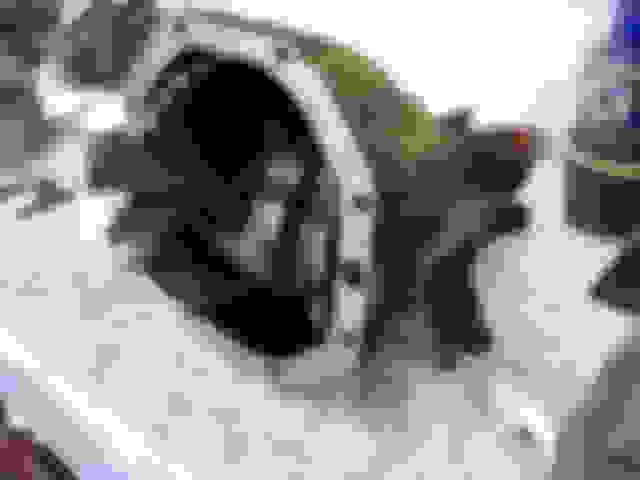
Spider gear pin pulled, snap rings removed, and shafts pulled out for repair:
Photo shows the severe wear on the end of the one stub shaft. Noting the endplay measured, we then added the amount to be machined off to create a flat surface. The factory center point was modified to create a counterbore:
Machined shaft end with counterbored center to accept a new thrust surface with press-in center nub:
A custom washer was then machined with a nub in the middle for pressing it into the counterbore created in the shaft. The thickness of the washer was determined by adding the measured shaft slop to the amount of material removed off the shaft and adding .010” for endplay clearance. The washers were then heat treated to Rockwell Rc48 and pressed onto the ends of the shafts. Machined and hardened custom thrust washers:
Completed shaft mod ready for install:
This saves the factory shafts and avoids needing to replace them with expensive and inferior aftermarket Chinese-made shafts. Many of these aftermarket shafts are not correctly heat treated, and they fail very quickly due to the soft non-heat-treated shaft ends.
RG = Ring Gear bolts
ARP = a brand name/manufacturer of high grade high quality bolts and hardware.
Here is a post I did a while ago here on the Forum about the worn out stub shafts. This will give you an idea of what the problem is:
As has been correctly stated above, the problem is that the ends of your stub shafts have worn out riding against the spider gear pin. It’s a common Corvette problem.
As long as the shafts have not worn so far that the snap ring groove has been consumed, you can repair the shafts by installing hardened steel caps on the ends of the shafts. You need to pull the differential out of the car to do this.
You can leave the trailing arms in the car and just drop the entire rear crossmember with the differential attached:
Once removed, you can remove the differential from the crossmember, drain it, and put it on your workbench:
Here I’m measuring the amount of slop at the ends of the stub shafts:
Notice the amount of shaft movement from “in” position to the “out” position. There should not be more than .010", although I think Gary likes to set his up even tighter:
Spider gear pin pulled, snap rings removed, and shafts pulled out for repair:
Photo shows the severe wear on the end of the one stub shaft. Noting the endplay measured, we then added the amount to be machined off to create a flat surface. The factory center point was modified to create a counterbore:
Machined shaft end with counterbored center to accept a new thrust surface with press-in center nub:
A custom washer was then machined with a nub in the middle for pressing it into the counterbore created in the shaft. The thickness of the washer was determined by adding the measured shaft slop to the amount of material removed off the shaft and adding .010” for endplay clearance. The washers were then heat treated to Rockwell Rc48 and pressed onto the ends of the shafts. Machined and hardened custom thrust washers:
Completed shaft mod ready for install:
This saves the factory shafts and avoids needing to replace them with expensive and inferior aftermarket Chinese-made shafts. Many of these aftermarket shafts are not correctly heat treated, and they fail very quickly due to the soft non-heat-treated shaft ends.
Lars
Very useful Lars...thanks so much. Now looks like I have "another" winter project.
From: At my Bar drinking and wrenching in Lafayette Colorado
I'm not aware of any published spec, because it's not an "adjustable" tolerance for most people. I run mine at .007" - .010", and I think Gary runs his just a few thousands tighter to keep better rear alignment control. I'll let Gary comment and correct me if I'm wrong.
Lars
Originally Posted by neil.anderson33
Very useful Lars...thanks so much. Now looks like I have "another" winter project.
If you have access to a machine shop and a heat treat facility, you can actually do this entire job in a weekend, or however long your heat treat shop takes to turn the parts around for you. Getting that Rc spec up there in the mid/high '40s is the key to making the shafts lasts. Lars
Lars
I set mine to 005-007"
Due to the lack of consistent QC with rebuilt axles your method makes perfect sense, it's just time to get them done. I still have some good rebuilt axles here but a box of cores I may start machining as well.
2020 Corvette of the Year Finalist (performance mods)
2019 C3 of Year Winner (performance mods)
2016 C3 of Year Finalist
Is there an issue when its on the ground? can yo make it move by pulling on the tire with the weight of the car on it. Can you feel the rear end wonder under hard acceleration? THe yoke end play isnt pretty but the looseness of the trailing arm bushing may let your rear end wander a little. There is no published number for end play but the guys that do the rebuilding will tell you thats a lot of movement in the yoke. One of my differentials had that issue and it was fine for a long time, but then I upped the horsepower to 500 and let her rip quite a few times.....If you drive like a normal person that yoke end play will probably be fine but that traililng arm needs somelove for sure. An while you have to take the half shaft off the differential to get the trailing arm off, you could play with the side yokes while your under there....I'll be in that boaat his winter as well. I may have to find a stronger rear end as well
Gary and Lars: Is there a reliable shop or vendor that will add the "buttons" on the axel shafts? Is it better to order the buttons and have a local machine shop do the work? Thanks. Jerry
Hi Jerry,
The easiest thing is to buy rebuilt axles and if they are correct they are fine and will last a long time. The endplay in them will depend on how they are rebuilt- the dimension from the face to snap ring and the posi setup.
The problem is rebuilt axles have been all over the place for years. The face dimensions have been within a window of 025" based on what I have received in. In addition the spline alignment of the hardened pressed in tips has been off, so much so that they would not fit into the spider splines. Many times they can be tapped in and out to clear any burrs but some are so bad I had to return them. Some I was able to dress with a diamond tip dremel. Then I found stress cracks in the tip from what appeared to be incorrect interference fit. It was hidden under the paint they came with. I never know what I will get when I order them and probably had a 30-50% return rate. I don't know what owner doing their own did if they got some of these?
To answer your question. Bairs might be able to help but I don't know of any shop offering what Lars does. The cost for a machine shop to make a couple and machine the axle would probably be more then going through the inspection process on getting in rebuilt axles. I am not saying you can't get good axles just explaining what I have seen. I have received in rebuilt axles that were fine to use, you have to check them.
I plan to go through my core box and see how many axles I have and whenever I get free time machine up some test plugs like Lars has and rebuild my stock. That probably won't be for a long time though. I also have good used GM axles that are soft, if they are caught in time they can be hardened and reused and are better than any rebuilt axle since there is no splice.
Speaking of spliced axles, there have been and are they are still out there splice axles with hollow cores. These I have documented in the past. I don't know who made them or sold them but have seen them in diff's shipped to me and they are junk. They will fail and shear once load is applied. You can ID them by the splice which is well below the snap ring groove. The splice should be at the groove, leaving the axle from the groove to yoke solid.
So I probably didn't give you an answer that you were looking for but anyone with a lathe can make the buttons, they do not require the splined end as you saw with Lars pictures. If the wear is down to the snap ring groove then replace the axle. A 4 jaw lathe chuck will hold the axle or they can be setup in a Bridgeport and bored.
2025 C2 of the Year ('64-'66) Finalist - Unmodified
2025 C3 of the Year Finalist - Modified
2025 C4 of the Year Finalist - Modified
2024 C4 of the Year Finalist - Modified
2023 C2 of the Year Finalist - Unmodified
2023 C4 of the Year Finalist- Modified
2022 C4 of the Year Finalist - Modified
2022 C3 of the Year Finalist - Modified
2021 C7 of the Year Winner -- Modified
2020 C4 of the Year Finalist - Modified
I'm in the same boat as Neil, I have defiantly more than .25" of end play (in/out) no wobble. My Diff was rebuilt by a Corvette specialist about 18,00 miles ago. He must have re-used my side yokes
Any way I do not have the tools to remake my yokes, I was looking @ Zip and Ecklers for their re-manufactures yokes with the harden tips machined in. Do you have any opinion about these? (I need hevi-duty)
You can check with those vendors but I would bet they are not rebuilding axles, just reselling someone elses. You still have to check any new or rebuilt axle when you get them.








 Normal or not? Rear suspension play





 Its debatable how much of a problem the trailing arm bushings are, but the output yokes at the differential are in serious need of replacement. Don't feel too bad, its a common problem on these cars. The weight of the car is basically supported by the end of the yoke. When you consider the amount of labor involved in taking things apart to do the necessary repairs, it makes sense to simply rebuild all the suspension components, including the trailing arm bushings. Good winter project.