When you click on links to various merchants on this site and make a purchase, this can result in this site earning a commission. Affiliate programs and affiliations include, but are not limited to, the eBay Partner Network.
Are you trying to raise the wheel in the wheel wells for a better look?
I have the older tom's differential kit. It help solve my wheel hop problem because the differential is more solidly mounted.
The position of the rear wheels in relation to the body is set by the rear spring and bolt length. After I put in the kit I was doing some hard turns and my slicks were grinding away the inside of my beautiful rear wheel flares. It actually did raise my rear tires in the wheel well because I put the spring end nylock nuts in the same position. I was at the track so I had to crank it up.
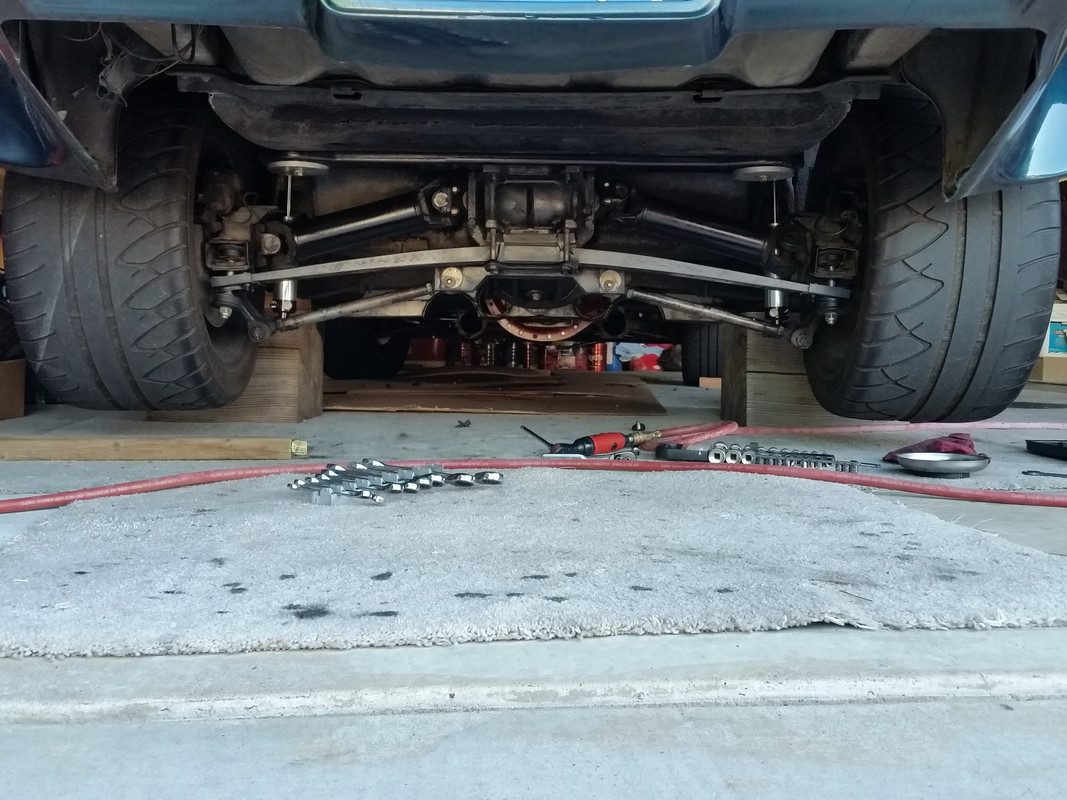
Maybe a genius on here can tell us all the advantages. I just wanted nearly level half shaft angle. I would think that less downward angle is better. So mine sitting on the ground is nearly level half shafts.
Even hanging down I don't have much angle with my flatter type mono spring.
Thanks for all the feed back
What started this is when I installed the lowered and himed strut rod. The nice and tight tell pipes I fabbed will no longer clear.
So it is ether rework tell pipes, or raise diff.
Raising the the diff will have the added benefits of lowering car, and helping half shafts angle
The C3 rear suspension’s toe curve goes nuts when at a point past the diff going below the wheel hub centerline. Raising the diff allows you to lower the car and still have wheel travel without getting into the nasty section of the toe curve.
That is definantly part of it
Here are the C2&3 Toe Curves according to Zora (I figure he should know)
(oopps...Top one is front, bottom one is rear.)
(Note toe in and toe out are reversed above)
Many things can shift it a little but the basic shape stays the same. It changes some if you change the ride height, the front tie rod positions, or the rear lower strut rod mounting positions, or the diff height, or half shaft angles. At least one typical shift is noted above.
One thing the curves show is you can get by with zero static toe in at the front. Even some very slight toe -out. It will add more toe out when you hit the brakes HARD (jounce), Can make it squirrelly on the brakes. Main reason race guys use stiff front springs. But it will just be "nervous"
When you hit the gas the front goes into to toe-in. Not usually a problem if you are going in a straight line. Drag racers set their alignment to zero toe after the front end lifts to compensate for this.
However the rear is less forgiving. It is really not too bad on the gas (jounce) The main problem as Sharkracer noted is when you hit the brakes and the rear goes up and you get toe-out and the rear gets squirrely. Try that in a corner at speed and see what happens. You could spin pretty easy. Yeah that's not good. That's the main reason you have to run a decent amount of static toe-in on these cars in the rear. More than most any other car. No-one wants to spin just cause they hit the brakes! Test it, add more rear spring, add more rear static toe, add more rear shock, until the squirreliness goes away.
Personally I would not lower the car any in the rear with the stock soft springs because you only have about 3 inches of jounce until you hit the bump stops. That's not a lot. A stock BB can do it in first gear just by hitting the gas, if it has the stock soft springs.. If you lower it in the back you should use a stronger spring to keep that from happening. Raising the diff will not have any effect on hitting the bump stops, that's a separate calculation.
I am unsure of the toe-in effect if you raise just the diff. I'd have to think about that pretty hard. But the curve shown would shift somehow.
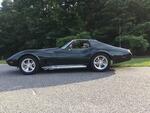
I think I would make sure the half shafts and the strut rods are parallel like in GKulls car above. That solves a lot of Neg Camber issues. You can see how flat his 285 rear tires are even in full droop! It looks like he is using a lowered inner strut rod mounting location, and has the raised diff crossmember solid spacers. As far as the toe curve, if the shafts are level at ride height, that should make toe curve centered and about the same top and bottom, not severely different like Zora's. End result much less toe-out on the brakes!
Last edited by leigh1322; Feb 13, 2021 at 08:47 PM.
Leigh - does the chart assume “0 wheel travel” is where the half shafts are level, or some other pre-determined ride height? The top chart is C2 and bottom chart is C3?
Note that raising the diff allows the body to be lower while maintaining level half-shafts.
Actually my rear tires are 335 on 13 inch wide wheels.
I have VB&P Smart struts and from years of experience I have them set to the lowest differential mounting point and. .50 degrees negative camber 1/8th toe in
On the front you install a bump steer kit and big springs
I took out the rubber suspension stops front and rear as excess weight a long time ago
Also I have 58% rear 42% front more like real racing cars
I did this by replacing the rubber bushings that mate the crossmember to the frame with metal plates. That gains you about .75 inch. This is shown in the Chevy Power Book (https://www.duntovmotors.com/Corvett...wer%20Book.pdf). I did it to lower the car a bit but also retain the downward angle of the half-shafts. By moving the whole assembly up into the frame, you keep many of the angles of travel for the axles the same.
I have not noticed any harshness or gear whine from solid mounting my crossmember/differential. Some have.
Leigh - does the chart assume “0 wheel travel” is where the half shafts are level, or some other pre-determined ride height? The top chart is C2 and bottom chart is C3?
Note that raising the diff allows the body to be lower while maintaining level half-shafts.
Oops... I didn't realize they were not labeled. Top is front, bottom is rear.
From a engineering paper on the C2 chassis when it was new.
Zero is normal ride height.
Jounce is wheel moving up.
I guess if you lower the car one inch 1" of jounce becomes your new ride height.
Raising the diff is in reality lowering the whole car, frame and all suspension mounting points.
So I think that would rotate the rear curve 1" counter clockwise.
That would lower the rear toe-out on the brakes during rebound.
Gkulls setup is likely ideal, he has changed the rear roll center (curve shape) by making the half-shaft and rear strut rods parallel. (That also really helps with the camber curve and keeping his enormously fat rear tires nice and flat)
The rear toe curve should just get flatter and not curve as much.
Then with his really stiff rear spring (2x stock) the rear moves up & down half as much, so say 1-1/2" vs 3". And he lowered the rear.
So if he gets everything just right he will have that straight up & down part of the curve at ride height, and hardly experience any toe change at all thru 1:1/2" of suspension movement. Or at least very small amounts. And the car is lower and the spring is stiff enough to not hit the frame or bump stop. That's a win-win. Zora knew all this when they built the car. Doing exactly what the power book says puts all the toe & camber curves in their sweet spot for racing.
(They suggest raising the diff in there) and mention a specific ride height.