When you click on links to various merchants on this site and make a purchase, this can result in this site earning a commission. Affiliate programs and affiliations include, but are not limited to, the eBay Partner Network.
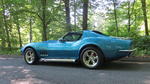
My 69 427/435 L71, original. I finally got to the point to drive it around the block a couple laps. When I got into the driveway I heard a pop and the hose on top of the expansion tank was spewing out lots of water with plenty of steam. Did I fill it up with too much water before my test drive?
Quite possibly just expelling excess volume from the heated, expanded state. Not sure of the expansion of antifreeze, but water expands about 4% from 70°ish F to 212°F. I assume the temp gauge was normal after your trips around the block. Drive it a few more times and watch the gauge. If it stays consistently in the normal range, then you're just fine.
One more thing, did you follow the recommendation engraved on that aluminum reservoir tank to only fill 1/2 full?
Last edited by barkingrats; Apr 20, 2021 at 07:52 PM.
My temperature was normal at 210. I did overfill the tank because I was filling a dry radiator. I was only using water for the anticipated drive around the block.
The hose popped off because the clamp was loose.
You have a RC15 cap which is incorrect for an aluminum expansion tank, it should be RC26.
RC26 is used to prevent corrosive electrolysis with the aluminum. https://willcoxcorvette.com/corvette...15-rc-26-67-72
Thanks about the cap info. I didn't know that. Although, my hose never popped off. All the water came out the discharge hose, which is attached to the tank with no clamp and runs underneath and just dangles open under the car.
Your link for the cap states its for all small blocks. I don't think that applies to me.
Last edited by 4speed69; Apr 21, 2021 at 04:01 PM.
The hose popped off because the clamp was loose.
You have a RC15 cap which is incorrect for an aluminum expansion tank, it should be RC26.
RC26 is used to prevent corrosive electrolysis with the aluminum. https://willcoxcorvette.com/corvette...15-rc-26-67-72
Since his 69 is a 427/435 it should have if original a Brass/Copper radiator with an Aluminum expansion tank the RC-15 is correct in this configuration.
Thanks about the cap info. I didn't know that. Although, my hose never popped off. All the water came out the discharge hose, which is attached to the tank with no clamp and runs underneath and just dangles open under the car.
Your link for the cap states its for all small blocks. I don't think that applies to me.
If you read the link description carefully there is a comma after all small blocks, after that point it lists big blocks.
Since it was the overflow hose it is because you overfilled the tank, it should be filled half way when completely cold.
Since his 69 is a 427/435 it should have if original a Brass/Copper radiator with an Aluminum expansion tank the RC-15 is correct in this configuration.
1968 to 1969 The cap for a copper radiator or a brass expansion tank is RC-15. It has a brass center rivet, which is flat in the center with a faint raised ring at the edge. On very early 1968s, the rivet has a depressed center with a rounded raised edge. A round-head rivet is not original. first photo The RC-15 has 15# and RC-15 in another circle. With an aluminum expansion tank, an RC[1]26 is used. It has a depressed aluminum center rivet with rounded raised edge and does not have the circle around the 15# and RC-26. Both caps are rated to hold 15 lbs. of pressure. The tops of both are plated bright silver cadmium, read TURN TIGHT and REMOVE SLOWLY, and have the AC logo in a circle.
1968 to 1969 The cap for a copper radiator or a brass expansion tank is RC-15. It has a brass center rivet, which is flat in the center with a faint raised ring at the edge. On very early 1968s, the rivet has a depressed center with a rounded raised edge. A round-head rivet is not original. first photo The RC-15 has 15# and RC-15 in another circle. With an aluminum expansion tank, an RC[1]26 is used. It has a depressed aluminum center rivet with rounded raised edge and does not have the circle around the 15# and RC-26. Both caps are rated to hold 15 lbs. of pressure. The tops of both are plated bright silver cadmium, read TURN TIGHT and REMOVE SLOWLY, and have the AC logo in a circle.
I should have added that if you have an Brass/Copper Radiator with an Aluminum Expansion tank an RC-15 is used. I now have add that info.
My 1969 came with base 350/300 engine. It was a November 1969 build car, first sold in February 1970. I bought it in August 1970 with 2,600 miles. It has the original aluminum rad, expansion tank, and as far as I know the original rad cap.
From what you posted MelWff this cap is wrong for my car? There is no corrosion, the cap is stainless, which would seem to inhibit or prevent corrosion.
I just went in the garage and took these photos for this thread. I’m suddenly wondering about the cap on my car.
My 1969 came with base 350/300 engine. It was a November 1969 build car, first sold in February 1970. I bought it in August 1970 with 2,600 miles. It has the original aluminum rad, expansion tank, and as far as I know the original rad cap.
From what you posted MelWff this cap is wrong for my car? There is no corrosion, the cap is stainless, which would seem to inhibit or prevent corrosion.
I just went in the garage and took these photos for this thread. I’m suddenly wondering about the cap on my car.
The service RC-15 Stainless Steel cap will work just fine. But you original Cap would have been an RC-26 like this. The Stainless Steel caps stared appearing around 1973.
For this thread we were discussing a 1969 427/435 which is an unusual setup it has a Brass/Copper radiator and an Aluminum Expansion tank. This particular combination uses a RC-15 cap which is the oddball of the normal GM setup.
My 1969 came with base 350/300 engine. It was a November 1969 build car, first sold in February 1970. I bought it in August 1970 with 2,600 miles. It has the original aluminum rad, expansion tank, and as far as I know the original rad cap.
From what you posted MelWff this cap is wrong for my car? There is no corrosion, the cap is stainless, which would seem to inhibit or prevent corrosion.
I just went in the garage and took these photos for this thread. I’m suddenly wondering about the cap on my car.
my understanding it is not cap corrosion but aluminum corrosion caused by the different construction/metal used in the cap.
A RC-26 was an Aluminum cap designed specifically for use with and Aluminum radiator and Aluminum expansion tank. As its parts were made from materials that would not have galvanic corrosion from dissimilar metals.
The RC-15 was designed for use with an Brass/Copper radiators. On certain specific engine combinations namely the 427/435 and 350/350 manual and with a Brass/Copper radiator with a Aluminum expansion tank the RC-15 was used due to the Brass/Copper radiator. These were the only exemption we know of.










 Expansion tank