When you click on links to various merchants on this site and make a purchase, this can result in this site earning a commission. Affiliate programs and affiliations include, but are not limited to, the eBay Partner Network.
Thanks, and nice to be here, hope I can help out some.
For sure I'm not specifically a "Pontiac guy", although I currently own/drive one and have extensive experience with them. I've actually owned and raced more Chevy powered cars than Pontiac's, and a nice 1970 440 powered Roadrunner for quite a few years.
I don't wonder around much on the Forums but retired first of April so have a little more time these days for posting. I still work on carbs and distributors daily and will continue the parts business for a few more years. The focus however is parts, and most of the carbs I'm working on have been done elsewhere and not working as intended. So nice clean/restored units for the most part that just need some help in a few places.
Another BIG issue I've seen with these offshore distributors is gear wear. Not sure what car bumpers they melted down to make the last one that was in here from but it was chewed to a "knife" edge in less than 200 miles. It was an Olds HEI bought from one of the big Speed Shops, no names mentioned.......
You built the QJet for my '72 LeMans and I got the parts from you when I rebuilt the QJet on my '71 Corvette. Thanks for making my cars run so well.
I used to do my own distributor work on a sun. Machine but I've been working with a timing light. I thought something was goofy on these aftermarket hei units. But couldn't nail it down.
I think I'll order the msd.
I have the MSD Pro-Billet HEI P/N 8365 and recommend it highly. It's a quality piece that is fully adjustable. What ever curve you want, you can create it with this unit. Expensive, but worth it.
I have the MSD Pro-Billet HEI P/N 8365 and recommend it highly. It's a quality piece that is fully adjustable. What ever curve you want, you can create it with this unit. Expensive, but worth it.
I considered the MSD, which is excellent, but it requires the MSD box, which I don't want.
The MSD 8365 is an HEI replacement distributor and as such is self contained. It does not require an external ignition box.
Thanks for that info. I was thinking of another MSD model (non HEI), which states the requirement of the box. The bushings included with MSD 8365 however don't quite allow 20° of initial timing, but you can supply your own if needed.
Buy a brand new GM Performance Parts 93440806 From Summit for $178. It has 18 degrees in the centrifugal mechanism. Curve starting at 900 RPM and finishing at 2900 RPM. Has a vacuum advance that is all in by 6.5" for 18 degrees extra. You might want to change the can or just limit the travel.
What else would you need?
This is exactly what I did in my 79. Only I bought a NOS crate ZZ4 take-off distributor (still PN 93440806) from eBay for ~$100-.
I added shims to remove endplay, used springs from a kit to get it all in at 2900 RPM (I measured 21 degrees mechanical), and added an Accel 31035 adjustable can to give me 12 degrees of vacuum advance (there are other ways to do this, but this worked for me).
Hi guys, once again thanks much for all the expert advice. thought I'd let you all know what I came up with. of course in addition to this thread, a bit over 40 years experience as a professional mechanic and reading everything I could find on the subject. All played into my fix.
first off someone asked if I tryed different springs.
Just SOME of the springs in my assortment,
plus different weight arms, footballs, etc.
now on to the brass tacks of the matter. Cliff made a comment about these cheap distributors advancing past the flats of the weights. yup, I thought about that and I'm certain he's correct.
pretty much everyone says these things are junk. this one is a Proform, made in Taiwan. There the same people who make the GM performance distributor.
my original question was can I just buy something that will work. the good answer was, yes, buy the MSD HEI adjustable billet distributor.
I looked on line, 620 bucks Australian. plus fright. will defiantly be north of 700 Australian.
So, this gave me incentive to try again.
I put the shaft from my factory distributor into the proform body. shimed the end play of course. I then ran a self tapping screw into the arm the rotor mounts to creating a positive stop so it can't advance past the flats on the arms.
like this,
Now this still gave me to much total advance. so I welded up the slots in the base plate on the idle side and filed them back using a caliper to messure as I filed. keeping them both the same. this took a couple go's assembling and installing, checking the timing . 3rd go I got it to 19 initial and 35 all up. then to get the spring rate. lots of tries. ended using the strongest pair of springs I had. came in at 2,400. I thought this to be a bit low as I had tryed something like this before but took it for a short run between the rain. sure enough. ran fine with light load, didnt like that much timing between 25 and 3 under a hard load.
ended up cutting a loop and a half off of one spring. 19 at idle, starts to advance at 1,150 smoothly climbs to 35 all in at 3,050. Thanks to my handy tach complements of my Summit EFI.
Hooked up my vacuum advance to double check it. I have 12 degrees of vacuum advance, not 10 as I stated earlier.
Still raining so I'll have to wait for dry roads to really test it. But I'm feeling confident.
Here is how I set them up for both a positive stop and to control how much mechanical advance is added at the same time. If you want to check your work and fine tune the amount of advance added before putting it all back together you can use a degree wheel with the shaft locked down in a soft jawed vise. This eliminates the need for a distributor machine as far as how much will be added. You will still have to figure out which springs to use to get the curve to start and end where you want.
The key here is to not have any of the timing in at idle speed, makes idle tuning difficult, if not near impossible. The trend has always been for a super quick curve with all the timing in early. I save my thoughts on that for later, but will say that the better you did with your choices for the cam and compression the less timing the engine will need to make best power, and it woln't need all the timing in right off idle either.
I also recommending using vacuum advance. It's a load sensing device and without it you are missing timing at light engine load that is needed to effectively burn leaner mixtures, plus improved power and efficiency (fuel economy), if you care about that sort of thing.......
Hi guys, once again thanks much for all the expert advice. thought I'd let you all know what I came up with. of course in addition to this thread, a bit over 40 years experience as a professional mechanic and reading everything I could find on the subject. All played into my fix.
first off someone asked if I tryed different springs.
Just SOME of the springs in my assortment,
plus different weight arms, footballs, etc.
now on to the brass tacks of the matter. Cliff made a comment about these cheap distributors advancing past the flats of the weights. yup, I thought about that and I'm certain he's correct.
pretty much everyone says these things are junk. this one is a Proform, made in Taiwan. There the same people who make the GM performance distributor.
my original question was can I just buy something that will work. the good answer was, yes, buy the MSD HEI adjustable billet distributor.
I looked on line, 620 bucks Australian. plus fright. will defiantly be north of 700 Australian.
So, this gave me incentive to try again.
I put the shaft from my factory distributor into the proform body. shimed the end play of course. I then ran a self tapping screw into the arm the rotor mounts to creating a positive stop so it can't advance past the flats on the arms.
like this,
Now this still gave me to much total advance. so I welded up the slots in the base plate on the idle side and filed them back using a caliper to messure as I filed. keeping them both the same. this took a couple go's assembling and installing, checking the timing . 3rd go I got it to 19 initial and 35 all up. then to get the spring rate. lots of tries. ended using the strongest pair of springs I had. came in at 2,400. I thought this to be a bit low as I had tryed something like this before but took it for a short run between the rain. sure enough. ran fine with light load, didnt like that much timing between 25 and 3 under a hard load.
ended up cutting a loop and a half off of one spring. 19 at idle, starts to advance at 1,150 smoothly climbs to 35 all in at 3,050. Thanks to my handy tach complements of my Summit EFI.
Hooked up my vacuum advance to double check it. I have 12 degrees of vacuum advance, not 10 as I stated earlier.
Still raining so I'll have to wait for dry roads to really test it. But I'm feeling confident.
Here is how I set them up for both a positive stop and to control how much mechanical advance is added at the same time. If you want to check your work and fine tune the amount of advance added before putting it all back together you can use a degree wheel with the shaft locked down in a soft jawed vise. This eliminates the need for a distributor machine as far as how much will be added. You will still have to figure out which springs to use to get the curve to start and end where you want.
The key here is to not have any of the timing in at idle speed, makes idle tuning difficult, if not near impossible. The trend has always been for a super quick curve with all the timing in early. I save my thoughts on that for later, but will say that the better you did with your choices for the cam and compression the less timing the engine will need to make best power, and it woln't need all the timing in right off idle either.
I also recommending using vacuum advance. It's a load sensing device and without it you are missing timing at light engine load that is needed to effectively burn leaner mixtures, plus improved power and efficiency (fuel economy), if you care about that sort of thing.......
Hi Cliff, this is a cool idea with the degree wheel. So in the pic, it shows 10 degrees, that equates to 20 degrees at the crank?
From: Some days your the dog and some days your the hydrant.
Royal Canadian Navy
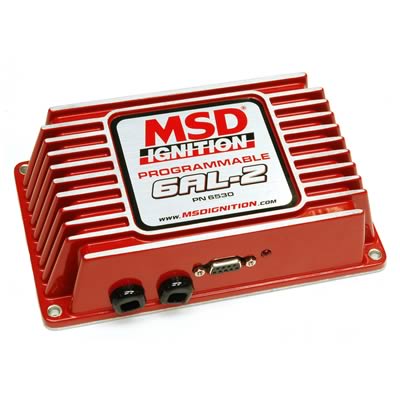
For the guys looking to buy a new MSD dist'r for $460 to mechanically adjust a curve, imo, money poorly spent. You may as well keep your oem HEI and buy the MSD 6530 box. Then you can very easily program any curve you like without touching the internals of the dist'r in a few seconds. It works with engine vacuum too with a $30 1 bar MAP sensor. I went through all the dist'r curve methods with reducing mech'l advance, springs, weight, vacuum advance limiters, etc. Way too labour intensive and time consuming. Now, I just have my HEI locked out at 42* initial advance and design my curves on the computer.
Curve above for my current timing.
MSD box mounted on firewall. They come in black too.
For the serious tuner, this is the way to go. All auto makers do it this way now but with way more sophistication. Installation was pretty straight forward. Only a few wires to connect to the original dist'r wiring. 12V source is connected to solenoid on the starter i.e. a direct connect to the battery positive. A wire does (edit) NOT need to go to the battery behind the seat. My MAP sensor just sits on top of the intake by the dist'r with manifold vacuum for the source. The only thing I don't like is the computer connectivity which uses a serial port. I'm lucky I kept an old desktop that has a serial port so its easy to connect. I have a USB-serial adapter but I haven't tried it on a newer laptop. It only takes about 20 seconds to download a curve to the box or from the box to the computer. Downloads can be done with the engine running too. Try that with changing dist'r springs. Anyway, no real downside so far. But I did get burned with the $600 Mallory all-in-one programmable dist'r. Hopefully the MSD will have some longevity.
Last edited by resdoggie; Apr 22, 2021 at 06:54 PM.
From: Into the Mystic And yet, despite the look on my face, you're still talking TN
St. Jude Donor '09 thru '25
Originally Posted by drwet
I have the MSD Pro-Billet HEI P/N 8365 and recommend it highly. It's a quality piece that is fully adjustable. What ever curve you want, you can create it with this unit. Expensive, but worth it.
For the guys looking to buy a new MSD dist'r for $460 to mechanically adjust a curve, imo, money poorly spent. You may as well keep your oem HEI and buy the MSD 6530 box. Then you can very easily program any curve you like without touching the internals of the dist'r in a few seconds. It works with engine vacuum too with a $30 1 bar MAP sensor. I went through all the dist'r curve methods with reducing mech'l advance, springs, weight, vacuum advance limiters, etc. Way too labour intensive and time consuming. Now, I just have my HEI locked out at 42* initial advance and design my curves on the computer.
Curve above for my current timing.
MSD box mounted on firewall. They come in black too.
For the serious tuner, this is the way to go. All auto makers do it this way now but with way more sophistication. Installation was pretty straight forward. Only a few wires to connect to the original dist'r wiring. 12V source is connected to solenoid on the starter i.e. a direct connect to the battery positive. A wire does (edit) NOT need to go to the battery behind the seat. My MAP sensor just sits on top of the intake by the dist'r with manifold vacuum for the source. The only thing I don't like is the computer connectivity which uses a serial port. I'm lucky I kept an old desktop that has a serial port so its easy to connect. I have a USB-serial adapter but I haven't tried it on a newer laptop. It only takes about 20 seconds to download a curve to the box or from the box to the computer. Downloads can be done with the engine running too. Try that with changing dist'r springs. Anyway, no real downside so far. But I did get burned with the $600 Mallory all-in-one programmable dist'r. Hopefully the MSD will have some longevity.
Sorry Resdoggie,......we agree on many things, but a "laptop" and my C3 are NOT living on the same planet. Long list of choices I made to specifically keep my car old school and simple. I will leave the fancy stuff to others and to modern cars......not interested in a "box" to hook up to a laptop. Did the same thing with my 2004 Road King.....ordered it with a carburetor,....and 132,000 miles later, its still running strong and simple. Thats the way I roll.
Well, the clouds cleared up this morning and I was about to take my baby for a test beat. drove her around kindly, had little choice, Traffic. And in a few opportunities was able to floor it hard though the gears.
The butt dyno, my ear, and the temp guage all agreed. The engine is pulling smoothly, pulling Hard, and running cool.
Maybe I could do even better with a MSD-2 type computer controled Ign. However, they cost just under 600 bucks Australian, plus frieght to get it overseas. And it's a HUGE box.
I went with a standalone type EFI system for a reason. I wanted to keep trouble shooting simple in the case of future problems.
Anyway, thanks much to Cliff for his great photos and detailed explanations. Hopefully they will be very helpful for future tuners.
Of course I got that info just after my experiment. I found a site called, "Hot Rodding a HEI Distributor" by the Crankshaft coalition. Here's a photo from that site,
So this is where I got my ideas from. So my solution may have been a bit unorthodox, but it seems to be working.
sometimes there can be a different solution. But, and I must say. putting the factory shaft, football and weight arms was totally the start of the answer.
Last edited by 4-vettes; Apr 23, 2021 at 03:16 AM.
From: Some days your the dog and some days your the hydrant.
Royal Canadian Navy
Originally Posted by Flyboy1958
Sorry Resdoggie,......we agree on many things, but a "laptop" and my C3 are NOT living on the same planet. Long list of choices I made to specifically keep my car old school and simple. I will leave the fancy stuff to others and to modern cars......not interested in a "box" to hook up to a laptop. Did the same thing with my 2004 Road King.....ordered it with a carburetor,....and 132,000 miles later, its still running strong and simple. Thats the way I roll.
Lol, you mention your Road King with a carb. I bought a 2007 RK with efi and also bought the Screaming Eagle tuning kit so I could play with maps!
My wife's Nightster My RK
Both were sold several years ago. I'm a car guy!
Last edited by resdoggie; Apr 23, 2021 at 10:15 AM.
Over 40 years as a Harley Davidson mechanic here. Worked on all the EFI Harleys from the 94's when they first started to the 21 models. Started Dyno tuning in the late 90's .
I run a EFI late model Harley. Absolutely no comparison to a carburated Bike.



























 Anyway, no real downside so far. But I did get burned with the $600 Mallory all-in-one programmable dist'r. Hopefully the MSD will have some longevity.