When you click on links to various merchants on this site and make a purchase, this can result in this site earning a commission. Affiliate programs and affiliations include, but are not limited to, the eBay Partner Network.
My girlfriend's been driven nuts for hours - down, up, down, up, down, up a hundred times pressing the pedal while I bleed the brakes, so I thought I'd spare her any more misery and buy a self-bleed kit. I'm not sure which is the best to use. Some operate from a compressor, some use the air from the spare wheel and others use a vacuum pump to draw the fluid. It looks like some are connected to the master cylinder, but the caps that are included in the kit wouldn't fit the Vette's master cylinder. Anybody got any views on the right kit to use, or does my girlfriend have to be pressed into service again?
I used the Motive Products power bleeder, it works OK. I don’t think there’s any whizbang solution for the old cars. It uses a big rubber plate that’s held against the master cylinder with J screws and chains. It pushes new fluid into the reservoir as you drain at the caliper.
It will get the job done.
It works REALLY well on most modern cars, particularly with the “premium” adapters. The plastic ones have been hit or miss in my experience.
I have never had good success with vacuum bleeding. Seems the bubbles are never-ending, which I think must be coming from around the bleeder screw threads. I even put teflon sealing tape on the threads in hopes it would seal the threads but still get small bubbles.
I made my own master cylinder cap to use my compressor and it worked very well. The Motive pressure pot works on a similar principle.
I have both a Mity Vac and the "standard" Motive pressure bleeder.
I've had the Mity Vac for 20 plus years and it still works. I use it when I build something that uses the plastic master.
I bought the Motive unit maybe 10 years ago and have used it a number of times. Works well. The chain clamps they provide are junk. I use c-clamps to to hold the pressure plate to the master. One down side to the Motive is that it will fill up the master to the very top and some fluid may run out when you take the plate off. So be careful to protect painted areas.
Before I bought the Motive I made a bubba version of a pressure bleeder with a piece of of 1/4" plate. Sealed the plate with a piece of scrap truck inner tube. (Told you it was a bit bubba) Drilled and tapped it for a NPT fitting that allowed me to attach an airline from my compressor. Set the regulator at about 25-30 psi. You do have to refill the master as you bleed fluid out.
I think you will find if you do a bit of research, there have been a TON of threads on here about bleeding brakes. Your not alone. Gravity bleeding takes time, But there is nothing to buy other than a short clear line to attach to the bleeder. suction or Vacuum bleeder's are really not a good idea if you still have the lip seal Calipers. lip seals are designed to seal one way. as in getting pushed against. When you "pull" with a Vacuum bleeder you can pull air in around the lip seals. Pressure bleeders along with tapping the Calipers as you go to "Knock" the bubbles loose seems to work the best for most.
Oh, and remember to start with the bleeder farthest away from the master and work your way around to the closest last. Starting with R.H. rear outside bleeder, then inside bleeder, moving to outside LH rear. ....... Last Caliper to be bleed is L.H.front.
I've used the vacuum method myself for years. Yes the bubbles are an issue, teflon tape works great most of the time other times so-so. I've learned to read the difference between thread bubbles and bubbles in the line.
I've used this for my old school stuff as well as modern cars with anti-lock brakes.
My girlfriend's been driven nuts for hours - down, up, down, up, down, up a hundred times pressing the pedal while I bleed the brakes, so I thought I'd spare her any more misery and buy a self-bleed kit. I'm not sure which is the best to use. Some operate from a compressor, some use the air from the spare wheel and others use a vacuum pump to draw the fluid. It looks like some are connected to the master cylinder, but the caps that are included in the kit wouldn't fit the Vette's master cylinder. Anybody got any views on the right kit to use, or does my girlfriend have to be pressed into service again?
I found the vacuum pulls the pistons away from the rotor and introduced the air back in past the pistons. Maybe my vacuum was too strong.
Instead, had someone help with the pedal and that worked best for me so far. In my mind, the rapid flow from someone pushing the brakes pulls all the air from the high spots in the system and gravity might let those air pockets just stay there. My theory is.... Helper is best, pressure is second, and vacuum is last..
What worked best for me was to have a helper push brake down, you open the valve, then close it, then helper lets the brake back up. Repeat until no air comes through clear hose connected to fluid exhaust.
2025 c3 ('74-'82) of the Year Finalist - Unmodified
2019 C3 of Year Finalist (appearance mods)
Important Correction
Originally Posted by 4-vettes
Oh, and remember to start with the bleeder farthest away from the master and work your way around to the closest last. Starting with R.H. rear outside bleeder, then inside bleeder, moving to outside LH rear. ....... Last Caliper to be bleed is L.H.front.
On the rear you must bleed the inners first then the outers.
Interesting, that's contrary to how I've always done it. And unlike so many on this forum, I've never had any trouble bleeding brakes. And just to play Devils advocate, Here's what the Factory service manual has to say. -
For those not familiar with the Factory Manuals. Corvettes are "Y" models. And no mention of inner and outer bleeders on the rear.
I've had good luck with the Motive Pressure Bleeder. Anytime I've tried the vacuum method, I suck air through the threads. And my wife doesn't like it when I use the girlfriend method, especially in her car.
The GM adaptor works fine, if you use a large C-clamp, or similar. I only use just air pressure, and take the lid off a bunch, so I use a large quick-clamp. It also helps to tap the junctions and calipers with a wrench to dislodge air bubbles.
Lots of folks will now tell you how to save $20- on something that costs $60-, when mechanic/girlfriend labor starts at $100-/hour. I even paid extra for two (2!) Motive brand catch bottles, so can do both of the rear caliper bleeders at once, by myself. I'm just throwin' money away over here!
Last edited by Bikespace; May 17, 2021 at 04:45 AM.
Thanks for the very useful advice. I should have said it's a '69 350, manual transmission, manual brakes, lip seals. I've had nothing but trouble with the brakes recently, and I've even had to fit new lip seals to brand new calipers so I'd be careful if a vacuum pump caused the seals to leak again. I found the 2 person process works well apart from two things 1. it's difficult to hold the tube on and adjust the screw and keep the jar on top of a couple of tins of paint without knocking it over while 2. the girlfriend gets bored out of her mind depressing the pedal. I haven't got a compressor just now and the portable 12v inflator isn't good enough. What about using the pressure from the spare wheel - it sounds amateurish but is it a good method to use? The Mity vac seems expensive to buy but the Motive is much cheaper. Am I right in thinking that all power bleeders need a compressor?
Interesting, that's contrary to how I've always done it. And unlike so many on this forum, I've never had any trouble bleeding brakes. And just to play Devils advocate, Here's what the Factory service manual has to say. -
For those not familiar with the Factory Manuals. Corvettes are "Y" models. And no mention of inner and outer bleeders on the rear.
It is not about "must" do it that way. This is only about saving fluid and time. You are purging the "trunk of the tree" all the way first, then just purging "the shorter branches".
"Inner screw first" saves you from pulling tiny bubbles forever from the air pocket at the inner screw if you are trying the outer screw first. Time and fluid waster. Always go back to the inner screw one last time before moving on to the next wheel in the sequence.
Check on EBay for a used Motive Tank. People buy these, use it once, then store it in the corner of the garage. They just need new clear hoses and a thorough rinsing with Acetone. (Mine needed a new pump $12 because nobody cleaned it.)
The cheaper pressure tanks do not have a gauge. I like to know what's going on with the master cyl. You only need about 12-15 lbs press. The Motive tanks will hold two bottles of DOT3 easily. Enough to bleed all six bleeder screws.
The Motive cover / lid for the master is a joke with the birdfeeder chains. Pitch all that in the round file box.
For a proper MC lid, check out my profile, then Photo Album, Brake Bleeding.
Thanks for the very useful advice. I should have said it's a '69 350, manual transmission, manual brakes, lip seals. I've had nothing but trouble with the brakes recently, and I've even had to fit new lip seals to brand new calipers so I'd be careful if a vacuum pump caused the seals to leak again. I found the 2 person process works well apart from two things 1. it's difficult to hold the tube on and adjust the screw and keep the jar on top of a couple of tins of paint without knocking it over while 2. the girlfriend gets bored out of her mind depressing the pedal. I haven't got a compressor just now and the portable 12v inflator isn't good enough. What about using the pressure from the spare wheel - it sounds amateurish but is it a good method to use? The Mity vac seems expensive to buy but the Motive is much cheaper. Am I right in thinking that all power bleeders need a compressor?
If you look carefully at the photo I posted, you will see the charge handle. It has a built in pump, not unlike a pesticide sprayer. If you have a compressor, all you really need is the adaptor plate, but the Motive can be used to provide air pressure, or to provide pressurized brake fluid directly.
The Motive system is cheaper than engineering all of this yourself, but you could do it for almost free if you have unlimited time. Any reasonable amount of money spent on solving this problem will be cheaper than finding a new girlfriend.






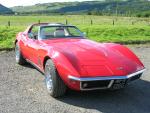


 What self-bleed brake kit?


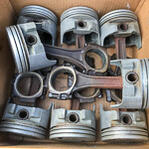











 😆
😆