When you click on links to various merchants on this site and make a purchase, this can result in this site earning a commission. Affiliate programs and affiliations include, but are not limited to, the eBay Partner Network.
I have a 1970 small block... I plan on changing the fuel pump. I've read and seen some videos, and several suggested setting the engine to TDC as it makes the location of the fuel pump push rod sit at it's furthest towards the engine so easier to install the pump... also there were several mentions of removing the bolt located on the front of the engine that is inline with the fuel pump bolts and inserting a longer bolt (actually one of the fuel pump bolts as it is longer) and simply screwing in the longer bolt just snug enough and it will hold the push rod in place while you replace the pump so that the push rod doesn't fall out.
My question basically is what is the purpose of this bolt hole on the front of the engine? Is it used for anything else (other than to hold the push rod in place while changing the pump)? What impacts can there be if there is no bolt in that location?
I checked on my car, and there is no bolt in that hole, so just wondering what problems I can run into. I'm going to buy a bolt to at least fill the hole. I was told a 9/16 about 1 inch long (including the bolt head) should be ok.
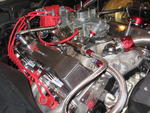
The yellow arrow in the picture below is pointing to the bolt I mean on the front of the engine.
That "tunnel" that the pushrod rides in, is well lubricated with engine oil.
You ask: what impacts if you leave a oil galley open?
Weepage..
For what its worth, the pushrod can not drop out unless the fuelpump "Mounting Plate" is removed along with the pump.
However, a wise man would remove that plate anyway and Permatex Black a brand new gasket, both sides, while you're at it.
To the OPs question:
"My question basically is what is the purpose of this bolt hole on the front of the engine?"
GM used those threaded bosses for front motor mounts on some applications.
From: At my Bar drinking and wrenching in Lafayette Colorado
Originally Posted by my1970conv
My question basically is what is the purpose of this bolt hole on the front of the engine? Is it used for anything else (other than to hold the push rod in place while changing the pump)? What impacts can there be if there is no bolt in that location?
The bolt hole is a direct passage into the engine crankcase. If you leave an open hole into the crankcase at a level that is a few inches above oil pan oil level, it will blow engine oil out of the hole with significant pressure at wide open throttle. It will spray out of that hole. If you have a PCV valve, it will not blow oil or leak at idle or at light throttle cruise - it will just suck road dirt, dust, and grime into the crankcase while driving.
The purpose of the bolt "boss" is exclusively used to aid in changing the fuel pump. I set the engine at TDC on the compression stroke. The rotor on the distributor will be pointing to the number one wire on the cap. Remove the bolt in the front of the engine, replace it with a longer bolt. Finger tighten the bolt so it lightly locks the fuel push rod. Remove the pump after clamping the rubber fuel line at the tank. It is easier to access the pump bolts through the pass. side wheel well with the wheel removed. Use a few socket extensions. Once the pump is removed, with one hand, push the rod as high as it will go while loosening the long bolt you already put in. Once the rod is all the way up, finger tighten the bolt again. Install the new pump with a fresh gasket and sealer. Remove the long bolt and install the short bolt with some sealer on the shoulder of the bolt. Remove the clamp on the fuel line, check for leaks, start the engine and check for leaks again. That should do it. Jerry
The purpose of the bolt "boss" is exclusively used to aid in changing the fuel pump. I set the engine at TDC on the compression stroke. The rotor on the distributor will be pointing to the number one wire on the cap. Remove the bolt in the front of the engine, replace it with a longer bolt. Finger tighten the bolt so it lightly locks the fuel push rod. Remove the pump after clamping the rubber fuel line at the tank. It is easier to access the pump bolts through the pass. side wheel well with the wheel removed. Use a few socket extensions. Once the pump is removed, with one hand, push the rod as high as it will go while loosening the long bolt you already put in. Once the rod is all the way up, finger tighten the bolt again. Install the new pump with a fresh gasket and sealer. Remove the long bolt and install the short bolt with some sealer on the shoulder of the bolt. Remove the clamp on the fuel line, check for leaks, start the engine and check for leaks again. That should do it. Jerry
and i learned on my fuel pump change recently.. you only need to be on tdc regardless of stroke...
and i learned on my fuel pump change recently.. you only need to be on tdc regardless of stroke...
Not so sure. Don't remember. Was four yrs ago when I changed my pump pushrod.
But the cam, which has the pump rod lobe turns at half the rotation of the crank.
Last edited by HeadsU.P.; Jun 22, 2021 at 03:38 PM.
Not so sure. Don't remember. Was four yrs ago when I changed my pump pushrod.
But the cam, which has the pump rod lobe turns at half the rotation of the crank.
ya i think someone told me that the lobe is not opposite but 90 degrees so either works…
or i just got lucky
Last edited by interpon; Jun 22, 2021 at 05:29 PM.
Designer Imagines A Corvette That Looks More Like a Corvette Than the Corvette
Slideshow: A Jaguar designer's personal project imagines what a modern front-engined Corvette might look like if Chevrolet revisited the golden age of the Stingray.








 Bolt purpose on front of engine