When you click on links to various merchants on this site and make a purchase, this can result in this site earning a commission. Affiliate programs and affiliations include, but are not limited to, the eBay Partner Network.
I also had a conversation with MIKE Jones.....the cam guy. I just wanted to review again with him, and question him again,......to verify that I am choosing the "right" cam specs for my engine and this car. I told him that I feel so outnumbered by opinions regarding this "lesser" duration choice that I doubt myself. He told me without reservation that it IS the right choice for my realistic operating range, my car,....on the street. He says he sees it ALL THE TIME,...where people choose cams that are not the best performance on the street and just choose the bottom of the page biggest cam.. He also said that lots of guys select cams ......"for the sound", no matter how badly the engine runs with it, and that these are the WORST cams for real performance on the street. He said that this cam choice IS the best choice for me. All of this is EXACTLY what I have read in numerouse engine publications over and over again. I just don't understand why people don't get it.
This is not to say that if a person is building an engine for drag racing, or illegal street racing....or any other type of racing, that hi RPM power is needed, that a low duration cam is the right cam for them. But to buy a cam for the sound....and sacrifice performance for where you actaully drive the car,...is not the way I do things. This is about the reality that driving on the street, you spend far more time between idle and 4000 RPM than you do above. I guess that some people bury the pedal when driving on the street.......but that is not me. And here is the thing......my cam choice IS about performance. I will have the BEST POWER / HP in the realistic operating range that I drive my car, and the way I drive it. A cam with higher duration is a sacrifice.
All of this is what Leigh has stood behind me on for years on this forum. Thank you Leigh for being the rare person who understands it. I have had a PM sent to me buy a regular who tells me that I ask too many questions, and don't make up my own mind. Well......I don't know much about all of this, but I am finally confident now that I am doing the right thing. This forum has allowed me the process of learning that.....no matter how many posts it takes.
Last edited by Shovels and Vettes; Nov 30, 2023 at 08:28 PM.
I would only accept the correction factor "SAE smoothing 5". Allows for comparisons from around the country to be on even playing field.
Mark Jones is apparently following this thread, so I will let him speak about the details of this. But....my take of what he told me was that correction factors are applied to identify the engine HP and torque at sea Level, standard day temp and humidity. I live at 1200 feet above sea level...and of course, the weather changes every day. So.....when I am driving my car....its doubtful I am making 560 HP / 565 ft lbs of torque. But.... I really don't care about the numbers. With the modifications I am making, I suspect that the car will have the best HP and torque in the operating range I drive the car.......finally. It only cost $20,000 and two years of my life. And it only will be this way by me making the decisions I have made on this THIRD build of this engine.
I know exactly what you're getting at, the best throttle response in your driving range. Like found in a '69 high compression non-performance big block.
Electric motor type response starting off idle.
I will have the BEST POWER / HP in the realistic operating range that I drive my car, and the way I drive it. A cam with higher duration is a sacrifice.
This forum has allowed me the process of learning that.....no matter how many posts it takes.
Think of it this way...it only took 1043 posts! LOL
And you are right, some people will always pick the biggest cam...and never get this....because bigger is always better right??
I have heard my best friend / engine builder say this over 1000 times to as many customers: "Always pick the smaller of the two cams you are considering"
FYI,
I just checked my dyno sheet and the lowest rpm listed was at 2600.
We shut the engine down at 5900 because I’ll never run it that high of rpm and I didn’t care about the numbers.
Like an ocilloscope is for elecrtrics the proper use of a dyno isn't to see who has the the biggest score it is to measure, tune and correct issues to insure the the products ($ paid out) selected perform to the expectations from the designer/ builders desk, workshop to the vehicle. Using correction factors other than what I wrote can fudge numbers to give a warm and fuzy that promotes the investment in the end has value even if the engine doesn,t perform. Most dynos I ran started at 2000 rpm.
Like an ocilloscope is for elecrtrics the proper use of a dyno isn't to see who has the the biggest score it is to measure, tune and correct issues to insure the the products ($ paid out) selected perform to the expectations from the designer/ builders desk, workshop to the vehicle. Using correction factors other than what I wrote can fudge numbers to give a warm and fuzy that promotes the investment in the end has value even if the engine doesn,t perform. Most dynos I ran started at 2000 rpm.
Way back when the OP started this he mentioned he liked the TQ curve on his Harley Davidson.
This is what one looks like:
Surprise:
a H-D makes way more TQ than HP!
But the Dyno run started from a DEAD IDLE
The TQ curve is almost DEAD FLAT from IDLE to 4500 RPM
The HP peters out at 5000-5500 RPM
Sound familiar to what he has been asking for all along?
Reminds me a a Buick GS455 Stage 1 I drove.....
Chevies just have such good breathing heads that most people do not build them this way.
It doesn't mean they can't do it.
Many other marques the heads do not breathe worth a *** past 5000 rpm, so they have little choice but to go for max TQ.
This variation of his engine will still make 430HP at 4000rpm just like the old one did (and past that he doesn't care).
But this one will make way more TQ from idle all the way up to around 4600rpm.
Past that the big cammed engine wins hands down, but not below it.
Last edited by leigh1322; Dec 1, 2023 at 09:15 AM.
Corvette Stories
The Best of Corvette for Corvette Enthusiasts
5 Best & 5 Most Overrated Corvette Track Packages of All Time!
Joe Kucinski
Every 2027 Corvette Engine Explained
Joe Kucinski
Designer Imagines A Corvette That Looks More Like a Corvette Than the Corvette
Verdad Gallardo
10 Ugly Corvettes That We Still Kinda Love
Joe Kucinski
Top 10 Most Expensive Corvettes Ever Sold on Bring A Trailer
Brett Foote
10 Things Every Corvette Owner Needs (2026 Edition)
Michael S. Palmer
8 Most "Only Corvette Owners Understand" Quirks and Problems
Pouria Savadkouei
10 Reasons the C6 Z06 is Still A Performance Benchmark After 20 Years
Joe Kucinski
How Much Horsepower Every Corvette Engine "LOST" in 1972
Joe Kucinski
Top 10 DOs and DON'Ts for Protecting Your Convertible Top!
Yes that is a TQ monster. Kind of like my Father in Laws Mack trucks!
Pistons make a BBC look like a peanut! Rod nuts half the size of your wrist!
700-900 cu. in. out of a six cylinder
The cam size of a H-D that the op was trying to emulate runs from 195-220 duration.
Same size as what he will have now.
Way back when the OP started this he mentioned he liked the TQ curve on his Harley Davidson.
This is what one looks like:
Surprise:
a H-D makes way more TQ than HP!
But the Dyno run started from a DEAD IDLE
The TQ curve is almost DEAD FLAT from IDLE to 4500 RPM
The HP peters out at 5000-5500 RPM
Sound familiar to what he has been asking for all along?
Reminds me a a Buick GS455 Stage 1 I drove.....
Chevies just have such good breathing heads that most people do not build them this way.
It doesn't mean they can't do it.
Many other marques the heads do not breathe worth a *** past 5000 rpm, so they have little choice but to go for max TQ.
This variation of his engine will still make 430HP at 4000rpm just like the old one did (and past that he doesn't care).
But this one will make way more TQ from idle all the way up to around 4600rpm.
Past that the big cammed engine wins hands down, but not below it.
Milwaukee-Eight's are a lot easier to make power compared to older engine versions those engines are 4 valves per cylinder and I have seen potentially150 out of those. The table top torque curve is real nice. Notice any correction factor?
[QUOTE=leigh1322; The cam size of a H-D that the op was trying to emulate runs from 195-220 duration.
Same size as what he will have now.[/QUOTE]
Very true. As a reference an Olds '68 or '69 442 400ci automatic (stick cars used larger cams) intake duration was 206* and the LS was 109, (This was also the manual trans late '70 350ci 4bbl camshaft). The very popular GTO cam 068 was only 212*. Quite a few Musclecar cams well under 220*.
Finally had a day off.......got the pistons cleaned up of all the carbon, gaskets and sealer removed, and the unexpected, and not sure why, RUST on the block, in the front behind the timing chain cover, as well as on crank bearing pad supports.....not sure why there is rust on the engine internally. But....even the flywheel that was shipped back to me had surface rust on it. Disappointing. I know it can be humid in Texas, but thought the stuff would have been stored in dry area......its not rusting in my garage, I can tell you that. And we have plenty of humidity here in PA. Fortunately, I was able to clean up most of it with combination of Scotchbrite and rust remover. You still can see the spots in the front and on a couple bearing supports.
I also cleaned off the orange paint off the oil pan rails and timing chain cover surfaces.....so the gaskets have a good smooth surface to adhere to, versus 1/2 paint, half steel.
And if I had the bare block.......I would have cleaned up that flashing around the valley center slots for better oil drainage. Simple.
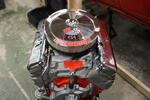
Went from this:
To this:
Last edited by Shovels and Vettes; Dec 4, 2023 at 07:12 PM.
I also added pictures to all the good removed engine parts for sale over on the C3 Parts for Sale forum......this is good stuff, but just not for me.
The new Mike Jones 224/228 cam has been ordered.......the new AFR 195 Street heads have been ordered, direct from AFR....with 7/16 inch rocker stud option. And....the new American Racing headers have been ordered...12-14 week wait time.
Last edited by Shovels and Vettes; Dec 4, 2023 at 07:16 PM.
Its been brought to my attention that the full circle dished pistons are not the best choice for quench. Unfortunately the only way to fix that is a new set of pistons....then a new rotating assembly balance.....which pretty much tears the engine comletely down to nothing....and then I would not only have to spend the money to buy a new set of pistons...but also find someone I can trust to balance it. In purchasing the new Street AFR 195 heads....I could buy the 75cc combustion chamber option....and then I could get a D-shaped piston with the right CC to set the compression right......those parts are available. Or I could find out if a D-shaped piston is available that has enough dish CC AND the D shaped.....with the 65cc head.
I don't know if I want to go down this road or not.....actually I DO know I don't want to. That doesn't mean I shouldn't. With the lower duration cam....detonation is more likely....so losing all the ideal quench only makes it worse. This BS never ends. The other benefit to replacing the pistons is I could use the traditional wider piston rings....not these thin ones that can have oil control problems.
More than likely.....I will just build it the way it is and hope it works out. And 300 posts from now,....next summer, I can continue the thread again for another year and another $5000.
I for one would like to see a formula for quench area and the intel that goes along with it. I have had many pistons made off molds I poured. Some piston designs I have received to a novices eye gave me questions. Ask yourself these questions.But in the end did your engine spark knock? Did you ever see metal transfer as in the appearance of pepper on your plugs or small craters on the piston tops? Did you experience your engine running hot? Or striations on pistons/cylinders from the piston out growing the cylinder? Top ring land damage? I'd say they are fine. Call the piston manufacture and try and get a hold of and engineer for an explanation.
What happens if you tear down the engine to nothing and find a scuff mark on a bearing? Are you going to spend months trying to get that perfect set of new bearings?
You had a running engine that needed an intake and an oil pan. Stop before you have nothing but an $18K pile of parts. You know the right thing to do. Button up that engine and run it!
Sitting in Alabama with nothing to do....so for those that believe there was nothing wrong with this engine build.....here you go. Suggesting that I am making things up, expecting perfection, exxagerating or worrying too much is insulting. Facts matter. Maybe none of the items below would bother you.....but they bother me,...and yes as I said....I am pissed about all of it. We won't even bother talking about the first build...its all been documented as a complete failure.....so lets just talk about this second engine build by Mark Jones / VortecPro.
- Massive oil consumption - 1 Quart for every 500 miles. Entire intake track on a brand new engine build became coked in oil...from manifold to valve to combustion chamber and piston tops...in 1600 miles.
- Oil leaking past rocker studs that extend into intake ports on heads. Had to be resealed.
- Drag racing oil pan that allowed excess oil accumulation in the front (oil laying on screen), aeration through a wire mesh screen,....and open area above rear sump, just below third rod set, allowing windage and aeration. Unfortunately to make the poor oil pan design even less functional, the builder cut the original screen off at the back, then installed a cut and shortened GM windage tray, leaving a large open area just below the third crank throw ....completely un-covered from oil in forward part of sump. See the pictures I posted on this thread, and you can see it. So....I am replacing oil pan with Milidon factory oil pan and GM windage tray. The crank will not be exposed to direct oil anywhere....just as in the original stock Chevrolet oil pans used on Corvettes. If you read the thread....I stated in the original post I wanted to get rid of this POS pan from the beginning. But the builder ensured me with his mods....this pan would work great. Well...it didn't.
- Oil pressure too high at 80 PSI....bypassing most of the time....only running less than 80 at idle and hot at 55 psi....also contributing to too much oil pumped to top end. Mulitiple publications, articles and experts state clearly normal oil pressure of 55 or less is more than adequate for a street car. My 06 C6 runs between 35-45 PSI. Replacing with Milidon stock pressure, stock volume pump and correct Milidon pickup.
- Oil and vacuum leak between intake manifold and heads - due to incorrect part number AFR gasket installed, which was smaller than port, as well as an intake manifold that was overported, and very little sealant used to prevent leaks. Its also possible that with the machine work done on block, the intake to head alignment was off, and nothing was done to verify that during the build and correct it before assembly. There was evidence of leaks at intake to manifold port when I removed the intake manifold.
- PCV system / valve not working properly - all associated with oil loss, in adequate valve cover baffling, too much oil in top end because of lifter choice, etc etc. And the builders advice and solution was to remove this valuable and proven beneficial system and replace it with valve cover breathers. I don't believe that is the best advice for a street driven car. Its not a drag racer run on the track three times a summer.....its a car I will drive 5000 miles a year, and everyone knew that. PCV systems have a valuable purpose on street cars...to prevent sludge from forming, and properly evacuate the case.
- Autotec pistons selected by builder provided the proper static compression with my heads, but a better piston, with D-shaped dish would have provided better squish / quench. I can only hope I do not have detonation issues with these less the optimal pistons. If I were to fix this,....it would require spending another $500-$1000 on new pistons, would require further disassembly, and possible crank balance. This may or not be a real issue....but I still think the D shaped piston would have been a better choice.
- Also....with the Autotec pistons he chose,, I get these 1.5/1.5/3.0 mm thin rings that are desirable for high performance engines to extract the very most HP at high RPM....but possibly less desirable for oil control....and provide me NO nenefit in the operating range i drive....they only provide potential oil control problems. A better piston with D shaped dish and standard SBC rings would have been a far better choice for my application...IMO..there is plenty of evidence of poor oil control on late model vehicles using these thinner oil control rings. Given the fact I was not asking for a high RPM HP racing engine.....I think I would have gladly sacrificed 5 HP for better oil control on the street.
- Use of aluminum cam button against an un-reinforced timing chain cover, allowing possible excess cam movement, especially over time and wear...when the Dart SHP block is made for factory retainer plate....one plate, two small screws. I will be converting to factory OEM style cam....which forces me to buy a new cam.
- Use of expensive short travel, high RPM Isky Johnson lifters made for high RPM applications ....when Dart SHP block is made for OEM factory roller style lifters and spider retainer that has worked on thousands of street cars including all post 87 Corvettes. I will be replacing with GM LS7 lifters, spider retainer and dogbones.
- The GM OEM Oil dipstick that was sent with engine was not returned, and no other oil dipstick was provided by builder. The $90 Lokar dipstick that was on engine when shipped was not returned so I could at least sell it. So TWO dipsticks sent to builder.....engine came back with NO dipstick. And so no oil dipstick was calibrated during engine build,.....leaving me with unclear indication of oil height in pan. Borescope images proved that the oil level at the FULL mark (where oil level was on dipstick with 6.0 quarts of oil installed) was at least 1/2-3/4 inch above the windage tray installed and definitely above the crank throws, meaning the oil was being churned up and aerated by the rods and cranks throws.
- Cam duration was selected that provided hi RPM power, not the best low RPM power as requested, ....causing a rough idle, low vacuum, less tuneability, less throttle response and less torque in my operating range. I will be replacing with a Mike Jones 224/228 112 LSA cam, specifications that provide more torque and power in the operating range I drive the car, which will smoother idle, more idle vacuum, which will provide better carb tuneability and throttle response. It is also a step nose cam, which allows it to utilize the OEM roller cam retainer.
- Below 2500 RPM, the engine was rough and stumbling with some trailer hitching, bucking, and lag. With the vacuum leaks, poor idle, low vacuum, oil consumption and intake track coking, alot more work was necessary to possibly to get it to run right......as well as getting good AFR information to try to get the carb tuned properly. A few engine dyno runs at 4500 RPM and above do nothing to prove engine peformance for when the engine is installed in the car and driven on the street. I didn't pay for an engine to run well on a dyno....I paid to have an engine rebuilt to be installed in my car to be driven on the street , 5000 miles a year...reliably.
- 160 degree thermostat installed.......replaced with proper 180 degree thermostat, as the OEM designed it. No meaningful reason for a 160 degree thermostat on my street car.
- No vacuum advance, which is proven to be beneficial in street driving, with typical light load cruising ignition requirements needed in normal street driving......I will install limited vacuum advance. Its a street car, not drag car running a FULL throttle.
- Distributor installed in wrong clocked position, preventing vacuum advance canister fit. Needed clocked one tooth. I will install it correctly on rebuild.
- Engine dyno run information not provided in the operating range I drive the car. Started above 4000 RPM....which did provide me with barstool bragging numbers I can tell everyone.....yeahhhhH!!!
- No paperwork provided for any of the parts I paid for, and installed. I did not get cam card, piston specs, bearings, lifters, timing chain set, cam button, etc. Every one of these parts comes with some documentation, and I got none of it. I eventually was able to get the cam card and piston specs. I think I am entitled to get the paperwork for the parts I paid for and installed on the engine.
- Milidon timing cover was gold anodized on engine when shipped and was stained with spots on return. I ended up painting it.
- Rust was found on front of engine, on crank bearing blocks, internally on engine.
- The inside of the Canton oil pan and pan rails was covered in rust....why?
- Paint on oil pan was poorly applied. I sanded and repainted the oil pan.
- ARP fasteners that attach timing chain cover to engine that were on engine before shipment to builder were not reinstalled on rebuild, and replaced with socket head screws. ARP fasteners were returned in box, and I reinstalled them.
- Expensive and reusable Felpro blue silicone valve cover gaskets where installed when engine shipped to builder. These were not reinstalled on rebuild, and not retuned to me with engine. Cork gaskets were installed, and paid for by me, when I had perfectly useable gaskets on the engine.
- The red Proform valve covers had nicks in paint that were not there when I shipped it. I am very careful when hoisting the engine to prevent any damage.....very careful. I think when people see how nice my car is....they can believe that.
- Oil pan stainless stud kit that was on the engine when shipped to builder was not reintalled on rebuild. It was replaced with bolts. Stud kit was returned with engine and I will install it.
- Spark plugs installed after rebuild were not the plugs recommended by AFR and were a different temperature range. I will be installing the proper plugs as recommended by AFR.
- The oval slots in the block valley have flashing......if I would have rebuilt the engine and had a bare block....I would have taken a few minutes to clean that flashing off to allow better oil drainage, given these are the primary and only oil path to sump. Its just a detail thing. At this point,....its too risky to grind on the engine and have possible chips in the wrong places.
- The Canton oil pan plug NEVER leaked on the first build,...but when I got it back from the second,...a different junk plastic washer was installed....and it leaked constantly,...so I had to buy another copper washer, like the one that WORKED on the first build, and replace it. And even then...it still leaked. Used Tightseal...and filed and sanded the surface on pan.....and finally it sealed.
So......for all of you that suggest I worry too much and expecting perfection......maybe you would be content with all the above issues.....but I am not.
And when people suggest there is nothing wrong with engine....right and wrong is not only defined by failures, which are bad enough and listed above,....but its equally defined as building an engine the wrong way for a stated purpose and operating range. A drag racing engine is not the right engine to drive on the street and visa versa. So.......wrong component choices equal something wrong with the engine...and has alot to do with the changes I am making. AND the fact is...my stated purpose and operating range was never a mystery and repeatedly stated in writing and verbally.....to both engine builders....before the engines were built. Alot of wrong choices were made.....at my expense.....and its now left to me to fix it, and make it RIGHT.
Last edited by Shovels and Vettes; Dec 8, 2023 at 05:36 AM.
Sometimes you just have to do it yourself to get it the way you want it. Even on normal "brake-jobs" and such.
It is unfortunate but the commercial shops are in car repair to make a buck, and I have seen way too many short-cuts in my lifetime for them to "save time" because "time is money". The "flat-rate" system definately has it's flaws.
I worked for a friend in his shop for a few summers, (during my teacher-off-summers), and I had to bite my tongue at many of the things I saw. Working at a commercial shop on the inside really opened my eyes to the "business". But when one of those nice classic car projects came in, (Corvette/Camaro/E-Type) I had to tell the owner "not to touch it" that I would handle it personally, because I was afraid of what he might screw up, because he was always in "hurry-up" mode. And if I was not there, he probably would have refused the job, because he was honest and knew his skill level and he knew the owner's expectations.
I know several shops around here that will not work on a corvette at all. Their excuses range from "they are too much trouble" to "the owners are too picky". What the shop owner really means is " I can't cut corners on it" or "I can't make any money on it".
Moral of the story: When you find a good mechanic you can trust, treat him well, like a valued friend. He won't know everything, and he won't do everything "perfect", but if he gets most of it 90-95% correct, and stands up to his slip-ups, then I suggest you put up with any slip-up he may have. Many times it is not even his fault, given the poor state of rebuilt and/or even new parts these days, with their horrible failure rate, and yet he is expected to re-do it, for free, on his dime. A good honest mechanic is just too hard to replace. Be willing to work "with" the guy. If shops did not have to "eat" come-backs, their shop rate could be $50-60/hour, vs $100-150. The "come-backs" are just that common.
He can do "A" quality work and he will still "mess-up" 10% of the time. Today's cars are just so incredibly complicated, and diverse. Simple they are not. I only take my cars to a commercial shop when I am in a time crunch, and even then I feel like I need to, and will, "check it over" when I get it back.
I actually feel sympathy for decent auto mechanics these days, and what they have to put up with, from both their non-honest competition, their supplier side and the customer side.
The "flat-rate" pricing system enables initial estimates for customers, but it promotes corner-cutting behind the scenes to make money. I will never again go with the "lowest priced estimate" for a car repair. I am willing to pay more, for decent work, and you should be too.
But when I want "perfection" it is just easier for me to do it myself. And every time I have to deal with an outside supplier, I have to "work with him" to get what I want, vs what he is capable of supplying. Every single outside supplier I have used on my C3 project I have had to go back to, for the same job, and do it twice, for one reason or another. But we have always been able to make it work out.
Last edited by leigh1322; Dec 6, 2023 at 09:43 AM.
Designer Imagines A Corvette That Looks More Like a Corvette Than the Corvette
Slideshow: A Jaguar designer's personal project imagines what a modern front-engined Corvette might look like if Chevrolet revisited the golden age of the Stingray.