



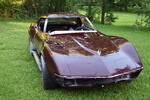

Carb sizing for '71 LT-1 : too big?

Advanced


Joined: Jun 2010
Posts: 95
Likes: 77

"A tuned Holley or Q-Jet is a wonderful carb, an Edelbrock is just a POS, no matter what you do to it."
+2, 3, 4 and 5. The Edelbrock AFB clones are not adjustable for opening rate so if they stumble, hesitate, bog or puke all over themselves when you go quickly to heavy/full throttle there really isn't anything you are going to be able to do about it.
The AVS versions at least have adjustable secondary air doors like a Q-jet, but it's just a slightly upgraded POS and those designs were obsolete clear back in the late 1960's......FWIW.....Cliff"
+2, 3, 4 and 5. The Edelbrock AFB clones are not adjustable for opening rate so if they stumble, hesitate, bog or puke all over themselves when you go quickly to heavy/full throttle there really isn't anything you are going to be able to do about it.
The AVS versions at least have adjustable secondary air doors like a Q-jet, but it's just a slightly upgraded POS and those designs were obsolete clear back in the late 1960's......FWIW.....Cliff"
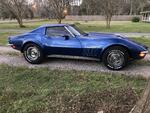
Thread Starter
Drifting


Joined: Feb 2015
Posts: 1,440
Likes: 1,031
From: Baton Rouge Louisiana
I have never touched a Brawler….and probably never will….I stick to what I know works  I not down for good deals either….the zinc plated Holley carbs are expensive for a reason….
Most common mistake on Edelbrock is not running a regulator…..
You seriously cannot beat a Holley HP…..best fuel mixer on the planet next to a Q-Jet…..
Jebby
I not down for good deals either….the zinc plated Holley carbs are expensive for a reason….Most common mistake on Edelbrock is not running a regulator…..
You seriously cannot beat a Holley HP…..best fuel mixer on the planet next to a Q-Jet…..
Jebby
I took your advice on the FPR, and took the fuel pressure down from 8.5PSI to 6PSI: there's a noticeable difference in the throttle tip in and an improvement in performance. She was definitely running rich! I read all the timing papers on this forum, and going to properly set my timing, as I found I missed some steps. Also going to put my wideband on this carb and see where it's at and tinker with it a little. It's not horrible enough for me to spend $700 on a new Holley, but I'll probably upgrade to that or Sniper EFI in the future.


Advanced
Joined: Jun 2010
Posts: 95
Likes: 77
The Sniper may not be an upgrade. I get more complaints to the shop about those than any other electric carburetor system being sold out there.
You have a LOT of rubber hose, clamps, glass fuel fuel and low-end regulator, etc on the pressure side of the fuel pump. Hopefully the original fuel line has had a "bulge" put on it where it was cut so the hose doesn't slip off. I see an engine fire in the making........FWIW.......
You have a LOT of rubber hose, clamps, glass fuel fuel and low-end regulator, etc on the pressure side of the fuel pump. Hopefully the original fuel line has had a "bulge" put on it where it was cut so the hose doesn't slip off. I see an engine fire in the making........FWIW.......

Racer

Joined: Sep 2021
Posts: 423
Likes: 137
From: Upstate South Carolina
No. I have just swapped out for a new Holley 750 on my 71 LT1 engine. Perfect size.
Thread Starter
Drifting
Joined: Feb 2015
Posts: 1,440
Likes: 1,031
From: Baton Rouge Louisiana
The Sniper may not be an upgrade. I get more complaints to the shop about those than any other electric carburetor system being sold out there.
You have a LOT of rubber hose, clamps, glass fuel fuel and low-end regulator, etc on the pressure side of the fuel pump. Hopefully the original fuel line has had a "bulge" put on it where it was cut so the hose doesn't slip off. I see an engine fire in the making........FWIW.......
You have a LOT of rubber hose, clamps, glass fuel fuel and low-end regulator, etc on the pressure side of the fuel pump. Hopefully the original fuel line has had a "bulge" put on it where it was cut so the hose doesn't slip off. I see an engine fire in the making........FWIW.......
Thread Starter
Drifting
Joined: Feb 2015
Posts: 1,440
Likes: 1,031
From: Baton Rouge Louisiana
Thought you guys would be entertained by this: Edelbrock's new racing carbureor is a direct copy of a Holley!
https://www.edelbrock.com/vrs-4150-carburetors
https://www.edelbrock.com/vrs-4150-carburetors
Thread Starter
Drifting
Joined: Feb 2015
Posts: 1,440
Likes: 1,031
From: Baton Rouge Louisiana
Advanced
Joined: Jun 2010
Posts: 95
Likes: 77
"What kind of fuel line and what methods are used on carbs that are recommended? What's the issue with a glass filter? seemed sager to me over plastic because it can't melt."
Glass is easily broken. Plastic melts. I'd use a metal filter of some variety.
Last time I looked it was 2023. We should be WAY past cutting stock metal lines (and very dangerous if you don't put a "bulge" on them to keep the line from slipping off/leaking). We should also be WAY past using rubber hose and clamps on the pressure side of a fuel system.
I use and prefer solid metal lines like the factory and inverted flare fittings. No hose to chafe, burst, slip off or rot and start leaking. I also use NPT to -6AN or even 8AN with high quality fuel hose and swivel fittings and that's light years better than rubber hose and clamps. Most fuel system components sold these days are NPT threaded, including pumps, regulators, etc. Not too difficult to set up a rock solid system that will not have the fuel lines rot, slip off or burst and start spraying fuel all over the engine compartment......FWIW......
Glass is easily broken. Plastic melts. I'd use a metal filter of some variety.
Last time I looked it was 2023. We should be WAY past cutting stock metal lines (and very dangerous if you don't put a "bulge" on them to keep the line from slipping off/leaking). We should also be WAY past using rubber hose and clamps on the pressure side of a fuel system.
I use and prefer solid metal lines like the factory and inverted flare fittings. No hose to chafe, burst, slip off or rot and start leaking. I also use NPT to -6AN or even 8AN with high quality fuel hose and swivel fittings and that's light years better than rubber hose and clamps. Most fuel system components sold these days are NPT threaded, including pumps, regulators, etc. Not too difficult to set up a rock solid system that will not have the fuel lines rot, slip off or burst and start spraying fuel all over the engine compartment......FWIW......
Last edited by Cliff R; Apr 17, 2022 at 08:09 PM.
Corvette Stories
The Best of Corvette for Corvette Enthusiasts

5 Best & 5 Worst Corvette Daily Drivers
Joe Kucinski
The Headlights of Every Corvette Generation Explained
Joe Kucinski
5 Best & 5 Most Overrated Corvette Track Packages of All Time!
Joe Kucinski
Every 2027 Corvette Engine Explained
Joe Kucinski
Designer Imagines A Corvette That Looks More Like a Corvette Than the Corvette
Verdad Gallardo
10 Ugly Corvettes That We Still Kinda Love
Joe Kucinski
Top 10 Most Expensive Corvettes Ever Sold on Bring A Trailer
Brett Foote
10 Things Every Corvette Owner Needs (2026 Edition)
Michael S. Palmer
8 Most "Only Corvette Owners Understand" Quirks and Problems
Pouria Savadkouei
Tech Contributor


Joined: Aug 1999
Posts: 14,384
Likes: 6,408
From: At my Bar drinking and wrenching in Lafayette Colorado

I have a complete article on how to build safe, steel fuel lines for use on the pressure side of any fuel system, along with photos and part numbers for fittings and filters. E-mail me if you'd like a copy. That rubber stuff with the glass filter is a fire accident waiting to happen.
Lars
V8FastCars@msn.com

Le Mans Master


Joined: Mar 2004
Posts: 7,507
Likes: 1,513
From: Little Rock AR
Glass filters have rubber O-rings in the end caps that can dry out and cause gas under pressure to be sprayed out when you start your car. You never know they were spraying out fuel until it finds an ignition source and by then, it is much too late. I had one on my Camaro when it was in paint jail for 11 months. I fired it up to drive home when it was finished and saw the trail of gas on the ground as I backed out of the paint shop. I was VERY LUCKY that day to catch it before disaster. NEVER AGAIN!


Safety Car

Joined: Oct 2004
Posts: 3,927
Likes: 740
From: Youngstown Ohio
Thought you guys would be entertained by this: Edelbrock's new racing carbureor is a direct copy of a Holley!
https://www.edelbrock.com/vrs-4150-carburetors
https://www.edelbrock.com/vrs-4150-carburetors

Is my vette stock?? HAHA


Joined: Oct 2015
Posts: 20,259
Likes: 9,401
From: Im not allowed to tell you
2020 C3 of the Year Finalist - Modified
2020 Corvette of the Year Finalist (performance mods)
2019 C3 of Year Winner (performance mods)
2016 C3 of Year Finalist
That new Edelbrock seems to address some small issues the Holleys had that were addressed by the aftermarket tuners. We shall see how it goes. I Wonder what the price point will be.
Advanced
Joined: Jun 2010
Posts: 95
Likes: 77
"Glass filters have rubber O-rings in the end caps that can dry out and cause gas under pressure to be sprayed out when you start your car. You never know they were spraying out fuel until it finds an ignition source and by then, it is much too late"
+2 and heat can cause long lengths of rubber hose to "sag" and when the glass fuel filters get against any metal another recipe for disaster.
I custom tune couple weekends a month. At least 1 in 5 vehicles brought here have a cut factory metal line and rubber hose/clamps installed. Some have added a filter and two more potential leak points. Never once has the person who cut the metal line taken the time to put it in the first step of a double flaring tool and put a "bulge" in the line so keep the hose from slipping off of it.
Here when I work on a customers vehicle it will get a solid metal line from the fuel pump to the carburetor and all rubber hose and clamps eliminated. I keep different lengths of metal line in stock just for that purpose........
+2 and heat can cause long lengths of rubber hose to "sag" and when the glass fuel filters get against any metal another recipe for disaster.
I custom tune couple weekends a month. At least 1 in 5 vehicles brought here have a cut factory metal line and rubber hose/clamps installed. Some have added a filter and two more potential leak points. Never once has the person who cut the metal line taken the time to put it in the first step of a double flaring tool and put a "bulge" in the line so keep the hose from slipping off of it.
Here when I work on a customers vehicle it will get a solid metal line from the fuel pump to the carburetor and all rubber hose and clamps eliminated. I keep different lengths of metal line in stock just for that purpose........

Le Mans Master

Joined: Apr 2006
Posts: 5,403
Likes: 95
I have a complete article on how to build safe, steel fuel lines for use on the pressure side of any fuel system, along with photos and part numbers for fittings and filters. E-mail me if you'd like a copy. That rubber stuff with the glass filter is a fire accident waiting to happen.
Lars
V8FastCars@msn.com


Le Mans Master
Joined: Mar 2008
Posts: 5,948
Likes: 72
From: Oxford MA-----You just lost the game!!!!
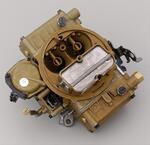
If I were in your shoes, I'd cruise some swap meets or surf the web and try to find an old Holley 3310 750 cfm to rebuild. (I think you would even be able to run a reproduction of the stock pump-to-carb fuel line) People want around $150.00 for them online, they must think they're made of gold or something. I remember when you could find them laying around at swap meets for 25 bucks. I had one on my 440 Roadrunner back in the day, and that thing pulled hard all the way up to 6500 rpm. Anyway, they are a great carb, very simple to tune if you know how to tune a Holley carb. Vacuum secondary with a metering plate so tuning the secondaries is just a matter of installing different springs.
I've never actually messed around with a double-pumper, but I get the impression that there would be a little more involved to tuning them than a vacuum secondary carb. The secondaries are basically another set of primaries. Metering block, jets, accelerator pump and everything. (That's why they're called double-pumpers, two accelerator pumps.)
As far as a carb being too big for an engine, that's one nice thing about a vacuum secondary carb. If the carb is too big, you can just adjust the secondaries so they don't open all the way. (You basically put heavier and heavier springs in the diaphragm canister until the bog from the secondaries opening too quickly goes away, although a smaller carb would have smaller primaries, theoretically giving you better throttle response, and could still satisfy the engine's wide open throttle requirements by allowing the secondaries to open more. Not TOO fast, though, as there is no accelerator pump to cover the lean spot if they open too quickly, A double-pumper has another accelerator pump to cover the lean spot when the secondaries dump open, so I think it might be a little more important to use the right size carb in that situation. This extra accelerator pump may be why double-pumpers have a reputation for getting a few less miles per gallon, too. People who know how to work 'em seem to think they are the bee's knees, though!)
Anyway, whichever way you decide to go, I'm with the folks who say get rid of that piece of junk Edelbrock carb and put a real carb on it.
If you'd rather start out with a new carb, the house brand carbs that Summit Racing sells are intriguing to me, as well. Check this one out for your application:
Summit Racing SUM-M08750VS Summit Racing™ M2008 Series Carburetors | Summit Racing
I've never messed with one, personally, but they've been out for years and years and they seem to have a great reputation with people who have used them, and the price is fairly reasonable compared to what Holley wants for one of their carbs brand-new.
Scotty
I've never actually messed around with a double-pumper, but I get the impression that there would be a little more involved to tuning them than a vacuum secondary carb. The secondaries are basically another set of primaries. Metering block, jets, accelerator pump and everything. (That's why they're called double-pumpers, two accelerator pumps.)
As far as a carb being too big for an engine, that's one nice thing about a vacuum secondary carb. If the carb is too big, you can just adjust the secondaries so they don't open all the way. (You basically put heavier and heavier springs in the diaphragm canister until the bog from the secondaries opening too quickly goes away, although a smaller carb would have smaller primaries, theoretically giving you better throttle response, and could still satisfy the engine's wide open throttle requirements by allowing the secondaries to open more. Not TOO fast, though, as there is no accelerator pump to cover the lean spot if they open too quickly, A double-pumper has another accelerator pump to cover the lean spot when the secondaries dump open, so I think it might be a little more important to use the right size carb in that situation. This extra accelerator pump may be why double-pumpers have a reputation for getting a few less miles per gallon, too. People who know how to work 'em seem to think they are the bee's knees, though!)
Anyway, whichever way you decide to go, I'm with the folks who say get rid of that piece of junk Edelbrock carb and put a real carb on it.
If you'd rather start out with a new carb, the house brand carbs that Summit Racing sells are intriguing to me, as well. Check this one out for your application:
Summit Racing SUM-M08750VS Summit Racing™ M2008 Series Carburetors | Summit Racing
I've never messed with one, personally, but they've been out for years and years and they seem to have a great reputation with people who have used them, and the price is fairly reasonable compared to what Holley wants for one of their carbs brand-new.
Scotty
Last edited by scottyp99; Apr 19, 2022 at 11:33 AM.
Thread Starter
Drifting
Joined: Feb 2015
Posts: 1,440
Likes: 1,031
From: Baton Rouge Louisiana
If I were in your shoes, I'd cruise some swap meets or surf the web and try to find an old Holley 3310 750 cfm to rebuild. (I think you would even be able to run a reproduction of the stock pump-to-carb fuel line) People want around $150.00 for them online, they must think they're made of gold or something. I remember when you could find them laying around at swap meets for 25 bucks. I had one on my 440 Roadrunner back in the day, and that thing pulled hard all the way up to 6500 rpm. Anyway, they are a great carb, very simple to tune if you know how to tune a Holley carb. Vacuum secondary with a metering plate so tuning the secondaries is just a matter of installing different springs.
I've never actually messed around with a double-pumper, but I get the impression that there would be a little more involved to tuning them than a vacuum secondary carb. The secondaries are basically another set of primaries. Metering block, jets, accelerator pump and everything. (That's why they're called double-pumpers, two accelerator pumps.)
As far as a carb being too big for an engine, that's one nice thing about a vacuum secondary carb. If the carb is too big, you can just adjust the secondaries so they don't open all the way. (You basically put heavier and heavier springs in the diaphragm canister until the bog from the secondaries opening too quickly goes away, although a smaller carb would have smaller primaries, theoretically giving you better throttle response, and could still satisfy the engine's wide open throttle requirements by allowing the secondaries to open more. Not TOO fast, though, as there is no accelerator pump to cover the lean spot if they open too quickly, A double-pumper has another accelerator pump to cover the lean spot when the secondaries dump open, so I think it might be a little more important to use the right size carb in that situation. This extra accelerator pump may be why double-pumpers have a reputation for getting a few less miles per gallon, too. People who know how to work 'em seem to think they are the bee's knees, though!)
Anyway, whichever way you decide to go, I'm with the folks who say get rid of that piece of junk Edelbrock carb and put a real carb on it.
If you'd rather start out with a new carb, the house brand carbs that Summit Racing sells are intriguing to me, as well. Check this one out for your application:
Summit Racing SUM-M08750VS Summit Racing™ M2008 Series Carburetors | Summit Racing
I've never messed with one, personally, but they've been out for years and years and they seem to have a great reputation with people who have used them, and the price is fairly reasonable compared to what Holley wants for one of their carbs brand-new.
Scotty
I've never actually messed around with a double-pumper, but I get the impression that there would be a little more involved to tuning them than a vacuum secondary carb. The secondaries are basically another set of primaries. Metering block, jets, accelerator pump and everything. (That's why they're called double-pumpers, two accelerator pumps.)
As far as a carb being too big for an engine, that's one nice thing about a vacuum secondary carb. If the carb is too big, you can just adjust the secondaries so they don't open all the way. (You basically put heavier and heavier springs in the diaphragm canister until the bog from the secondaries opening too quickly goes away, although a smaller carb would have smaller primaries, theoretically giving you better throttle response, and could still satisfy the engine's wide open throttle requirements by allowing the secondaries to open more. Not TOO fast, though, as there is no accelerator pump to cover the lean spot if they open too quickly, A double-pumper has another accelerator pump to cover the lean spot when the secondaries dump open, so I think it might be a little more important to use the right size carb in that situation. This extra accelerator pump may be why double-pumpers have a reputation for getting a few less miles per gallon, too. People who know how to work 'em seem to think they are the bee's knees, though!)
Anyway, whichever way you decide to go, I'm with the folks who say get rid of that piece of junk Edelbrock carb and put a real carb on it.
If you'd rather start out with a new carb, the house brand carbs that Summit Racing sells are intriguing to me, as well. Check this one out for your application:
Summit Racing SUM-M08750VS Summit Racing™ M2008 Series Carburetors | Summit Racing
I've never messed with one, personally, but they've been out for years and years and they seem to have a great reputation with people who have used them, and the price is fairly reasonable compared to what Holley wants for one of their carbs brand-new.
Scotty
Thank you for the well thought out explanation and advice, instead of autistic screeching about Edelbrock's lol. You guys have convinced me to make the change to Holley, but it won't be an immediate change, as it currently runs good enough and I have other priorities in my budget at the moment. I'll certainly look into these Summit carbs, and 3310's. I've never tuned a Holley, but have worked on many carbs, so it's something I can learn from YouTube like anything else.