When you click on links to various merchants on this site and make a purchase, this can result in this site earning a commission. Affiliate programs and affiliations include, but are not limited to, the eBay Partner Network.
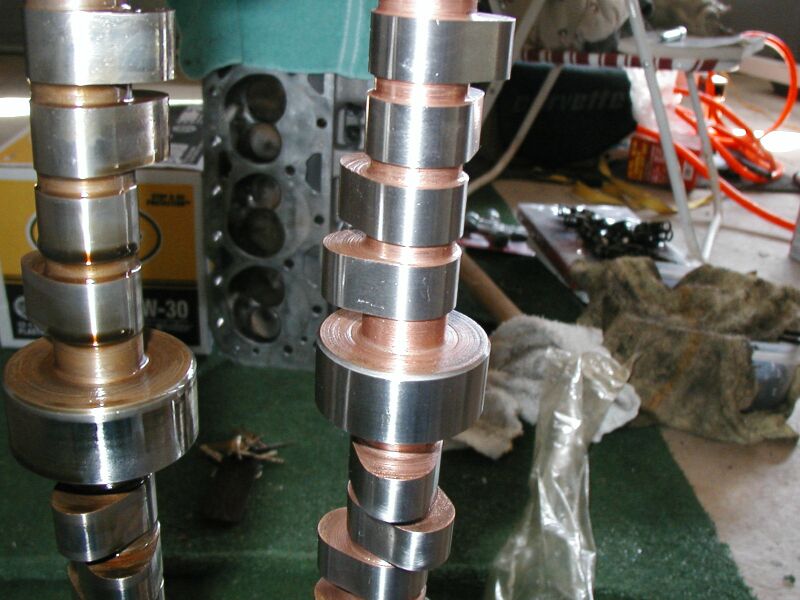
I've just experienced the failure of a hydraulic roller cam from Comp Cams and believe it was because the spring pressures were too light. Two lifters managed to rotate in their bores and damage those lobes and it appears they have been leaving the lobe surface, striking the OEM dog bone retainers, breaking one and leaving witness marks on others. There's a nominal clearance of 0.040" between the underside of the retainer and the step at the bottom of the lifter flat so it's hard to imagine anything else other than spring pressure. I'm running Gen 1 Trick Flow heads with their standard single springs that have a 110# installed seat force and 299# at full lift. These numbers correlate well to the springs recommended by Comp but differing from other guidelines for a cam with 0.510/0.520" lift. Trick Flow recommends their dual springs with 134/369# forces. From what I've read, those numbers are higher than are recommended for cast core cams, thus my interest in billet core cams.
FWIW - 406sbc w/11.0:1 CR. TF Gen 1 heads with Crane Gold roller rockers. Thanks!
as you've found, these days, most big cam marketers first offerings are on a cast core. Typically, any & all under about $350 are cast cores, While billet steel cores come at a $premium.
Can I just ask a dumb question? Are you talking about the problematic original altered location valve low lift heads?
If you're referring to the Trick Flow heads, they are the first generation that had several issues that I'm aware of. Biggest among them was Trick Flow advertised that users could use OEM rockers (and maybe even pushrods) and that led to bent push rods, valve stem wear and other problems. Fortunately the solution was simple - Crane Gold rockers and LS pushrods. Another problem was these heads would break rocker studs and Gen 2 used ARP studs which solved that problem.
When you say "low lift" I'm guessing you mean cam restrictions so yes, these are those heads. With the standard springs, they're limited to a 0.520" lift which were I stayed within. My next cam will probably be a little less for whatever that's worth. With the optional springs, these head are supposed good for up to 0,600" lift.
You should be able to order a cam from Comp with a billet core and cast distributor gear. I did that for my motor maybe 10 years ago. Just give them a call.
You should be able to order a cam from Comp with a billet core and cast distributor gear. I did that for my motor maybe 10 years ago. Just give them a call.
Thank you, I was just starting to consider that option but didn't expect it could be done.
Comp cams does coatings also. I have used their nitride on flat tappet cams and like it. I use it with direct lube lifters and have not had problems with proper break in and correct oil. They have a new one called DLC for lifters on tool steel, but I have not researched it yet. Don’t know if it’s for rollers or not but worth a call.
Last edited by Vette5311; Jul 12, 2022 at 11:50 AM.
some billet alloys require special gears/pushrods while other billet alloys don't
The above summit billet cams ( just like OE GM rollers) are on a 5150 alloy billet core and require a simple melonized dist gear and an OE GM PR.
it does matter which alloy.
Please explain, I'm always interested in learning more.
XE282HR Advertised Intake Duration:282 Advertised Exhaust Duration:288 Intake Duration at .050 Inch Lift:230 Exhaust Duration at .050 Inch Lift:236 Intake Valve Lift:0.51 Exhaust Valve Lift:0.52 Lobe Separation:110
You would need to read up on Dynamic Compression Ratio and Static Compression Ratio. You can find online calculators. You would need your cam card valve timing events.
I'm a little confused with comp cams and trying to look up XE282HR. It didn't come up under chevy gen 1 motors, but anyway. These are the numbers you need to have to find out DCR. It's worth mentioning that 8.5:1 DCR is considered to be the maximum for iron heads and 92 octane fuel (MON + RON divided by 2) So in your case you claim to have 11:1 and I suggest you find the true C/R. The valves bleed off pressure because of beginning opening Before Top Dead Center and closing after Bottom Dead Center, over lap etc. It's the amount of trapped gases. DCR is only a ruff tool, but it gives you an idea of the cam duration required for a static compression ratio, so the motor doesn't have detonation or require race gas Exhaust Close ATDC:30 Intake Open BTDC:31 Exhaust Open BBDC:79 Intake Close ABDC:70
You would need to read up on Dynamic Compression Ratio and Static Compression Ratio. You can find online calculators. You would need your cam card valve timing events.
I'm a little confused with comp cams and trying to look up XE282HR. It didn't come up under chevy gen 1 motors, but anyway. These are the numbers you need to have to find out DCR. It's worth mentioning that 8.5:1 DCR is considered to be the maximum for iron heads and 92 octane fuel (MON + RON divided by 2) So in your case you claim to have 11:1 and I suggest you find the true C/R. The valves bleed off pressure because of beginning opening Before Top Dead Center and closing after Bottom Dead Center, over lap etc. It's the amount of trapped gases. DCR is only a ruff tool, but it gives you an idea of the cam duration required for a static compression ratio, so the motor doesn't have detonation or require race gas Exhaust Close ATDC:30 Intake Open BTDC:31 Exhaust Open BBDC:79 Intake Close ABDC:70
Thanks. It appears you did find the right cam, you'll see that number I provided now shown as the grind number. For some reason they don't list them as they used to.
Anyway, when I first built the motor, I did my own spreadsheet to calculate CR as some didn't account for every detail such as distance from top of piston to top ring as well as head gasket bore diameter and I was getting CR's well over 11:1 which alarmed me. I got 10.95:1 doing it myself using all the parameters. I also did calculate DCR at that time and IIRC, was on the borderline for pump gas with aluminum heads.
Going back over this stuff, I now remember that when I rebuilt the motor after breaking a ring land in the first few thousand miles, I went to thicker head gaskets with a slightly larger bore which dropped the CR to around 10.6:1. Unfortunately in their infinite wisdom, Microsoft trashed all my files during a routine disk cleanup years ago so I no longer have those spreadsheets and don't recall if I recalculated DCR with the lower CR...somehow I'm thinking I did not.
If I were to start over, I'd use dished pistons with thinner head gaskets for a comparable CR but with better squish.
Thanks. It appears you did find the right cam, you'll see that number I provided now shown as the grind number. For some reason they don't list them as they used to.
Anyway, when I first built the motor, I did my own spreadsheet to calculate CR as some didn't account for every detail such as distance from top of piston to top ring as well as head gasket bore diameter and I was getting CR's well over 11:1 which alarmed me. I got 10.95:1 doing it myself using all the parameters. I also did calculate DCR at that time and IIRC, was on the borderline for pump gas with aluminum heads.
Going back over this stuff, I now remember that when I rebuilt the motor after breaking a ring land in the first few thousand miles, I went to thicker head gaskets with a slightly larger bore which dropped the CR to around 10.6:1. Unfortunately in their infinite wisdom, Microsoft trashed all my files during a routine disk cleanup years ago so I no longer have those spreadsheets and don't recall if I recalculated DCR with the lower CR...somehow I'm thinking I did not.
If I were to start over, I'd use dished pistons with thinner head gaskets for a comparable CR but with better squish.
Thanks for your input.
So you understand that you have to maybe go with more duration and drop the DCR. Was it detonation that broke the ring land? I built my first 383 and didn't want to go overboard with a solid roller cam, but it had right at 11:1 Dart 227cc heads so I bought a Crane cams billet steel SR street 232/238 112 with mid .600 lifts. It was pure detonation rattle at light throttle cruising down a freeway with pump gas even with ceramic coated piston tops. I mucked with the timing and limited my vacuum advance to 8 degrees. I was running octane boosters. I had never heard of DRC and 30+ years ago the internet wasn't really around. So I had a custom billet steel cam made by Comp cams from their cam lobe book.
Just going to a 236/242 Endurance Road racing profile cured the problems and really turned it into a hot rod.
look at the size difference and rate of lobe lift. Max valve open time. Not for your HR roller though
A ring land broke because the rings were closing up their gaps and binding in the cylinder. The rings were gapped according to their enclosed recommendations but after this incident, I've learned that's not an adequate gap for hypereutectic pistons. So my first engine failure was due to bad information provided by those are supposed to know better - the component manufacturer. And now this recent cam failure due to lifter float is likely because the cam manufacturer made and continues to make a recommendation that isn't appropriate. I find multiple sources that indicate higher spring forces are required for cam profiles such as mine. And In the reading I've been doing, I found where a lawsuit was filed against Comp Cams for the exact same thing that happened with me but in that case resulted in the loss of an engine.
Regarding duration, I found an excellent article on the relationship between cams and compression ratios. One thing that puzzles me from that article though is that with with the higher duration cams, cranking compression values are going to be lower but in my case my pressures were higher than I've ever seen in a gasoline engine. When the engine was first started, I had an issue where a valve wasn't closing so I was concerned about whether it had been hit by the piston. I did a compression check and the intake manifold was off so the pressures were going to be higher than one might see otherwise but I was getting 240+ on all cylinders. I retarded the cam 4 degrees but that had little effect. I had to go with a high torque starter as a results. Low end torque is absolutely phenomenal though!
I bought hypereutectic pistons when they were brand new. According to all the car rags they were the best of both worlds and I wanted to make a highley efficient 355 ci motor. I had it all super balanced with forged crank and rods. I drove it for a year or two and then decided to put on 200cc heads and a bigger cam to go racing. Keith Black hypereutectic pistons failed to disclose that those pistons had a feet per minute limitation. The pistons were smeared in the bores and it sounded like horrible rod knock when I was driving at max speed over 7000 rpm with 3.55 rear end. It was a sad day!
Thicker gasket to drop compression is not the answer. More cam duration is the correct route. My 383, 396, and now 434 are all 11 and above compression running fine on pump gas.
I've never done a compression test, But my new 434 is about a ball buster to rotate the motor over with the plugs in. I use a 3 foot long 1/2 inch breaker bar on the crank shaft bolt. 4.5 HP mini starter made for 17:1 motors over 500 ci it doesn't have a problem
Ditto what GKUL recommends. With true 11:1 CR you are most likely going to be limited to cams with around 230 degree duration or better intake at .050" That's around LT-1, LS6, L72 territory. Smaller duration will make it detonate, and that is not "ping". 240# compression is extremely high, and would require an expert tuner to keep out of detonation, and the setup still would not be ideal. With 100 Octane gas or lower compression or more cam it could run stronger.
You must get the DCR down to 8.2 or 8.5 with iron heads. Or you will have to heavily restrict timing, and that's definately not ideal. And the more you crank up the duration the worse the idle gets and the worse the vacuum gets. It is a compromise dance! So experiment with cams online in your calculator until you find one that meets all your parameters.
The online calculators at Wallace Racing are very highly regarded. Some others, not so much.
They will let you turn cam specs into valve timing events, and then DCR.
It sounds like you get it, but the duration, lobe center split, and intake lobe center advance/retard all matter. It is where the intake valve closes that controls your DCR once the CR is set.
And yes I have zero interest in cast core rollers with light stock type springs. That is all marketing and causes very problematic setups. 'nuff said. Billet rollers are the way to go for lobe reliability. Milder HR or SR ramps for valvetrain reliabilty. But yes even then you must run the cam mfgrs recommended spring pressures, or more.
Last edited by leigh1322; Jul 15, 2022 at 10:40 AM.
I did not know as much as I do know when I selected this cam so in some ways I was lucky. My DCR is 8.4 and I'm running aluminum heads and there's been no evidence of detonation. The one thing my ignorance did lead to was using a cast core cam with rollers and following their recommendation for spring force. I would likely be fine with an identical cam in a steel core and raising the full open spring force accordingly.
The cranking pressure under normal conditions...intake and carb in place runs 205-210. Still high but apparently not an issue. I could retard the cam to reduce this at the expense of low end torque but doubt I'd be able to tell with this motor.
Last edited by 65air_coupe; Jul 15, 2022 at 11:30 PM.
Sounds good. Something with specs like the like the XR282HR that you mentioned with 230/236 duration intake and 8.4DCR sounds pretty ideal, and about the smallest cam you could get away with, with that 11:1 CR. And even the next step up starts to lose idle vac pretty quickly.
Just ask for it on a Billet Core, a 2 piece, with a pressed on cast iron distrib gear.
Designer Imagines A Corvette That Looks More Like a Corvette Than the Corvette
Slideshow: A Jaguar designer's personal project imagines what a modern front-engined Corvette might look like if Chevrolet revisited the golden age of the Stingray.









 Billet cam recommendations