When you click on links to various merchants on this site and make a purchase, this can result in this site earning a commission. Affiliate programs and affiliations include, but are not limited to, the eBay Partner Network.
Be careful boxing in those front frame horns.....specifically the passenger side. If you are putting in a big block, and big block radiator, the outlet hose on the bottom fits INSIDE the front frame horn and a gusset will interfere. I looked at this closely at Carlisle on a big block....and will not work. No problem on driver side. I don't think a small block radiator is an issue on either side. I would like Reno Staillion to let us know if his gussets worked out ......IF he has a big block radiator.
Be careful boxing in those front frame horns.....specifically the passenger side. If you are putting in a big block, and big block radiator, the outlet hose on the bottom fits INSIDE the front frame horn and a gusset will interfere. I looked at this closely at Carlisle on a big block....and will not work. No problem on driver side. I don't think a small block radiator is an issue on either side. I would like Reno Staillion to let us know if his gussets worked out ......IF he has a big block radiator.
That is some beautiful welding done....and that vertical piece in the front crossmember is going to be HUGE in keeping sag from every happenning,..and will also make the front virtually solid. I do believe that the large triangular gusset, and the front frame boxing on the passenger side will have to be cut away. You have completely blocked access to thelower radiator hose fitting. Its great idea, but it is hard enough getting the rubber hose attached with the little amount of room there is in a stock unmodified frame. Unless you have an alternative plan.....like maybe pulling the radiator up and out with the hose attached, but again...even doing that is one of the hard jobs. Alot depends on the radiator size and configuration. If you are using electric fans....that also may save you.
I am absolutely NOT claiming to be an engineer, or understand hi level science.....but I believe the problem with the front rail extensions is that the was the sway bar is mounted to the lower surface of the open C section. It allows vertical flex of the C flange. The boxing of those front rails would be to reduce the twisting or the bending of that lower flange upwards / downward. Boxing them helps prevent this and better transfers the sway bar action to the frame. If I am correct on that, the horizontal large gussets do little to improve this. Those gussets would strengthen the front rails in the event of a forward crash? The Chevy Power Book did not include those gussets....they only box the frame. The gussets on the lower control arm mounts are to strengthen that fairly weak connection to the crossmember, therefore make perfect sense.
Lastly,.....and I am not picking at the strengthening, because I have done almost all the same, even though I have no intention of racing. I think this is all worth it when the frame is bare, and all it takes is some welding. Your front crossmember is now effectively a solid piece.....very very strong.......so all the flex loads will now be back in the S-bend area of the frame. My paranoid thoughts about this make me wonder if repeated frame flexing, now concentrated on the S-bends will result in eventual cracking there. Before gussets, the twisting would be spread across the entire area....now concentrated on the S-bends only.
Anyway....just random thoughts, ones that I have been considering as I do most of the same mods. Sometimes, changes have consequences. I have found it to be true in many mods done to these cars. You fix one thing.....break it in another way.
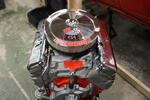
Here's a pic of my 454 today. I measured it just for you. 543# . I need to remove the weight of the heavy chain, and the engine cradle, and then add back the distrib and carb. So I guess around 535# like that.
Mine is built like an LS6 and dyno'd at 500HP at 5800 and 550TQ at 3400. Pretty mild flat TQ curve. 230/240 Solid Roller. Could easily be 560+HP with just a head change to new AFRs vs these 50 year old Winters heads.
Here's another alternative:
It's a 640 cu. in. and near 950-1000HP at 8000 rpm. It's a tall deck block with aluminum procomp heads full stud girdle, etc. It weighed 567#. It doesn't even have a 30# flywheel on it like mine does, but then the water jacket is literally full of concrete. That may have added some weight LOL! If you are gonna build a big block, you might as well go BIG. It is close to Two HP per pound.
On the block weight I'll go look it up. Attached is my weight spreadsheet data I have been collecting.
My calcs say a BBC like mine is only 40# more than an all iron SBC. Too me the TQ is worth it.
But to the OP, GKULL is dead right, it is the total combo that counts on the track. The BBC GT1 car he mentions has more weight due to a 300# weight penalty, smaller brakes, same size tires, more HP and an understeering chassis tune. Can some of this be changed to make the car more competitive and able to use the extra HP? Right now GKULL has a much better setup, and faster, car.
Zdave you asked about block weights.
I have 3, all w/o 4 bolt main caps:
Merlin aluminum 120#
MkIV BB 200#
Bowtie 270#
The other thing you should consider is a complete re-vamp of the rear suspension. It will take so much work (& $) to make the stock 400HP capable IRS hold up to 800HP, and the geometry will never be very good anyway, so you make as well start over from scratch. If it was me, and the rules allowed it, I would strongly consider an entire Ridetech Track 1 rear suspension, or better. You are going to have to work at it to pass GKULL, he has been at this for years!
By the time you beef up the C3 IRS to not break you will spend at least half of this. And this starts with a Ford 9 inch, allows wider tires, bolts in, but honestly still has the same geometry. https://www.ridetech.com/product/com...corvette-comp/
I really appreciate the detail you provided. You mentioned an attached spreadsheet ... is that an attachment in the post or someplace else ?
The small weight difference between an all (or mostly) aluminum big block and an all-iron small block like my current engine is a green light for the big block. And no extra 300lbs Between your two examples ... how about the 640 with a more mid-range cam ? Or would that be too much of a miss-match of flow for the current heads ?
I completely agree about the rear suspension. In addition to the setups in the links you sent, have you looked at SRIII ? Check out the solution at the bottom ... C4 suspension grafted to the factory frame. https://www.sriiimotorsports.com/196382corvette.html
From: I tend to be leery of any guy who doesn't own a chainsaw or a handgun.
The new Ozark track is on my list, whenever I can get things to work out.
Pulled the engine out last fall for a cam swap. I don't know what configuration guys use when comparing different engines, but I just left everything on the engine that I could so I could get a measurement of how much the engine was contributing to front axle weight. (Some of the unseen parts are the starter, flywheel, pressure plate, bellhousing, motor mounts, 6 quarts of oil, and about a gallon of coolant left in the block). The distributor/shield and air filter assembly wouldn't fit with the engine tilter, so add about 8 pounds).
It's a moderate power big block. I've got the car down to 2700# (with full factory interior), so I can get a decent power to weight ratio without having to worry too much about breaking parts from excess engine power.
FYI 69427's engine has an aluminum block, he is very weight concious.
On the C4 suspension, it is better than the C3, it has 4 forward links?? IIRC, replacing the trailing arms, so it has some anti-squat, which the C3 does not. I am unsure about the toe-in issues on the C3 being resolved tho, because it still uses the half-shaft as a link. 69427 has the C4 added to his car, and he races it, he would have much better input.
I guess the spreadsheet did not attach the first time, here it is. A lot of credit goes to Yellow Bullet for starting this... I just added to it.
The new Ozark track is on my list, whenever I can get things to work out.
Pulled the engine out last fall for a cam swap. I don't know what configuration guys use when comparing different engines, but I just left everything on the engine that I could so I could get a measurement of how much the engine was contributing to front axle weight. (Some of the unseen parts are the starter, flywheel, pressure plate, bellhousing, motor mounts, 6 quarts of oil, and about a gallon of coolant left in the block). The distributor/shield and air filter assembly wouldn't fit with the engine tilter, so add about 8 pounds).
It's a moderate power big block. I've got the car down to 2700# (with full factory interior), so I can get a decent power to weight ratio without having to worry too much about breaking parts from excess engine power.
Is that 2700 with or without engine ? In either case that seems really low ... any special secrets to getting that much weight out ?
FYI 69427's engine has an aluminum block, he is very weight concious.
On the C4 suspension, it is better than the C3, it has 4 forward links?? IIRC, replacing the trailing arms, so it has some anti-squat, which the C3 does not. I am unsure about the toe-in issues on the C3 being resolved tho, because it still uses the half-shaft as a link. 69427 has the C4 added to his car, and he races it, he would have much better input.
I guess the spreadsheet did not attach the first time, here it is. A lot of credit goes to Yellow Bullet for starting this... I just added to it.
leigh1322 69427
Since I need to have both frame reinforcement and suspension changes performed by someone else, figuring out what will get the job done, and who to rely on, is really a challenge. I've found 6 or more shops and I'm sure there are more. My first question for them will be horsepower & torque ratings, and how many customers are racing a setup like I want. I appreciate the information you've offered, and leigh1322 especially for the spreadsheet. If you have any additional info on what works well with high horsepower big blocks on the track I'm all ears !









 Between your two examples ... how about the 640 with a more mid-range cam ? Or would that be too much of a miss-match of flow for the current heads ?