When you click on links to various merchants on this site and make a purchase, this can result in this site earning a commission. Affiliate programs and affiliations include, but are not limited to, the eBay Partner Network.
Hello ... I'm planning a high horsepower big block swap and want to work with someone on frame reinforcement. Has anyone worked with, or know of, a shop with extensive experience at reinforcing C3 frames and strengthening them for road racing ? If there's a past thread or other source please let me know. Thanks in advance ... Dave
There is a Chevrolet Performance Manual. In the racing preparation section it covers all the frame upgrades they recommend. To include completing all the seam welds and reinforcing the engine mounts and frame horns. Maybe someone with more knowledge can chime in.
As mentioned, look for the Chevy Power Book, widely available on internet. It shows the mods the race boys did when planning to race the C3 Corvette. I also highly recommend the "spreader bar" mod that is available.....it puts a rigid rod between the two front A-arms mounts....and is a noticeably improvement in front end stiffness. I finished the seam welds on my 77, doing the same on the 69....and I have gusseted the lower control arm mounts and engine mounts per the Power Book. Don't expect massive improvements, but in a frame off restoration, its too easy to NOT do the mods for whatever improvement it makes.
Hello ... I'm planning a high horsepower big block swap and want to work with someone on frame reinforcement. Has anyone worked with, or know of, a shop with extensive experience at reinforcing C3 frames and strengthening them for road racing ? If there's a past thread or other source please let me know. Thanks in advance ... Dave
First off I would rethink BBC and road racing the weight penalty is too great. If I had it to do all over again instead of 427 SBC the LSX motors are clear out to 472 ci with dry sump. Either of these motors will beat up any BBC. Oiling control becomes a real problem in a competition car. I just had so much SBC stuff I just went with it. I used a 4 quart accusump to keep oil pressure in the turns.
Back in the day I read the "Chevy Power Book" and at the time VB&P sold the total gusseting kit that any competent welder could install. So I got to welding and had a shop custom build my roll cage. I have a perfect rust free South West only 79. I had all the log books from my transponder that recorded every lap I did for many many years and kept notes on changes to measure gains and hopefully not losses in lap times
But anyway I always had solid motor mounts which adds the engine as a frame stiffener. So after years of racing with 700# front coil over springs and 295/17 width RR front slicks and 345 rear slicks I added the VB&P front spreader bar and didn't gain a 1/10 of second on any track. In a weaker car without gusseting and rubber engine mounts they are probably good.
Why I say no to BBC is because I raced against them and got to drive friends historic racing GT1 vettes. The forward weight penalty required 800 or even 850 pound front springs. My big Wilwood GT1 road racing front brakes and the same size slicks lasted longer. In the slow infield my lighter sub 700 hp Vette would just eat them up and they couldn't catch up to use their superior high speed to pass me on the straights. I have a very light front end with big % of rear weight bias. Where I point my front tires it goes. The BBC driving experience was like relearning how to drive the track. No late braking and front end push plowing through the turns. Powering out of turns in the slow corners required some finesse to keep the rear from stepping out. Over 800 hp BBC is very different and really stresses things.
OK I'll interject some more facts here. A BBC with al heads, intake, water pump weighs about 535#.
99% of the numbers you see quoted online are not apples to apples comparisons, but I am a science guy, so I deal in one change at a time.
I know these weights because I weighed all the pieces, built a spreadsheet, etc. etc.
A SBC with the same parts in Al, would weigh 422#.
A LS motor (all Al) would weigh 390#
These are apples to apples comparisons.
For comparison, a stock all Fe SBC would weigh around 494# and an iron BBC around 648#.
So yeah, of course, all those Al components make a difference. But they matter more on the BBC.
Now in the same vein it is not fair to compare the handling characteristics of a 650HP car to a 800+HP car. They will not be the same, I could care less what the engine type is. In the same vein two 650HP cars would not handle the same if: one was a high rpm engine, and the other was a lower rpm, higher TQ, larger cu. in. engine.
My observations:
A bored & stroked SBC can make 650HP, but a somewhat equivalent cammed, tuned bored & stroked BBC can make 800HP. A milder BBC could make 650HP, but at that point why would you want the BBC weight penalty? But it would be much milder, much more streetable, have much more TQ, and much more driveable at a lower rpm. Is the extra 100# and cu.in. worth it to have a much milder 650HP engine?
And an LS does not save nearly as much weight as the internet would leave you to believe, unless you want to compare all-Fe to all-Al, and is that fair?
It is up to everyone to make their own "trade-offs" and compromise. As a science guy, I find it helps to know the facts, so you can decide for yourself what the trade-off is worth to you.
First off I would rethink BBC and road racing the weight penalty is too great. If I had it to do all over again instead of 427 SBC the LSX motors are clear out to 472 ci with dry sump. Either of these motors will beat up any BBC. Oiling control becomes a real problem in a competition car. I just had so much SBC stuff I just went with it. I used a 4 quart accusump to keep oil pressure in the turns.
Back in the day I read the "Chevy Power Book" and at the time VB&P sold the total gusseting kit that any competent welder could install. So I got to welding and had a shop custom build my roll cage. I have a perfect rust free South West only 79. I had all the log books from my transponder that recorded every lap I did for many many years and kept notes on changes to measure gains and hopefully not losses in lap times
But anyway I always had solid motor mounts which adds the engine as a frame stiffener. So after years of racing with 700# front coil over springs and 295/17 width RR front slicks and 345 rear slicks I added the VB&P front spreader bar and didn't gain a 1/10 of second on any track. In a weaker car without gusseting and rubber engine mounts they are probably good.
Why I say no to BBC is because I raced against them and got to drive friends historic racing GT1 vettes. The forward weight penalty required 800 or even 850 pound front springs. My big Wilwood GT1 road racing front brakes and the same size slicks lasted longer. In the slow infield my lighter sub 700 hp Vette would just eat them up and they couldn't catch up to use their superior high speed to pass me on the straights. I have a very light front end with big % of rear weight bias. Where I point my front tires it goes. The BBC driving experience was like relearning how to drive the track. No late braking and front end push plowing through the turns. Powering out of turns in the slow corners required some finesse to keep the rear from stepping out. Over 800 hp BBC is very different and really stresses things.
Thanks for passing along the info & experience ! Much appreciated. This is for road racing so as you described, weight and weight distribution counts.
The big blocks I've looked at are tall decks ranging from 600-700ci ...aluminum blocks and heads. The builds are mid-range (5000-6000 rpm) peak horsepower and lots of torque ... very easy to modulate power. To your point ... I've been trying to estimate the weight difference with small blocks that have an iron block and aluminum heads. Do you run an iron or aluminum small block ? Can you share your total weight and weight distribution ? I'd also be very curious about the rest of the drivetrain and suspension
The home track will be Ozark Int'l Raceway ... 4 mile track, 19 curves, and 1,200 ft of elevation change on each lap ... power is helpful. The first couple minutes of the video below give a good overview of the track. I think your car would like this track
OK I'll interject some more facts here. A BBC with al heads, intake, water pump weighs about 535#.
99% of the numbers you see quoted online are not apples to apples comparisons, but I am a science guy, so I deal in one change at a time.
I know these weights because I weighed all the pieces, built a spreadsheet, etc. etc.
A SBC with the same parts in Al, would weigh 422#.
A LS motor (all Al) would weigh 390#
These are apples to apples comparisons.
For comparison, a stock all Fe SBC would weigh around 494# and an iron BBC around 648#.
So yeah, of course, all those Al components make a difference. But they matter more on the BBC.
Now in the same vein it is not fair to compare the handling characteristics of a 650HP car to a 800+HP car. They will not be the same, I could care less what the engine type is. In the same vein two 650HP cars would not handle the same if: one was a high rpm engine, and the other was a lower rpm, higher TQ, larger cu. in. engine.
My observations:
A bored & stroked SBC can make 650HP, but a somewhat equivalent cammed, tuned bored & stroked BBC can make 800HP. A milder BBC could make 650HP, but at that point why would you want the BBC weight penalty? But it would be much milder, much more streetable, have much more TQ, and much more driveable at a lower rpm. Is the extra 100# and cu.in. worth it to have a much milder 650HP engine?
And an LS does not save nearly as much weight as the internet would leave you to believe, unless you want to compare all-Fe to all-Al, and is that fair?
It is up to everyone to make their own "trade-offs" and compromise. As a science guy, I find it helps to know the facts, so you can decide for yourself what the trade-off is worth to you.
Appreciate the response. In your weight comparison at the top, is the big block 'block' aluminum ? If not, how do you think that would affect total weight, iron block vs aluminum block ?
I mentioned in the previous post that the big blocks I've looked at are tall decks ranging from 600-700ci ...aluminum blocks and heads. The builds are mid-range (5000-6000 rpm) peak horsepower and lots of torque ... so to your point very easy to modulate power and drive on and off the track I also posted some info and a link to what will be the home track.
BTW ... I saw the thread on your '72 454 restoration ... starting to read ... good luck with that !.
There is a Chevrolet Performance Manual. In the racing preparation section it covers all the frame upgrades they recommend. To include completing all the seam welds and reinforcing the engine mounts and frame horns. Maybe someone with more knowledge can chime in.
Originally Posted by CorvettePassion
As mentioned, look for the Chevy Power Book, widely available on internet. It shows the mods the race boys did when planning to race the C3 Corvette. I also highly recommend the "spreader bar" mod that is available.....it puts a rigid rod between the two front A-arms mounts....and is a noticeably improvement in front end stiffness. I finished the seam welds on my 77, doing the same on the 69....and I have gusseted the lower control arm mounts and engine mounts per the Power Book. Don't expect massive improvements, but in a frame off restoration, its too easy to NOT do the mods for whatever improvement it makes.
Originally Posted by derekderek
i believe corvette passion's last sentence should read more like... it is too easy to do the mods to justify NOT doing them.
Appreciate the responses. I'll be sure to talk with the frame shop(s) about Chevy's published guides for frame reinforcement. I won't be doing the work myself because 1) I'm not an accomplished welder; and, 2) I may be seeking a suspension upgrade in conjunction with the frame reinforcement.
Since I intend to road race the car, a coil-over setup and expanded adjustment capabilities may be advantageous. I intend to start a separate thread to seek more information and experience.
OK I'll interject some more facts here. A BBC with al heads, intake, water pump weighs about 535#.
99% of the numbers you see quoted online are not apples to apples comparisons, but I am a science guy, so I deal in one change at a time.
I know these weights because I weighed all the pieces, built a spreadsheet, etc. etc.
A SBC with the same parts in Al, would weigh 422#.
A LS motor (all Al) would weigh 390#
These are apples to apples comparisons.
For comparison, a stock all Fe SBC would weigh around 494# and an iron BBC around 648#.
So yeah, of course, all those Al components make a difference. But they matter more on the BBC.
Now in the same vein it is not fair to compare the handling characteristics of a 650HP car to a 800+HP car. They will not be the same, I could care less what the engine type is. In the same vein two 650HP cars would not handle the same if: one was a high rpm engine, and the other was a lower rpm, higher TQ, larger cu. in. engine.
My observations:
A bored & stroked SBC can make 650HP, but a somewhat equivalent cammed, tuned bored & stroked BBC can make 800HP. A milder BBC could make 650HP, but at that point why would you want the BBC weight penalty? But it would be much milder, much more streetable, have much more TQ, and much more driveable at a lower rpm. Is the extra 100# and cu.in. worth it to have a much milder 650HP engine?
.
Being a science guy. If the 427 SBC makes 650 HP which is 1,522 HP per ci. My local friend bought a historic 76 GT1 Vette with a 496 stroker BBC. 496 X1.522 = 755 hp.
What was the weight of your BBC crankshaft to get the 535#. I just looked up some quality forged crankshafts for BBC and 76 pounds for a BBC. The rods, damper... for the rotating assembly far exceed my 42 # crank. I have the light weight damper and 22 pound flywheel. Rotating mass is a great gain when you are looking at how fast a motor can change RPM.
Another thing you might not have known is that to bring Parity between cars the up to 508 ci motors were penalized 300 pounds compared to any SBC like mine at 3000 min with driver. I was just over 3000 win me in and my buddy was just over 3300. I was right at 42% front and 58 % rear. The BBC was right around 50/50 even with the battery and fuel cell clear in the back. We had the same tires, but he had probably over 300 lbs more on the front tires and a slower revving motor.
Where the weight is located makes a big difference on a lapping car.
I actually had better brakes.
The real gains of LS type motors is the dry sump. You can dry sump a chevy, but you are probably talking 10 grand by the time it's all said and done.
If you have $35 - $60K to build a 700+ ci aluminum motor. I would get on the racing junk for sale web site and buy some car that is turn key and ready to race. I always wanted to buy a "Radical" LMP look alike car with the Susuki 1340 cc motor. If you were good enough you could set the fast time at most any track that you showed up at. They are a blast to drive and cheap to maintain
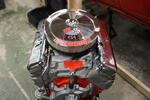
Here's a pic of my 454 today. I measured it just for you. 543# . I need to remove the weight of the heavy chain, and the engine cradle, and then add back the distrib and carb. So I guess around 535# like that.
Mine is built like an LS6 and dyno'd at 500HP at 5800 and 550TQ at 3400. Pretty mild flat TQ curve. 230/240 Solid Roller. Could easily be 560+HP with just a head change to new AFRs vs these 50 year old Winters heads.
Here's another alternative:
It's a 640 cu. in. and near 950-1000HP at 8000 rpm. It's a tall deck block with aluminum procomp heads full stud girdle, etc. It weighed 567#. It doesn't even have a 30# flywheel on it like mine does, but then the water jacket is literally full of concrete. That may have added some weight LOL! If you are gonna build a big block, you might as well go BIG. It is close to Two HP per pound.
On the block weight I'll go look it up. Attached is my weight spreadsheet data I have been collecting.
My calcs say a BBC like mine is only 40# more than an all iron SBC. Too me the TQ is worth it.
But to the OP, GKULL is dead right, it is the total combo that counts on the track. The BBC GT1 car he mentions has more weight due to a 300# weight penalty, smaller brakes, same size tires, more HP and an understeering chassis tune. Can some of this be changed to make the car more competitive and able to use the extra HP? Right now GKULL has a much better setup, and faster, car.
Zdave you asked about block weights.
I have 3, all w/o 4 bolt main caps:
Merlin aluminum 120#
MkIV BB 200#
Bowtie 270#
The other thing you should consider is a complete re-vamp of the rear suspension. It will take so much work (& $) to make the stock 400HP capable IRS hold up to 800HP, and the geometry will never be very good anyway, so you make as well start over from scratch. If it was me, and the rules allowed it, I would strongly consider an entire Ridetech Track 1 rear suspension, or better. You are going to have to work at it to pass GKULL, he has been at this for years!
By the time you beef up the C3 IRS to not break you will spend at least half of this. And this starts with a Ford 9 inch, allows wider tires, bolts in, but honestly still has the same geometry. https://www.ridetech.com/product/com...corvette-comp/
In todays dollars if you go to a NASA road racing event the competitive cars have over $100K in them. So you get a Vette and have it fully gusseted and roll caged. Then add. 9 inch Ford IRS rear end is $10K, SFI everything blow proof bell housing 1000 HP clutch Magnum 6 speed Tranny, chromemoly drive line, drive shaft hoops $10,000, Brakes greater than $5000 depending on what you get. Buy some sets of wheels.
It's better to buy at the end of a racing year when someone is getting rid of everything for 1/2 of what it cost to build it.
Racing in the class below the super unlimited is for people with thick wallets Just in tires and rotors you might spend $20K per year in the past. I was pit crewing on a car this weekend and 4 tires are now $2800 and you might get a total of two hours of track time on them.
My frame was gusseted years ago. What the power book and my kit didn't cover was the lower front frame where the lower A-Arm attaches. I got cracks in the frame from front slicks and 700# springs. I ended up grinding out the cracks welding then fish plating over the whole area. Another weak spot I never addressed is fish plating the steering box frame area.
I put in a roll cage welded in at nearly the highest wheel well hoop so the kick up area was a moot point.
Removable tranny cross members and a pass under exhaust system is really a MUST have! My 3 exhaust pipes with cross pipe is only held on by two hanger points per side and the three collector flange bolts. I can take off the whole exhaust in a matter of minutes to work on anything from the differential forward.
Being a science guy. If the 427 SBC makes 650 HP which is 1,522 HP per ci. My local friend bought a historic 76 GT1 Vette with a 496 stroker BBC. 496 X1.522 = 755 hp.
What was the weight of your BBC crankshaft to get the 535#. I just looked up some quality forged crankshafts for BBC and 76 pounds for a BBC. The rods, damper... for the rotating assembly far exceed my 42 # crank. I have the light weight damper and 22 pound flywheel. Rotating mass is a great gain when you are looking at how fast a motor can change RPM.
Another thing you might not have known is that to bring Parity between cars the up to 508 ci motors were penalized 300 pounds compared to any SBC like mine at 3000 min with driver. I was just over 3000 win me in and my buddy was just over 3300. I was right at 42% front and 58 % rear. The BBC was right around 50/50 even with the battery and fuel cell clear in the back. We had the same tires, but he had probably over 300 lbs more on the front tires and a slower revving motor.
Where the weight is located makes a big difference on a lapping car.
I actually had better brakes.
The real gains of LS type motors is the dry sump. You can dry sump a chevy, but you are probably talking 10 grand by the time it's all said and done.
Originally Posted by gkull
If you have $35 - $60K to build a 700+ ci aluminum motor. I would get on the racing junk for sale web site and buy some car that is turn key and ready to race. I always wanted to buy a "Radical" LMP look alike car with the Susuki 1340 cc motor. If you were good enough you could set the fast time at most any track that you showed up at. They are a blast to drive and cheap to maintain
Originally Posted by gkull
In todays dollars if you go to a NASA road racing event the competitive cars have over $100K in them. So you get a Vette and have it fully gusseted and roll caged. Then add. 9 inch Ford IRS rear end is $10K, SFI everything blow proof bell housing 1000 HP clutch Magnum 6 speed Tranny, chromemoly drive line, drive shaft hoops $10,000, Brakes greater than $5000 depending on what you get. Buy some sets of wheels.
It's better to buy at the end of a racing year when someone is getting rid of everything for 1/2 of what it cost to build it.
All good info ... however I don't intend to compete wheel-to-wheel. More like lap speeds amongst friends. So the good news is that I don't have to worry about a 300lb weight penalty And while the Radical LMP looks like a lot of fun, I'm more interested in the Vette and using it on street & track. I've been weighing options with my Vette vs something like a used GT500/350, ZL1 1LE, or Z06. I really favor a large big block in my Vette, but, like you mentioned, there's a lot of other things to do to get it up to speed. Aluminum big blocks are expensive ... so yes it'd be great to find one that needs to be refreshed but could be purchased at a nice depreciation discount Or, even a similar Vette with all the needed track mods in place. In that case having the frames swapped might make sense ... then sell the donor as a drivable Vette.
Racing in the class below the super unlimited is for people with thick wallets Just in tires and rotors you might spend $20K per year in the past. I was pit crewing on a car this weekend and 4 tires are now $2800 and you might get a total of two hours of track time on them.
See ...... its the consumables, tires and rocket fuel, that get ya







 Frame reinforcement