When you click on links to various merchants on this site and make a purchase, this can result in this site earning a commission. Affiliate programs and affiliations include, but are not limited to, the eBay Partner Network.
I have searched here, other engine build sites and tried web searches, everyone is building high compression engines, I can't find the info for maximum static and dynamic compression for low octane gas.
I can't remember if we have 87 or 89 octane fuel here, with good quench and aluminum heads can I run 9.73:1 static compression if the dynamic compression is under 7.89:1?
These days I don't want to build an engine for high octane, only to have a hard time finding it in the future.
Your dynamic C.R. should fall in the range of 8.0 - 8.5.
Above that, can run the risk of grenading the engine.
Below that range you will continue losing power.
Ideal D.C.R is 8.25
And its been said that 93 octane is good for all the way up to 11:1 Static C.R.
If certain fuels are not available, one can always tweak the IGN timing down to 35* > 34* > 33*
I have searched here, other engine build sites and tried web searches, everyone is building high compression engines, I can't find the info for maximum static and dynamic compression for low octane gas.
I can't remember if we have 87 or 89 octane fuel here, with good quench and aluminum heads can I run 9.73:1 static compression if the dynamic compression is under 7.89:1?
These days I don't want to build an engine for high octane, only to have a hard time finding it in the future.
Short answer is yes. I'm running 10.57 CR with a 7.99 DCR and I can run 87 octane without any problems.
However engine cooling, gearing, quench, head flow, cam dynamics, and overall tuning including timing come into play as well.
I run 32* all in have a 3000 stall coveter and a 3.55 diff. with a th350 trans. I can't make it detonate. I've ran it lean at full throttle multiple times( bad fuel pump delivery) and added timing all the way to 36* and never heard a peep out of it from detonation.
A LOT has to do with good quench. Running .038" with AFR 180 eliminator heads.
DCR is going to vary with density altitude. So hot days you have less. Cold days you have more. Ultimately it's a cylinder pressure issue. Don't choke up the exhaust, good flowing exhaust pretty important as well.
One of the nice things about good heads is you can run less timing and still maximize burn.
Extend the straight line, and if I were you, I would shoot for a little lower on DCR. Maybe 7.5 DCR tops?
I had seen that chart.
I tried to imagine it extended to cover the compression I'm interested in, I had not considered printing it out and using a ruler until you posted it, thanks.
Oh I don't think it's irrelevant at all, that's a strong word.
It shows some trends.
But I also would not treat it as the "gospel" either.
As others have noted there are many other factors to consider as well.
Aluminum heads have been purported to handle 0.5 point more compression than iron.
Quench, air intake temp, block temp, chamber swirl, also all play a role.
FWIW my original iron head LT-1 with iron heads detonated badly on 93 and required 97 to run an ideal timing curve. 7.8 to 8.0 DCR That is well above the curves shown
I had to retard the timing by 8 degrees (28 total) for it to handle 93. Took 30 HP out of it. Block was never decked so it likely had lousy quench I guess.
Mostly irrelevant. Meaning Not totally. If we're talking 1970s, tech, ok relevant.
Since we're not still there then I'd still say mostly irrelevant. 87 and 89 octane don't even appear on the table.
I run 200* @ 7.99 DCR with 87 octane. That chart says I should require 95 octane. I'm 8 points below that. So why can I do that? Time has marched on and so has engine dynamics and tech and knowledge etc.
So if all is stock from 1970 something, it may be relevant..however it fails to consider a plethora of other factors.
that chart isn't in the ball park at all, my 80 L82 burns 87 fine with aluminum 64cc chamber heads and steel shim head gasket according to the chart I would need 103 to 108 octane
that chart isn't in the ball park at all, my 80 L82 burns 87 fine with aluminum 64cc chamber heads and steel shim head gasket according to the chart I would need 103 to 108 octane
Are using SCR, the chart is used with DCR. And as noted above aluminum heads have a higher value DCR than cast iron.
Short answer is yes. I'm running 10.57 CR with a 7.99 DCR and I can run 87 octane without any problems.
However engine cooling, gearing, quench, head flow, cam dynamics, and overall tuning including timing come into play as well.
I run 32* all in have a 3000 stall coveter and a 3.55 diff. with a th350 trans. I can't make it detonate. I've ran it lean at full throttle multiple times( bad fuel pump delivery) and added timing all the way to 36* and never heard a peep out of it from detonation.
A LOT has to do with good quench. Running .038" with AFR 180 eliminator heads.
DCR is going to vary with density altitude. So hot days you have less. Cold days you have more. Ultimately it's a cylinder pressure issue. Don't choke up the exhaust, good flowing exhaust pretty important as well.
One of the nice things about good heads is you can run less timing and still maximize burn.
I find it very interesting that you can run that much compression and still manage to get by on 87 octane.
Your setup seems to be close to the typically accepted recommendation of 8.5 DCR max with 93 octane gas
Do you have any other specifics you can share as to what you think makes it work for you?
Lots of variables in compression, cam, heads, quench, temp, altitude etc
I'm 11.3:1 static, aluminum heads, good quench with flat top pistons, XR282 cam, I generally run around 3000 -4000 feet in elevation and my dynamic compression is 8.3@ 3k feet. It runs fine with 91 octane.
At sea level my dynamic compression is 8.9, so I would be cutting it close on 93 octane.
I find it very interesting that you can run that much compression and still manage to get by on 87 octane.
Your setup seems to be close to the typically accepted recommendation of 8.5 DCR max with 93 octane gas
Do you have any other specifics you can share as to what you think makes it work for you?
in addition to the items I mentioned, I also run dish pistons with angle milled heads down to 55.5cc’s to give me the 10.6 CR.
I polished the combustion chamber, chamfered the dish edges on the pistons, and removed all sharp edges in the combustion chamber around valve cutouts and the ground straps on the plugs.
the exhaust tracts on the heads were also polished smooth.
intake tracts were left rough cnc finish.
intake manifold ported and textured for maximium fuel vaporization. Crossover heat blocked.
electric fans for cooling.
running side pipes with sts inserts for free flowing exhaust.
cam specs 270/270. 219/219@.050 on a 108 LSA .549 lift using 1.6 RR.
compression readings all over 200 psi.
in addition to the items I mentioned, I also run dish pistons with angle milled heads down to 55.5cc’s to give me the 10.6 CR.
I polished the combustion chamber, chamfered the dish edges on the pistons, and removed all sharp edges in the combustion chamber around valve cutouts and the ground straps on the plugs.
the exhaust tracts on the heads were also polished smooth.
intake tracts were left rough cnc finish.
intake manifold ported and textured for maximium fuel vaporization. Crossover heat blocked.
electric fans for cooling.
running side pipes with sts inserts for free flowing exhaust.
cam specs 270/270. 219/219@.050 on a 108 LSA .549 lift using 1.6 RR.
compression readings all over 200 psi.
Wow. You certainly have some significant chamber prep there. And terrific AFR heads that produce high swirl. Certainly a way above average build. Cool.
Wow. You certainly have some significant chamber prep there. And terrific AFR heads that produce high swirl. Certainly a way above average build. Cool.
It has worked out well so far😁. Pretty happy with the AFR heads. Forgot to mention, the dish pistons are D-dish, making quench relevant.
Thanks.
I'm looking at the AFR 180 and Pro-Filer 185 heads.
I ordered a Scat stroker rotating assembly with D-dish pistons.
I'm evaluating cams now, intake closing will probably determine which head I go with for combustion chamber size.
If I can't find one close enough I'll consider milling a head.
One other thing to mention is that 7.99 DCR is computed at an altitude of 4000 ft.
At sea level it would be 8.80 DCR.
I live at 4000ft, however I drive to lower altitude of 3000 ft often, even on a cool day of 45* so density altitude may be 2700 ft or so. That would raise my DCR above 7.99, no detonation. It can be done. Cool temps of course help.
Cold air intake is of great importance as well. I have only cold air for the engine to breathe, no underhood air.
One other thing to mention is that 7.99 DCR is computed at an altitude of 4000 ft.
At sea level it would be 8.80 DCR.
I live at 4000ft, however I drive to lower altitude of 3000 ft often, even on a cool day of 45* so density altitude may be 2700 ft or so. That would raise my DCR above 7.99, no detonation. It can be done. Cool temps of course help.
Cold air intake is of great importance as well. I have only cold air for the engine to breathe, no underhood air.
I'm at 4800 feet however I may want to drive to sea level, the numbers I'm considering are uncorrected for altitude.
I am considering a cowl induction hood for cold outside air.
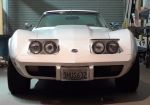
The main issue is the car is metal flake/pearlescent white, I don't know if I can get the color matched for a new hood.
That's one thing I'll look into before buying a hood.
I may look for an L-82 intake ducting and air filter, though I would prefer cowl induction.
Ahh Now your build is making much more sense to me.
The air pressure at 4000 ft is 40% less than at sea level.
That makes a much different build.
And changes your CR & your DCR needs.
That's why your DCR can be so high! And "off" the chart.
Some of us (like me) live at sea level in the hot & humid east coast.
That's a whole different build too.
And that's why sea level builds run so poorly at altitude, they are gasping for breath!







 How Much Compression on Low Octane?