When you click on links to various merchants on this site and make a purchase, this can result in this site earning a commission. Affiliate programs and affiliations include, but are not limited to, the eBay Partner Network.
I have only had my 1970 L46 for a couple months now, but enough time to take it out for three good drives (city, highway, and country roads). I have a few issues that I've discovered I need help/advice on, and will post them separately:
#1. The temperature gauge does not work, so I planned to systematically replace the easy things first (thermostat, sending unit, sending unit lead, etc.). I'm pretty sure the sending unit lead is the issue (the wire appears to be just hanging on by a thread), but I had already bought the $16 thermostat and decided to switch it out anyway... I removed the housing to find no thermostat at all! Is there any situation at all where there would not be a thermostat, or some form of a thermostat installed somewhere else I'm not aware of?
My only guess here is that someone removed it as a "safety measure" to try and avoid possible unknown overheating since the temp gauge did not work (rather than fixing the issue with the temp gauge?). Any other thoughts?
That is a misconception that still goes on today that the engine will run cooler w/o the T-Stat. In some cases, it actually ran hotter, but whatever.
Don't know what type / brand waterneck gasket you plan on installing but I have had excellent luck with Permatex Waterneck / Waterpump RTV. Found at Autozone, small white tube. It is glycol proof, where some sealants are not.
Another tip is to remove that upper Rad Hose and take the waterneck over to your belt sander. You need to roughen up the chrome to get a good seal with the hose.
And again, use a RTV on the hose also. Let everything dry overnite.
The temp sender could be faulty or oily spade connector or bad wiring. If you end up removing the sender, never use a sealant or tape over the entire threads, only part way. The sender needs to GRD itself on a "one-wire system".
One other tip on those waternecks reedyfork
Whether its aluminum, cast iron, billet, bling chrome, take the two bolts you plan on using and place them in the respective holes. Just snug them by hand.
Now slide your waterneck over next to the bolts. The bolt head must be lower than the bosses.
You would be surprised how many people bottom out those bolts then the housing leaks.
Last edited by HeadsU.P.; Jan 21, 2023 at 05:04 PM.
Reedy, yes you need a thermostat in there and no there isn't any other one in the cooling system.
Heads, I had to read what you posted a few times to figure out what you meant. You're right. It just read kind of strange. What he means is hand thread the water outlet bolts into the intake manifold as far as they will go, then put the water outlet NEXT to the bolts with the outlet leveled on the thermostat hole You can't slide the outlet over the bolt heads. Yes, the bolt heads have to be lower than the bolt bosses on the outlet to be sure the bolts won't bottom out before they clamp the outlet in place.
Thermostats are there for a reason. That is to bring the engine to operating temp (thermostat rating) asap. Running an engine too cold can create damage caused by sludge (condensation in oil).
there s one valid reason to find no thermostat under the gooseneck. Bubba was here!! and drop the bling gooseneck on a piece of sandpaper and get the plating off the base.where it seals to the gasket.
Before you install you're new thermostat. Put it in a pot of water on the stove and heat it up. Insure that it opens, and opens at the rated temperature. A 180 thermostat is a good place to be. With the quality you get these days I would not trust any thermostat before testing it.
Another consideration is the robert shaw/ parallel flow thermostat. Much superior to coolant flow vs the standard type thermostat.
Keep in mind the temp rating is merely the lowest temperature the coolant will achieve. It will likely run higher than the thermostat rated temp under many conditions.
Last edited by REELAV8R; Jan 22, 2023 at 10:26 AM.
Before you install you're new thermostat. Put it in a pot of water on the stove and heat it up. Insure that it opens, and opens at the rated temperature. A 180 thermostat is a good place to be. With the quality you get these days I would not trust any thermostat before testing it.
...
Keep in mind the temp rating is merely the lowest temperature the coolant will achieve. It will likely run higher than the thermostat rated temp under many conditions.
reedyfork, testing is always good advice for thermostats (and heater cores (BTDT)) --- plus understand that these are not precision devices. Beginning to open will likely occur within 5°F +/- of the rating with fully open 20-30°F above the rating.
Reelav8r, as you know, a lot of folks think an engine will maintain whatever temp the thermostat rating is, which is why they think a 165°F thermostat will run cooler than an 180°. Chevrolet data, for where the high for normal operating temperature occurs, is generally in the 220-230°F range and that's going to happen no matter what thermostat is installed (as long as it's rated below that range). I think those unaware of the normal range get frightened when they see the temps this high.
2020 Corvette of the Year Finalist (performance mods)
2019 C3 of Year Winner (performance mods)
2016 C3 of Year Finalist
while others dont understand that an engine does make more horsepower at cooler temps and that running a 165F merely allows the engine to cool to that temp versus staying at or above 200F with a 195F thermostat. And please dont compare todays temps, emissions standards and horsepower numbers with the relics that come in our 50 year old cars...theory may remain constant but technology does not and has bypassed these dinosaurs




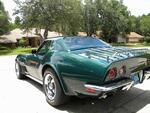



 1970 - thermostat missing?