When you click on links to various merchants on this site and make a purchase, this can result in this site earning a commission. Affiliate programs and affiliations include, but are not limited to, the eBay Partner Network.
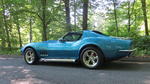
I inherited a 1973 350 Corvette from my father late last year. He was getting ready to sell it, but it needed a few thousand in repairs and I offered to pay the bill and the difference in what he paid for it five years before. He ended up "selling" it to me for the cost of the repairs and shipping to the West Coast. Can't beat that deal. It's in pretty good condition and just needs some refreshing.
My sons and I so far have installed a new interior and upgraded the stereo, and changed out most of the fluids. The rear brakes are rusted through and leaking, replacing them is the next item on the list, as well as replacing the shocks and possibly the bushings depending on how difficult the trailing arms are to take off. I might also upgrade the rear leaf-spring to a fiberglass mono while we're under there.
I have learned nearly everything I need to about Corvettes from this forum and/or Google searches, to the extent that I haven't needed to sign-up or post any questions yet.
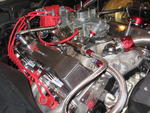
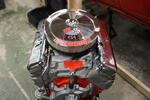
However, one thing that continues to stump me is trying to figure out what the engine is. The number stamped on the front passenger side indicates it was originally from a 1978/79 C/K-20 truck, which I really hope it isn't! If it were, it would be producing 20-30 hp less than the original '73 made. While it idles relatively rough, I have no reason to believe that it needs to be rebuilt. There are a few drips of various fluids around the engine, but none severe. Spark plugs all came out a nice shade of tan and the exhaust is clean. It has an Edlebrock Carb and manifold, though, from the research I've done, they look like economy parts that are not the greatest.
I have yet to tune it, but it runs well and moves quickly off the line. It seems to loose a little oomph at freeway speeds, but that may be attributed to the carb, intake manifold, what look to be stock ram's horn exhaust headers, and an exhaust system that needs to be replaced (it's dented from hitting the ground a few too many times).
Is there a way to determine what the cam specs are without taking it out of the engine? I thought I saw something about using a dial gauge on the rocker arms and turning the engine by hand?
And does anyone know what type of heads these might be? I haven't been able to find these markings anywhere on the web.
Thanks for all the great info I've gleaned from this site!
Tom
You can use a magnetic dial indicator mounted to a pushrod for example to try to get lift of the cam lobe. Don't use a rocker arm. Their ratios can be way off, and your math will be obscured.
But let's say you come up with a lobe lift number. Then what? There could be 50 cams with that same lift measurement. So, you need the duration also to narrow it down which cam it could be. You still won't know the brand or type of lobe, aggressive? So, then you will need a degree wheel mounted on the crank.
You see where I am going with this? You will have so much time and money into specialty tools that you might as well just pull the water-pump and timing cover to get the cam numbers.
Also, a great time to decide on the timing chains condition.
Once the fan belts, fan and water-pump are out of the way, it's not a bad job. You will need a harmonic balancer puller / installer. Still cheaper than all the other tools.
Last edited by HeadsU.P.; Feb 24, 2023 at 08:20 PM.
just cuz it is a pick up block number is meaningless. it could even be a better bottom end than the 73 vette engine. what is in the engine NOW is what counts. and a 78 truck block-crank-pistons worst case is essentially identical to L48 vette. pull valve covers and get head casting numbers. get an ebay or amazon borescope and go thru the spark plug holes and oil drain to see what you have for pistons and bottom end. in 78 the fastest production american vehicle was the dodge lil red express truck. why? emissions specs. trucks had way less stringent specs than cars. so higher compression ratios and hotter cam profiles were still acceptable to the epa.
welcome! take better pics with numbers for those that know can help
Thanks for the welcome.
I thought the head could be determined by the casting marks I showed in the photo. Or is that only on a certain vintage those can be used?
If that's the case, I'll take the covers off and look up the casting number.
Thanks!
You can use a magnetic dial indicator mounted to a pushrod for example to try to get lift of the cam lobe. Don't use a rocker arm. Their ratios can be way off, and your math will be obscured.
But let's say you come up with a lobe lift number. Then what? There could be 50 cams with that same lift measurement. So, you need the duration also to narrow it down which cam it could be. You still won't know the brand or type of lobe, aggressive? So, then you will need a degree wheel mounted on the crank.
You see where I am going with this? You will have so much time and money into specialty tools that you might as well just pull the water-pump and timing cover to get the cam numbers.
Also, a great time to decide on the timing chains condition.
Once the fan belts, fan and water-pump are out of the way, it's not a bad job. You will need a harmonic balancer puller / installer. Still cheaper than all the other tools.
Got it. Yes, it makes sense to just pull the timing cover.
Do all cams have a cam number on the front? Just want to make sure it's not a fruitless endeavor. Of course, knowing the condition of the timing chain would be good also.
Since I'm pulling all that off, would it make sense to replace the harmonic balancer with a new one that has timing marks on it? Any recommendations? And, are there other parts that should be looked at/replaced while there? I know its sort of a can-o-worms thing, but better to find out now than later.
just cuz it is a pick up block number is meaningless. it could even be a better bottom end than the 73 vette engine. what is in the engine NOW is what counts. and a 78 truck block-crank-pistons worst case is essentially identical to L48 vette. pull valve covers and get head casting numbers. get an ebay or amazon borescope and go thru the spark plug holes and oil drain to see what you have for pistons and bottom end. in 78 the fastest production american vehicle was the dodge lil red express truck. why? emissions specs. trucks had way less stringent specs than cars. so higher compression ratios and hotter cam profiles were still acceptable to the epa.
Good point.I didn't think that being a truck engine it might not have to meet emissions requirements for that time. I do know that this one has no emissions equipment on it at all. It's a good thing that in California the 1973 model year (and earlier) don't have to be smogged at all!
As far as the borescope and looking at the pistons, would this indicate whether they are dished or something else? This would also figure out whether this engine might have either 2- or 4-bolt main. When I looked up the engine number everything I saw was too vague to make that call. Any ideas? I need to clean off the number pad better to make sure I have everything correct, too.
C373,
I can't speak for all cams but there is a 90% chance the part number is behind the timing sprocket. On occasion, the number is on the rear journal.
Here is what usually happens. You note the slop in the chain, so you swap that. The cam number revels it belongs in grandmas car. So, now you want to pull it out.
Off comes the dizzy, Intake & fuel pump. And you dropped the oil pan so might as well change the oil pump.
Then, a better Intake is on sale . . . . . . . . . . . .
yes, borescope will tell you dish, flat or dome. borescope through oil filler will tell you 2 or 4 bolt, and steel or cast iron crank. may even be able to see piston numbers. timing cover requires pan off. after 40 years all oil pans need to come off. timing gear and valve seal chunks need cleaned out and new oil pump. i replace rod bearings and check lower mains every time i drop a pan but i don't like newbies effing with them.
The image you show has the same head number highlighted twice. Just wondering if that just happened to be on the image you posted or are you thinking that those are the casting marks on the photo I uploaded?
If the latter, then that would be interesting since the head number "3998993" highlighted in your image would be from a 1972 or 73 SBC, making me wonder if the original engine block was damaged and they put the old heads on the new block.
C373,
I can't speak for all cams but there is a 90% chance the part number is behind the timing sprocket. On occasion, the number is on the rear journal.
Here is what usually happens. You note the slop in the chain, so you swap that. The cam number revels it belongs in grandmas car. So, now you want to pull it out.
Off comes the dizzy, Intake & fuel pump. And you dropped the oil pan so might as well change the oil pump.
Then, a better Intake is on sale . . . . . . . . . . . .
You read my mind!
But, yes, I will admit, I was already thinking in that direction.
Fortunately, oil pressure is good, so maybe one less thing on that list?
The image you show has the same head number highlighted twice. Just wondering if that just happened to be on the image you posted or are you thinking that those are the casting marks on the photo I uploaded?
If the latter, then that would be interesting since the head number "3998993" highlighted in your image would be from a 1972 or 73 SBC, making me wonder if the original engine block was damaged and they put the old heads on the new block.
Hi again,
I FINALLY got around to pulling the valve covers and getting the casting numbers from the heads. The number just makes this engine even more of a mystery! To recap this is in a 1973 base, that someone replaced the engine block with one from a 1978-79 C/K-20 truck, according to the block number. It has a TH400 transmission, that I believe is original. It has a late 70's intake manifold and Edelbrock Carb, that are both apparently smog era replacements (planning to replace both at somepoint). The exhaust system was in horrible condition and has been replaced with a dual, full 2-1/2" exhaust and 2-1/2" outlet ramshorn manifolds.
The head casting number is 3973487. That makes it from a 1971-72 Corvette (similar to ones used on LT-1 engines) and with either 1.94"/1.5" or 2.02"/1.6" valves and a combustion chamber volume of 75cc.
Anyone know if there is a way to tell which valve size it has? Or would that require pulling the heads and measuring them. I'd be happy to have either size valve (sounds like the heads flow pretty well) if it weren't such a large chamber. Although I did just read that the combustion chambers are pretty good for their size, but I would still like a little higher compression ratio. Is there a way to get that with these heads?
Of course there is. But first 3 questions for you.
how much more compression are you looking for?
What are you trying to achieve?
And what's easier, swapping the heads? Or the other end around?
High dome pistons will raise your compression. Getting your heads decked off will raise your compression. Just installing shim type head gaskets should net you about a half point in compression.
So, back to those questions. Let's begin with what do you wish to achieve.
Then it's easier to look at the other questions.
Bottom line is, aftermarket aluminium heads will net you more compression and more flow/power than anything else. High dome pistons will net you compression, but your heads still won't flow any better. And it's just a bit of work changing out pistons.
It's a 50 year old car with a garden variety 350 SBC which typically wore out by 100k miles back then, if they didn't get "broke".
It could have any possible combination of parts.
It idles "rough" could mean a lot of things.
It could have a big cam, etc. vacuum leak, wiped cam, bad wires etc.
What I would do is determine how well the engine runs now, and then decide how to proceed.
- Compression gauge check
- Vacuum gauge check at idle and cruising.
- Oil pressure, hot at idle, and 2000-3000
- Spark plug color check
- Driveability or revability check, smooth throttle, and sudden throttle
- AFR if you have a tailpipe sniffer gauge
Post your answers here, and what your goals are, and then we can help more.
Hi again,
I FINALLY got around to pulling the valve covers and getting the casting numbers from the heads. The number just makes this engine even more of a mystery! To recap this is in a 1973 base, that someone replaced the engine block with one from a 1978-79 C/K-20 truck, according to the block number. It has a TH400 transmission, that I believe is original. It has a late 70's intake manifold and Edelbrock Carb, that are both apparently smog era replacements (planning to replace both at somepoint). The exhaust system was in horrible condition and has been replaced with a dual, full 2-1/2" exhaust and 2-1/2" outlet ramshorn manifolds.
The head casting number is 3973487. That makes it from a 1971-72 Corvette (similar to ones used on LT-1 engines) and with either 1.94"/1.5" or 2.02"/1.6" valves and a combustion chamber volume of 75cc.
Anyone know if there is a way to tell which valve size it has? Or would that require pulling the heads and measuring them. I'd be happy to have either size valve (sounds like the heads flow pretty well) if it weren't such a large chamber. Although I did just read that the combustion chambers are pretty good for their size, but I would still like a little higher compression ratio. Is there a way to get that with these heads?
They will be smaller valve heads if they do not have pushrod guideplates and screw-in studs. You can see that easy from the top. Pressed in rocker studs and obround pushrod holes are for small valve heads of this time frame. They are "smog" heads for sure though.
Your cam is likely original "929" cam that was used in base 350's for over a decade. No need to pull it out unless you want to throw it in the trash.
The pistons are probably ordinary factory cast reverse deflector type.
The block itself could be a desirable 4 bolt main. Trucks use them frequently. Is your damper 8" diameter? Might be the smaller one 6.75".
Of course there is. But first 3 questions for you.
how much more compression are you looking for? Would like to get closer to a CR of 10:1. I know I need to figure out what I have to start with, but I'm sure it's in around 8.5
What are you trying to achieve?
Getting around 250 RWHP
And what's easier, swapping the heads? Or the other end around?
High dome pistons will raise your compression. Getting your heads decked off will raise your compression. Just installing shim type head gaskets should net you about a half point in compression. Whats the cost to deck a set of heads?
So, back to those questions. Let's begin with what do you wish to achieve.
Then it's easier to look at the other questions.
Bottom line is, aftermarket aluminium heads will net you more compression and more flow/power than anything else. High dome pistons will net you compression, but your heads still won't flow any better. And it's just a bit of work changing out pistons.
I wasn't even thinking of high domed pistons. That seemed like a lot more work than I was wanting to put into it. Thanks for insight!








 Head and Cam Identification