When you click on links to various merchants on this site and make a purchase, this can result in this site earning a commission. Affiliate programs and affiliations include, but are not limited to, the eBay Partner Network.
I am prepping the bare frame to be blasted and powdercoated. I am concerned that the threads of the bolt holes and screws are going to be compromised. How would you guys handle this ? Leave bolts in ? SAE taps are not available here. Melt coating off with butane torch and a bore brush ?
Talk to the powder coater. Typically they tape off studs, like the upper control arm ones. And there's silicone plugs for tapped holes.
maybe go through the frame and mark every hole with a wire that they will need to remove after blasting before coating or provide drawing.
putting bolts into holes can cause different problems as the coating goes over there as well.
Talk to the company
M
I am prepping the bare frame to be blasted and powdercoated. I am concerned that the threads of the bolt holes and screws are going to be compromised. How would you guys handle this ? Leave bolts in ? SAE taps are not available here. Melt coating off with butane torch and a bore brush ?
MTIADC3
Are you located in a prison ? SAE taps are available world wide
Just a personal opinion. I'm not all that enthused about powdercoating. I've had a lot of body parts powder coated. $$$$$. Unfortunately after about 12 years or so, a film of rust over the parts. My theory is that the powder coating process does/can leave microscopic openings in the coating to allow humidity start rusting. I noticed when I soaked a panel in phosphoric acid (Krud Kutter) not only did it remove visible rust, but it also removed some of the powder coated paint...once again the microscopic pore theory,,,,,the phosphoric acid creeped into these hypothetical openings and removed rust/corrsioin under the paint which in turn caused the paint to peal off. Portions of powder coat that did not apparently have these "pores" did not peal off. Also powder painting requires static electricity to hold the paint particles on the to-be-painted part. Crevices may not get powder and powder painted edges tend to have very thin layers of paint.
Recently I've been painting frame parts with Eastwood 2K frame paint. 2K refers to a recent hardening process that takes place in the paint. Eastwood also makes two part frame paints.....in an aerosol can if you want. Two part means it's a catalyst activated paint. I've also used Rustoleum...using the traditional oil based paint only sold in a can. Rustoleum, traditional formula, is banned for sale in California so I'd guess it's pretty good stuff. All these paints I mentioned here take 48 hours to fully harden.
There is no process using a standard spray gun that will coat the interior part of the frame, you can get a lot of it shooting into various holes but not 100%. As for powder coating, IMO a complete waste of time and money.
When I prep a frame I start with an end to end sand blasting shooting into every hole I can get the nozzel into, follow this up with a long air nozzel and blow out all the remaining sand inside the frame than spray it with PPG DP90LF (epoxy primer). I try to pick a day of good weather and do this all in one setting to prevent flash rusting between the sand blasting and epoxy primer.
I had a local sand blasting guy I could take the frame to in the AM and be back home by noon to prep for the epoxy primer. You can topcoat with your choice of chassis black but I never did that, the DP90LF looks good as-is.
Is DP90LF even available today or did the EPA get that too. ?????
Buy a set of SAE Thread Chaser taps online.
You do not need to cut new threads or damage existing threads.
You just want to clean the rust & powder coat out of them.
Buy a set of SAE Thread Chaser taps online.
You do not need to cut new threads or damage existing threads.
You just want to clean the rust & powder coat out of them.
Buy a set of SAE Thread Chaser taps online.
You do not need to cut new threads or damage existing threads.
You just want to clean the rust & powder coat out of them.
Hi, my Frame was first Acid dipped, that removes all Kind of Paint, Rust, Oil and Grease. Second Step ist a KTL Coating, that will Coat the inside and outside of the Frame and every possible Corner and Edges. Finally a Hot Wax in the inside from Mike Sanders.....
Hi, my Frame was first Acid dipped, that removes all Kind of Paint, Rust, Oil and Grease. Second Step ist a KTL Coating, that will Coat the inside and outside of the Frame and every possible Corner and Edges. Finally a Hot Wax in the inside from Mike Sanders.....
Ok so I watched a Video on the process and I'm sold on it. Google didn't come up with anybody doing it in the Pacific North West ( lots of aerospace like Boeing) So do I just ship my Frame to Germany ?
Ok so I watched a Video on the process and I'm sold on it. Google didn't come up with anybody doing it in the Pacific North West ( lots of aerospace like Boeing) So do I just ship my Frame to Germany ?
If you decide to go powder coat don't use lock washers that will bite into the powder as you tighten down the bolt/nut. The lock washer will crack the powder coat and rust could start.
Many primers aren't UV stable and the sun can cause fading.
I powder coated my LS6 swapped 98 Wrangler 15 plus years ago and it still looks great. The Wrangler frame is a tube type frame similar to the C3.
Powder loves sand blasting. Great "bite" for the powder.
The company I used to work has a big powder coat shop. If someone would want do something frame wise with tapped holes or areas that needed to be taped off they will hand you a bag of silicone plugs and a roll of high temp tape and do it yourself. So no issues with the powder coater missing something.
Well the Video I watched was done in Germany. They had a fully automated system that was similar to Chrome Plating. The Parts were being submerged in Tanks. Nothing was being done by hand it was all automated. It would be nice to get the inside painted after being chemically striped and the only way to do that would be to submerge it. You would have to drill some holes to let the air out. So you would have to get in line with some sort of production line, a one off paint job in a dunk tank is going to be hard to find. The factory painted them with the frames hanging up by the front with sprayers. So very little paint got on the inside. You might find runs and sags in original paint they are always running aft as the frames were hung. Then they were stacked on top of one another and loaded onto Rail Cars and left outside in what ever weather until needed. The A Arms and other small parts were the same paint but they remained indoors so the paint held up better and had more of a sheen to it.






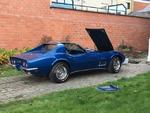


 Powdercoating a bare frame