


Check your ring gears closely

Thread Starter
Tech Contributor


Joined: Aug 1999
Posts: 15,159
Likes: 3,965
From: Connecticut, USA
 Check your ring gears closely
There is always a thread or comment on differential rebuilding. I just answered one here a minute ago.
Today the price of parts and shipping is going up every time I reorder parts. What used to cost say $20 to ship now is $100. A differential, pre-covid, was about $120 to ship from CT to CA, today it's about $250- one way. Eaton goes up on their prices more times than the sun rises in a month nas back orders are common. Those copying Eaton have some issues too.
As a result, more and more "rebuilders" are popping up. Trying to cash in on the high cost by offering low ball quotes and questionable work. Some are taking the bait and finding out later maybe they really didn't save much in the long run.
The point of this thread is the cheap rebuilders all have one thing in common- doing the job fast for the most profit AND to check the parts used in your diff. Whether you do the work or buy it done. I am not selling anything here, just passing along some info that may or may not help some.
EXAMPLE
I am working on a diff now that was "rebuilt" by a vette shop 20 years ago. I think I posted about it here but in case I didn't, it was supposed to be a complete rebuild with new 355 gears. What it turned out to be was: 1 bearing replaced and imported Chinese gears used. The rest of the diff was left with the original parts. That cost more from the vette shop 20 years ago, then it will today to correctly fix! Think about that. The car was not driven much, if at all, in the past 20 years, so it's not like it was 20 years of use and abuse. It should have been as clean as the day it was assembled.
Working on it I found the new gear pattern was really askew, an oddball pattern running off the heel. While that can be used if the pattern is equal it's not the best. Today I found the gears bind in one spot. Checking the RG runout, it is under 001" which is good. So, it has to be the machining on the gears and possibly lack of a good final lap, I really can't say other than I don't like them. The kicker, 20 years ago there were plenty of USA made gears for sale and even from the highest marked up vendor, were under $250. Why would they go with imported gears 20 years ago? Cheap parts more profit.
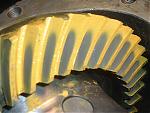
So, ok I pull a set of 1978 GM 355 gears I had on the shelf. They came out of a 78 diff I rebuilt and used 373's in. They were bolted on the posi case, probably since 1978 until the day I removed them. I cleaned them up and they looked good. I would sell them for $100 to save the owner from buying $450-$650 new gears today. All was looking good until I removed the ring gear from the lathe and looked into the ring bolt holes. 3 holes had machine chips packed in them. They weren't from me and as mentioned I was the first person to remove the gear from the case since 1978. I dug out the chips and washed out the holes, then saw they were not tapped enough. My guess is when they were made, the chips got it, no one cleaned them out, the gear was tapped as far as the tap would go without breaking, and then assembled in the diff. Hole depth among the 10 holes varied as much as 130", the worst ring gear I've ever seen. How the bolts stayed in and didn't back out is beyond me since the RG bolts used in that period were garbage to begin with. It is not uncommon to find original C3 diff housings and cases gouged by broken RG bolts and this may be just one reason. The main reason was lousy QC in the 70's, GM tanked badly while Japan was putting together cars that run forever, at least until they rotted out. I am going to use these 78 355's to hold my scrap barrel on the floor until dump it. New 355's will be used, cost goes up.
Check your parts, ask questions if you use a rebuilder or buy an exchange unit. Believe it or not.
Today the price of parts and shipping is going up every time I reorder parts. What used to cost say $20 to ship now is $100. A differential, pre-covid, was about $120 to ship from CT to CA, today it's about $250- one way. Eaton goes up on their prices more times than the sun rises in a month nas back orders are common. Those copying Eaton have some issues too.
As a result, more and more "rebuilders" are popping up. Trying to cash in on the high cost by offering low ball quotes and questionable work. Some are taking the bait and finding out later maybe they really didn't save much in the long run.
The point of this thread is the cheap rebuilders all have one thing in common- doing the job fast for the most profit AND to check the parts used in your diff. Whether you do the work or buy it done. I am not selling anything here, just passing along some info that may or may not help some.
EXAMPLE
I am working on a diff now that was "rebuilt" by a vette shop 20 years ago. I think I posted about it here but in case I didn't, it was supposed to be a complete rebuild with new 355 gears. What it turned out to be was: 1 bearing replaced and imported Chinese gears used. The rest of the diff was left with the original parts. That cost more from the vette shop 20 years ago, then it will today to correctly fix! Think about that. The car was not driven much, if at all, in the past 20 years, so it's not like it was 20 years of use and abuse. It should have been as clean as the day it was assembled.
Working on it I found the new gear pattern was really askew, an oddball pattern running off the heel. While that can be used if the pattern is equal it's not the best. Today I found the gears bind in one spot. Checking the RG runout, it is under 001" which is good. So, it has to be the machining on the gears and possibly lack of a good final lap, I really can't say other than I don't like them. The kicker, 20 years ago there were plenty of USA made gears for sale and even from the highest marked up vendor, were under $250. Why would they go with imported gears 20 years ago? Cheap parts more profit.
So, ok I pull a set of 1978 GM 355 gears I had on the shelf. They came out of a 78 diff I rebuilt and used 373's in. They were bolted on the posi case, probably since 1978 until the day I removed them. I cleaned them up and they looked good. I would sell them for $100 to save the owner from buying $450-$650 new gears today. All was looking good until I removed the ring gear from the lathe and looked into the ring bolt holes. 3 holes had machine chips packed in them. They weren't from me and as mentioned I was the first person to remove the gear from the case since 1978. I dug out the chips and washed out the holes, then saw they were not tapped enough. My guess is when they were made, the chips got it, no one cleaned them out, the gear was tapped as far as the tap would go without breaking, and then assembled in the diff. Hole depth among the 10 holes varied as much as 130", the worst ring gear I've ever seen. How the bolts stayed in and didn't back out is beyond me since the RG bolts used in that period were garbage to begin with. It is not uncommon to find original C3 diff housings and cases gouged by broken RG bolts and this may be just one reason. The main reason was lousy QC in the 70's, GM tanked badly while Japan was putting together cars that run forever, at least until they rotted out. I am going to use these 78 355's to hold my scrap barrel on the floor until dump it. New 355's will be used, cost goes up.
Check your parts, ask questions if you use a rebuilder or buy an exchange unit. Believe it or not.



Instructor

Joined: Jun 2023
Posts: 201
Likes: 66
From: Orlando, FL.
Leftover machining "chips" being found in assemblies from the O.E.M.'s executions is not really that uncommon, whether it be of differentials (actually more so) all the way to the engines.
As an example, Ford Motor Co. was outsourcing the 8.8 differential production from Dana Corp. (in a convoluted way that would be Chrysler) and we saw quite the number in our shop since the eighties as "virgin" (not having been opened up before) assemblies brought in solely for gear ratio changes, no complaints of noise or other problems, just the customer wanting something more sporting in gearing. Even on quite low mileage vehicles, we would find that new bearings and a thorough clean-out was needed due to the damage caused by "chips" having been left by the O.E.M.. In one instance, a customer brought us his car which had 267 miles since new for a gear swap, upon opening it up, so much was going to need to be replaced due to this exact issue that I buttoned it back up and suggested that he return to the Dealer and have them replace that which it required under warranty rather than shouldering the entire cost himself; and then if he couldn't get the Dealer to install the preferred gear ratio (under the warranty repair) he could then return to us for the gear swap.
This issue was well understood by us at the time and when we would purchase brand new complete 8.8 axle assemblies from Ford Motorsport/Racing/Performance, but before we would install these we would open them up and completely flush them out to remove the remaining byproducts of production that would otherwise migrate into the componentry and cause damage.
In another more recent example, Ford Motor Co. issued a T.B. on head gasket fluid leakage noted on some of the "Modular" engines (4.6/5.4), this where an excessive sum of "chips" left behind in the cylinder head water jackets from the machining operations, would fall out on to the block decks when the heads where in the process of installation, this causing incomplete clamping/sealing of the head gasket and the leakage issue!
So, leftover chips, though unappreciated, really are not an unusual event in the manufacturing process.
Scott.
As an example, Ford Motor Co. was outsourcing the 8.8 differential production from Dana Corp. (in a convoluted way that would be Chrysler) and we saw quite the number in our shop since the eighties as "virgin" (not having been opened up before) assemblies brought in solely for gear ratio changes, no complaints of noise or other problems, just the customer wanting something more sporting in gearing. Even on quite low mileage vehicles, we would find that new bearings and a thorough clean-out was needed due to the damage caused by "chips" having been left by the O.E.M.. In one instance, a customer brought us his car which had 267 miles since new for a gear swap, upon opening it up, so much was going to need to be replaced due to this exact issue that I buttoned it back up and suggested that he return to the Dealer and have them replace that which it required under warranty rather than shouldering the entire cost himself; and then if he couldn't get the Dealer to install the preferred gear ratio (under the warranty repair) he could then return to us for the gear swap.
This issue was well understood by us at the time and when we would purchase brand new complete 8.8 axle assemblies from Ford Motorsport/Racing/Performance, but before we would install these we would open them up and completely flush them out to remove the remaining byproducts of production that would otherwise migrate into the componentry and cause damage.
In another more recent example, Ford Motor Co. issued a T.B. on head gasket fluid leakage noted on some of the "Modular" engines (4.6/5.4), this where an excessive sum of "chips" left behind in the cylinder head water jackets from the machining operations, would fall out on to the block decks when the heads where in the process of installation, this causing incomplete clamping/sealing of the head gasket and the leakage issue!
So, leftover chips, though unappreciated, really are not an unusual event in the manufacturing process.
Scott.

Drifting


Joined: Oct 2020
Posts: 1,566
Likes: 574
From: Wisconsin
Gary, just out of curiosity, you said you were going to toss the ‘78 355 ring gear in favor of a new one. Is that because the labor cost of tapping the 10 holes properly would eclipse the cost of a new gear, or was there actual damage from the RG bolts bottoming out? Or other damage making the used gear undesirable?
Thread Starter
Tech Contributor
Joined: Aug 1999
Posts: 15,159
Likes: 3,965
From: Connecticut, USA
Street ring gears are hardened. The thread is a 3/8-24, maybe using a carbide tap would work or maybe it still breaks. Those are brittle holes, the end of the bolt will roll easy if bottomed out. Other options exceed the value of the part.
Used gears are not worth a lot to begin with. Since most don't have a history with them, meaning who knows if they are actually a matched set or have been in someone's garage for 42 years mixed up with other parts. There was no sense in wasting any more time on it.
Used gears are not worth a lot to begin with. Since most don't have a history with them, meaning who knows if they are actually a matched set or have been in someone's garage for 42 years mixed up with other parts. There was no sense in wasting any more time on it.
Old Pro Solo Guy


Joined: Dec 2017
Posts: 8,043
Likes: 4,396
From: Marlton NJ
Very similar to the issue I found on my OEM 72 323 gears. I had 10 different depths on the bolt holes, and had to trim 6 or 8 of the ARP bolts by a thread or so.
Maybe .060 or so too shallow on several holes. All the stock bolts fit, but not the longer ARP ones.
Oh I almost forgot, there was even a special "short" factory bolt in one hole!
Geez....
Maybe .060 or so too shallow on several holes. All the stock bolts fit, but not the longer ARP ones.
Oh I almost forgot, there was even a special "short" factory bolt in one hole!
Geez....









