When you click on links to various merchants on this site and make a purchase, this can result in this site earning a commission. Affiliate programs and affiliations include, but are not limited to, the eBay Partner Network.
I recommend AEM Wideband gauge install properly with no exhaust leaks. A pinhole will throw an oxygen sensor way off.
That said high HC and while also running lean sounds like poor efficiency, gunk buildup and carbon deposit contribution. HC can also be high if the engine is super-lean. Carbon residue and deposits including oil ingestion contribute to HC. Oil and gasoline are both hydrocarbons and will produce partially oxidized hydrocarbon products and oil due to chain length produces far more variety and arrangements due to more possibilities because of the additional covalent bonds supporting so many additional carbons.
I recommend:
Clean the engine.
remove intake manifold and wash it out completely.
Replace hoses for PCV system & brand new pcv valve.
Inspect gaskets for oil leaking where the PCV system will pull leaking air which brings in more oil to the cylinders and rises crankcase pressure.
Replace spark plugs and re-tune the engine using wideband, and then replace the spark plugs again once the engine is finished tuning properly.
Consider a sea-foam style of treatment to remove some build up carbon from the cylinders valves and rings.
Perform a compression test before during and after these things are done to monitor progress. What you want is for every cylinder to balance compression and at first they may each have different values, until you fully clean the engine in its various ports and surfaces.
If the oil is dark quickly then perform several oil changes early to rinse out some of the circulating carbon. Consider mild engine flush although keep in mind the risk if the buildup is very bad a flush could ruin the engine. It depends how bad the situation is whether or not to flush the oil. The safest way if you are not sure is to simply keep changing the oil quickly and use quality synthetic and ensure the crankcase is fully sealed with no leaking for contamination entry points.
Make sure the pcv system is attached FULLY as OEM FACTORY with no aftermarket parts or pieces or lines unless you've got a crankcase measurement tool and have set it yourself properly to the correct range of 1" to 2"Hg of vacuum at all times.. This is very important to maintain proper PCV flow friction component vector for streamline and turbulent fluids alike.
Maintain the engine.
Besides plugs perform a tune-up. One of the difficult things for a sbc style engine to do is send a powerful spark consistently to all cylinders for 200k miles. It is very easy to distract spark and burn wires until the LS era appears. Insulate brand new plug wires fully using shealth and plates/shields to direct heat away from ignition parts. Measure them with IR thermometer if you are unsure whether proper precaution is taken.
Replace fuel filter and make sure the gasoline is clean in the fuel tank is not rusty or corroded and the fuel sock is intact.
Use a high quality paper style air filter like OEM for max filtration which limits carbon contamination from the air that causes deposits/gunk/wear/residues/etc... bad things happen when the air is not clean and filthy air leads to the sort of damage and gunk accumulating on parts that prevents them from working such as valve sealing and piston ring freedom,
This may seem like a long list but its basically reversing the damage that has been done if any and giving a new clean bill of health to the engine to start fresh and become tuned properly. This sort of beginning to end diagnostic and practice is necessary to keep from missing any single issue that could be have been corrected or contributing to problems without rebuilding the engine and getting it back to clean and healthy.
With a clean engine and clean fuel and clean air and clean strong spark taken care of, the fuel and air mixture will combust as much as it was designed to and lead to normal HC output when tuned properly and improved economy and better balance/noise/vibration and ultimately lifespan and power transfer.
Now on the issue of air fuel ratio. Using a lean mixture (A good reason to get wideband gauge) around gasoline a/f ratio 14.8 to 15.5:1 for idle and cruise will help further clean and keep the engine healthy. This applies to all engines in the world. You prefer the lean mixture because it will leave behind the least carbon deposits and carbon residues which will enhance oil longevity and keep the plugs and cylinder components clean.
THe engine only needs to run richer under load approximately after intake manifold pressure values of roughly 50 to 60KPA the enrichment begins and max around max output.
Well not me. Running that lean at idle he says is true for ALL ENGINES AROUND THE WORLD.
I dyno engines. I have been a mechanic for 50 years.
I vehemently disagree.
Well not me. Running that lean at idle he says is true for ALL ENGINES AROUND THE WORLD.
I dyno engines. I have been a mechanic for 50 years.
I vehemently disagree.
Not what I said. Re-Read. Use comprehension please.
Please consult the picture which applies to all combustion engines in the world.
Now on the issue of air fuel ratio. Using a lean mixture (A good reason to get wideband gauge) around gasoline a/f ratio 14.8 to 15.5:1 for idle and cruise will help further clean and keep the engine healthy. This applies to all engines in the world. You prefer the lean mixture
This is what you wrote. I can use all the comprehension I have. And I still vehemently disagree.
If a customer came into the shop needing to have a carburetor rejeted as his engine was running lean and he asked to have all the things done you have suggested I would think he's absolutely nuts. He just needs to rejet his carb.
A modern engine with modern combustion chamber design may be happy idling at 14.7
A old school engine with a Holley not so much.
So, I respectfully disagree. You do it your way Sir.
It is beneficial to all combustion engines in the world to operate in lean conditions when the there is no danger of temperature or problem with emissions under that operating condition.
The design of the engine helps with the emissions component, Nevertheless, emission aside, there isn't any engine on the planet ranging from 1 cylinder to sbc to LS to skyline to aircraft which couldn't utilize a lean mixture beneficially for conditions where economy, cleanliness or longevity are most important.
Aircraft
You might think that this chemically perfect air-fuel ratio at which EGT peaks would be where we should always operate our engines, but you’d be wrong. Just because it’s chemically perfect doesn’t mean it’s operationally useful. It’s not the mixture that produces best power, and it’s not the mixture that produces best economy. So, it’s not generally the optimal mixture for flying.
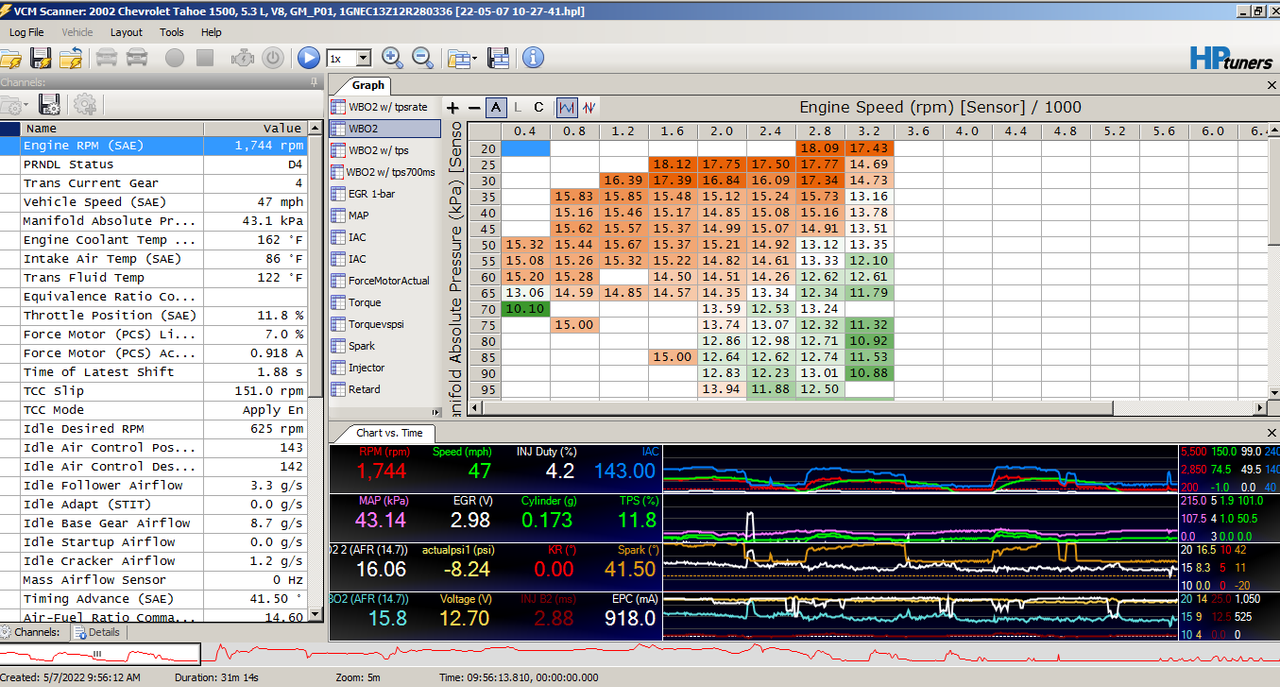
Finally heres my own free 5.3L garbage 240,000 miles engine tuned extremely lean at idle and cruise. I am not just teaching these subjects like a keyboard preach: I also build the general vehicles to demonstrate key issues how to tune an engine properly and how to maintain the high mileage engine, how to properly setup and measure the crankcase pressure, and how to acquire true reliability despite pushing 3x factory output to the tires, etc... Everything I've done documented in sig feel free to review my work.
Since we brushed the subject of modern engines I just want to remind everyone that there are 5.3L Engines sitting in junkyard practically free, they cost less than a pair of tires, and those engines such as LM7 L33 are reliable to 300k miles and beyond, totally factory will support upwards of 600 to 800 rear wheel horsepower when turbocharged.
This is what you wrote. I can use all the comprehension I have. And I still vehemently disagree.
If a customer came into the shop needing to have a carburetor rejeted as his engine was running lean and he asked to have all the things done you have suggested I would think he's absolutely nuts. He just needs to rejet his carb.
A modern engine with modern combustion chamber design may be happy idling at 14.7
A old school engine with a Holley not so much.
So, I respectfully disagree. You do it your way Sir.
What I said
Using a lean mixture (A good reason to get wideband gauge) around gasoline a/f ratio 14.8 to 15.5:1 for idle and cruise will help further clean and keep the engine healthy. This applies to all engines in the world. You prefer the lean mixture
Is true
You do not seem to understand what you are even saying. Why did you even bring up 14.7? 14.7 gasoline is not lean mixture. You seem confused. We are discussing 15.5:1 not 14.7:1.
No performance engine in the world should ever be run at 14.7:1 air fuel ratio. That is not a performance ratio. It is an emission ratio. Even if there are cats for GM vehicles the ECU threshold for narrowbands is reported to be shifted to provide extra air e.g. lean mixture for complete burning of HC near the cat.
It may come as a shock but it is possible to do something incorrectly for 50 years without realizing it. It takes more than experience... it takes education. Perhaps consult a doctor of mechanical engineering?
Absolutely sir. We both know why I pointed out 14.7.
your correct, Honda developed a very special engine to run that lean.
That's about it. The engine needs to idle and come off idle.
Yes running beyond 14.7 will induce heat.
Lots of it.
You think running an old school engine that lean is actually good for it? You think it will actually perform well with a carburetor that lean?
OK.
I know better.
You do it your way. But without precise engine management control going that lean is a great way to burn holes in pistons. And cause running issues.
We DO NOT AGREE!
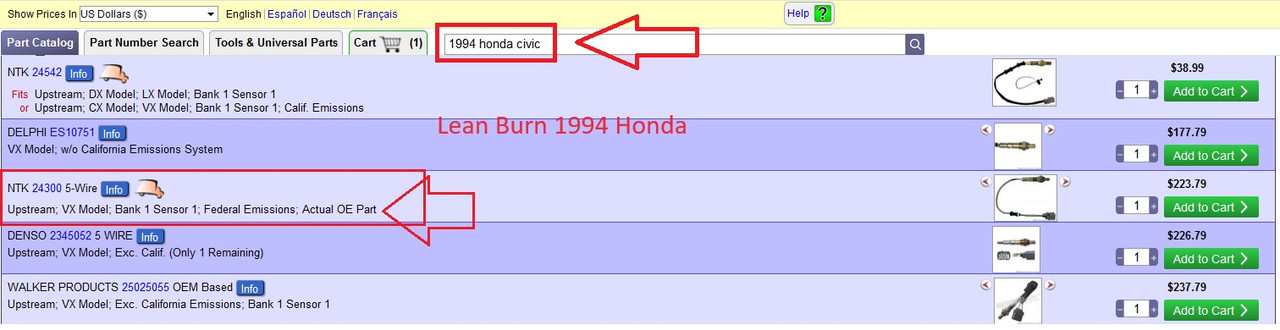
Ummm...you own chart for your efi junkyard 5.3 shows you running 14.6 afr cruising down the highway at 47 mph and only 11 percent throttle and idling at 15. That's pretty normal to me. A carb can be tuned to yield that at cruise, but will not normally be that lean at cruise unless you work hard at it. but carbs with wet intakes like it a little richer at idle. Afrs higher than that are not normally useable except on closed throttle (irrelevant) or special lean burn engines like the two combustion chamber cvcc Honda.(Also irrelevant to this discussion). So I do not see a disagreement here really.
Especially if we stick to V8s which is what this forum is about.
It is true you have to run a little richer with old school sbc combustion chambers. Newer heads have much better chambers and the fast burn stuff can be run a little leaner. EFI can be run a little leaner still. The LS engines have equally matched ports, unlike any sbc & especially not BBC. Those can be run leaner still but only because all the cylinders are the same. You can also run them leaner than the factory does, at cruise only, because they are emission constrained. But exhaust valve heat is your limit. You go ahead and run one down the highway at 16-17-18 and you tell me how long your exhaust valves last. I'm not talking closed throttle like your chart shows, I am talking real world at highway speed & load. It will work...for a while. Anyone have any data there? And if it doesn't richen up real quick, as soon as you nose into the throttle, all the way back to the 12s or 13s, you'll find out how easy pistons melt. I've seen that dozens of times (no keyboard warrior here.) Now the long term engine reliability test to see how far you can push afr? I'll leave that to someone who likes changing exhaust valves.
Just lean the cruise out until it stutters and misfires a little bit, then back up. That's the way we did it pre wideband.
Last edited by leigh1322; Jun 30, 2024 at 04:46 PM.
When I last redid my engine, I too found my Holley way out of wack. So I thought about adding O2 sensors to help dial it in. Then of course you need some sort of computer or ECU to get readings and interpret them and send them to a screen to read them.
Then I thought if I'm going to go through all of that I may as well build up a EFI system. So I did.
Damn it's nice! Don't get me wrong, it was a bit time consuming getting all the parameters set up perfectly.
Lots of time.
So glad I did!
I was able to use my AFR meter for tuning without graphs.. I guess they would of helped but it wasnt really a big deal with a carb since I just had to see where it was reading at different rpms and determine which circuit on the carb was in play at the readings in question that needed adjustment.
My current 355 cruises somewhere near 14.5-sometimes even 14.7 that just cruising though and my afr sensor is in one collector of one sidepipe so....It goes much richer on acceleration. and idles around 14:1 but that varies a bit. My plugs were super clean when I pulled them as im swapping to a 406. I mean they almost looked new clean... no surging or heat issues. in fact my engine runs cooler than most from what I read here.
Last edited by augiedoggy; Jun 30, 2024 at 04:09 PM.
If I were you, in the UK, I would not depend on the MOT to set up my carb. Or tell me if it is right or wrong. Make sure it is, before you go.
Go buy an Innovate Motorsports LM -1 or 2, or a wideband gauge, that you can temporarily put in your car to tune the carb with.
Yes it needs tuned. You made a lot of mods letting the exhaust breathe.
Once the carb is tuned, you can remove it.
Rescue Rogers on here, spent a lot of time tuning his tripower 68. It's just carbs, x3. These are his guidelines:
>Also keep a log of all changes no matter how small and what the throttle response, AFR and general drivability is. Anything that is a hard reading and the initial feel is ideal to record. Going back to see what you have changed and not repeating something you already tried is key. IS your AFR gauge a wide band gauge?... IF you are above 16 you are too lean to be getting any good information and mine wont read nearly as lean as yours.. I try to keep everything in all 3 phases inside the 12 to 16 range and no higher. 12-12.5 for the richest at wot and 13 to 13.5 for idle, 14 to 14.5 transition and cruising and 14.5 to 15 for a lean cruise on a climb before the power valve opens. Mine could see a bit better as I push 16 on a steep hill in a high gear if I don't get more into the throttle.<
Perfect guidelines for a carb!
This is not EFI. You only have 4-5 circuits total.
Idle/cruise, power valve (or APT), main jet, accelerator pump, choke.
Since it is mechanical, you address each one separately.
Thanks for all the comments guys, they've given me lots to think about.
I'm currently thinking that it seems pretty unlikely that I can actually have such a lean mixture and at the same time the car idles very well, doesn't stutter or hesitate or misfire. I doubt that the MOT station's equipment is wildly out of calibration, if so they would be failing every car they test on emissions. That leaves the possibility of air being sucked into the exhaust. This is also one of the easier things to check out, so seems like a good place to start.
First of all today I took the car for a 20 mile run with the pcv valve disconnected and left open to atmosphere (the carb port was of course blocked off). The good news is that there is nothing noticeable coming out of the pcv, so hopefully I don't have much blow by. When I got back I pulled a couple of plugs, they both looked like this, one side of the plug was white the other side was light tan.
I then took off the exhaust from one side of the car. The inside has a light coating of carbon, not what I was expecting if I'm running super lean. What do you think?
As you can see from the picture above, I had assembled the exhaust with exhaust sealer, but I didn't use any on the joint that connects to the header. I've now taken it all apart, cleaned it up and reassembled with plenty of sealant on all joints.
My plan is to take the car back to the MOT station and get them to re-test both sides, Hopefully the untouched side will still show very lean numbers and the re-sealed side will be much more reasonable (if not, then it will have to be plan B!).
The only slight problem is that I'm on holiday later this week, so it's not going to get done for a couple of weeks.
Getting back to the O.P.'s original inquiry, be aware that the "wand" up the tailpipe has proven to be notoriously unreliable, particularly in aftermarket performance componentry laden vehicles, and in this case the presents of the "side-pipes"; even if not exhibiting a leak up-stream, the isolation of the left and right banks of the engine with the odd-fire result, coupled to the (generally) larger cross sectional pipe bore, lends to permitting greater reversionary effect and hence corruption in the resulting test. And this is further exacerbated particularly if greater duration camshafts are incorporated.
Scott.
P.S. One cannot directly make comparisons in the fueling requirements of more modern by design engines of today, particular fuel-injected small capacity examples, to these older carbureted dinosaurs. Simply stated: these older engines just won't run properly on the numbers we're getting out of today's stuff, and that's one of the reasons they (O.E.M.'s) don't make 'em anymore!
"There's no way the engine will run that lean; 16-17:1 is at or beyond the lean ignitibility limit."
I think I agree with the tailpipe senso being "off" huge diameter sidepipes could easily equal backflow between 4 pulses, or header leaks which sidepipes are nortorious for leaks. Plus it seems very odd it would run at all w/ AFR that high.
You may need a welded bung.
Examples from online:
Tailpipe sniffer running much leaner that welded bung, until exhaust flow increases.
Corvette owner Jim Lockwood getting contamination from tailpipe exit using tailpipe bung with factory dual exhausts, and his solution:
"I use the tail pipe clamp from Innovate but, as designed, it permits too much extraneous gas to enter and this gives false lean indications at low speeds/low flows. To solve this I made an extension that sampled exhaust gas farther into the tail pipe: This completely solved the false lean indications. I get accurate AFR indications at all engine speeds from idle up to wherever I chicken out. At low exhaust flow, there is a slight lag between throttle input and AFR indication. "
Last edited by leigh1322; Jul 2, 2024 at 09:16 AM.
Yes I could well end up with a welded bung, although I think it would have to be downstream of 2 of the 3 joints in the system, so not much help if the problem is air leaks. I'm not keen on putting a bung in the header itself. The probe that the test station guy used was about 18" long, but I didn't notice how far up the pipe he actually put it. I'll make sure it goes all the way up next time!
Anyone got suggestions for a good wideband kit that doesn't cost the earth?
As this instance isn't that as of the desires of the opposite sex, 18" not only ain't impressive, but it ain't gonna work, not for what your trying to accomplish! The "tunner" guys I've encountered (those whom are able to draw any real conclusions that is) realize the deficiencies in the "wand", but in instances where that's all they've got, it's usually yard-stick or better in length.
So it's taken 3 months, but I now have a wideband sensor fitted in my exhaust and it seems like I really was running that lean!
With the sensor fitted I drove the car and at a light cruise it was running around 17.5:1. One thing I realised is that the 18:1 that the garage had measured was calculated by multiplying the measured value of lambda of 1.22 by 14.7. However, the fuel I'm using is E5 (5% ethanol) so stoich is actually 14.4 not 14.7, which gives a garage AFR value of 17.6:1.
Sitting in the car in neutral and just revving it I could see that it was running rich at tickover, then around 14 to 15:1 from 1000rpm to 1500rpm until 2000rpm when it shot up to 17.5:1.
Since the only easy things to alter on my quadrajet are the idle mixture and APT (on my later carb you can do this from outside the carb) I started there.
I had the idle mixture screws 4.5 turns out, I've now set them to 3.5 turns out.
I thought I had set the APT to 3 turns out, but it appears it was only 2 turns out. It's now at 3 turns out and here are the results I'm getting.
This looks pretty good to me but does raise 2 questions
1) what's happening at 1000 to 1500rpm when just sitting in neutral?
2) my carb is now set up basically exactly as it came from the factory. It has the same jets and rods, float height and as far as I know the same APT setting. This says that the change in resistance through the exhaust system has made no difference. Can this be correct, or would the AFR readings have been significantly different as the car left the factory?
The AFRs certainly do look more normal for a carb.
However, since you have headers, do not say you do not have a leak.
At least not until you prove it.
Headers are nortorious for having small leaks. And even pin-hole leaks are said to affect AFR readings.
The only way to prove to yourself, or your tuner, is to run a smoke test on your exhaust system.
The smoke should not come out of the pipes anywhere under the car. Engine should not be running.
I found several leaks on mine, and was sure it was not leaking, at least I couldn't hear anything.
Surprise!
And that was on a 6 year old car, but with modded cat back exhaust.
Both cylinder head gaskets and collector gaskets are common leak points, but even the welds themselves can leak.
If you have a leak before the O2 sensor, or downstream but very close to it, you will get bad readings.
Last edited by leigh1322; Oct 5, 2024 at 11:27 AM.
As you can see in the photo Leigh, I've used jointing paste to try and make sure I don't have air leaks. The thing is if there is an air leak then that would make my AFR readings show the car to be running more lean than it actually is. In that case it would actually be running pretty rich and I would need to lean it off from the standard setting to get it right. That doesn't seem likely, as by 1978 the cars were set up to run fairly lean and why would putting a free flowing exhaust on make the car run richer?
Oh I get it. Your AFRs do seem pretty decent now.
Can you pass emissions in the UK without a convertor?
I am not sure what could be causing your rich 12.5 at 1500 spike tho.
Is that at steady state or could it be related to throttle movement?
Steady state jetting, or idle/cruise mixture screw tuning circuit, are completely separate from accelerator pump / throttle movement.
But basically, with those numbers, shouldn't it pass MOT now?
If you really have to hit 14.2 to 15.1, you may have a little more work to do.
Can you find out at what rpms, etc they test at?
Your 2000-2500 cruise looks decent. Low 14s.
But if you could figure about a way to get it into the mid 15s, without screwing up the other numbers, you would be supertuning your carb, and would get better mpg.
In the UK, I have to believe that would be worth a little effort.