When you click on links to various merchants on this site and make a purchase, this can result in this site earning a commission. Affiliate programs and affiliations include, but are not limited to, the eBay Partner Network.
I bought a nice 4 speed '72 Stingray a couple of months ago and after enjoying it and driving it A LOT over the Summer, the time has come to start to improve it a little.
It's a nice car but needs a bit of work. I'll list some of my plans below - looking for advice in a few areas so hope it's OK to merge a few topics together.
It's a nice original matching numbers car with some decent mods to the motor - original bored out block - will follow up with a of upgrades list in a later post. Otherwise, it's pretty original and unmolested with lots of history (important for me).
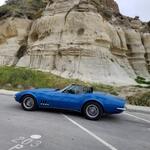
Some more pics taken during the Summer (I am UK based so sun is about as rare as seeing another Corvette). I hope these pictures aren't too big - been a long time since I uploaded anything to a forum !
I don't want to do much to it, but my vibe is absolutely period correct / day 2 type stuff. Subtle Le Mans references Also a few things to make it drive a little better.
Suspension:
It definitely needs to sit a little lower. Keen to have adjustability and the ability to dial in some camber at the front. You can't really tell in these pictures but it leans to one side and is pretty high on the passenger side. Think it's pretty standard as it stands.
Can anyone recommend a good setup to drop a standard car a few inches and ideally add some adjustability and camber?
Wheels:
I really would eventually like some 200S / Daisy Mags (ideally newer non-porous ones with a DOW7 type finish in the centre). Ideally 15x8" front 15x9" rear as I don't want to touch the arches. Just want to go as wide as I can and be wise with camber. Failing this I would like a bit more meat on the back so some slightly wider Rally wheels (widen to 9" or so).
Has anyone got any experience with the newer 200s's? Difficult to find much about them
Spotlights:
I've always loved the look of a spotlight for the Le Mans / Gumball Rally aesthetic. My only concern is that locating a Spotlight in the desired location (front grille) may restrict airflow in what is already a pretty hot car, however, I have also read that little air actually flows through the front anyway. My other flight challenge here is the 'sagging' of the right hand bumper / grill assembly if anyone can advise how to solve this? Seems to be quite common on chrome bumper cars.
Is it a bad idea to put anything in front of the grilles?
Any advice on how to fix the 'sagging'?
Leaks / power steering pump:
It has a leak under the hood. Given the fact that the power steering doesn't work I'm fairly sure the culprit is the power steering pump, and the fan is splattering this upwards, but keen to hear if anyone else has any thought on what this may be.
Thanks in advance!
James
Last edited by SwedishJames; Oct 31, 2024 at 10:11 AM.
Welcome to the forum! Beautiful car, I like the color.
If you’re looking at lowering the car cutting a coil out of the front spring and getting some 8” bolts for the rear leaf spring is a cheap and easy way to lose an inch or two. The more expensive option is coilovers.
I have year one aluminum rally wheels in 17x8 in the front and 17x9 in the rear. With 255s and 275s respectively they’re a bit wider than stock, but still look factory to the uniformed observer.
As for the power steering, there’s a number of threads here on the forum that can help diagnose your issue. I would fix it sooner than later though. It’s better to have no power steering from you intentionally taking the belt off than running the pump dry and ruining it.
Shouldn’t have any issues with picture sizes anymore. The internet is several magnitudes more powerful than it was just a few years ago.
Looks like you hang with some heavy hitters, Good luck with your mods .
Thank you, the thing about C3's, particularly over here is that everyone seems to love them... plus with the looks they don't look out of place at all next to super high-value stuff.
Originally Posted by Piersonpie
As for the power steering, there’s a number of threads here on the forum that can help diagnose your issue. I would fix it sooner than later though. It’s better to have no power steering from you intentionally taking the belt off than running the pump dry and ruining it... Shouldn’t have any issues with picture sizes anymore. The internet is several magnitudes more powerful than it was just a few years ago.
Thank you. Will definitely follow your advice here. I don't mind driving it without the PS, but would rather not do a whole load of extra damage! Forum intel noted - told you it had been a while!
Yours looks great - sits really well and is obviously the best colour.
Last edited by SwedishJames; Oct 31, 2024 at 08:23 AM.
Regarding the spotlights, this is the sort of look I have in mind. I have the Cibie's already, but not 100% if I'll fit them.
Is it a terrible idea to block the airflow here or will it not make much difference?
Will ideally locate them 'inside' the grille which would required some trimming. Also need to adjust the position of the drivers side grille.
Again, it's inspired by the racing versions which often ran similar. Just fancy changing up the look a bit. Will fit in better when it sits a little lower with some wider meat at the back.
2025 c3 ('68-'73) of the Year Finalist - Unmodified
2025 C4 of the Year Finalist - Unmodified
2025 C8 Stingray of the Year Finalist - Unmodified
It is my understanding that oil sprayed on the backside of the hood can seep into the fiberglass possibly causing paint issues in then future therefore I would address this issue promptly. Beautiful car.
That is a nice looking Corvette you have there SwedishJames!
I like the fact that your license plate does not block the incoming air. Here in Virginia they expect us to use the two plates given to us at registration time. When I put the front plate on it literally blocks the best airflow path on a 1968 C3. Keeping the headlights up also gets more airflow in the engine compartment I have learned using temperature senders in various locations testing the airflow in the engine compartment at various speeds up to highway speeds. I told a friendly police officer that I would drill the plate full of holes if I Had to use one, today I have no front license plate...
The Cibie fog lamps are a nice touch but may not a great idea on a Hot running Corvette. They will affect the airflow entering the engine compartment and likely not to your advantage. If I were doing the fog lights I might consider different mounting again trying not to affect the airflow to your radiator. Lets solve the reason for a Hot running Corvette in England first and then the CIBIE lights can stay!
WHY does your Corvette run Hot?
Has the engine been modified at all? Transmission? How are the brakes in your Corvette? Does the parking brake work? Sometimes the brakes can drag and make the engine work harder.
Have you checked the timing? How about the vacuum hoses that feed vacuum to the vacuum advance on the side of the distributor? If you have a leak in your vacuum hose then the vacuum advance doesn't move and the engine runs retarded which can make it run hotter.
Another thing is to check the coolant overflow hose to ensure that it IS still getting into the overflow tank as the engine warms up. If this is not working then you will have a large air bubble in the top of the radiator and that makes a engine run hotter. Replacing the overflow hose is easy and the cooling system will work even better.
How much anti-freeze are you using in the 1972? Here in the U.S. they like to use 50/50water to anti-freeze. I personally use 70% water and 30% anti-freeze concentrate to give my vehicles protection from a possible cold snap. Too much anti-freeze does not help cooling, it only prevents the engine from freezing. For cooling purposes the radiator cap is essential for the proper operation of the cooling system. A 15lb radiator cap will keep the engine from boiling over up to ~261* (F). I replace the Radiator cap every few years to prevent overheating from a radiator cap unable to provide 15 lbs of protection. They do loose the ability to hold pressure over time. There is a product made by REDLINE called Water Wetter and it helps knock off a few degrees of heat by changing the surface tension of the Coolant. It simply transfers more heat OUT of the engine, it helps.
After checking these items please let us know what you find when working on your "new to you" Corvette. I often suggest that new to you Corvette owners drive their Corvettes and then make a list of every defect before you start changing the Corvettes personality.
I also like to save every part that comes off the Corvette, someday you might want to undo any changes made to the Corvette. Alternators and starters can be rebuilt using the same housing as are Master cylinders and many other dated parts. Never "trade in" or "return for core charges" any of the parts the car came with to you. That doesn't mean saving old spark plugs or other disposable parts.
You are on the right direction and you will have a heck of a car when finished with your modifications. Being in England it is better that you have a small block, feeding a big block could get very expensive over there. I have a 1968 C3 four speed convertible with a 427 L88 Clone engine in it. With the 12.25-1 compression the big block is a radical engine that makes over 560 hp. THIS is why I learned about airflow and how to get the most for least money. I have a BeCool radiator, a heavy duty aluminum water pump with two 11" SPAL electric fans on my car with a large shroud. The engine makes a lot of heat but it is quite bearable even in the summer months as long as the top is down. I do not have AC as they didn't put it on the higher performance engines as they might spin too fast.
Last edited by ctmccloskey; Nov 1, 2024 at 09:17 AM.
That is a nice looking Corvette you have there SwedishJames!
I like the fact that your license plate does not block the incoming air. Here in Virginia they expect us to use the two plates given to us at registration time. When I put the front plate on it literally blocks the best airflow path on a 1968 C3. Keeping the headlights up also gets more airflow in the engine compartment I have learned using temperature senders in various locations testing the airflow in the engine compartment at various speeds up to highway speeds. I told a friendly police officer that I would drill the plate full of holes if I Had to use one, today I have no front license plate...
The Cibie fog lamps are a nice touch but may not a great idea on a Hot running Corvette. They will affect the airflow entering the engine compartment and likely not to your advantage. If I were doing the fog lights I might consider different mounting again trying not to affect the airflow to your radiator. Lets solve the reason for a Hot running Corvette in England first and then the CIBIE lights can stay!
WHY does your Corvette run Hot?
Has the engine been modified at all? Transmission? How are the brakes in your Corvette? Does the parking brake work? Sometimes the brakes can drag and make the engine work harder.
Have you checked the timing? How about the vacuum hoses that feed vacuum to the vacuum advance on the side of the distributor? If you have a leak in your vacuum hose then the vacuum advance doesn't move and the engine runs retarded which can make it run hotter.
Another thing is to check the coolant overflow hose to ensure that it IS still getting into the overflow tank as the engine warms up. If this is not working then you will have a large air bubble in the top of the radiator and that makes a engine run hotter. Replacing the overflow hose is easy and the cooling system will work even better.
How much anti-freeze are you using in the 1972? Here in the U.S. they like to use 50/50water to anti-freeze. I personally use 70% water and 30% anti-freeze concentrate to give my vehicles protection from a possible cold snap. Too much anti-freeze does not help cooling, it only prevents the engine from freezing. For cooling purposes the radiator cap is essential for the proper operation of the cooling system. A 15lb radiator cap will keep the engine from boiling over up to ~261* (F). I replace the Radiator cap every few years top prevent overheating from a radiator cap unable to provide 15 lbs of protection. They do loose the ability to hold pressure over time. There is a product made by REDLINE called Water Wetter and it helps knock off a few degrees of heat by changing the surface tension of the Coolant. It simply transfers more heat OUT of the engine, it helps.
After checking these items please let us know what you find when working on your "new to you" Corvette. I often suggest that new to you Corvette owners drive their Corvettes and then make a list of every defect before you start changing the Corvettes personality.
I also like to save every part that comes off the Corvette, someday you might want to undo any changes made to the Corvette. Alternators and starters can be rebuilt using the same housing as are Master cylinders and many other dated parts. Never "trade in" or "return for core charges" any of the parts the car came with to you. That doesn't mean saving old spark plugs or other disposable parts.
You are on the right direction and you will have a heck of a car when finished with your modifications. Being in England it is better that you have a small block, feeding a big block could get very expensive over there. I have a 1968 C3 four speed convertible with a 427 L88 Clone engine in it. With the 12.25-1 compression the big block is a radical engine that makes over 560 hp. THIS is why I learned about airflow and how to get the most for least money. I have a BeCool radiator, a heavy duty aluminum water pump with two 11" SPAL electric fans on my car with a large shroud. The engine makes a lot of heat but it is quite bearable even in the summer months as long as the top is down. I do not have AC as they didn't put it on the higher performance engines as they might spin too fast.
Wow, thank you for the comprehensive reply - some great advice in here!
When I first got it I forced the seller to put it through an MOT to help iron out any issues it might have had - so he fixed a few issues (eg: new fuel tank). After buying it went straight to a trusted garage who basically made it safe.
It does however still need quite alot done to get it where I want it to be. Nothing massively urgent but I plan on keeping it for a long time and improve it as I go.
Engine-wise it is modified - thankfully I have pretty much every receipt to back up whats been done (mostly in the '90s/00s). It's only had 4 owners - first in CA, second GA, a Kuwait Sheikh and finally me. Second owner in GA did most of the work and had it a good while. This covers most of it (ad from around '05 I think)
Main engine issue it had initially was that the HT leads were shorting (causing a misfire) and were really badly routed, this has been resolved though. it's also on the stock cast manifolds, so really does need some headers. It does runs really well overall now and sounds great though.
Brakes are OK, parking break works fine, AC works pretty well too.
It's all relative I suppose, the gauges don't indicate anything alarming but the trans tunnel does get quite warm (trans is standard as far as I'm aware), From other owners, my understanding was that they do generally just run pretty warm. It's my first Corvette though so I will be looking into everything you have suggested!
The plate is pretty small by UK standards, but was the look that I wanted. It came with something that can best be described as giving a strong beaver tooth aesthetic .
Last edited by SwedishJames; Oct 31, 2024 at 10:39 AM.
Hej Svenska!
These are very special cars as you know. CTM gives excellent advice.
I strive to keep my 69 in the condition it came off the showroom. Everything working down to the seatbelt light! But, of course, it's yours to do as you wish.
I marvel at the tech in these cars of 55 years ago, and everything still works with a touch of TLC.
Sounds like the front seal if gone on your power steering pump. That should be an easy rebuild. 2 1/2" ram horns do pretty well (according to jebby). (where is jebby?) rather than headers unless you have a really built engine.
There is nothing like the view over the hood and the howl of the quadrajet! View out the back with the glass out is cool too!
Sounds like your car is in good hands!
VS
Seems your 1972 has a chin spoiler (the black thing across lower front valance). It's very important that it stays put. That is primarily what gulps up air that's fed to radiator. Cars configured like this are also known as "bottom feeders or bottom breathers". With that in mind, additional lighting on-in-behind grille should have little affect on cooling. Do ensure All foam & rubber seals around radiator and radiator support are in good condition and are positioned correctly; they matter just like that chin spoiler matters.
It might pay you dividends to have your entire internal cooling system cleaned (in addition to flushed) with a strong caustic solution such as Oxalic Acid followed by a proper rinse with a Sodium Carbonate Neutralizer. GM published a TSB about 1999 or 2000 on this subject. You can search this forum and find good info as well. Perhaps you might imagine that such a time-consuming procedure might Never have been performed on yours ? Imagine how much sludge and rust and sediment and scale may have accumulated deep within your motor's water jackets ? Also, please understand how flushing alone cannot remove all of it. But the Oxalic Acid will dissolve it; actually putting it into suspension. First, repeated flushes with Both block plugs open (R & L); followed by the acid and then the neutralizer. It takes about a half-day of high-idling to do the job properly. Begin with a full tank of gas. Don't drive it; do the procedure while stationary.
Seems your 1972 has a chin spoiler (the black thing across lower front valance). It's very important that it stays put. That is primarily what gulps up air that's fed to radiator. Cars configured like this are also known as "bottom feeders or bottom breathers". With that in mind, additional lighting on-in-behind grille should have little affect on cooling. Do ensure All foam & rubber seals around radiator and radiator support are in good condition and are positioned correctly; they matter just like that chin spoiler matters.
Yeah, putting the driving lights in the front grilles isn't going to have much effect on cooling. When you look at the black plastic headlight shields, they pretty much block off 2/3 of each side's air flow anyway. The three huge holes in front of the chin spoiler are the important ones, in conjunction with the spoiler, seals, and fan.
As for the "sagging" (Right Front):
As you may've already learned, None of the four C3 "fenders" are bolted on.
Instead, All C3 front fenders are bonded on.
? Perhaps this car has been in a previous road accident and, perhaps the Right Front fender was Removed and Replaced ?
Perhaps others will attest to fact that when a C3 front fender (or an entire front clip) is replaced, proper panel alignment is critical.
That panel alignment Must be perfect; Before the bonding agent has set / cured.
I don't benefit by having the car for inspection; so I cannot say with confidence exactly what is cause of "sagging".
Suggest you make multiple height measurements of Both Right and Left sides as compared to a very flat surface.
Today, hand-held 3D laser scanners have become ubiquitous; perhaps that tech could also aide your investigation ?
Designer Imagines A Corvette That Looks More Like a Corvette Than the Corvette
Slideshow: A Jaguar designer's personal project imagines what a modern front-engined Corvette might look like if Chevrolet revisited the golden age of the Stingray.











 White '72 Stingray Upgrades

 !
!







 .
.