


Alumni-Chek crack detection definitive?

Thread Starter
Race Director


Joined: Nov 2018
Posts: 13,247
Likes: 79
 Alumni-Chek crack detection definitive?
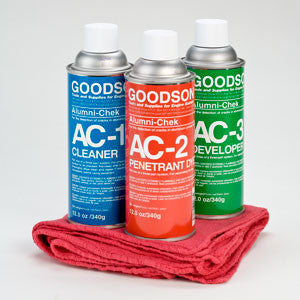
Is this as good a way as any to check for cracks in heads?
https://goodson.com/products/ac-kit-alumni-chek-kit
https://goodson.com/products/ac-kit-alumni-chek-kit

Tech Contributor


Joined: Aug 1999
Posts: 14,380
Likes: 6,391
From: At my Bar drinking and wrenching in Lafayette Colorado
Accurate dye pen inspection requires a lot of training and practice (there are industry-required certifications required to use the technique in busniness, and the training is extensive), and once you have it mastered, doing an actual dye pen inspection of a cylinder head casting would be extremely time consuming if you're looking for a random crack in an unknown location. Bottom line: Doing dye pen on a cast iron or cast aluminum surface would be a bitch. If you suspect where the crack might be, or want to verify that a small area is, or is not, cracked, it can be a good tool. For example, if you suspect a coolant crack in cylinder #4, you can effectively do a dye pen inspection of the #4 machined combustion chamber, the valve seats, and the machined head gasket surface in the #4 cylinder area. But to do a dye pen inspection on an entire cylinder head and its runners would be an absolutely horrible job that would take at least a half day per head, and you better have a pile of clean rags a lot bigger than what's shown in your photo.... If your heads are cast iron, you do a fluorescent magnectic particle inspection to look for cracks.
Last edited by lars; Feb 1, 2025 at 08:48 PM.
Thread Starter
Race Director
Joined: Nov 2018
Posts: 13,247
Likes: 79
Accurate dye pen inspection requires a lot of training and practice (there are industry-required certifications required to use the technique in busniness, and the training is extensive), and once you have it mastered, doing an actual dye pen inspection of a cylinder head casting would be extremely time consuming if you're looking for a random crack in an unknown location. Bottom line: Doing dye pen on a cast iron or cast aluminum surface would be a bitch. If you suspect where the crack might be, or want to verify that a small area is, or is not, cracked, it can be a good tool. For example, if you suspect a coolant crack in cylinder #4, you can effectively do a dye pen inspection of the #4 machined combustion chamber, the valve seats, and the machined head gasket surface in the #4 cylinder area. But to do a dye pen inspection on an entire cylinder head and its runners would be an absolutely horrible job that would take at least a half day per head, and you better have a pile of clean rags a lot bigger than what's shown in your photo.... If your heads are cast iron, you do a fluorescent magnectic particle inspection to look for cracks.
This is the video where I first learned of the Goodson products.








