When you click on links to various merchants on this site and make a purchase, this can result in this site earning a commission. Affiliate programs and affiliations include, but are not limited to, the eBay Partner Network.
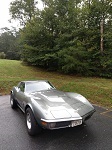
71 454 manual A/C car. has that original black Harrison "surge tank" inside passenger fender well. Cap less radiator. return side of heater core goes to this surge tank and comes out and goes to water pump, has the correct 16 PSI cap on surge tank. Car doesn't overheat or anything - 180 Tstat - however, keep loosing coolant in a very slow rate from the small hose right under the cap, causing heater core aerated and no heat. I'd like to know this is how these suppose to work? meaning, you need to keep adding coolant over time and it puke it out when it warms up? I mean, is not rocket science. coolant warms up, expands, pressure goes past 16 PSI and opens the valve on cap and puke, and there's no way to recover it when it cools down. What you guys do. keep adding coolant or what. Help me out here.
Generally your symptoms are a sign that you're overfilling the expansion tank.
If you look on the side of the tank you'll see it indicates it should only be half full when cold.
This allows for fluid expansion when the coolant is hot.
Try reducing the level and see if that corrects your issue.
If not it could be that your pressure cap is weak and needs replacing.
Even with the "Surge"tank on the engine you should still have an "overflow" system that is plumbed into the cooling system and functions properly. As the coolant expands it should only fill the surge tank a bit more, if it is overfull, then the coolant will leak out and be lost. As the engine cools down, it will draw the coolant back into the system which helps keep the radiator full of coolant all the time.
I have an early 1968 C3 with a BB and my car did not come with the aluminum surge tank in it. My car started life at the factory with it's BB but they never drilled the holes to mount the bracket that supports the weight of the surge tank. On my 427 I had to use a standard overflow tank connected to the radiator below the radiator cap. This allows my coolant to expand and go to the overflow container and as it cools it draws the coolant back into the radiator.
Without the overflow tank my engine would spit out coolant as it heated up. When the engine was cooled back down again I could open the radiator and see that the coolant was a couple quarts low inside the radiator. Without the expansion tank allowing for the extra coolant I would risk running my engine hotter. With a radiator full of coolant it makes an amazing difference in it's ability to cool down quickly.
No matter if you have a surge tank or not I would verify that your cooling system has a path to overflow excess coolant into a sealed container. The tube connected to the radiator just below the radiator cap needs to be good enough to hold vacuum allowing the radiator to draw in coolant as it is cooling down. If the radiator cap is old and no longer working then your overflow system will not work. If you have a leaky hose on the expansion tank then it will not draw coolant back into the cooling system.
If my 427 started "puking coolant" I would probably start by looking at the ignition timing of the engine. The BB engines seem to be very sensitive to having the ignition timing being retarded. On my engine I have the mechanical advance (centrifugal) in my distributor as well as a Vacuum advance. One day my engine was running hotter than normal so I checked the vacuum hose going to the distributor and I found it had a hole leaking the vacuum and not advancing the timing to the full 36-38* of timing I generally run. This happens often in our world and the hoses need to be checked regularly to prevent issues from happening. Without the extra advancing from the vacuum advance my engine was not running at its best.
Aluminum Radiators, Modified Thermostats, higher flow water pumps and many other parts are available to "enhance cooling". I am a big believer of the RedlineWater Wetter as it helps the engine get rid of the heat a bit better. It is a "surfactant" and will help prevent the layer of tiny bubbles that form on the inside of your cooling system on the metal surfaces. These little bubbles actually "slow" the heat transfer between the coolant and the metal inside your engine. The Water Wetter does work but will not deliver a 25* reduction in coolant temperature, there are many variables like how much coolant your engine holds. My 427 hold about 22 quarts of coolant and I only run 30% anti-freeze with 70% Reverse Osmosis water. Too much anti-freeze and the cooling ability will be reduced, too much water and your freeze protection is weakened. Since I live in an area where we spend more time "cooling" than "heating" so I don't need -40* protection. I saw a Asian Car that somebody had 100% anti-freeze in the cooling system and they wondered why the car was overheating.
I hope this gives you an idea of where to start looking for the "cause" of your engine puking coolant. I personally am using a coolant that is completely water-less and uses zero pressure inside the system. This coolant is supposed to eliminate Hot spots inside the engine and thus virtually eliminating detonation from occurring. The only negative is that this stuff is close to $100 a gallon and I use over 5-1/2 gallons of this material in my cooling system.
2020 Corvette of the Year Finalist (performance mods)
2019 C3 of Year Winner (performance mods)
2016 C3 of Year Finalist
you need to test the radiator cap to see if the cap is still 16 psi. My brothers kid had the same symptoms and it was a bad cap. Either that or you have a bad head gasket....IF you have a coolant system pressure tester you can pressurize your cooling system and see if you put coolant into the oil or just plain loose pressure.
Is not like puking all the time. since restoration done in 2018, this thing maybe seen 2500 miles. Sunny day cruiser, otherwise is parked in garage all winter. I noticed coolant drips maybe 4-5 times in the past 9 years, mostly is summer time after shutting it off hot. Last week I just went to start it and let it run for a while after sleeping for 3 months, then I noticed I have no heat. Initially I was about to blame Vintage air heater valve, until I removed the cap and found that skinny black tank (AKA surge tank) dry inside. That explained why no heat. Is low on coolant.
Now, I'd like to know, while I hate to remove the original "Harrison" surge tank, if the late 74-77 overflow tank will fit these? I'd like to get rid of that and run a conventional overflow tank with a radiator cap. Radiator is a Aluminum "Be cool" unit. It does have provision for a cap.
Is not like puking all the time. since restoration done in 2018, this thing maybe seen 2500 miles. Sunny day cruiser, otherwise is parked in garage all winter. I noticed coolant drips maybe 4-5 times in the past 9 years, mostly is summer time after shutting it off hot. Last week I just went to start it and let it run for a while after sleeping for 3 months, then I noticed I have no heat. Initially I was about to blame Vintage air heater valve, until I removed the cap and found that skinny black tank (AKA surge tank) dry inside. That explained why no heat. Is low on coolant.
Now, I'd like to know, while I hate to remove the original "Harrison" surge tank, if the late 74-77 overflow tank will fit these? I'd like to get rid of that and run a conventional overflow tank with a radiator cap. Radiator is a Aluminum "Be cool" unit. It does have provision for a cap.
74 to 77 has a cap on the radiator you do not. Your system is an expansion tank not overflow. Why cannt you rent a pressure tester and check the cap?
First, I have been calling the large Harrison branded aluminum tanks "Surge" tanks when their correct name is an "Expansion tank".
It would seem that using a expansion tank in the lines going to the heater core would make the overflow system useless. On my 427 I run just an overflow system and I don't have the big Aluminum Expansion (surge) tank.
The Overflow System used on the C4 Corvettes might be something you could re-engineer to fit in your engine compartment. The most important part is to have a workingradiator cap with the provisions for a tube to take the excess to the reservoir. The tank has one line that comes from the overflow below the radiator cap that takes the coolant to the Overflow container. The overflow container should have a lid on it and are usually clear so you can see the fluid inside the overflow tank. The tank is vented at the tank level. When the coolant gets hot it will expand and move into the overflow tank. If the Overflow systems vacuum tube is good, it should pull the fluid back into the radiator as the system cools down and shrinks. If the overflow vacuum tube is too soft, it can close off preventing the fluid from returning to the radiator by collapsing under the vacuum. I use heavy vacuum hose or even fuel injection hose to connect the overflow system. I also replace my radiator caps on a schedule to prevent cooling issues.
First, I have been calling the large Harrison branded aluminum tanks "Surge" tanks when their correct name is an "Expansion tank".
It would seem that using a expansion tank in the lines going to the heater core would make the overflow system useless. On my 427 I run just an overflow system and I don't have the big Aluminum Expansion (surge) tank.
The Overflow System used on the C4 Corvettes might be something you could re-engineer to fit in your engine compartment. The most important part is to have a workingradiator cap with the provisions for a tube to take the excess to the reservoir. The tank has one line that comes from the overflow below the radiator cap that takes the coolant to the Overflow container. The overflow container should have a lid on it and are usually clear so you can see the fluid inside the overflow tank. The tank is vented at the tank level. When the coolant gets hot it will expand and move into the overflow tank. If the Overflow systems vacuum tube is good, it should pull the fluid back into the radiator as the system cools down and shrinks. If the overflow vacuum tube is too soft, it can close off preventing the fluid from returning to the radiator by collapsing under the vacuum. I use heavy vacuum hose or even fuel injection hose to connect the overflow system. I also replace my radiator caps on a schedule to prevent cooling issues.
mine is not that fat barrel look aluminum one. Is a skinny cylindrical brass, then painted black ( specific to BB Air cars) And yes, My radiator does have a cap, although currently has a blocking cap installed (cap with no valve inside) just to block it.
My understanding is, since the highest point of radiator is lower than engine, they put this "tank" somewhere higher to bleed the air out of system. otherwise I don't see any other point to put a pressurized tank there. I can easily vacuum fill the system like many newer cars. will look into C4 stuff.
mine is not that fat barrel look aluminum one. Is a skinny cylindrical brass, then painted black ( specific to BB Air cars) And yes, My radiator does have a cap, although currently has a blocking cap installed (cap with no valve inside) just to block it.
My understanding is, since the highest point of radiator is lower than engine, they put this "tank" somewhere higher to bleed the air out of system. otherwise I don't see any other point to put a pressurized tank there. I can easily vacuum fill the system like many newer cars. will look into C4 stuff.
Your original post stated no cap on radiator and now it turns out you have a radiator neck with a blank cap. Factory never used two caps. Either you have the wrong radiator or should not have the external tank. The factory radiator with the black expansion tank did Not have a neck. The system will work as long as you use a blank cap.
Have you found your pressure tester?









 71 454 puking coolant