



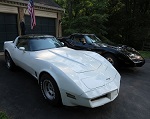

81 tcc

Thread Starter
Instructor


Joined: Aug 2012
Posts: 248
Likes: 63
From: Matamata, NZ
 81 tcc
Hi there, just looking for some confirmation if I change my carb and hei, this will not have any effect on tcc function , I think not but as believe it gets a water temp and brake but don't know how that is wired . Cheers colin

Pro

Joined: Nov 2014
Posts: 503
Likes: 66
From: Florida
Why do you want rip out the CCC?
When I bought my 81 that is what many will tell you to do, but do you really need to.
I kept my CCC, bought a shop manual and read all that I could find on maintaining the CCC. After rebuilding the engine, carb and updating with other OEM parts I got the CCC fine tuned and never looked back. The CCC or non-CCC C3 is only as good as who sets it up. You will get better performance, gas mileage etc.
As to your question, the CCC controls the timing, carb, lock up torque converter and monitors the MAF, EGR, Temp, oxygen sensor, and other pollution control equipment. If you do replace the carb, distro et. You will need to find a solution for the lock up torque converter.
Reach out anytime for assistance.
When I bought my 81 that is what many will tell you to do, but do you really need to.
I kept my CCC, bought a shop manual and read all that I could find on maintaining the CCC. After rebuilding the engine, carb and updating with other OEM parts I got the CCC fine tuned and never looked back. The CCC or non-CCC C3 is only as good as who sets it up. You will get better performance, gas mileage etc.
As to your question, the CCC controls the timing, carb, lock up torque converter and monitors the MAF, EGR, Temp, oxygen sensor, and other pollution control equipment. If you do replace the carb, distro et. You will need to find a solution for the lock up torque converter.
Reach out anytime for assistance.
Thread Starter
Instructor
Joined: Aug 2012
Posts: 248
Likes: 63
From: Matamata, NZ
Thanks, you have a very valid points. Have only just bought the car so will live with it for awhile and see how it goes. 100% don't want to loose lockup, in fact would love to go 200r4 for economy but they are like hens teeth out here.

Team Owner


Joined: Jan 2006
Posts: 37,637
Likes: 3,113
From: Crossville TN
If the '81 engine control system is still intact and operational, it is better than a regular carb, IMO. Better idle, better fuel mileage, etc. But, to answer your question, yes, I believe that if you leave the computer connected to the transmission, it will manage the L/U system even though the dizzy and carb have been replaced.

Race Director


Joined: Nov 2006
Posts: 13,090
Likes: 7,714
From: Sunshine Coast, Queensland, Australia
2025 C3 of the Year Finalist - Modified
2024 C3 of the Year Finalist- Modified
2022 C3 of the Year Finalist - Modified
Cruise-In VIII Veteran
Pro
Joined: Nov 2014
Posts: 503
Likes: 66
From: Florida
If the '81 engine control system is still intact and operational, it is better than a regular carb, IMO. Better idle, better fuel mileage, etc. But, to answer your question, yes, I believe that if you leave the computer connected to the transmission, it will manage the L/U system even though the dizzy and carb have been replaced.
Just a correction. If you remove the carb and distro the CCC will no longer control the lockup torque converter. The CCC requires feed back from the TPS on the electronic carb to control when to lock up the torque converter. 🙄
Corvette Stories
The Best of Corvette for Corvette Enthusiasts

10 Revolutionary 'Corvette Firsts' Most People Don't Know
Joe Kucinski
5 Reasons to Upgrade to an LS6-Powered Corvette; 5 Reasons to Stay LT2
Michael S. Palmer
2027 Corvette vs The World: Every C8 vs Its Closest Competitor
Joe Kucinski
10 Most Common Corvette Problems of the Last 20 Years!
Joe Kucinski
5 MOST and 5 LEAST Popular Corvette Model Years in History!
Joe Kucinski
2027 Corvette Buyer's Guide: Everything You Need to Know!
Joe Kucinski
10 Things C8 Corvette Owners Hate (But Won't Tell You)
Joe Kucinski
10 Best Corvettes Coming to Barrett-Jackson Palm Beach 2026!
Brett Foote
Every Corvette Grand Sport Explained! (C2, C4, C6, C7, & C8)
Joe Kucinski
Racer

Joined: Mar 2018
Posts: 390
Likes: 50
From: wilmington Ma
it's very true , look at Mecum, Barrett Jackson, and old car dealers , there is a youtube channel c3 that guy showcases auction cars have a look, I have seen good money build c3 cars not even sell or sell for short money . I am only saying what I see I am sure some real nice built cars get good money.
Pro
Joined: Nov 2014
Posts: 503
Likes: 66
From: Florida



Pro
Joined: Nov 2014
Posts: 503
Likes: 66
From: Florida
81 is a TH350C lockup transmission. The ECM monitors and controls the lock up function.
The TH350C was the lock-up version of the TH350 automatic transmission, and it was available in 1981 Corvettes. The TH350C used an electronic lock-up converter to improve fuel efficiency at cruising speeds. The 1981 Corvette offered a 3-speed automatic transmission with a 2.87 final drive ratio as an option.
Pro
Joined: Nov 2014
Posts: 503
Likes: 66
From: Florida

Drifting


Joined: Aug 2016
Posts: 1,726
Likes: 890
From: Arizona
The 1981 uses an electronic connection to trigger the Lock Up Torque converter. Not sure if you can use a pressure switch like the 1980?
81 is a TH350C lockup transmission. The ECM monitors and controls the lock up function.
The TH350C was the lock-up version of the TH350 automatic transmission, and it was available in 1981 Corvettes. The TH350C used an electronic lock-up converter to improve fuel efficiency at cruising speeds. The 1981 Corvette offered a 3-speed automatic transmission with a 2.87 final drive ratio as an option.
81 is a TH350C lockup transmission. The ECM monitors and controls the lock up function.
The TH350C was the lock-up version of the TH350 automatic transmission, and it was available in 1981 Corvettes. The TH350C used an electronic lock-up converter to improve fuel efficiency at cruising speeds. The 1981 Corvette offered a 3-speed automatic transmission with a 2.87 final drive ratio as an option.
Thread Starter
Instructor
Joined: Aug 2012
Posts: 248
Likes: 63
From: Matamata, NZ
Drifting
Joined: Aug 2016
Posts: 1,726
Likes: 890
From: Arizona
